

Former employees of the John F. Kennedy Centre for the Performing Arts have told Congress that centre officials cancelled a plan to repair leaking infrastructure months before those same officials began citing the leaks as an urgent safety risk requiring the building’s closure, according to a letter and internal documents reported by The New York Times.
A lawyer representing the former employees sent the material to lawmakers on Thursday, adding fresh fuel to an already contentious standoff over President Trump’s tenure atop the institution.
The centre’s main building remains shut, officials say, because of structural deterioration that previous leaderships failed to address. The whistleblower argues that the opposite is closer to the truth, suggesting that the severity of the problem has been overstated, given that the current leadership had the chance to fix it but chose to wait.
The centre pushed back firmly on Friday, saying that recent inspections had uncovered damage far more extensive than anyone previously realised. “The safety of our patrons, artists, and staff comes first,” said Matt Floca, the centre’s executive director, in a statement carried by the Times. “The Kennedy Centre has known for years that the roof overhang leaked. What we did not know until this summer was how far the damage had spread inside it.”
The dispute lands squarely inside Trump’s ongoing push for a two-year, $257 million renovation of the building, which he has repeatedly described as dilapidated and unsafe. A federal court has so far blocked that closure from proceeding on the scale he wants. However, officials announced last week that the main building would close temporarily to address what they called acute risks to public safety, while a smaller annex would continue limited programming. Democratic lawmakers have accused the administration of using maintenance concerns as cover for a shutdown they say is really driven by the centre’s financial and artistic decline since President Trump took control.
Floca, who Trump appointed to run the centre, has pointed specifically to a five-foot section of plaster that fell from the ceiling of the Grand Foyer during a storm earlier this month, telling the board that roof-overhang leaks may have contributed. However, he said the investigation remains ongoing.
David Seide, the lawyer representing the whistleblower, wrote to lawmakers on the Senate and House committees overseeing the centre that the water intrusion problems Floca now cites were, in fact, known internally for years. “They were not treated as priorities nor as acute risks to public safety,” Seide wrote, according to the Times.
According to the letter, Floca secured $9.3 million to address the roofing problems through the major domestic policy law that Trump signed in July 2025, and, the following month, approved nearly $300,000 for a firm to design a replacement for the roof overhangs. “Yet six months ago, with the funds in hand, he stopped the remediation process from moving forward,” Seide wrote. The letter reportedly included a screenshot of internal communications showing that the funding request had been cancelled at Floca’s direction in April, without a clearly stated reason.
Floca has since said the cancellation happened because the contractor’s bid came in at three times the projected cost, and that the roofing work has instead been folded into a larger, more comprehensive renovation plan still being developed. The centre disputed the characterisation that any delay occurred. The firm eventually brought in to manage the broader renovation submitted a $250 million plan in June that includes $14 million specifically for structural work addressing the leaks, which Floca described as a change in procurement strategy rather than any admission that the work had been unnecessary. That plan also covers a long list of other ageing systems, including an outdated HVAC network, malfunctioning elevators, an ageing electrical grid and theatre infrastructure due for replacement.
The controversy arrives amid an already tense few weeks for the institution. After a federal judge ruled for a second time that Trump’s name could not be placed on the building, the president said last week that renovations would not proceed unless the ruling is overturned on appeal. He was subsequently photographed aboard Air Force One reviewing what appeared to be a poster depicting the centre’s demolition. This detail has done little to calm anxieties among staff and supporters.
Senator Sheldon Whitehouse, the top Democrat on the Environment and Public Works Committee, which received the whistleblower documents, wrote to the centre accusing leadership of hoarding federal funding while simultaneously blaming previous administrators for the state of disrepair. This marks the second such letter to reach Congress through a nonprofit representing government whistleblowers, following an earlier submission in June that detailed cosmetic renovations undertaken since Trump became board chair, including gold plumbing fixtures installed in three presidential boxes and the repainting of the centre’s exterior columns from gold to white.
The letter alleges that $1.4 million originally allocated for waterproofing repairs was instead diverted to help fund the $4.4 million column repainting project. The centre maintains that the project included legitimate maintenance work, such as addressing rust at the bases of the columns, rather than serving purely cosmetic purposes.
Financial pressure on the institution continues to mount. According to documents submitted to the White House’s office, ticket sales dropped sharply following Trump’s takeover. They fell further still after his name briefly appeared on the building’s facade, a placement that Representative Joyce Beatty of Ohio successfully sued to have removed. Her broader legal effort to block the closure entirely remains ongoing, as the centre continues to attribute its financial troubles to prior leadership, even as Floca positions himself and the current administration as the institution’s only viable path forward.
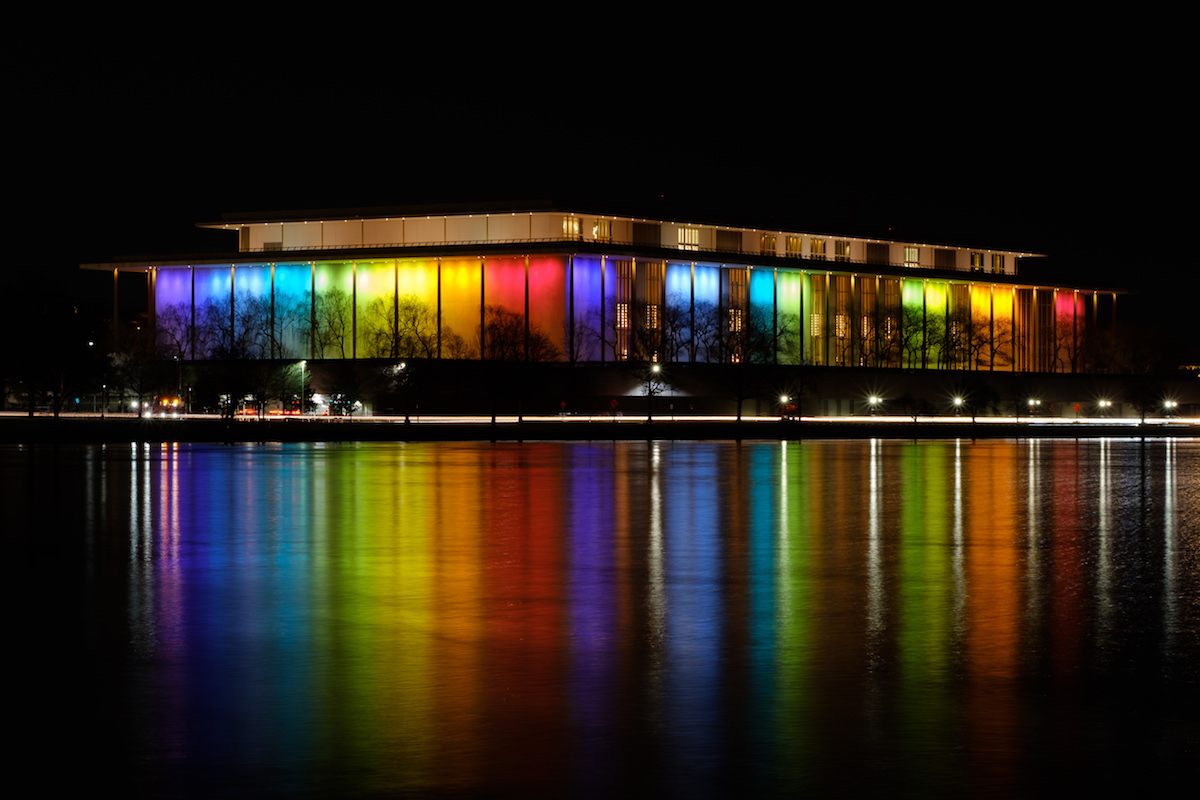
Photo: Der Berzerker, Washington, DC, USA – Kennedy Centre, Wikimedia Commons