

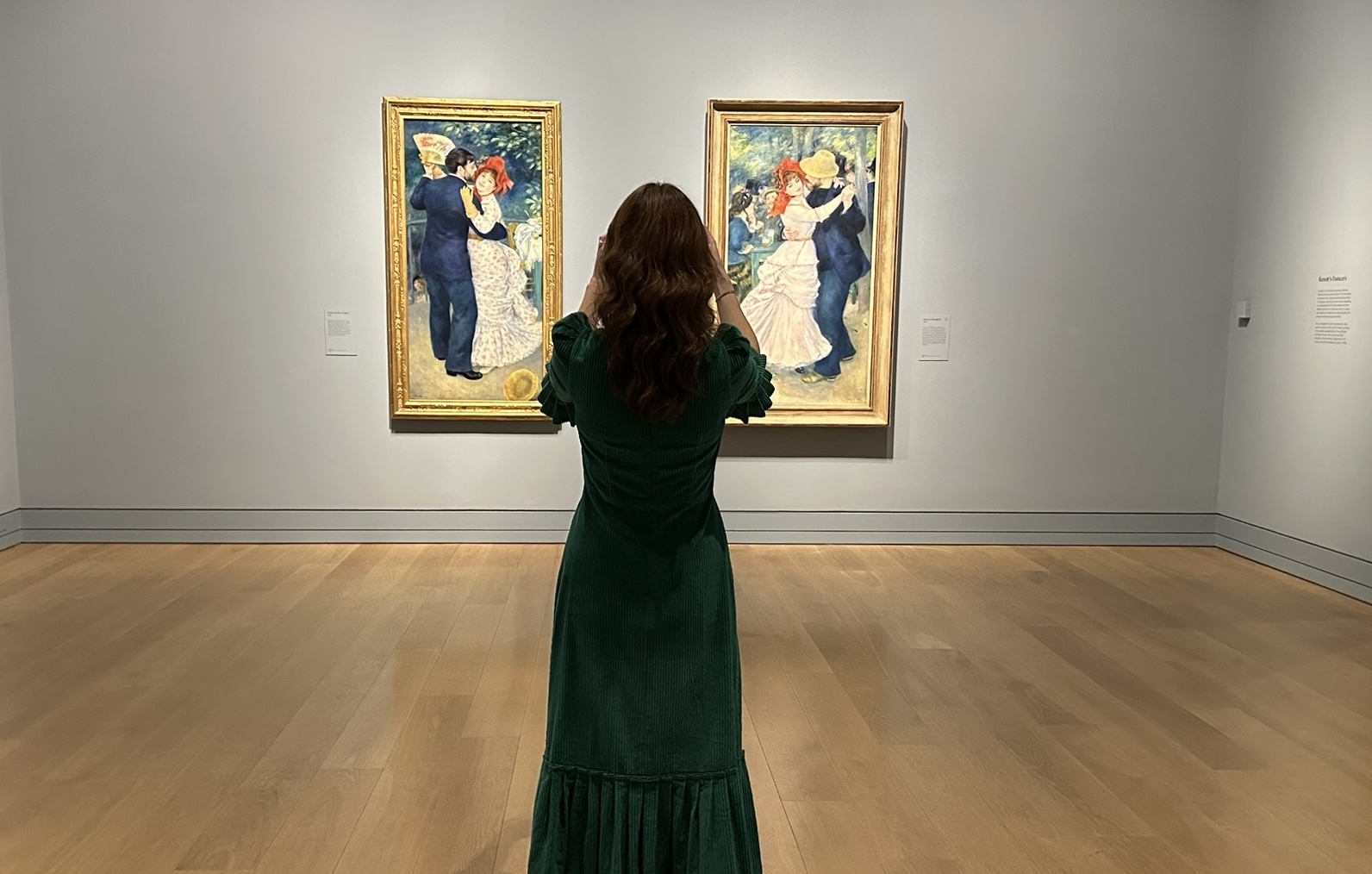
The words Renoir exhibition can fill you with trepidation. At his best, he produced outstanding, joyous paintings, and at his worst, he was the most chocolate-boxiest of the Impressionists, with works painted through a soft-focus lens reminiscent of a Doris Day film. In between, he can be bland and mediocre. Fortunately, the forty-five works, on display at the National Gallery, are the crème de la crème of his oeuvre. Well, nearly all of them …..
It has been two decades since the National Gallery last gave Renoir (1841–1919) an exhibition to himself, and Renoir and Love arrives with the significance of that absence. This is the most noteworthy gathering of his paintings shown in Britain in twenty years, and at its centre, making its UK debut, Dance at the Moulin de la Galette, the 1876 canvas that has spent its life at the Musée d’Orsay and rarely travels anywhere at all.
The exhibition, organised jointly with the Orsay and the Museum of Fine Arts in Boston, narrows its focus to roughly two decades of Renoir’s career, from the mid 1860s through to the mid 1880s, the stretch during which he became genuinely preoccupied with love, flirtation, friendship and the small social choreography of Parisian life. More than a third of what he painted during those years depicts exactly that subject, often staged in the new public spaces the city had only recently built: gardens, dance halls, riverside cafés, places where strangers and lovers alike could be watched mingling in daylight.
Co-curator Chiara Di Stefano describes Renoir’s approach as deliberately light on anecdote or drama, sketching instead what she calls a joyful, lighthearted portrait of modern romance, one where youth and sensual pleasure take centre stage without needing narrative justification. Her co-curator, Christopher Riopelle, frames it slightly differently, arguing that Renoir treated love and friendship, in all their informal, everyday manifestations, as genuinely central to understanding modern life, and that he approached emotion with the same fascination he brought to his other great transitory subject, sunlight, both fleeting, both nearly impossible to pin down.
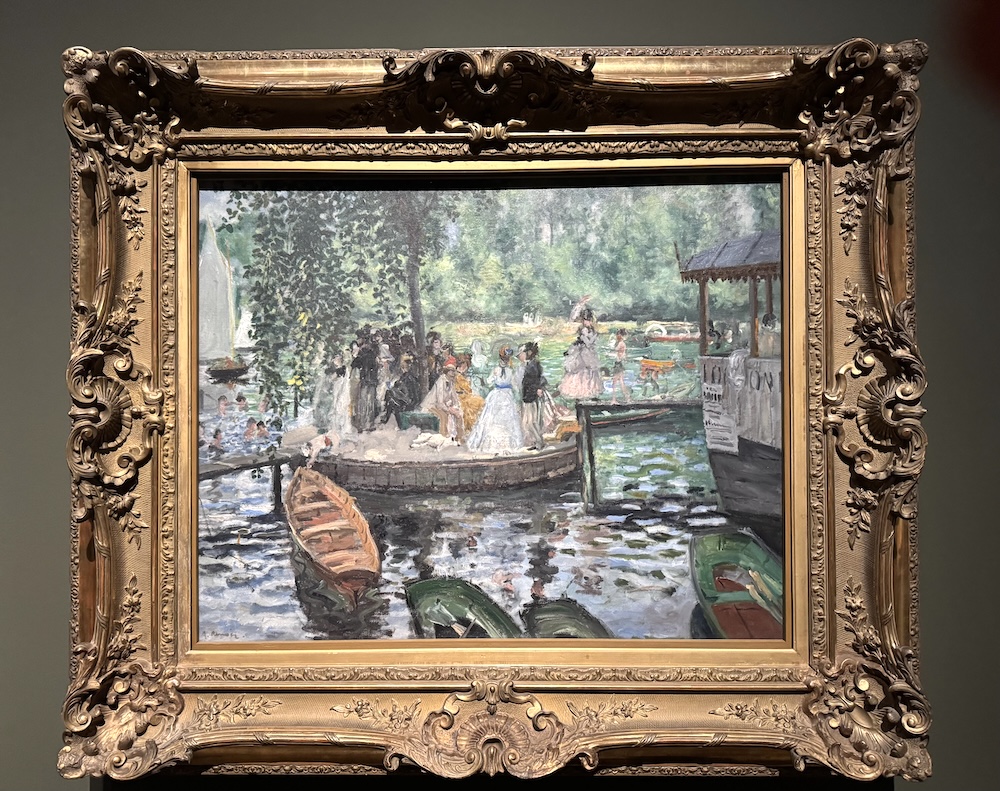
Renoir, La Grenouillère 1869, Nationalmuseum, Stockholm
The show moves through six rooms, each putting forward a different register of obsession. It begins with Renoir’s early years. In Mother Antony’s Tavern from 1866, the picture treats an ordinary tavern scene with the compositional gravity normally reserved for mythology or religious subjects, a quietly radical gesture for the time. He painted La Grenouillère (1869), a popular bathing spot on the River Seine, alongside Monet, and when these paintings are placed side by side, it is difficult to discern which artist painted each picture.
From there, the exhibition moves into the gallant scenes of the 1870s, where Renoir positioned himself as the heir to Fragonard, Watteau, and Boucher, updating the eighteenth-century fête galante for an audience strolling through the Bois de Boulogne rather than in an aristocratic garden. The Promenade (1870) and the Dance at the Moulin de la Galette (1876) anchor this section, and it is hard to imagine a stronger pairing.
Street and café life gets its own room, featuring La Place Clichy (1880), Leaving the Conservatory (1876-77), and one of the strongest works in the exhibition, The Umbrellas (1881-6), before the show shifts outward to the Parisian suburbs, where Oarsmen at Chatou (1879), Dance in the Country (1883) and Dance at Bougival (1883) capture the leisure culture that sprang up along the Seine as the city’s middle class began escaping to the riverbanks on weekends. His handling of the dress fabrics in both the dance pictures is filled with movement, and you can feel the sexual chemistry between the couples.
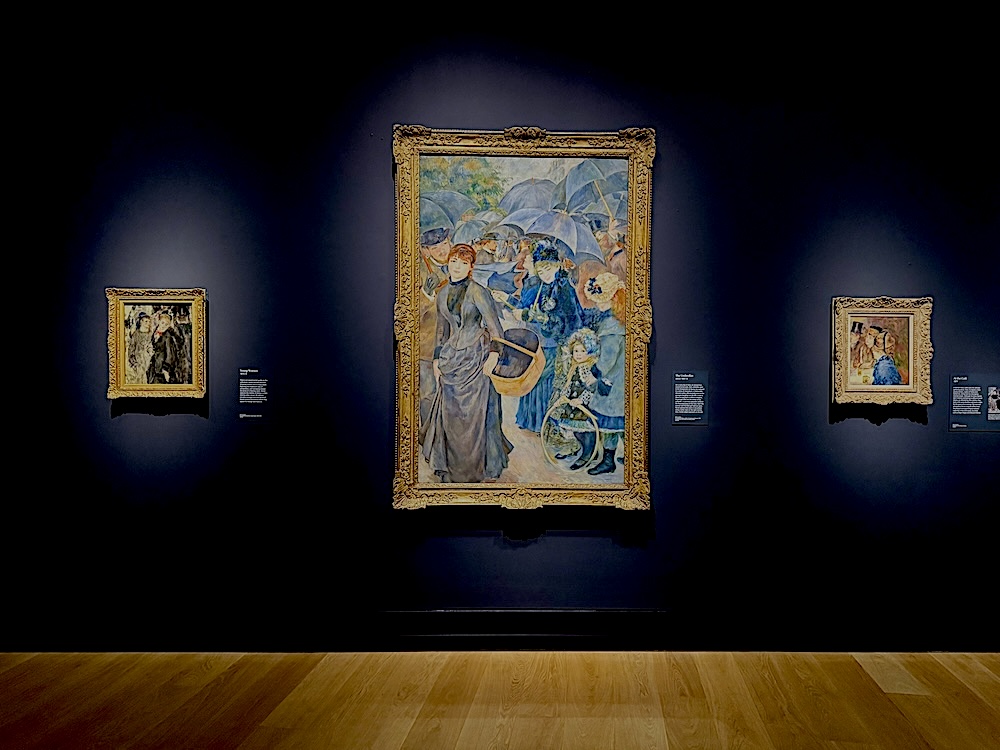
Renoir and Love, National Gallery, installation shot showing The Umbrellas (1881-6)
Family life follows, gentler in tone, including Motherhood, a picture that Renoir apparently held in particular affection, showing his future wife, Aline Charigot, nursing their first son. A smaller room considers intellectual and physical closeness more directly, pairing The Conversation with a handful of theatre box scenes that catch Parisians watching each other as much as watching the stage.
The exhibition closes on a genuine turning point. From 1883 onward, Renoir began pulling away from Impressionism’s fascination with shifting light, moving toward firmer, more sculptural compositions and, at the same time, trading scenes of contemporary Paris for something closer to timeless, classical subject matter. The Great Bathers (1884-87), painted between 1884 and 1887, marks the decisive shift, closing the Impressionist chapter of his career just as the exhibition itself closes.
None of this happens in a vacuum, and Renoir remains a genuinely contested figure, something the show does not really address but that hovers around any serious engagement with his work. In 2015, protesters gathered outside the Museum of Fine Arts in Boston, carrying signs reading “God Hates Renoir,” organised by the creator of an Instagram account dedicated entirely to arguing that Renoir was not a very good painter. It was a strange, mostly good-natured protest with chanting about anatomically odd hands without fingers, but it points to something real. Renoir’s late work in particular has always divided opinion, variously accused of sentimentality, softness, and a certain prettiness that can tip into the saccharine.
Whether Renoir and Love changes that argument is another matter. What it does, convincingly, is make the case for Renoir’s middle years as something considerably more ambitious than mere prettiness, a sustained, genuinely inventive study of how people find and lose each other in public, in daylight, in the newly built leisure spaces of a rapidly modernising city. Artists fall in and out of fashion. Whether that fully answers his critics is a separate question. But it is, at the very least, a serious and overdue attempt to look again.
Words/Photos: PCR/SF © Artlyst 2026
Renoir and Love, National Gallery, 3 October 2026 – 31 January 2027
Booking essential and filling up fast
4****star
Visit Here