‘It is an old faith, and it is a good faith that our life is a pilgrims’ progress – that we are strangers in the earth, but that though this be so, yet we are not alone for our Father is with us. We are pilgrims, our life is a long walk, a journey from earth to heaven.’
Vincent van Gogh is in Isleworth, England. At the age of twenty-three, he delivered his first sermon in English, opening with these very lines. The date is Sunday, 29 October 1876, and the setting is the Wesleyan Methodist Church in Richmond; he later transcribed it in a letter to his brother Theo – five closely written pages in which he repeatedly alluded to The Pilgrim’s Progress, the allegorical tale by John Bunyan (1678). Vincent’s story is well known: after years spent at Goupil & Co., followed by a period of religious fervour, he decided at the age of twenty-seven to become a painter. But what accompanied and guided Vincent’s artistic journey?
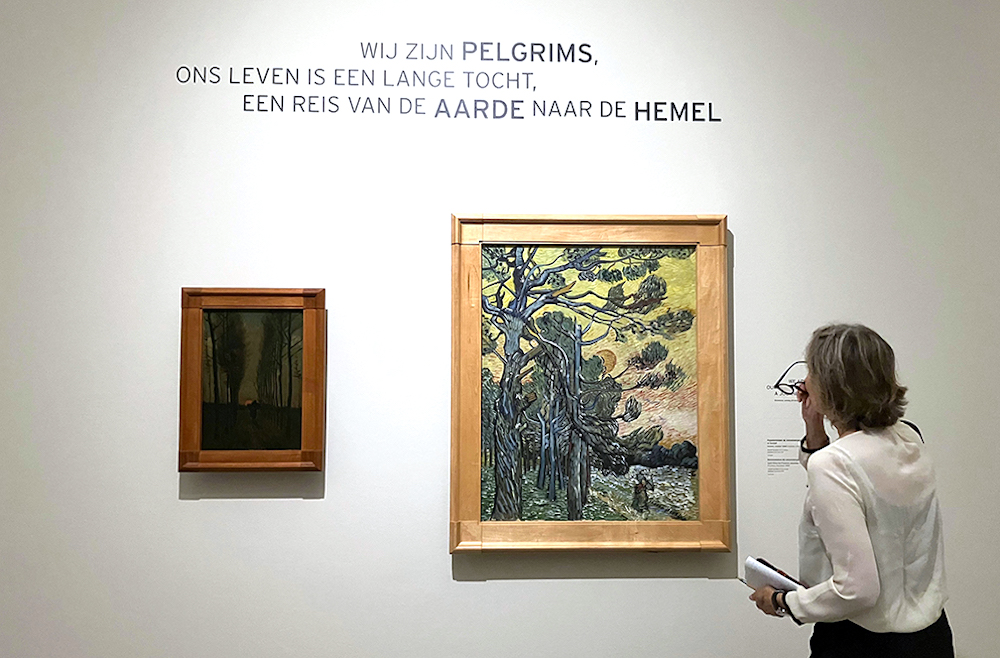 From the left: Vincent van Gogh, Lane of Poplars at Sunset (1884), and Pine Trees at Sunset (1889). Photo © M. Guzzoni/Artlyst 2026.
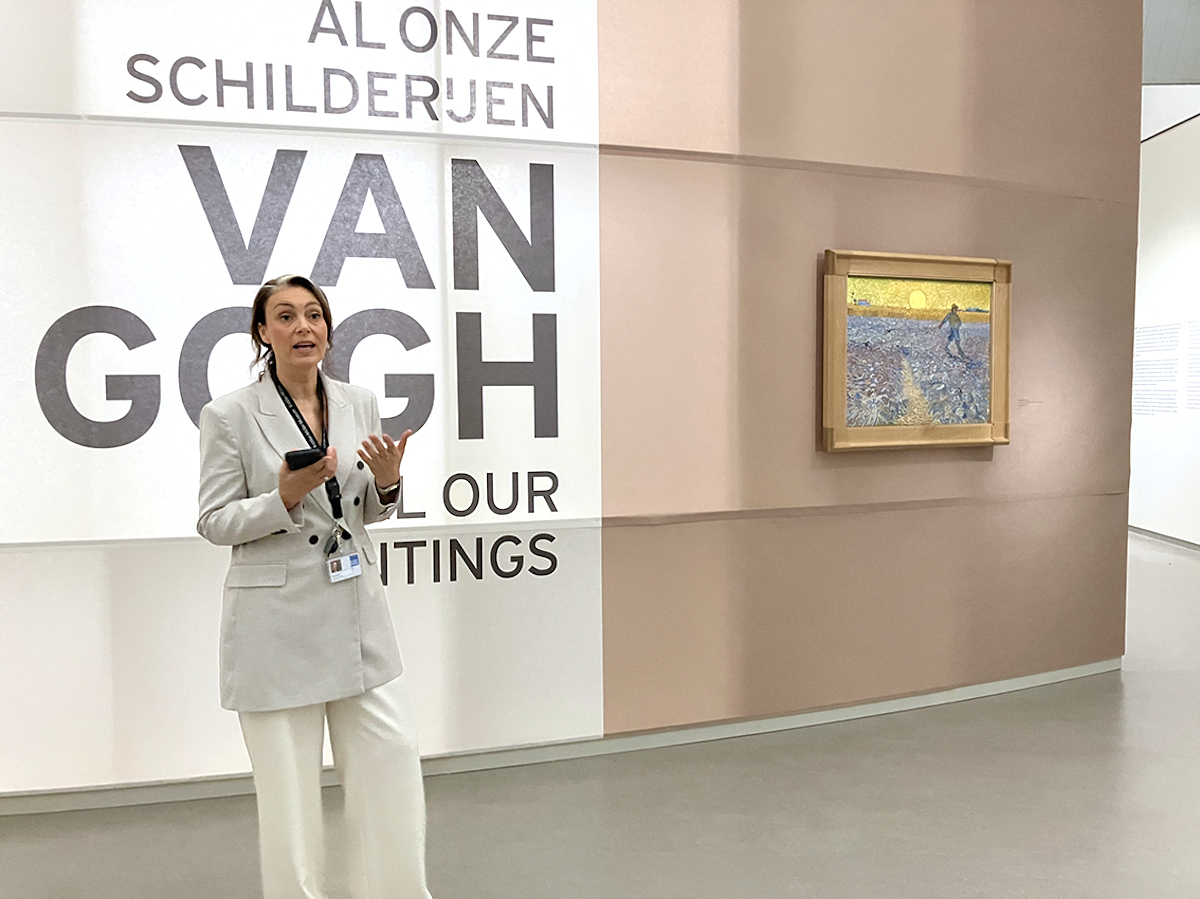
The new exhibition ‘Van Gogh, All Our Paintings’ is now open at the Kröller-Müller Museum in Otterlo (until 3 January 2027), and provides the answer: Faith, hope and love. The theological virtues Vincent cited in his early sermon (‘Faith, Hope and Charity’) inspired the three themes guiding us through this landmark exhibition, curated by Renske Cohen Tervaert. In fact, for the first time since 1984, we can admire all 88 paintings from the Museum’s collection (usually around 40 are on display). It’s the world’s second-largest collection of works by the Dutch artist, assembled by the Museum’s founder, Helene Kröller-Müller. ‘It is a rare opportunity, as it is almost impossible to present all our Van Gogh paintings at once’, comments Benno Tempel, the Museum’s director. ‘First of all, the museum conducts research, and the paintings around us are often on the table of our researchers and conservation department… a second aspect is that the works are frequently out on loan’. This is, therefore, a truly exceptional event for one of the Netherlands’ finest museums, hidden in the stunning De Hoge Veluwe National Park. There is great anticipation here. Next year, work will begin on making the existing architecture more sustainable. At the same time, construction of a new extension is expected to start in 2028, based on designs by Japanese architect Tadao Ando, which MVSA Architects will further develop in collaboration with Ando Studio. The extension will provide more space for the collection and temporary exhibitions. It will be built almost entirely underground, with a refined use of natural light to ensure harmony with the existing landscape.
‘One of the aspects of Van Gogh’s work that strikes me most’, says Renske Cohen Tervaert, ‘is that, through deeply personal subjects, he managed to convey a universal message to us all… He understood the power of art; for him it was a mission. And the three virtues – faith, hope and love – reflect his story; indeed, they are the three pillars intimately linked to his philosophy of life’. With this approach, the exhibition eschews the usual chronological layout. Instead, it presents works from the Dutch and French periods, powerfully demonstrating the strength of his artistic vision, regardless of the palette employed. Lane of Poplars at Sunset, painted in 1884 using earthy tones, welcomes visitors alongside the luminous Pine Trees at Sunset created in 1889. Dutch haystacks are displayed next to those of Provence. Postman Joseph Roulin – a close friend of Vincent’s in Arles – engages with The Potato Eaters, his first masterpiece created in Nuenen. After years of work and hundreds of canvases, the sentiment at the core of his art remains unchanged: Vincent’s love for nature and for working-class people speaks to us with the same immense power.
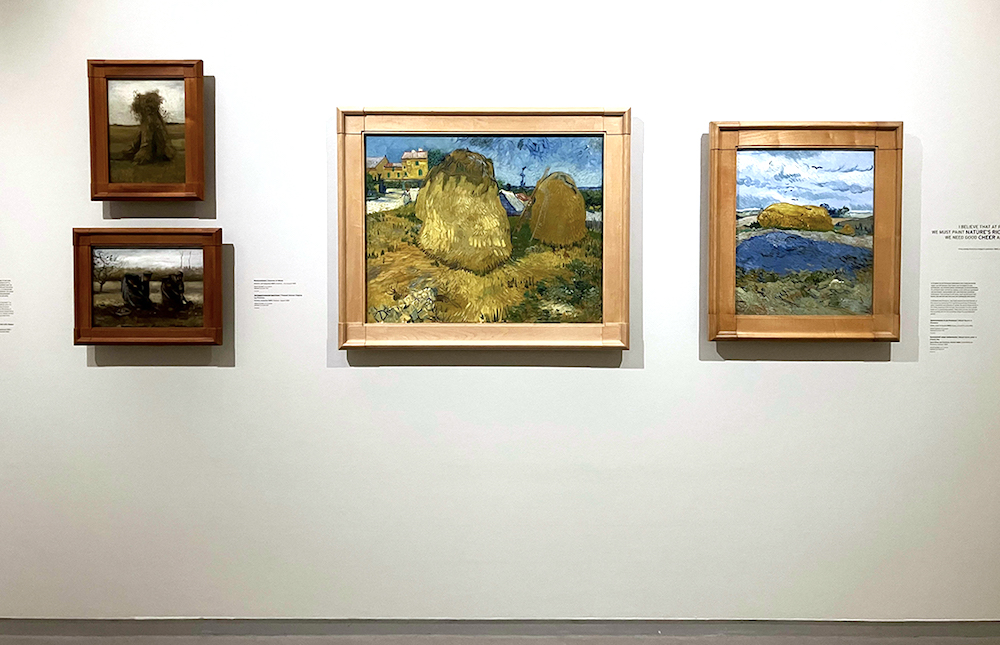 Installation view in ‘Van Gogh, All Our Paintings’. Photo © M. Guzzoni/Artlyst 2026.
The Good Samaritan
A man with a reddish beard is depicted almost from behind as he lifts a wayfarer onto his horse. The strain is visible: his back is arched, his right foot planted firmly on the ground. The wayfarer is exhausted; his body is limp and wounded, with a bandage wrapped around his head. Working from a small black-and-white lithograph after Delacroix’s The Good Samaritan that hung in his room, Vincent painted a large canvas measuring 73 by 60 centimetres. ‘I also tried making a copy of The Good Samaritan by Eugène Delacroix,’ he wrote to Theo on 2 May 1890, from the psychiatric hospital in Saint-Rémy-de-Provence. We have no further commentary from him on this canvas, but during that trying period – following several crises – Vincent had begun translating works by his favourite artists into colour: he likened his efforts to those of a violinist interpreting Beethoven. And so, we find ourselves enveloped in this symphony in blue, where every element plays a part – nature, the mountains, and the horse all vibrate in unison. Blue: torment and peace, as Goethe wrote in his 1810 Theory of Colours – a union of restlessness and tranquillity. This extraordinary canvas opens the section dedicated to Love (Charity); here, however, the three virtues seem to converge. There is the unwavering trust from Theo, who becomes his saviour; the hope of an early return to the North; and his profound love for art.
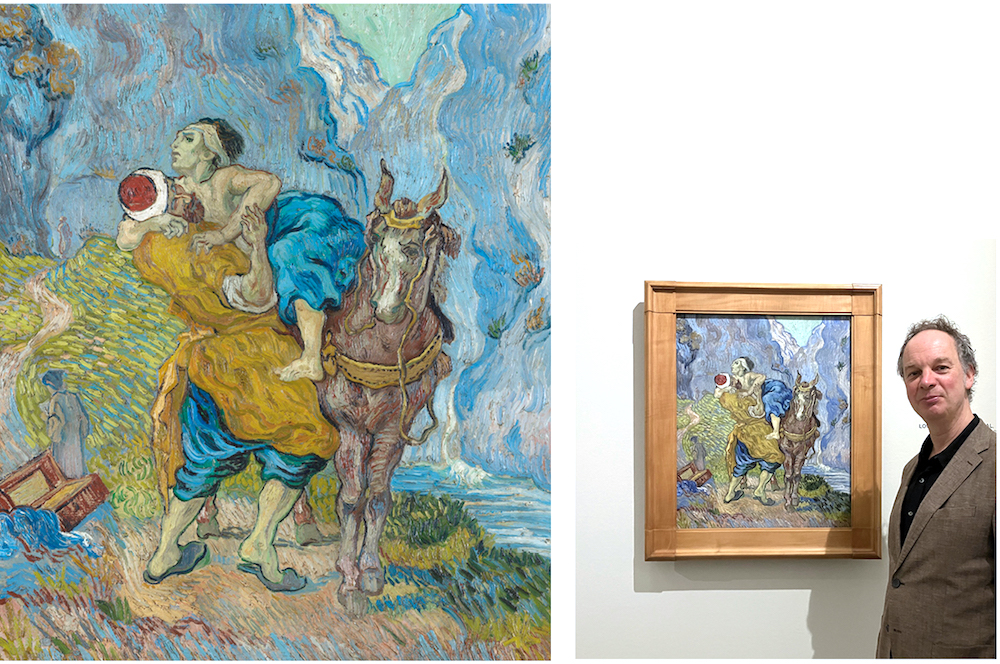 Director Benno Tempel and Van Gogh’s The Good Samaritan (after Delacroix) (1890). Photo © M. Guzzoni/Artlyst 2026.
One of the few works with a religious subject, The Good Samaritan (after Delacroix) has regained its full splendour following the removal of yellowed varnish and resin residues left by a relining in the 1970s. Its frame has also been restored. It holds historical significance as one of only six surviving originals commissioned by Helene for her Van Goghs, and designed by Jacob van den Bosch in 1910. In the 1950s, more modern frames were introduced. Still, at the turn of the millennium, the Museum decided to commission replicas of Van den Bosch’s original frames for all the other canvases. ‘Vincent’s paintings from our collection are instantly recognisable worldwide by their frames’, observes Tempel. At a time when the debate over museum frames remains ongoing, this detail is far from trivial.
Bridge at Arles: ‘the crystal clearest’
“I believe in the absolute necessity of a new art of colour, of drawing and – of the artistic life. And if we work in that faith, it seems to me that there’s a chance that our hopes won’t be in vain”, confessed Vincent to his brother on 16 March 1888, as soon as he arrived in Arles. And with this conviction he set out to experience the most luminous period of his life, a time when the simplest scenes were transformed into something entirely new: ‘it’s a drawbridge, with a little carriage going across it, outlined against a blue sky – the river blue as well, the banks orange with greenery, a group of washerwomen wearing blouses and multicoloured bonnets’.
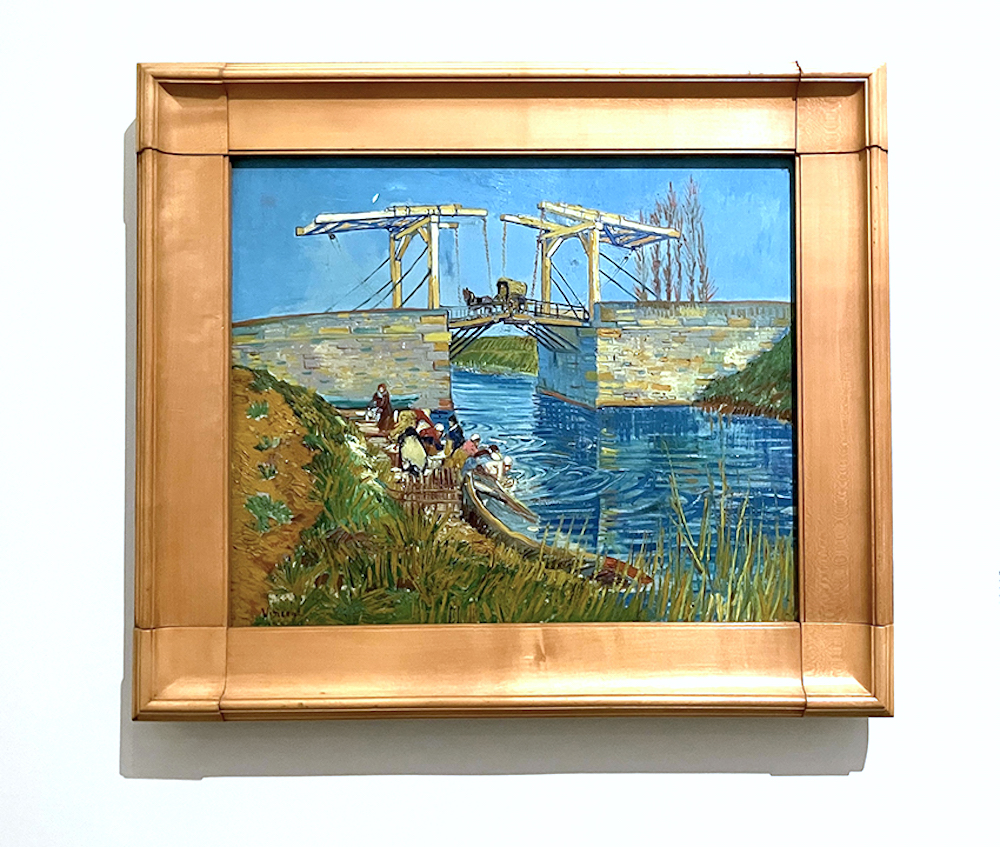
Vincent van Gogh, Bridge at Arles (Pont de Langlois) (1888). Photo © M. Guzzoni/Artlyst 2026.
For Helene, this picture was one of ‘the most beautiful, most powerful, the crystal-clearest’. The horse-drawn carriage and its driver occupy a privileged position in the work, at the centre of a bridge that surely reminded him of his native land. It is a bridge that is also metaphorical – a crossing, a watershed, a credo. The painter felt the duty to pursue his artistic quest and to speak to future generations through art. This is how art moves forward, as he repeatedly wrote: ‘artists perpetuate themselves passing on the torch, Delacroix to the Impressionists, etc.’
Helene’s passion for Vincent’s art
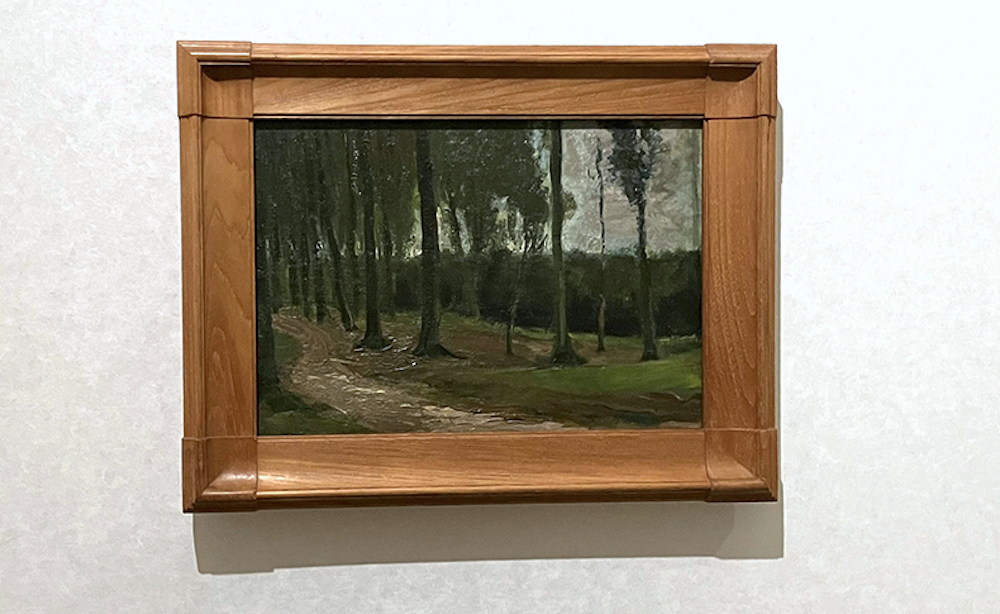
Vincent van Gogh, Edge of a Wood (1883). Photo © M. Guzzoni/Artlyst 2026.
At this point, I go back to look for the small canvas that launched Helene Kröller-Müller’s Van Gogh collection. It’s Edge of a Wood (1883), a quiet, twilight painting, one of the artist’s early oil studies that goes almost unnoticed. It invites us to venture in solitude along the path of our own existence… In her youth, Helene had loved authors such as Schiller, Lessing, Goethe, and Spinoza, but she had also read Dante.
She purchased the painting in 1908 – halfway through her life’s journey – for a mere 110 guilders: the lowest price among all her subsequent acquisitions. The wife of the immensely wealthy industrialist Anton Kröller, and a mother of four, Helene had previously collected antique furniture, ceramics and Asian art for their lavish home in The Hague. However, in 1906, something changed radically. She began taking private lessons in modern art from Henk Bremmer, and discovered Van Gogh. The distinguished scholar and teacher maintained that ‘Art is that which evokes an emotion, and is made with the intention of evoking an emotion’. His passionate lectures on Vincent’s work made a deep impression on Helene, who soon appointed him as her art advisor. A few months later, she purchased Sunflowers Gone to Seed for 4,800 guilders – a groundbreaking work from the artist’s Paris period, destined to become a symbol of the Dutch artist.
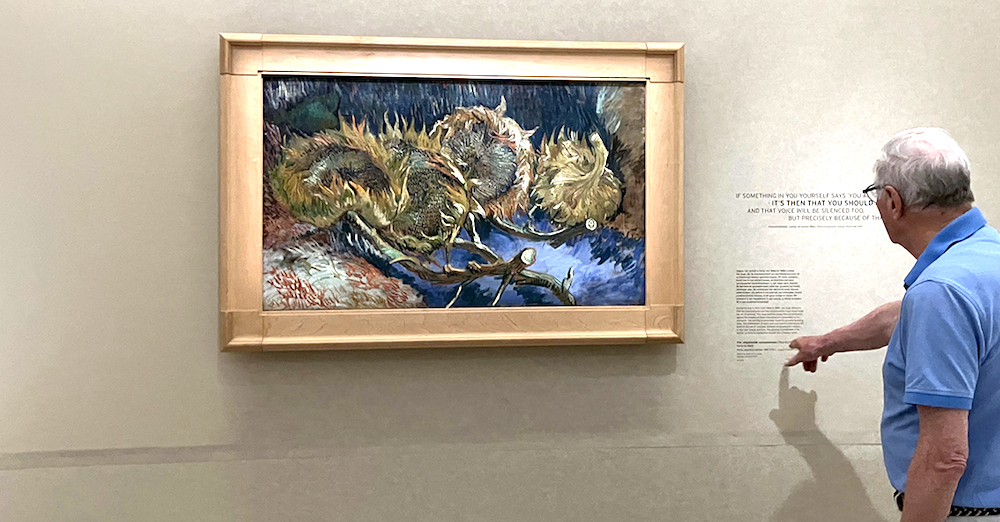
Vincent van Gogh, Sunflowers Gone to Seed (1887). Photo © M. Guzzoni/Artlyst 2026.
The collection grew rapidly; in April 1912, while visiting Paris with Bremmer, the couple embarked on a buying spree for Van Gogh’s works on the French capital’s market, acquiring fifteen pieces in just two days, and causing a major stir in the Parisian art circles. Between May and November of the same year, another twelve Van Gogh paintings were added to the collection, including Sorrowing Old Man (‘At Eternity’s Gate’), which had been on display at the groundbreaking Sonderbund exhibition in Cologne, an event to which the Kröller-Müllers had lent twenty-five Van Goghs. Anton paid Paul Cassirer the highest sum ever for this work: 30,000 marks (approximately 37,000 francs), a staggering amount for the time.
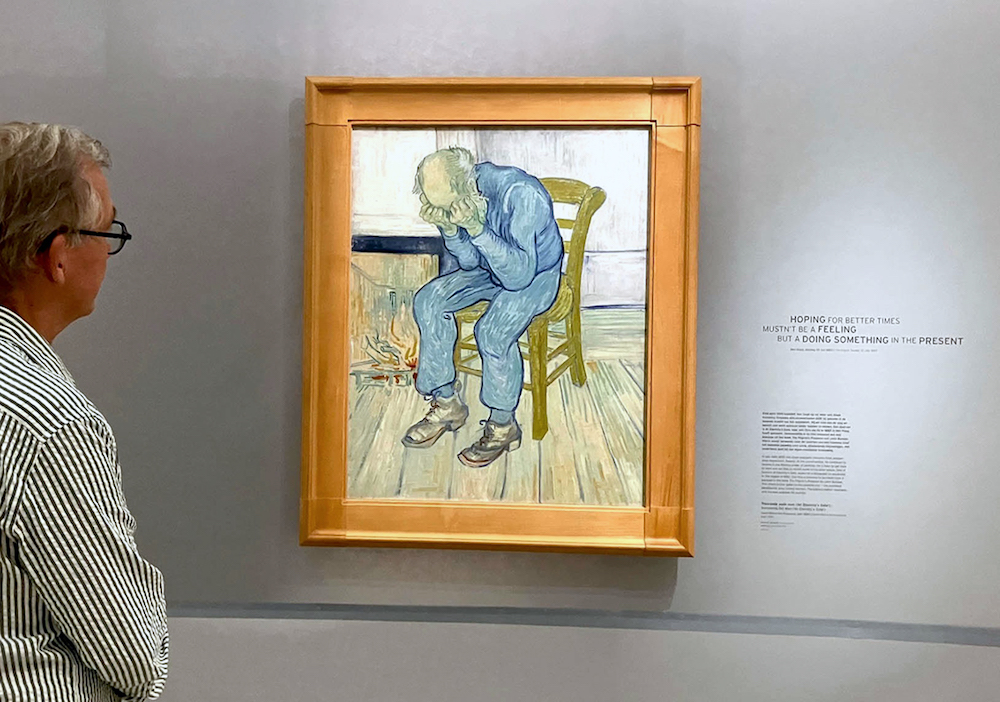
Vincent van Gogh, Sorrowing Old Man (‘At Eternity’s Gate’) (1890). Photo © M. Guzzoni/Artlyst 2026.
The path was now marked; there was no time to lose. Indeed, the previous year, Helene had undergone a life-threatening surgery and had decided that, if she should survive, she would fund a museum, ‘a monument of culture’, to be donated to the Dutch people. Its beating heart was to be Van Gogh’s work, as one of ‘the great minds of modern art’ – an artist capable of evoking ‘aesthetic emotions’, as Bremmer put it. Thanks to his unfailing assistance and advice, ten years later the Kröller-Müller collection boasted an extraordinary survey of works representing every phase of Vincent’s production, alongside paintings by contemporary masters such as Renoir, Milliet, Weissenbruck, Seurat, Gauguin, Redon, Picasso, and Mondrian, to name but a few. In the 1920s, Helene organised lectures and exhibitions that attracted a broad audience, thereby contributing significantly to the early recognition of Vincent’s work and the spread of modern art in the Netherlands. Drawing inspiration from Bremmer’s ideas, she developed her own theory of the evolution of modern art, discussing ‘realism’ and ‘idealism’ and comparing pairs of works from her collection. Yet Van Gogh – her favourite artist – held a special place; he was ‘one of the great spirits of modern art’, and defied all categorisations. A century has passed: she was right. Her dream became a reality in 1936 with the opening of the Museum, of which she served as the first director – albeit for only one year. By then extremely frail, she passed away in 1937. The museum catalogue features a historic black-and-white photograph showing her coffin in the central hall, surrounded by ‘all her Van Goghs’. No fewer than 85 of the masterpieces on display today were handpicked by Helene – and now, we all share in her remarkable legacy.
Top Photo: Curator Renske Cohen Tervaert at the opening of ‘Van Gogh, All Our Paintings’ at the Kröller-Müller Museum in Otterlo, with Van Gogh, The Sower (1888). Photo © M. Guzzoni/Artlyst 2026.
Van Gogh, All Our Paintings – Kröller-Müller Museum, Otterlo – 15 September 2026 – 3 January 2027