October is a stunning month for art linked to aspects of spirituality, with several of my favourite artists exhibiting. Solo shows mentioned in my October art diary include Anthony Lawrence, Peter Howson, Richard Kenton Webb, Rob Floyd, Mimmo Palandino, Antony Gormley, Hilma af Klimt, Michaela Yearwood-Dan, Rachel Feinstein, and Liz Larner, among others. There are also group shows in Malta and Finland focusing on aspects of the spirituality of women artists, along with the Laing Art Gallery’s survey of ‘Pre-Raphaelites: Art and Poetry ‘, which surveys artists and poets for whom spirituality was often central to their practice.
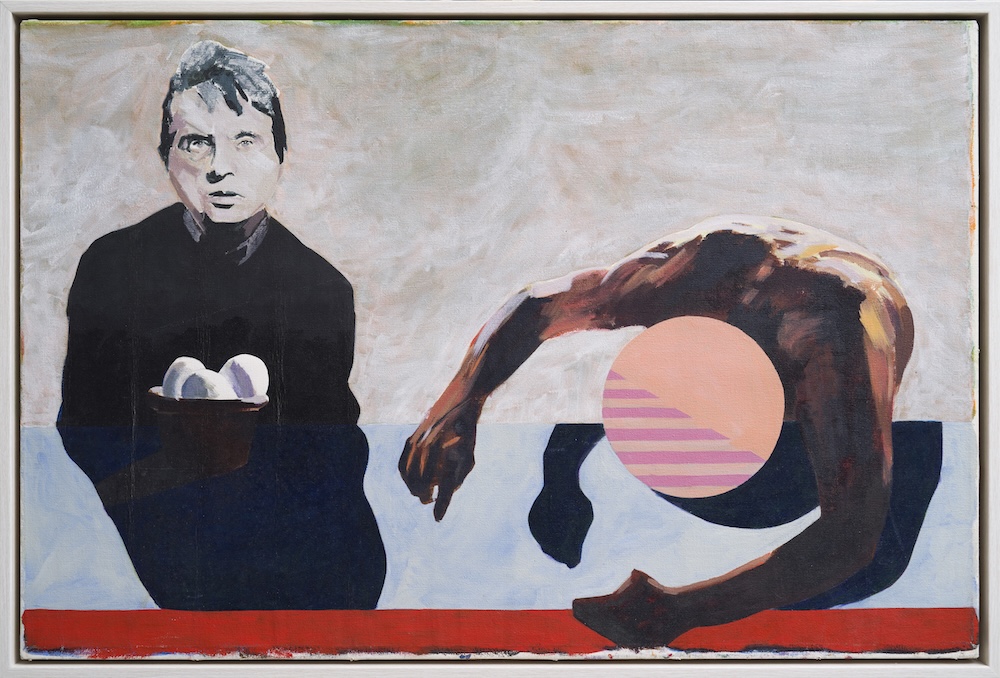
Anthony Lawrence, Bacon and Eggs, 1980, oil on canvas, 20inch x 30inch
‘Anthony Lawrence: A Practical Guide To Aesthetics‘ is an exhibition of the work of post-modern artist Anthony Lawrence at St John’s, Waterloo. Coinciding with Frieze week, the exhibition shows some of Lawrence’s major works from his series of grand themes, such as Dante, Tannhäuser, and the Damned Demoiselles, as well as portraits and several of his religious and spiritual paintings. Lawrence worked intensively over five decades, creating a vast collection of work that is now being made public.
‘A Practical Guide to Aesthetics’ follows a critically acclaimed 2025 retrospective at Nick and Caroline de Rothschild’s Palais des Vaches Gallery in the New Forest, which was the first to show the full spectrum of Lawrence’s career. Forbes described the work as blending “classical technique, pop-cultural wit, and poetic imagination. Playful portraits, surreal landscapes and painterly still lifes bring overdue recognition to a hidden genius of British art”. Many of the works in that show had not been seen before then; this exhibition at St John’s will bring to light several more of Lawrence’s paintings, including some from the newly restored ‘A Practical Guide to Aesthetics’ series from the early 1990s.
Lawrence worked throughout his life on portrait commissions; his works included sitters such as John Wayne, Yehudi Menuhin, Ian McKellen, and Rt Rev Hassan Dehqani-Tafti, among others. Included in this show are Lawrence’s paintings of Francis Bacon and Seamus Heaney, with whom he became friends.
Fascinated by religion, Lawrence spoke of the “constant fight between the sacred and the secular” and made many works relating to religion and spirituality. His own ‘The Stations of the Cross’ was inspired by the restoration of the display of religious imagery in the Byzantine Empire; these colourful and dramatic paintings show his commitment to technique, stressing the importance of post-modern framing. In my review of the 2025 retrospective for The Church Times, I said, “While constantly evolving through styles and series as a great ‘knowing’ Post-Modernist, Lawrence sought, through his blend of tradition and invention, history and innovation, to hint at how reconciliation might be found in the great contest of social humanity.”
‘Salvation’, at Flowers Gallery, is a major new exhibition by Peter Howson showing a new series of interconnected oil paintings on gesso panels that chronicle the life of Christ as depicted in the Gospels, through a sequence of intensely personal encounters, marking one of the artist’s most sustained examinations of biblical narrative to date.
Howson’s personal battles with addiction and subsequent recovery led him to find his faith and profoundly impacted his work, which consistently addresses suffering alongside the prospect of redemption. Religious subject matter has occupied a significant place within Howson’s practice for more than two decades. Following his conversion to Christianity in 2000, biblical narratives and devotional works became an increasingly important vehicle through which he explored themes of sacrifice, spiritual renewal and belief. Major projects reflecting a prolonged engagement with sacred subjects have included ‘The Stations of the Cross’ (2003), ‘Christos Aneste’ (2005), ‘Harrowing of Hell’ (2008), and his monumental painting of the martyrdom of Saint John Ogilvie for St Andrew’s Cathedral in Glasgow, completed in 2011.
Created in 2026, ‘Salvation’ revisits familiar episodes from the Gospels not as grand historical events, but as intimate scenes charged with vulnerability, doubt, courage and compassion. The series begins with Christ’s nocturnal conversation with Nicodemus, in which the possibility of spiritual rebirth is first articulated, and unfolds through scenes of teaching, healing and confrontation. Children, outcasts and those pushed to the margins emerge repeatedly throughout the cycle, reflecting Howson’s longstanding commitment to depicting the dignity and struggles of ordinary people. In these works, Christ is not presented as a remote divine figure but as a man moving among those around him, confronting hypocrisy, offering consolation and challenging established power.
As the narrative progresses, the emotional intensity deepens. The betrayal by Judas, Christ’s interrogation before Pilate and the events of the Crucifixion are rendered with a striking psychological immediacy. Howson focuses not on spectacle but on the experience of abandonment, suffering and sacrifice, emphasising the profound solitude at the heart of the Passion story. The final panels move beyond death towards resurrection and renewal. Encounters with Mary Magdalene and the triumphant vision of Alpha and Omega transform the cycle into a meditation on hope and the promise of eternal life.
Howson’s expressive figuration and deeply empathetic vision bring renewed urgency to stories that have shaped Western culture for centuries. Both devotional and profoundly personal, ‘Salvation’ reveals Howson engaging with some of the most enduring narratives in art history while exploring concerns that have remained central to his practice: resilience, faith and the capacity for change.
Richard Kenton Webb‘s life’s vision has been to communicate the practice of colour. Since the early 1990s, when he posed the question ‘is colour a language?’ whilst teaching at the Slade School of Fine Art, he has been involved in a personal pilgrimage into colour. Sister Wendy Beckett was “there for me,” he has said, “as was Peter Fuller, supporting my fiery vision”. Friendship and support have also always come from Dr Revd Richard Davey, who has engaged in ongoing discussions on “colour, landscapes, language, narratives, faith and the human figure”.
Webb believes that painting is a human language that will never disappear. Against the backdrop of digital technology going from strength to strength, he has envisioned a counterculture in which his students can engage slowly with the physicality of paint. This has included helping them to make their own paints, using the colours of creation. For Webb, colour is the language of God, the language of love.
His latest exhibition, at Whitworth University, features three suites of works on paper spanning seven years. The linocuts form part of a larger conversation with John Milton’s epic poem, ‘Paradise Lost’. This body of work led to a commission from The Milton Society of America to respond to John Milton’s poem ‘Lycidas’. Finally, Webb took up the prestigious artist-in-residence position at the Joseph and Annie Albers Foundation, where he completed a series of 72 drawings, the start of his ‘Manifesto of Painting’. A small selection of that set of work is included.
Kenton Webb has said of his Milton-related works: “For the last ten years, Milton has been a companion like Virgil to Dante, guiding me through the narrative of my own life. I started this collaboration with an imagined drawing of Milton the Blind Poet, considering the problem of evil. I ended my journey with a portrait of myself, acting as a companion piece to the long journey about good, evil, and everything in between that we had taken together. Milton is a great English poet who gives hope, which in itself is a creative act for these difficult times.”
‘Still Activity’ by Rob Floyd at Manchester Cathedral is an exhibition featuring a new body of work, paintings and drawings on the theme of mystical investigation. Floyd, an artist born and raised in Hertfordshire, UK, has been exhibiting work in galleries and religious spaces for over ten years. Over a four-year period beginning in 2012 and culminating in 2016, he painted a ‘Stations of the Cross’ cycle for Manchester Cathedral, followed by a ‘Stations of the Resurrection’ cycle for Liverpool Anglican Cathedral. Both are now part of the respective cathedrals’ permanent art collections.
He also paints striking portraits. His 2015 ‘Self-Portrait Facing Artist’s Block’ won the Gordon Hulson Memorial Prize at the Royal Society of British Artists Open Exhibition. Last year he exhibited a series of works that harness this mastery of portraiture to depict various saints, including St Francis, St Cuthbert, and St John the Baptist. This new exhibition continues this fertile theme. With his lead image for this exhibition, ‘The Annunciation’, Floyd has said that he “wanted to depict Mary as a little more ‘in control’, for want of a better phrase”.
‘One and All: Adam Belt‘ is an exhibition at Parsonage Gallery by an artist who is driven by the pursuit of enduring philosophical questions. Belt frames these investigations with elegant simplicity, anchored in a profound appreciation of materiality. Whether through microscopic texts, refracted light, or artificially grown crystals, he takes us on a search for “real presence” at the intersection of spiritual and scientific inquiry.
In a new work entitled ‘One and All’, Belt reproduces every single page of the Bible in a vast grid. Aaron Rosen writes that: “The words on each page are miniscule and impossible to read by eyesight alone, although they reveal themselves perfectly with the assistance of a magnifying glass. As viewers, we are faced with a conundrum. We can either press closely, straining to glimpse a passage while losing sight of the whole, or stand back and apprehend the entirety of the text without the possibility of reading it. Adopting either hermeneutic posture brings us closer to one truth but further from the other. If the clarity of revelation exists, it lies in the tension itself, suspended dynamically between the poles of particularity and totality. To be human, the work suggests, is to know one or all, the macrocosmic or microcosmic. To know both at once would be divine.
‘One and All’ provides us with a cypher for understanding Belt’s work more broadly. He is driven by the pursuit of enduring, esoteric questions. And yet he frames these investigations with elegant simplicity, anchored in a profound appreciation for the material world and the properties of human perception. In ‘Merton’, which at first glance looks like a simple cube, sustained attention reveals beguiling, counterintuitive refractions as light passes through layers of resin. Belt’s subtle optical experiments invite metaphysical reflection, drawing us into the contemplative realm of the eponymous mystic, Thomas Merton. In another piece, which takes the form of a geode, Belt cultures crystals from altar wine on a communion wafer … In Belt’s imagination (pace Aquinas), the very “accidents” of the Eucharist—the physical qualities we perceive—are themselves miraculous and strange.”
‘Mimmo Paladino: Present into Past‘ is a landmark exhibition, organised by the Raclin Murphy Museum of Art, that examines the dynamism of Mimmo Paladino’s repertoire. An overview of Paladino’s career introduces audiences to the artist’s repertoire and highlights his position within the currents of art history through his paintings and sculptures. Following that contextualisation, the exhibition illuminates his fascination with literature and the art of the book, including his illustrations of the Roman Missal for Pope Francis. The final section examines the commission and creation of the Mary, Queen of Families Chapel, including the premier presentation of Paladino’s unique handmade vestments that he has donated to the Museum and University. Although Paladino is not exclusively a religious artist, this exhibition highlights his commitment to the great humanistic and spiritual traditions that have shaped his work while also acknowledging the contribution his contemporary voice has added to the history of human civilisation.
England & Co are presenting paintings by Paul Heber-Percy during their October residency at 36 Great Pulteney Street in London’s Soho. Simon Moretti writes: “The exhibition takes its title from Rilke’s ‘Book of Hours’, in which a solitary house stands at the threshold between the known world and the vast unknown beyond it — a village’s last dwelling before the road slips out into the night. It is an image Heber-Percy’s paintings seem to inhabit directly: each work a threshold structure standing at the edge of the visible, looking out toward something larger and unnamed.
This new body of work returns to the landscape not as a record of what is seen, but of what is remembered, dreamed, or half-glimpsed at the edge of consciousness. Heber-Percy’s paintings inherit the silence and stillness of Caspar David Friedrich and the visionary charge of nineteenth-century Symbolism, while remaining unmistakably contemporary in their restraint: muted greys, silvered blues, the low burn of a hidden sun …
A central group of works, which the artist calls the ‘Antiphon’, introduces something stranger into the landscape: luminous geometric diagrams hovering over a tree line or darkened valley, like constellations remembered from an old book of alchemy. Invented by the artist, these forms — string-thin lines and pinpoint lights — transform the picture plane into a threshold, nature interrupted by pattern, by intention, by mind. They recall Rilke’s conviction that landscape can be read as a kind of script, disclosing a hidden order beneath the visible. The ‘Antiphon’ diagrams seem to paint that order directly onto the sky: not illustrations of energy, but vibration made visible.”
Cristea Roberts Gallery is hosting ‘Where’, an exhibition of over twenty new works on paper by Antony Gormley, some monumental in scale, each a direct trace of a place and a body. Presented across the gallery’s two floors, the exhibition is an attempt to both subjectivise and universalise the question, ‘Where am I?’ ‘Where’ proposes art as an invitational space, one from which we can look both deeply into ourselves and out to a reality that unfolds within and without us.
The show opens with a group of eight unique prints titled Lux, 2025–26, including Gormley’s largest work on paper to date, ‘Lux I, 2026’, measuring four and a half metres long. Working at a scale intended to contain the viewer, the series grew out of ‘Cave, 2019’, Gormley’s enterable sculpture, where visitors navigate towards light through darkness, guided by touch and hearing alone – an experience that sharpened his sense of being in a body and, in the artist’s words, “the deep memory of being somewhere and looking out”.
The black that dominates each work comes from pressing paper against inked plywood, which is rotated and re-pressed up to 12 times per work. This physical, demanding process layers fractal planes, which build towards an intense darkness that progressively gives way to light. A corresponding series, ‘Aperture, 2026’, comprises six prints in editions of 25, using fine-grained plywood with nearly twice the layering, some featuring twenty impressions. Both series conjure openings and passages: skylights and chimneys resolving towards an untouched open space of white paper.
‘Raquib Shaw: Night Sonnets’ at Compton Verney brings together paintings and tapestry that examine how memory, exile, autobiography and history are internalised in visual form. Beginning with the earliest and largest work, ‘The Dream’ (2018), ‘Night Sonnets’ presents new paintings made for Compton Verney. Spanning eight years, the works trace a psychological investigation that moves from the expansive, proliferating pictorial field of ‘The Dream’ towards images that are quieter, more concentrated and increasingly inward.
For Shaw, the silence of night concentrates attention, allowing the works to pursue a sustained, exacting psychological enquiry. These paintings function as conversations with the self; arches, lattices, windows, reflections and water depicted in the works operate as thresholds in the psyche. These open onto Henry Corbin’s concept of mundus imaginalis, an intermediate realm between sense and intellect, where imaginal forms acquire visibility and memory, history and prophecy become material for examination.
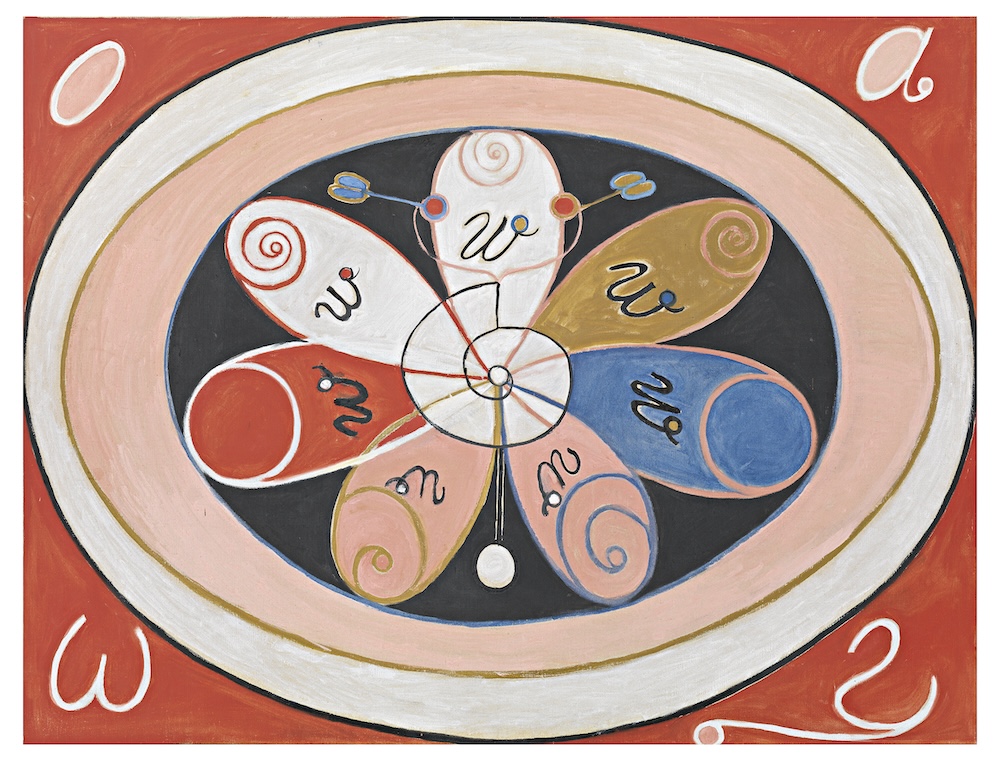
Hilma af Klint, The Evolution, The WUS/Seven-Pointed Star Series, Group VI, No.16, 1908
© Stiftelsen Hilma af Klints Verk
Hilma af Klint is now recognised as one of Europe’s foremost abstract painters and one of Sweden’s most celebrated modern artists. ‘Hilma af Klint: Artist and Visionary’ at National Gallery of Ireland marks the first major exhibition dedicated to the artist’s work in Ireland. Af Klint’s art was profoundly informed by spirituality and her explorations of Rosicrucianism, Theosophy, and Anthroposophy. Like many artists of her time, she sought to make sense of and articulate the modern world. Inspired by nature, science and religion, af Klint developed a visionary abstract painting style – highly charged emotionally, spiritually and chromatically.
While portraiture and illustration provided a source of income, af Klint’s spiritual paintings – the ‘great work’ – were seldom shown beyond her close circle. Her vast body of work remained in storage until the 1980s, largely unknown outside Sweden. This show explores the time, place and circumstances that shaped her unique artistic vision. Key spiritual works such as ‘The Swan’ (1914–15) and ‘Altarpieces’ (1915) feature alongside plant studies, early portraits and landscapes, some of which have never been publicly exhibited. 79 works by the artist are included, from her groundbreaking abstract works to portraits, early landscapes, plant studies, late watercolours, and an apocalyptic map of Great Britain.
Visitors will get a sense of the time and place that she grew up in: a turn-of-the-century explosion in spiritualism, a burgeoning Swedish arts scene, and a small but dedicated female friendship circle. This led her to create a unique body of work, both alone and in collaboration, that would eventually include around 1,300 paintings and 124 notebooks containing more than 26,000 typed and handwritten pages. Influenced by her exposure to new spiritual movements from the late 19th century, such as Theosophy, af Klint’s artistic practices included automatic drawing and séances where she would try to communicate the messages she received.
Her life and career bridged the 19th and 20th centuries – a time of great change when developments in science and technology led to re-evaluations of the place of human beings in the universe. This had repercussions across all aspects of society, from social reforms such as women’s suffrage to culture and the artistic ideas and images that were being produced. ‘Hilma af Klint: Artist and Visionary’ is a unique journey into an idiosyncratic, singular mind that melded spiritual and artistic engagement, forging a new way of artmaking and thinking for the future.
‘The Practice of Liberation‘ is an exhibition at The Whitworth by Michaela Yearwood-Dan. The exhibition, formed entirely of new work, centres on a series of 14 paintings and six ceramic vessels presented within a multidimensional installation designed by the artist and accompanied by a bespoke musical score by composer Alex Gruz. The exhibition is organised in collaboration with Towner Eastbourne and Arnolfini in Bristol, which will present it following its premiere at the Whitworth.
Drawing on the aesthetics and symbolism of the Catholic church, Yearwood-Dan creates a powerfully resonant space to examine the intersection of the histories of colonialism and institutional religion through the lens of her own memory and experience – reflecting on the ongoing process of personal and collective liberation. Using the language of abstraction, Yearwood-Dan’s paintings incorporate fragments of her own diaristic writing alongside adapted and borrowed texts and lyrics. These words move between intimate and political, appearing at varying scales across the canvases. References to writers such as civil rights activist James Baldwin sit alongside the artist’s own reflections, inviting the viewer to consider how the personal and the political intersect in new ways. The exhibition’s title references the writings of bell hooks, whose work explores how education, culture, love, and art can become tools for social and personal freedom.
Visual and symbolic references to Catholicism appear both directly and indirectly, alongside the artist’s reflections on love, colonialism, patriarchal structures and class systems that have shaped her experience. Rather than presenting liberation as a fixed state, ‘The Practice of Liberation’ explores it as ongoing — grounded in care, introspection and new ways of communing. At the heart of the exhibition, the 14 paintings echo the motif of the Stations of the Cross- a sequence of devotional images central to Catholicism. Yearwood-Dan adopts this structure as a compositional reference point, with visual motifs throughout the works echoing religious architecture and symbolism, including fallen crosses and diptychs reminiscent of stained-glass windows. The six ceramic vessels reference both Jesus’ first miracle of turning water into wine at the wedding in Cana, and the malleable shapes of Ghanaian bolga baskets, evoking domestic comfort and ritual.
The titles of Yearwood-Dan’s work convey additional layers of meaning. Within this body of work, the painting ‘Passio’ takes its title from the Latin term meaning suffering and endurance – a spiritual concept historically embedded within Catholic narratives of devotion. Known for her vibrant and expansive canvases, Yearwood-Dan introduces, in this body of work, a palette that moves between bold colours and softer, more subdued tones. Evoking both faded colours of historic religious paintings and sun-bleached hues of the Caribbean, the surfaces of her paintings reflect the personal and cultural histories that underpin her practice.
Gagosian is presenting Rachel Feinstein‘s debut exhibition in Greece. ‘Fates’ features new sculptures, mirror paintings, and works on paper that engage with classical Greek motifs to address archetypes of femininity, memory and memorials, and the intersection of mythology with everyday life.
The exhibition’s centrepiece is a pair of large caryatid sculptures that combine the female figure with architectural forms. These works explore the caryatid’s Hellenic roots, as well as subsequent Roman, Renaissance, and Neoclassical interpretations; Auguste Rodin’s sculpture ‘Fallen Caryatid Carrying Her Stone’ (1881–82); and Agnes Varda’s short film ‘Les dites cariatides’ (1984).
Also on view in Athens are mirror paintings that incorporate the figures and architecture of memorial steles marking ancient Greek tombs. These works represent the past as a mirror that reflects the present world, reinforcing themes of the duality of life and death that run through the exhibition. Additionally, ‘Fates’ features gouache paintings in a circular format with motifs inspired by classical ceramic painting, while a related group of sculptures adapts painted and incised designs from ancient Athenian black- and red-figure vases, wrapping them around hollow, amphora-shaped volumes and transforming their forms. Feinstein has sculpted these works in copper and terra-cotta, materials that she links with Father Sky and masculinity and with Mother Earth and femininity, respectively. Their narratives appeal to her for the integration of mythic symbolism into the representation of quotidian life, including athletic competitions, fashion, and sex, connecting them to the present.
For the past three decades, Liz Larner – one of the most influential and significant American sculptors of her generation – has explored the potential of sculpture to affect and expand our embodied encounter with the world. ‘Liz Larner: A hard line to bend’ at Camden Art Centre brings together works primarily from the last decade and foregrounds the artist’s current ecological concerns and her continued radical experiments in material and form. Unfolding as a series of rooms, the show traces ideas of transformation: from ancient myth and cosmology to the cycles of matter. Informed by post-human and eco-feminist thought, the works reflect on how we are embodied within and intervene in the material world around us.
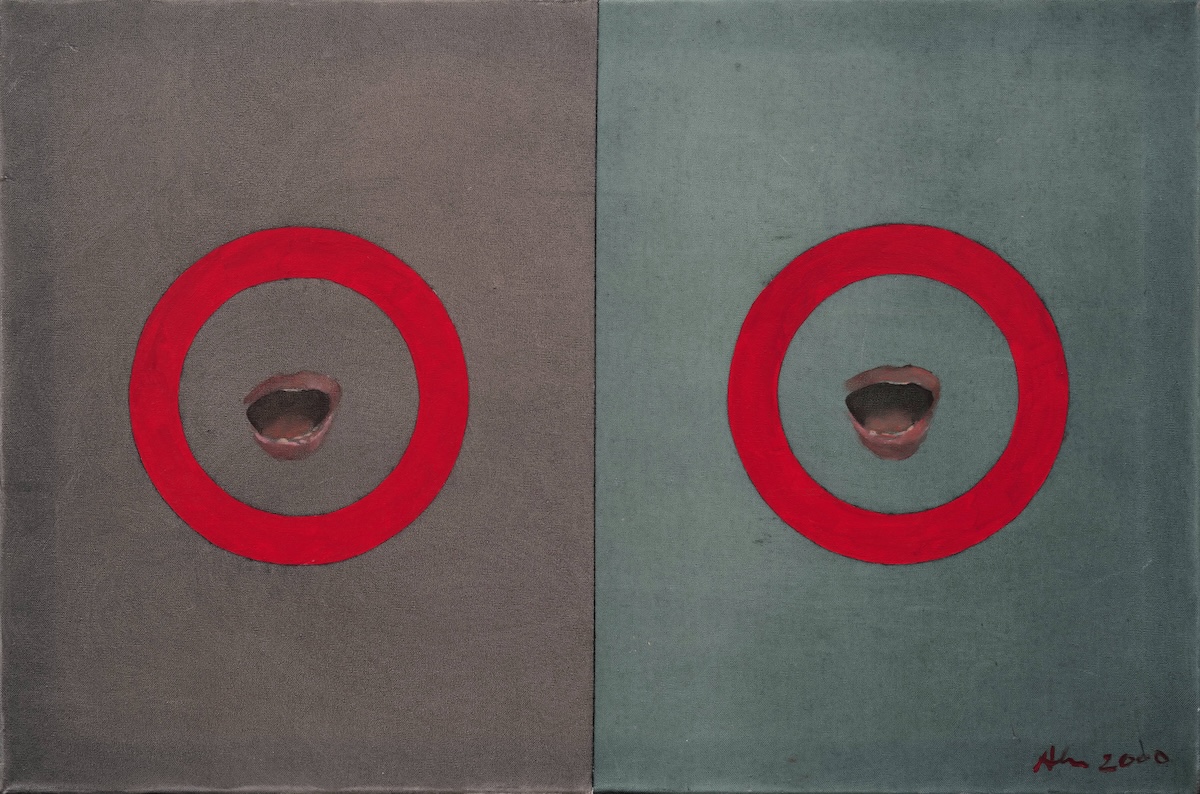
In her ‘Chemical Alphabet’ paintings being shown at Hauser & Wirth New York, Rita Ackermann takes on a new source of vocabulary: letters from a Semitic alphabet. The structure of each symbol serves as an anchor for each composition. The configuration of the letter, painted in acrylic green chalkboard paint on a canvas primed by multiple silkscreen prints, allows the surface to be built through Ackermann’s chalkboard method: layers of pastel and chalk drawings are erased, washed away, and redrawn until multiple states of the painting coexist on the canvas. Here, the picture advances through accumulation and erasure. At the centre of this constructive destruction, the letter remains, its meaning shifting with the evolving image around it. What stays visible is not the frozen image but the chronicle of its becoming.
Malta International Contemporary Art Space presents ‘A New Life Force‘, a major new exhibition bringing together three painters each gaining international recognition: Nathanaëlle Herbelin, Kemi Onabulé and Megan Rooney. Working across distinct visual languages shaped by diverse cultural backgrounds, the exhibition offers a compelling insight into the next generation of women artists who are redefining contemporary painting today.
Curated by Edith Devaney, Artistic Director of MICAS, the exhibition reflects the museum’s commitment to supporting artists at pivotal moments in their careers while fostering new international dialogues around modern and contemporary art. Designed by Paris-based Cécile Degos, the exhibition unfolds across three gallery floors at MICAS, with each artist occupying their own dedicated space, creating a dynamic conversation between their practices, which draw from their respective cultural heritages while connecting to historic traditions of painting.
Based in Paris, French-Israeli artist Nathanaëlle Herbelin is celebrated for atmospheric figuration that combines intimacy, memory and psychological depth. Drawing upon the poetic sensibility of post-impressionist artists such as Les Nabis, as well as Ferdinand Hodler and, later, Martin Wong, her paintings invite close, contemplative viewing. Their softened forms and muted palettes suggest fragments of recollection and emotional interiority, evoking experiences that are at once disturbing and wondrous. Her paintings are deeply imbued with spiritual dimensions, influenced by the devotional ex-voto artefacts found in historic buildings and churches across Malta.
London-based painter Kemi Onabulé draws upon her Greek, English and Nigerian heritage to explore humanity’s relationship with landscape, ecology and collective memory. Her paintings often depict figures inhabiting dreamlike environments poised between harmony and uncertainty, evoking both ancient histories and speculative futures. As part of her research visits to Malta, Onabulé was struck by the island’s vitality and the visible traces of its combative past. The intensity of the landscape, flora and colour palette all informed a powerful new body of work for the exhibition, many of which mark her largest canvases to date.
Canadian artist Megan Rooney, who lives and works in London, is known for a multidisciplinary practice encompassing painting, installation and performance. Her paintings emerge through accumulations of gesture and colour, built up and sanded back in a physically demanding process that gives her works a vivid sense of movement and intensity. Through layered surfaces alive with colour, atmosphere and fleeting intimations of nature, her paintings evoke interior landscapes, inviting contemplation of time, transformation and our connection to the natural environment. This entirely new body of work draws on Rooney’s longstanding interest in memory, myth and the ancient world.
A landmark exhibition in Finland reconsiders modern art through the hidden influence of esotericism, spirituality and women’s artistic networks. ‘Arcana Borealis – Northern Women and Esotericism’ is the first large-scale museum exhibition to examine how women artists from across the Nordic region and Sápmi have engaged with esotericism, spirituality and alternative systems of knowledge from the nineteenth century to the present day. Bringing together over 200 works by 50 artists, ‘Arcana Borealis’ – from the Latin arcana (“hidden knowledge”) and borealis (“the north”) – offers a major new perspective on modern and contemporary art through women’s practices shaped by spirituality, ecology and unseen worlds.
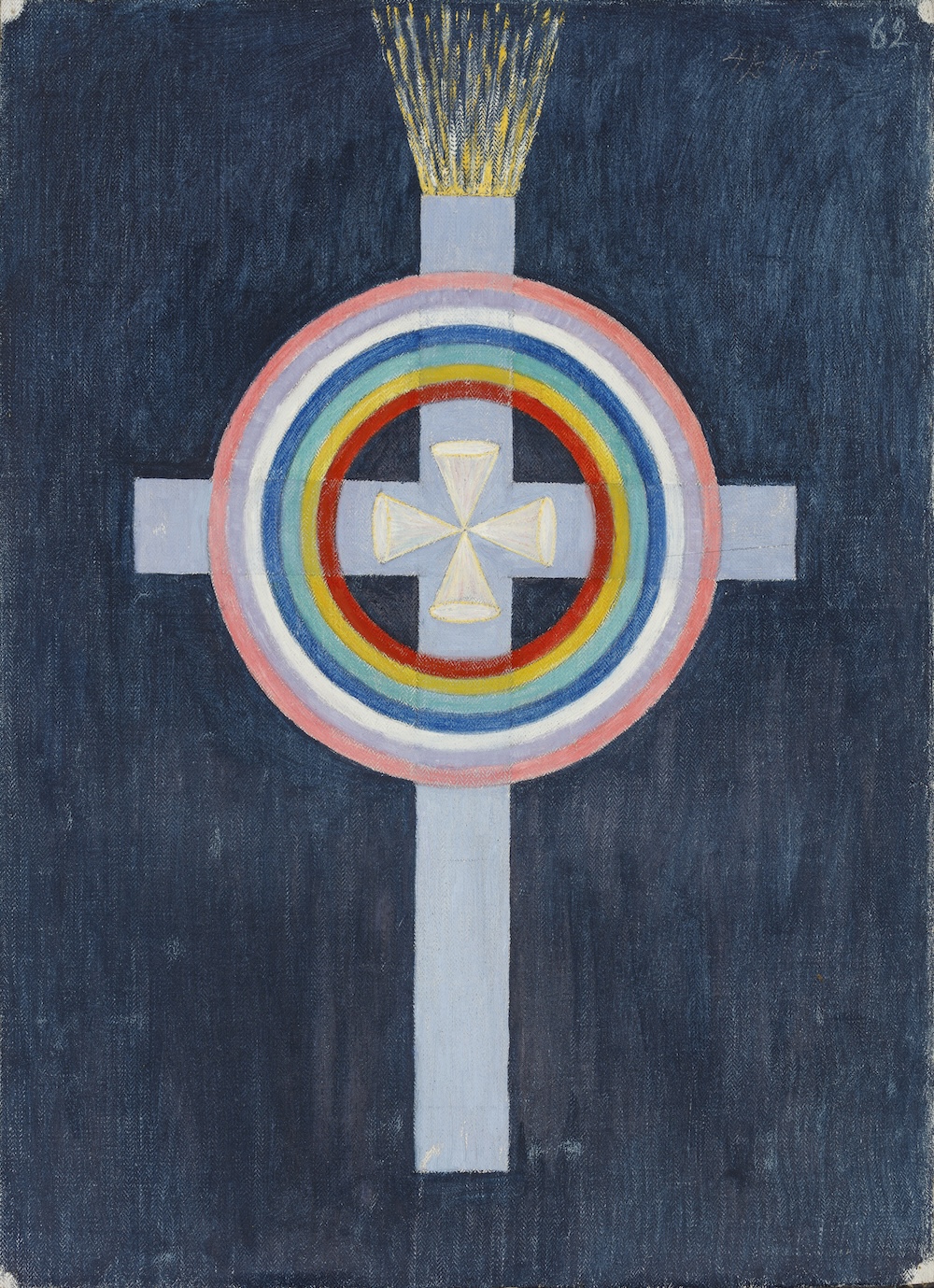
Anna Cassel, Untitled II, No. 62, 1915
Opening at the Ateneum Art Museum, part of the Finnish National Gallery in Helsinki, the exhibition features painting, sculpture, textiles, ceramics, tempera, stained glass, mosaic, video, and archival materials. It brings together internationally recognised figures alongside historically overlooked artists, including Hilma af Klint, Anna-Eva Bergman, Anna Cassel, Maja Fjaestad, Ilona Harima, Iria Leino, Sonja Ferlov Mancoba, Outi Pieski and Ellen Thesleff. Continuing Ateneum’s ongoing commitment to reappraising and platforming women artists, ‘Arcana Borealis’ is co-curated by Dr Nina Kokkinen (University of Turku) and Dr Marja Lahelma (Chief Curator, Ateneum) as part of a groundbreaking long-term research project.
“This exhibition challenges some of the most enduring narratives of modern art,” commented the exhibition co-curator Dr Marja Lahelma. “By bringing these artists together, we reveal how spirituality, collaboration and women’s artistic networks played a far more significant role in the development of modernism than has previously been acknowledged.”
Rather than presenting the Nordic region through national frameworks, ‘Arcana Borealis’ approaches ‘the North’ as a cross-border cultural and imaginative space shaped by mythology and spiritual traditions. It traces how artists across Finland, Sweden, Denmark, Norway, Iceland and Sápmi turned to esotericism, alternative cosmologies, meditation and mediumistic practices to explore questions of existence, creativity and belonging.
The exhibition also challenges art-historical narratives that have privileged the myth of the lone artistic genius, instead foregrounding practices rooted in collaboration and spiritual communities. In this context, Hilma af Klint – long celebrated as a pioneer of abstraction – is presented within the wider network of women artists and spiritual practitioners, including Anna Cassel, with whom she worked, offering a richer and more collective account of how modernism took shape.
Themes include spirit and matter, communication with invisible worlds and other-than-human agents, communal ritual and living in harmony with nature. Works such as Tyra Kleen’s ‘The Reaper’ (1909) and Ellen Thesleff’s ‘Star’ (1915) explore aspirations toward higher spiritual realms alongside meditations on mortality and the unknown. Else Alfelt’s ‘Flower of the Universe No. 13’ (1966) and Helene Schjerfbeck’s ‘Self-Portrait with Red Spot’ (1944) examine expanded consciousness and the boundaries of the self, while Anna-Eva Bergman’s ‘No. 2-1953 Stele with Moon’ (1953) reflects esoteric ideas of the cosmos as an interconnected living whole.
For many of the artists in ‘Arcana Borealis’, art was not simply a means of representation but a spiritual practice: a way of accessing hidden realities, cultivating inner transformation and imagining alternative forms of community. Unlike Surrealism’s emphasis on the individual unconscious, many of the artists in the exhibition understood artistic practice as a means of accessing a universal or cosmic consciousness extending beyond the self. The exhibition reflects on how many of these practices emerged during periods of profound social and political change. More than a century later, amid ecological anxiety, political instability and growing disillusionment with conventional ideas of progress, ‘Arcana Borealis’ draws parallels with our renewed interest in spirituality and alternative belief systems.
An innovative exhibition at Laing Art Gallery explores the connections between Pre-Raphaelite art and poetry for the first time. Though they are synonymous with taking inspiration from medieval and early Renaissance visual art, the Pre-Raphaelites were also hugely influenced by literature, ranging from Dante Alighieri (1265-1321) and Geoffrey Chaucer (c.1343-1400) to John Keats (1795-1821) and that giant of Victorian poetry, Alfred, Lord Tennyson (1809-1892).
Uniquely exploring these connections between Pre-Raphaelite art and poetry, ‘Pre-Raphaelites: Art and Poetry’ features over 100 masterpiece paintings, drawings and objects by luminaries of the movement (founded in 1848) by artists such as William Holman Hunt (1827-1910), John Everett Millais (1829-1896), Edward Burne-Jones (1833-1898), Arthur Hughes (1832-1915), and the influential poet-painter Dante Gabriel Rossetti (1828-1882) and poet and designer William Morris (1834-1896). The emphasis on contemporary female artists and poets, including Elizabeth Siddall (1829-1862), Kate Bunce (1856-1927), and Julia Margaret Cameron (1815-1879), is also a key aspect of this extraordinary show.
The exhibition follows three distinct themes; ‘Poems Past’, ‘Romantic Rhymes and ‘Victorian Visions’. The show opens with a section exploring the importance of poetry within Pre-Raphaelitism. Here visitors will be able to see a copy of the Pre-Raphaelite Brotherhood’s own illustrated publication, ‘The Germ’ (also titled ‘Art and Poetry’), in which they published their own poetry and prose alongside close associates including the poet Christina Rossetti (1830-1894).
The connection between visual art and poetry is then developed in ‘Poems Past’. Here, the curators explore how the Pre-Raphaelites engaged with early literature as subject matter for visual works, from the poetry of the classical world to 16th-century works by writers such as William Shakespeare (1564-1616). This section includes a grouping of artworks that each relate in some way to Dante, who strongly influenced his namesake Dante Gabriel Rossetti. ‘Poems Past’ also draws attention to the strong influence Chaucer had on Burne-Jones, Morris and the influential book illustrator and designer, Walter Crane (1845-1915).
‘Romantic Rhymes’ presents works inspired by 17th-century poetry before revealing the great importance of the ‘Romantic’ period (late 1700s to mid-1800s) on Pre-Raphaelitism. One of the figures in this display is the great Scots poet, Robert Burns (1759-1796), who worked on the cusp of Romanticism. Another central figure is Keats, whose poems proved a favourite subject for Pre-Raphaelite paintings at the movement’s beginning and in later decades.
The exhibition concludes with ‘Victorian Visions’, which looks at how the Pre-Raphaelites engaged with the poetry of their own time. It is the largest section, reflecting the importance of this literary form to the artists. Here we see how artists found inspiration in the poetry of Elizabeth Barrett Browning (1806-1861), Robert Browning (1812-1889) and the celebrated Pre-Raphaelite poet, Christina Rossetti, whose poem ‘Goblin Market’ and book ‘Sing-Song: A Nursery Rhyme Book’ both figure in the exhibition. It was Tennyson, though, whose poetry inspired the most Pre-Raphaelite art, and the exhibition sets out how Tennyson’s verses particularly chimed with Pre-Raphaelitism.
Seeking to give a wider context and visually demonstrate the interconnections between fine and decorative art and the written word through innovative arrangements, the exhibition explains how this relationship endured and evolved throughout the Victorian era. Indeed, fine and decorative art was interwoven throughout this period, with many artists working in a range of media using the same poetic sources to inspire their work. As a result, embroidery, metalwork, stained glass, tapestry, illuminated manuscripts and books, in addition to paintings, drawings, prints and photographs, are showcased in this rich show, with often overlooked designers such as Fanny Bunn (1871-1950) and Phoebe Anna Traquair (1852-1936) now given much-deserved, fresh attention.
Julie Milne, Chief Curator of Art Galleries, says: “Art and poetry have always been closely entwined, inspiring the creation of two of the most important paintings in the Laing Art Gallery’s collection. For the first time, this unique exhibition brings together these works and other key Pre-Raphaelite paintings and decorative arts from UK-wide collections. Through set piece arrangements the exhibition will explore this enriching connection which we hope will prove to be both insightful and thought provoking.”
Finally, a brief mention for Museum of the Environment, a new community-led cultural and creative space in the heart of Ipswich. ‘Planned Obsolescence: Tristan Burfield, Hannah Ayres, Liza Read & Michael Ridge‘ has photography, installation, recycled materials, interactive sculpture, noise machines and obsolete technology — all asking us to look twice at what we throw away.
‘Anthony Lawrence | A Practical Guide to Aesthetics’, 15 – 23 October 2026, St John’s Waterloo – Visit Here
‘Peter Howson: Salvation’, 10 September – 10 October 2026, Flowers Gallery – Visit Here
‘The Call of the Visual Poet: Visionary Drawings & Prints’, 15 September – 29 October 2026, Brian Oliver Gallery, Whitworth University, 300 W. Hawthorne Road, Spokane, WA 99251 – Visit Here
‘Still Activity’, 28 September – 31 October 2026, Manchester Cathedral – Visit Here
‘One and All: Adam Belt’, 4 September – 29 November 2026, Parsonage Gallery – Visit Here
‘Mimmo Paladino: Present into Past’, 1 September – 13 December 2026, Raclin Murphy Museum of Art, University of Notre Dame
Notre Dame, IN 46556 USA – Visit Here
‘Antony Gormley: Where’, 14 October – 23 December 2026, Christea Roberts Gallery – Visit Here
‘Raquib Shaw: Night Sonnets’, 19 September 2026 – 21 February 2027, Compton Verney – Visit Here
‘Michaela Yearwood-Dan: The Practice of Liberation’, 7 April – 18 October 2026, Whitworth Gallery – Visit Here
‘Hilma af Klint: Artist and Visionary’, 15 October 2026 – 7 February 2027, National Gallery of Ireland – Visit Here
Paul Heber-Percy: Last House Before The Far-Off’, 7 – 24 October 2026, England & Co – Visit Here
‘Rachel Feinstein: Fates’, 24 September 2026 – 9 January 2027, Gagosian, Athens – Visit Here
‘Liz Larner: A hard line to bend’, 11 September 2026 – 17 January 2027, Camden Arts Centre – Visit Here
‘Rita Ackermann. The Chemical Alphabet’, 9 September – 17 October 2026, Hauser & Wirth New York – Visit Here
‘A New Life Force’, 10 October 2026 – 31 January 2027, MICAS – Visit Here
‘Arcana Borealis – Northern Women and Esotericism’, 23 October 2026 – 28 February 2027, Ateneum Art Museum, Finnish National Gallery – Visit Here
‘Pre-Raphaelites: Art and Poetry’, 17 October 2026 – 13 February 2027, Laing Art Gallery – Visit Here
‘Planned Obsolescence: Tristan Burfield, Hannah Ayres, Liza Read & Michael Ridge’, 1 – 31 October 2026, Museum of the Environment – Visit Here