
It starts and ends with footwear. In the first room is Sarah Lucas’s 1-123-123-12-12 (1992), a pair of Dr Martens boots with razor blade-filled toecaps placed on a plinth, versus the velvet slipper midair in Yinka Shonibare’s The Swing (after Fragonard) (2001) in the final room. Perhaps a fitting beginning and conclusion to the exhibition The 90s: Art and Fashion at Tate Britain, which aims to define that decade, one bookended by Thatcher’s resignation and the apprehension of Y2K.
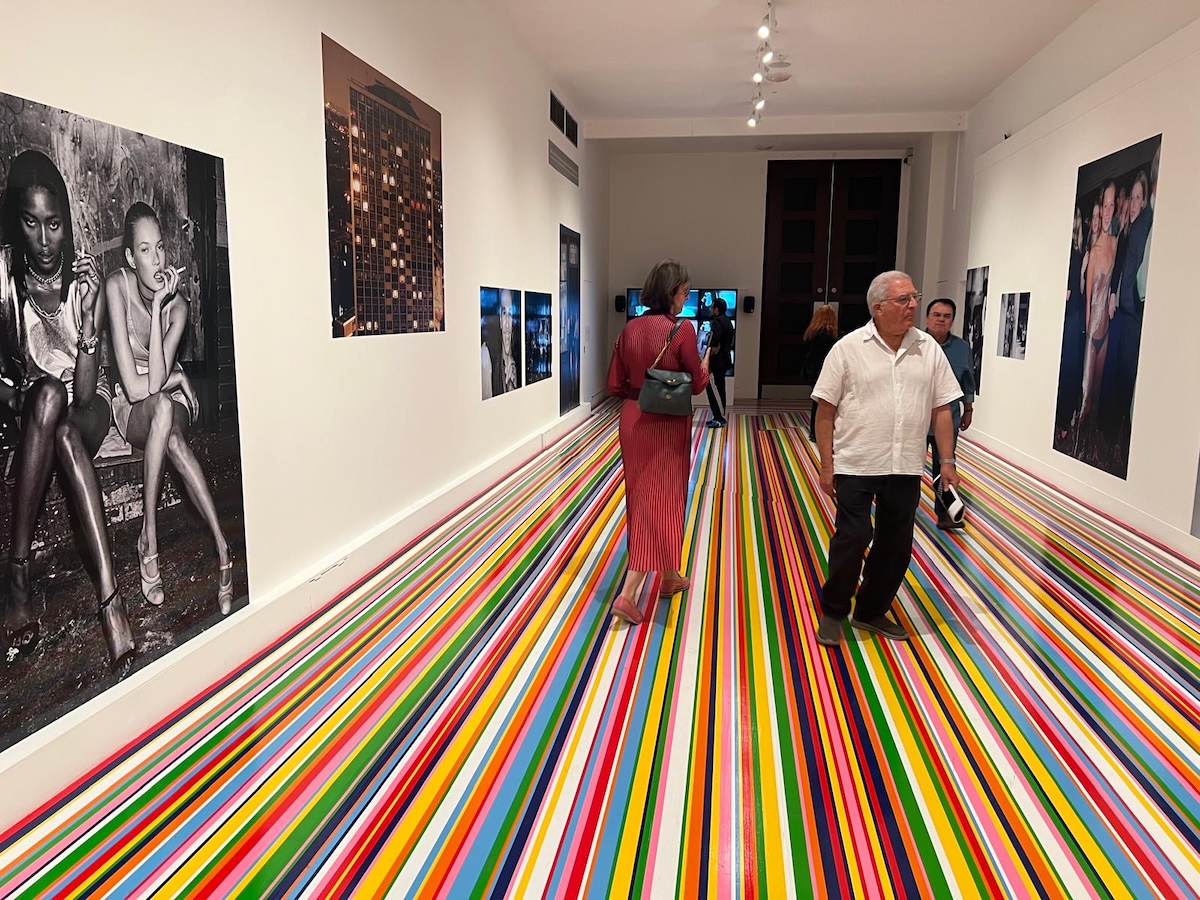
It’s a huge challenge and tricky to define a decade by its art and fashion. Much easier with an artistic movement, a specific place or person – the recent Blitz Club focus at the Design Museum or fashion house presentations at the V&A, for example. And to satisfy everyone’s personal memories of the past is nigh impossible. The misleading preface of the antechamber room, the “zig-a-zig-ah” of its multicoloured floor entitled Zobop (1999) by Jim Lambie, contains a bank of TV monitors playing Sinéad O’Connor and the Spice Girls and more, blown-up photographs on the wall including Sarah Lucas with Chris Ofili at The Atlantic, Tracey Emin and Sarah Lucas in a doorway, Kate Moss in a transparent dress, Goldie, Kate and Naomi smoking…but through the gallery doors everything is quite stark, rooms painted white or black.
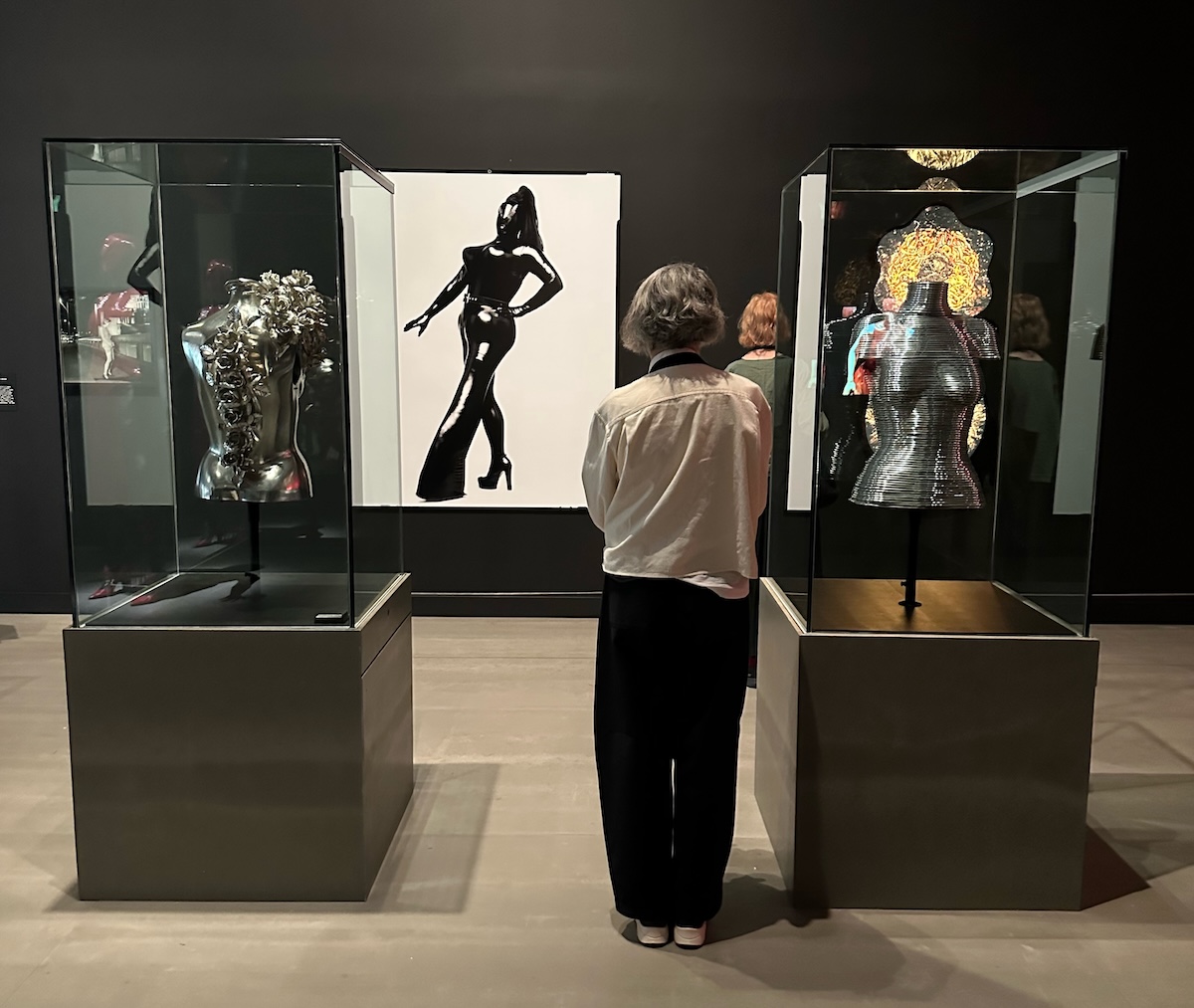
The 90s Art and Fashion,Tate Britain, installation view
The antithesis of 80s ‘perfect’ supermodels, Kate Moss emerged with her imperfections and minimal style, here seen throughout the exhibition in familiar photographs by Corinne Day and Juergen Teller versus Gary Hume’s powerful Kate (1996), painted on aluminium, her face becoming a blank anonymous mirror. Naomi Campbell is depicted shaving her legs, splayed on a toilet seat, in a 1994 photograph by Ellen Van Unwerth for a Babywoman album cover.
In the first room, Kate Moss is photographed in a barely-there skimpy nothing dress, Stella McCartney’s flimsy, gauzy shift hanging high in the doorway to the next room. A kind of anti-fashion versus the high fashion seen further on in the formality of some of Alexander McQueen’s pieces, the rigid metal armour, the high performance of it all. But there’s no sportswear, no khaki parkas, tracksuits or sneakers, or the casual wear of the clubs. Sharp suits by Joe Casely-Hayford and Ozwald Boateng are displayed, as are monitors playing highly performative and dramatic runway shows. In the final room, the rococo opulence and tartans of Vivienne Westwood and John Galliano’s dramatic and theatrical pieces can be seen.
Photography features strongly throughout the exhibition as it not only documented the times for magazines such as Dazed and Confused, i-D, and The Face, but also the counterculture of the clubs, queer nightlife and all-nighters. Taking place in warehouses and disused spaces as well as small clubs, before the advent of the smartphone and social media gave us Google Maps and cameras in the palm of your hand, listening to music on Walkmans. DJs mixed sounds and sampled to keep the dancing going, while photographers documented the clubs, nightlife, and subcultures of the day. Room 3 is the clubbing room showcasing these images, including Tim Smith’s photos from Bradford of British Asians enjoying Bhangra; Normski’s images highlighting the jungle, drum and bass, and hip-hop scenes; Mark McNulty’s queer club nightlife; and Mischa Haller’s image of girls outside a Gap store.
Perhaps surprisingly, there’s no soundtrack running through the gallery spaces, though in the clubbing room you can download a Spotify playlist selected by the photographers. It’s like a silent disco in your own head and enhances the experience, putting a different perspective on the entire exhibition.
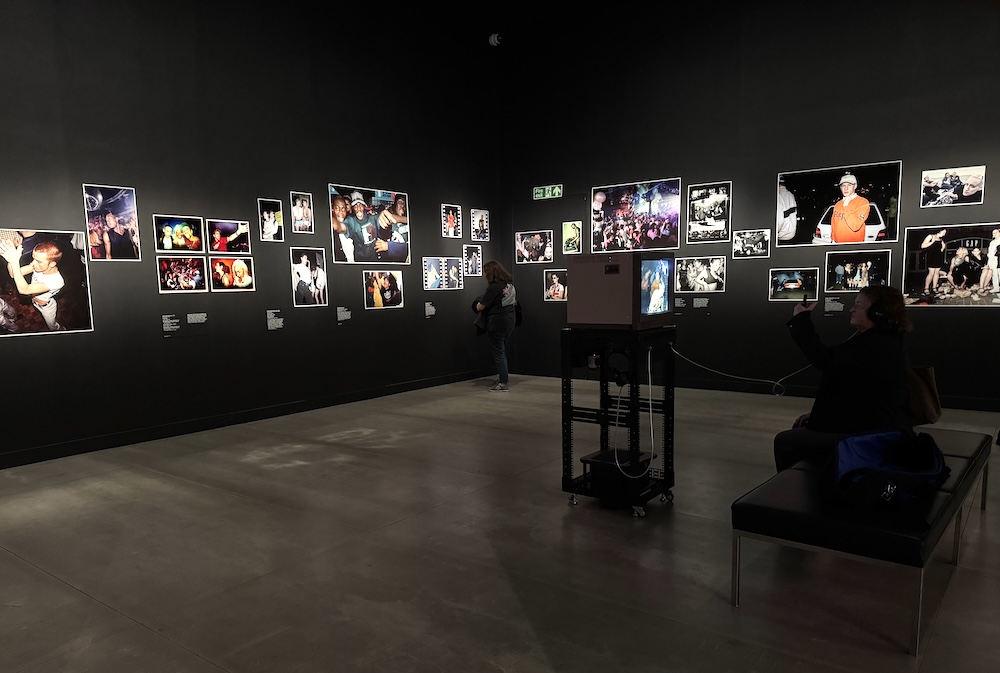
The 90s Art and Fashion, Tate Britain, installation view
Combining the art and fashion of a specific decade is a big undertaking, and at times it feels overstuffed and a mixed bag. Perhaps the singular vision of Edward Enninful is too ambitious, but combined with a number of Tate curators, possibly there are too many cooks to define the era. There are some gems though – Barbara Walker’s portrait of her daughter barely awake, Attitude (1998), in the first room stands out against the photos and magazine spreads, as does Gillian Wearing’s film Dancing in Peckham (1994). Donald Rodney’s In the House of My Father (1996-7), depicting his poignant house made from his own skin in the palm of his hand is heartbreaking, and Sonia Boyce’s Black Female Hairstyles (1995) in the last room pops. You could miss what I felt was the beating heart of the exhibition, just off Room 6 – Steve McQueen’s first film Bear (1993), a silent, black and white film 10 minutes and 35 seconds long, focusing on two faces. It’s tender, poignant and affecting.
The decadence of the decade can be summed up in the frivolity and fin-de-siècle vibe of the final room. In Yinka Shonibare’s The Swing (After Fragonard) (2001), the mannequin-like figure on the swing kicks off her left slipper, which is thrown up into the air, out of the door, exiting the exhibition and veering towards the next century. It’s in stark contrast to the gritty realism of the first room. Tate Modern was about to open its huge new space in 2000, and the future looked bright.
The 90s: Art and Fashion,Tate Britain, 8 October 2026 – 28 February 2027
Visit Here