
The British public has long held a fascination with the Bloomsbury group and their particular form of English eccentricity: the gender bending, the same sex relationships often with an incestuous edge, the entangled social and sexual web that enmeshed the artistic, intellectual and social movers and shakers of their day. Unlike that other set almost a century earlier, the Pre-Raphaelites, who looked back to a fabricated golden age of Medievalism, the Bloomsbury Group preferred the modern and the avant-garde; a reaction against the prim constraints of 19th-century Victorian life and art. As with the Pre-Raphaelites, there have been numerous books and films about them, satisfying the English middle classes’ prurience with a titillating soap opera of painting and promiscuity that has continued to define a certain privileged English bohemianism ever since.
Never a movement in any organised sense, their life and work are seen in this new Tate Britain exhibition through the lens of Vanessa Bell and Duncan Grant. The pair first met in London when Duncan moved to Fitzroy Square and spent time with the Stephen sisters, Vanessa and Virginia, becoming an established part of the loose group of writers, artists and thinkers. In 1909 Vanessa wrote: ‘Dear Duncan, May I call you so & will you call me Vanessa? It seems rather absurd to begin with Dear Mr Grant’. The two were to go on to live and work together for five decades at Charleston, a rambling farmhouse in East Sussex, in an unconventional relationship that rejected not only the usual delineations of sexual fidelity but the distinctions between Fine and Decorative Art. A major catalyst in this development was Roger Fry’s exhibition Manet and the Post-Impressionists, which led to experimentation with ‘significant form’, exemplified in Vanessa’s painting Studland Beach c1912, an expressionist response to the broad sands with their acute angles and yellow blocks, rather than a depiction of reality.
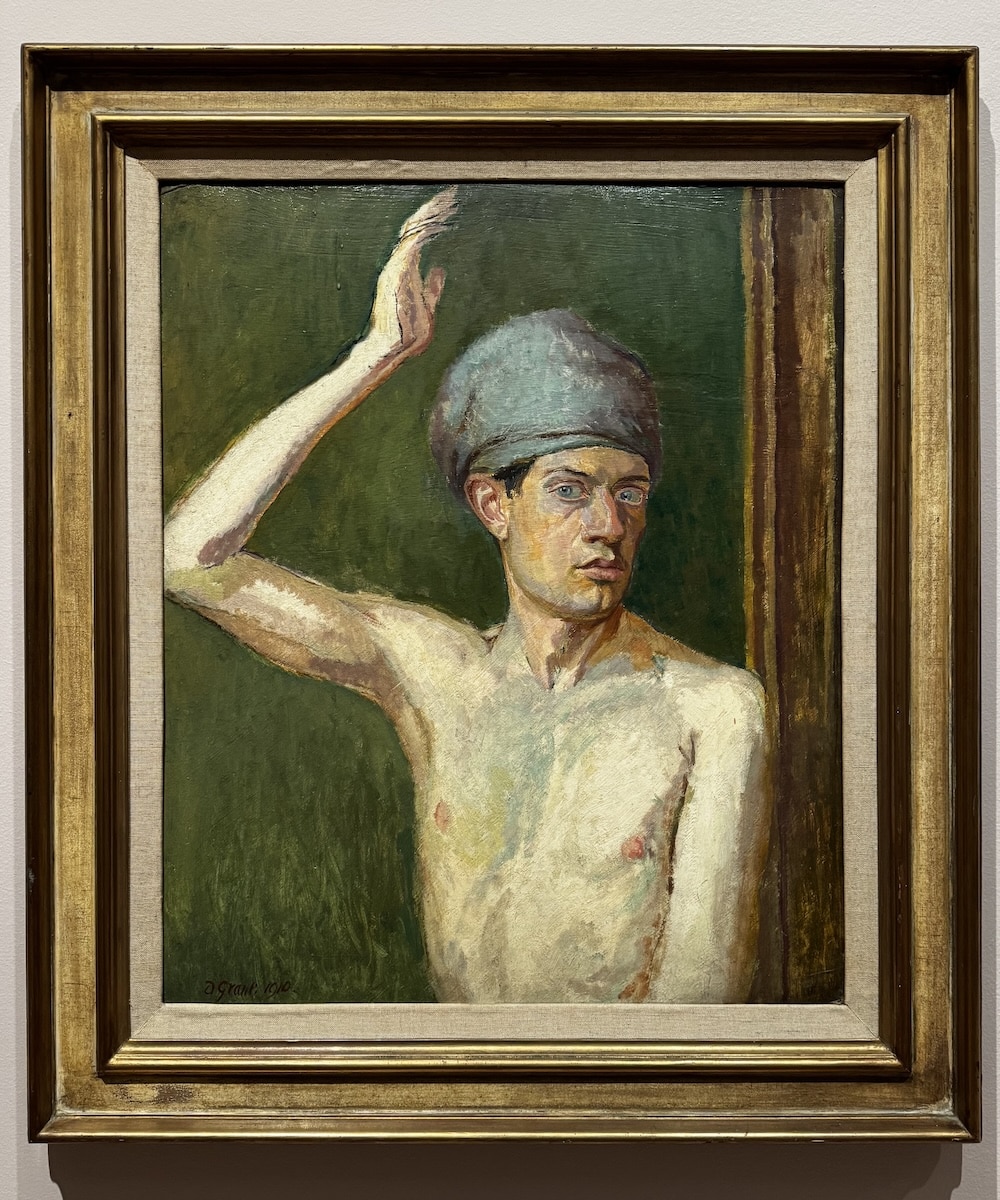
Duncan Grant, Study for Composition: Self-Portrait with a Turban, 1910
Near the beginning of the exhibition is Vanessa’s painting of Duncan posing in front of a mirror recovering from a cold. It was done in West Wittering, West Sussex, when she and Duncan first moved there with his lover David ‘Bunny’ Garnett at the outbreak of the First World War. Nearby, Duncan stands with one arm above his head, wearing a blue turban that matches the blue of his eyes. This bare-chested, implicitly queer image challenges conventional ideas about masculinity, flagging up the sexually fluid relationships between the group. Nearby, in a self-portrait, Vanessa stares out at the viewer (her sister, Virginia Woolf, would base her character Lily Briscoe in To The Lighthouse on Vanessa – an artist who struggled with her confidence after hearing that ‘women can’t paint, women can’t write’). The slabs of experimental colour highlight her sensibility towards contemporary European art. She and Duncan had met Matisse, along with Picasso and André Derain, while they were staying in Paris, and these encounters would have a profound effect on their work. Two paintings of tents raised, no doubt in the garden, show a growing move towards modern abstraction and the use of expressive colour. But while Duncan’s painting The Artist’s Camp, 1913, is still essentially a realist study, Vanessa’s much looser and expressionistic work, Summer Camp, painted in the same year, indicates that she would become the more innovative painter of the two.
Throughout the exhibition there are portraits of their friends, the critic Roger Fry, the socialite Lady Ottoline Morell, the moon-faced Iris Tree, a nude David Garnett, and the camp thinker, Lytton Strachey. Many were cousins, lovers or related by marriage. It was a small, tight social coterie. They may have lived a simple, bohemian life, but all of them had, as Virginia Woolf suggested, a woman writer needed in order to be creative, ‘a room of their own and at least two hundred pounds a year.’ They were members of the privileged upper-middle elite who, despite their fluid lifestyles, still had cooks and housekeepers to attend to their daily needs that allowed them to concentrate full time on their art and sexual needs.
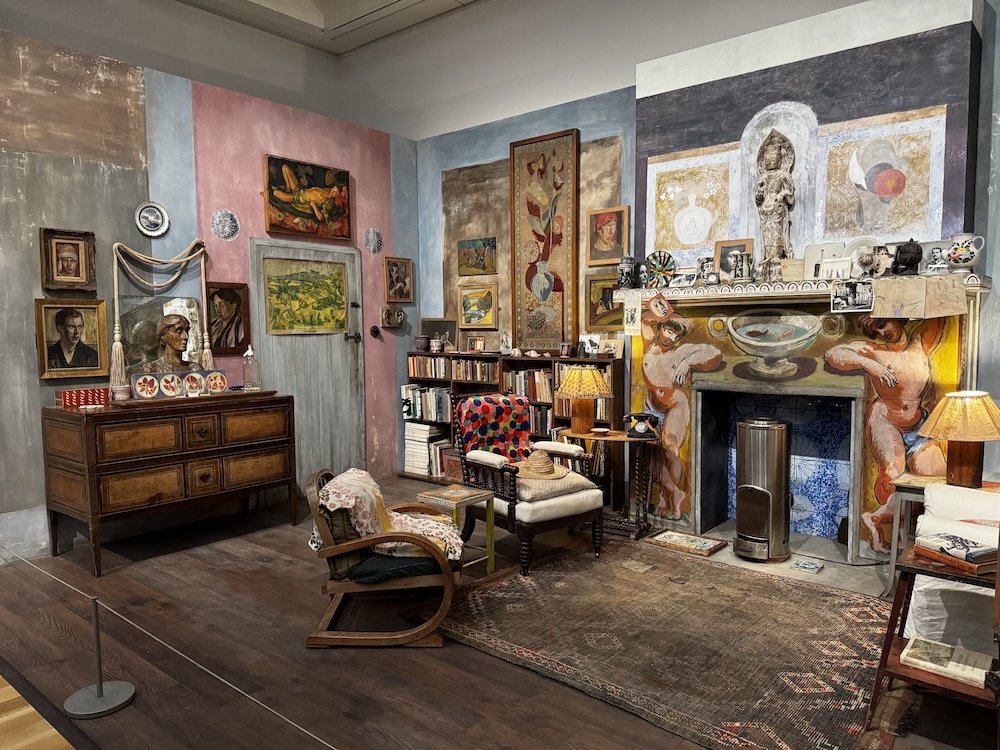
A recreation of Vanessa Bell’s studio at Charleston, the Bloomsbury Group’s country headquarters in Sussex, at Tate Britain
The walls and furniture of Charleston provided endless blank surfaces to decorate. Pottery, chests and cupboards, as well as fabrics, were covered in their distinctive designs that melded flowing Arts and Crafts lines with a more angular modernism. Nowhere was this approach more apparent than in the goods produced for the Omega workshop. For Roger Fry, the picture frame represented a barrier, both emotional and actual, a delineation between art and craft to the detriment of both. His aim was for the Omega Workshops to forge a symbiotic relationship between Fine Art and domestic crafts.
Although Vanessa knew Duncan was gay and accepted that fact, despite their having a daughter, Angelica, in common, he kept large areas of his life from her. Between 1946 and 1959 he produced over 500 erotic drawings depicting acts between two, three or more men that hover on the edge of art and pornography. Kept secret for many years, they may suggest lived experience – a black lover, for example – or simply be erotic fantasies around the male body. Certainly he found being gay a strain a lot of the time, saying ‘you can’t imagine how much I want to scream sometimes’, an emotion, made more complicated because of his real devotion to Vanessa.
It has, in certain circles, become fashionable to be ‘down’ on the Bloomsbury Group for being privileged and amateurish. The English distrust the intellectual and the self-consciously artistic. Certainly some of their early paintings, such as Bell’s Apples 46 Gordon Square 1908-9 and Grant’s full-length 1908 full-length portrait of John Maynard Keynes, are painted in the muted duns and browns that defined much British painting of the period, the sort of colour sensibility of the early London Group, untouched by the colour experiments of European Modernism.
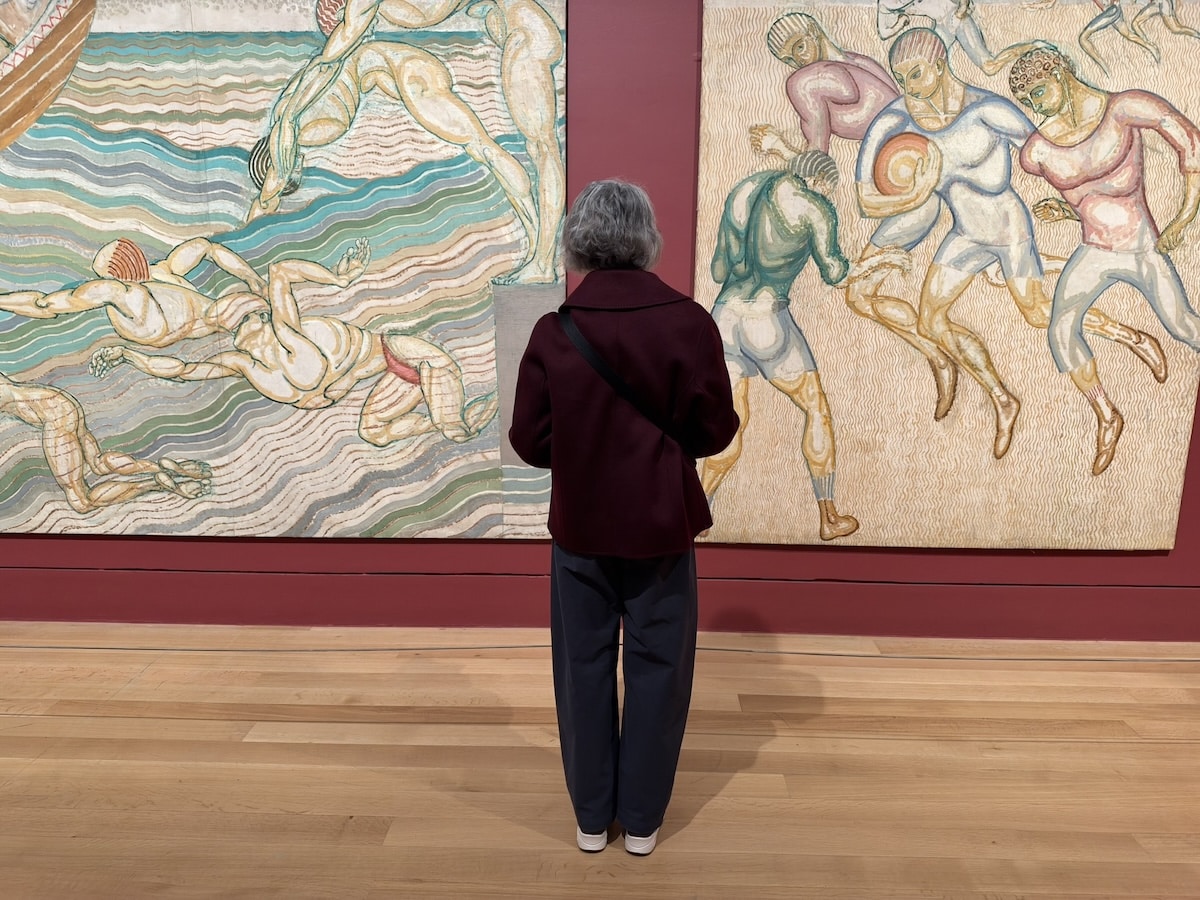
But Duncan Grant and Vanessa Bell’s relationship defies easy categorisation. They were lovers but mostly friends, their friendship defined by a shared creativity, and extended family. Not all their work is good, though there are some memorable paintings: Vanessa’s Matisse-inspired Interior with a Table, 1921, and Duncan’s iconic homo-erotic Art Deco-style swimmers in Bathing, 1911. Mostly, though, they challenged definitions of what a relationship should be, whilst insisting that art did not belong only in academies, galleries and studios, but rather could be woven into the fabric of daily life.
Vanessa Bell & Duncan Grant: Inside Bloomsbury, Tate Britain, 12 November 2026 – 11 April 2027
Visit Here
Sue Hubbard’s latest novel Flatlands (‘a tender portrait of wartime youth’ The Guardian) is published by Pushkin Press: https://pushkinpress.com/books/flatlands/
Her new collection of poetry God’s Little Artist: poems on the life of Gwen John is published by Seren Books: https://www.serenbooks.com/book/gods-little-artist/