
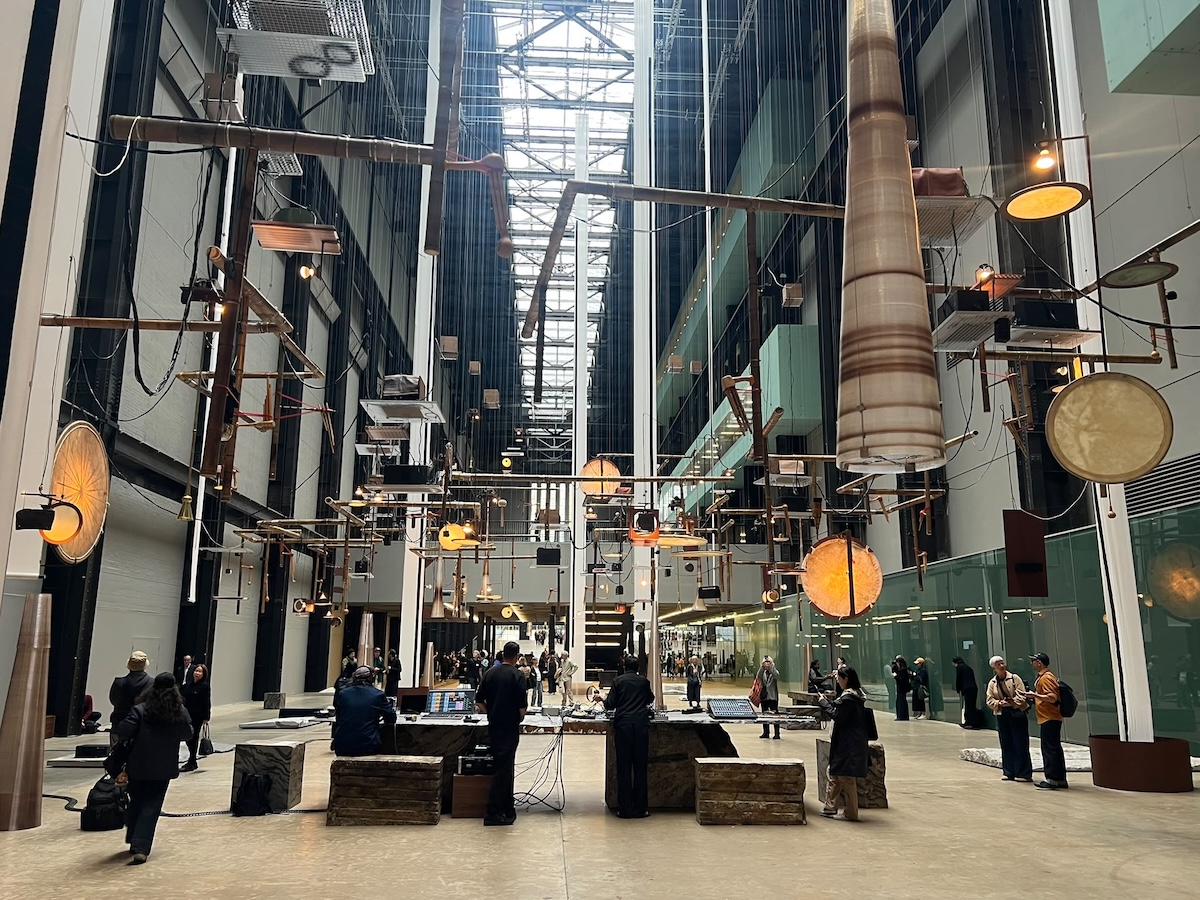
Tate Modern’s Turbine Hall is a perfect venue for sound art. It is cavernous, echoing, and filled all day with noisy day-trippers and overstimulated schoolkids. From 13 October, the Lebanese artist and composer Tarek Atoui will try to turn it into an orchestra as part of the eleventh Hyundai Commission, which runs until 11 April 2027.
Atoui says he is not “too worried” about the room. His work has never been about the ideal execution of a finished piece of music. It is about giving a stage to the process, and the unpredictable noise of a public space is, on that logic, more material. He cannot yet say what the commission looks like, only that it will be one of his “places for listening and playing” and the latest stage in a long move away from concert halls, “on to the street and into the market”. The museum describes the piece as a way of connecting earth and sky, drawing on the hall’s volumes and acoustics through sound, sculpture and technology.
Tarek Atoui
The approach comes from his own history. Atoui left Lebanon to study experimental music in France and fell under the spell of Iannis Xenakis and György Ligeti. But he did not want the treadmill of albums and touring. He wanted to travel, meet people and learn from them, and a model for that was Fluxus, the 1960s network of artists and musicians shaped by John Cage. His career since reads as a map of encounters: Korean drum-makers, and Palestinian children in refugee camps, for whom he developed software that composes sound through PlayStation joysticks.
The most transformative meeting may have been with students at the Amal School for the Deaf in Sharjah. Workshops there began with bass speakers playing frequencies so low the body registers them. “I learned from working with deaf people that there is more than one way of hearing,” he says. Every space, in his view, holds several overlapping worlds of sound, shaped by the density of your skull, your mood, even what you happen to be paying attention to.
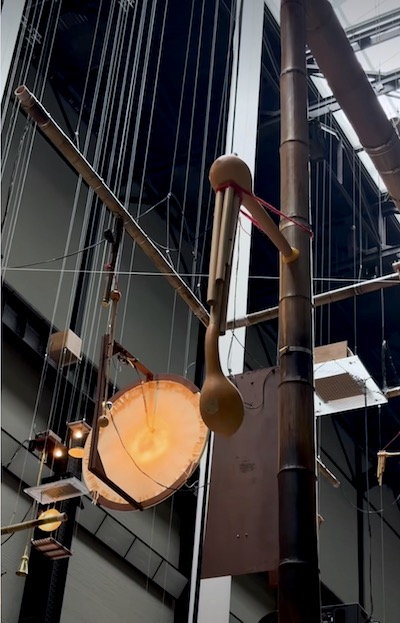
Past exhibitions have looked like recording studios caught mid-improvisation. There have been tentacular wind organs, wires snaking from synthesisers, a glass booth that functions as a walk-in flute, marble boulders emitting woozy pulses, and microphones that feed visitors’ footsteps back into the music. The instruments are made in collaboration and double as sculpture, so when nobody is playing, they can be viewed for their craftsmanship. During workshops and improvisation sessions, the space becomes more like a concert hall or classroom.
His recent projects show the range. At Kunsthaus Bregenz in 2024 and in Milan more recently, visitors could stay five minutes or an afternoon, sit still or wander through a crowd of sounds. Waters’ Witness records the ambient noise of the seas around harbour cities from Istanbul to Sharjah.
Athens, near the site of the Battle of Salamis, is quiet now, he says, while Singapore’s marina is thick with underwater explosions, military exercises and shipping. It places him near Lawrence Abu Hamdan, the joint 2019 Turner Prize winner, who also treats sound as a record of hidden history.
The audience, Atoui insists, is his most important collaborator. He does not try to anticipate or determine what a visitor experiences. Hearing cannot be separated from the other senses, and what you see and feel in the room matters as much as what you hear. “I want to encourage people to play in their own lives,” he says, and everything in his own life, every place and conversation, finds its way into the work.
The commission is the latest in a series that Hyundai Motor says has drawn more than 19 million visitors over the past decade.
Tarek Atoui’s Hyundai Commission, Tate Modern Turbine Hall, London, from 12 October until 11 April 2027
Lead photo: Tarek Atoui, Hyundai Commission 2026, Turbine Hall Tate Modern photo: Miranda Carroll