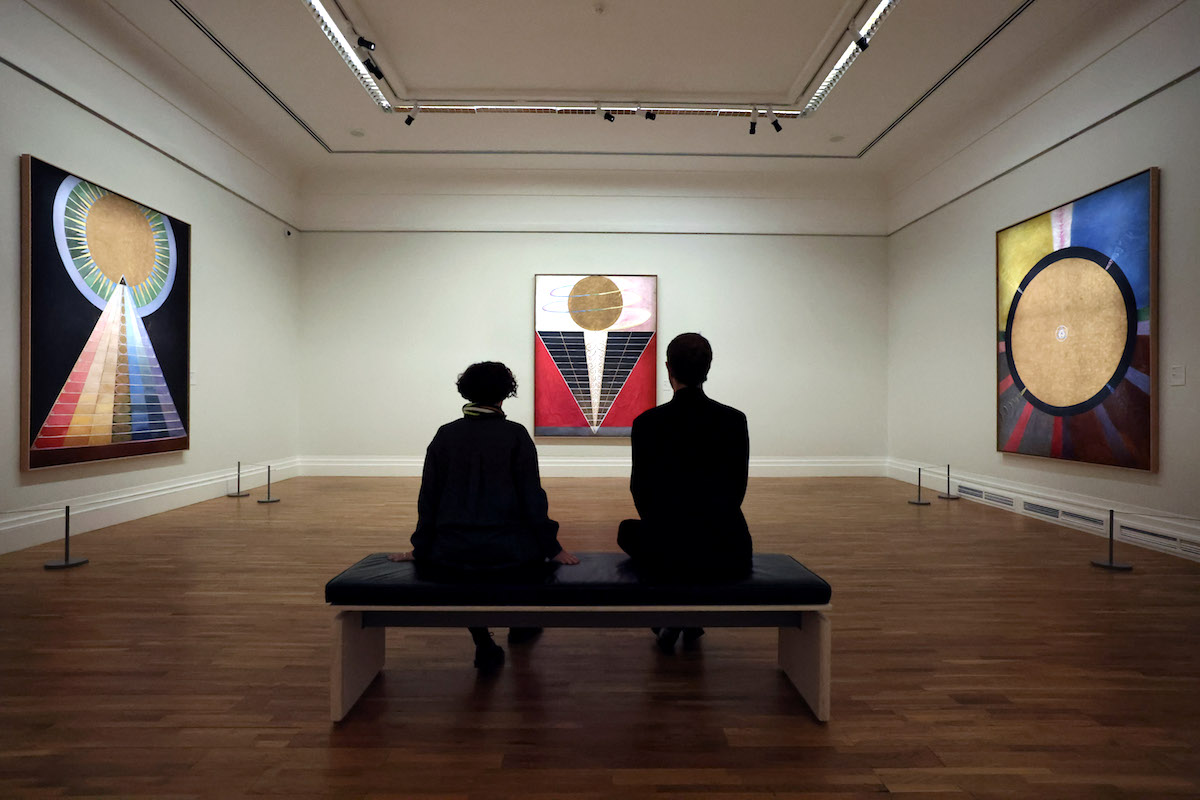
Whilst Frieze opens in London this week, there is also the major draw of Hilma af Klint at the National Gallery Ireland, but why? What has a Swedish female spiritual artist (1882-1944) got to do with Ireland, apart from the European connection? Does there need to be? No, but there is subconsciously anyway. Immerse yourself on a sunny day in Dublin. The magic of this incredibly vibrant city of Yeats and Joyce, Wilde, Beckett and O’Brien seeps into your consciousness when you walk past a builder’s hoarding. It states – the heaven tree of stars hung with humid night blue fruit, a quote from Ulysses; you know this is the right place for Hilma af Klint’s work, a spiritual home even if she never visited. And if she didn’t read WB Yeats’s poetry, I would be surprised, for they were belief bedfellows, of the Golden Dawn and Theosophists.
Ireland, mystical island of magic and fairytales, and though Hilma was a celebrated, trained landscape and portrait artist, she got into the Theosophy movement of Madame Blavatsky via Spiritualism and Rudolf Steiner; it was all the rage in those days, post the slaughters of the Balkan wars of the late 1800’s and the coming of Modernism. By 1906, Hilma was transferring mystical geometry, science, and colour theory, as shown in the book of one-time President of the Theosophists, Annie Besant, Thoughtforms (abstract visual manifestations of vibrations, thoughts, and feelings, pub in 1902), and the spirit world into her work.
Hilma said a spirit guide commissioned her to make a message for humanity from birth to old age. She called these the Temple paintings, and on her death she said these were not to be shown for at least twenty years. Then they should be in a spiral gallery ascending to the heavens; unfortunately, it took a bit longer than 20 years because The Guggenheim, a spiral gallery in New York, wasn’t able to do her first major show until 2018. Since then, her Foundation has been touring the work around the world, but there is so much of it that even though I saw the extensive exhibition at the Tate in 2023, it was not the same exhibition I saw at the National Gallery this week, which goes from first accomplished drawings into fizzing early landscapes that pull you in with their miraculous use of light and colour. In the next rooms are the Temple paintings. These large canvases are not meticulously painted but made quickly with vigour and vivid energy, of colour shapes and notations, a language if you have done your Theosophical and Golden Dawn homework, this pulls in Theosophy’s ancient Egyptian, Tibetan, Hindu Sanscrit and Greek philosophic threads together as I realised when I stumbled upon a displayed letter by Yeats with drawings explaining mans personality and the waxing and waning of the moon, that perfectly mirrors Hilma’s work, in the National Library in a wonderful exhibition of Yeats, with its partitions into rooms covering Yeats life, work, love and beliefs.
There is an argument in the art world, dating back to the 30s, about who made the first abstract work. Kandinsky claimed it was him in 1911; others say it was Mondrian, and still more that it was Hilma af Klint. The thing about zeitgeist is not who conceived the first abstract painting because, of course, that is ridiculous in the whole of history and the world, but why that was so much in the air, like a contagion all over the world in a time of letter writing when radio hadn’t even been invented. Yet, artists, writers, philosophers and psychotherapists were turning towards spiritual practise for answers. The same thing would recur in the 1960s with the Hippie movement’s turn towards Eastern mysticism; perhaps the popularity of Hilma’s work now shows a resurgence and a belief in the mystical power of nature, earth, and the profound feelings that it stirs within us simple humans as we look to the heavens upon a star-laden sky that can create such poetry from Joyce. Look upon, absorb, drink in, feel these paintings of colour, light, and shape, and then walk among the trees in Saint Stephen’s Green Square and wonder if you haven’t been touched by Irish magic or Swedish magic.
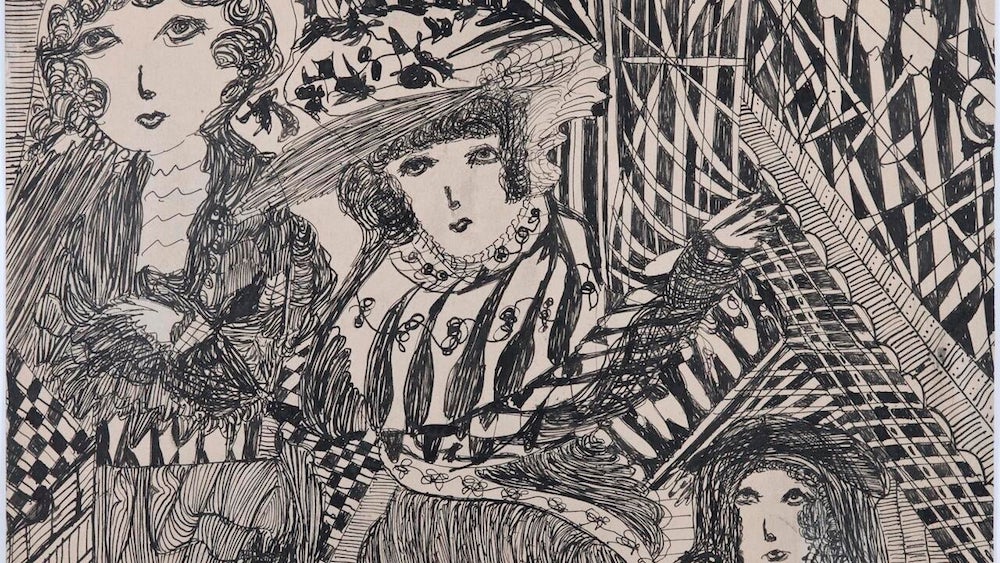
Madge Gill, Untitled, c.1950. Ink on card, 39 × 49 cm. Courtesy: The Gallery of Everything
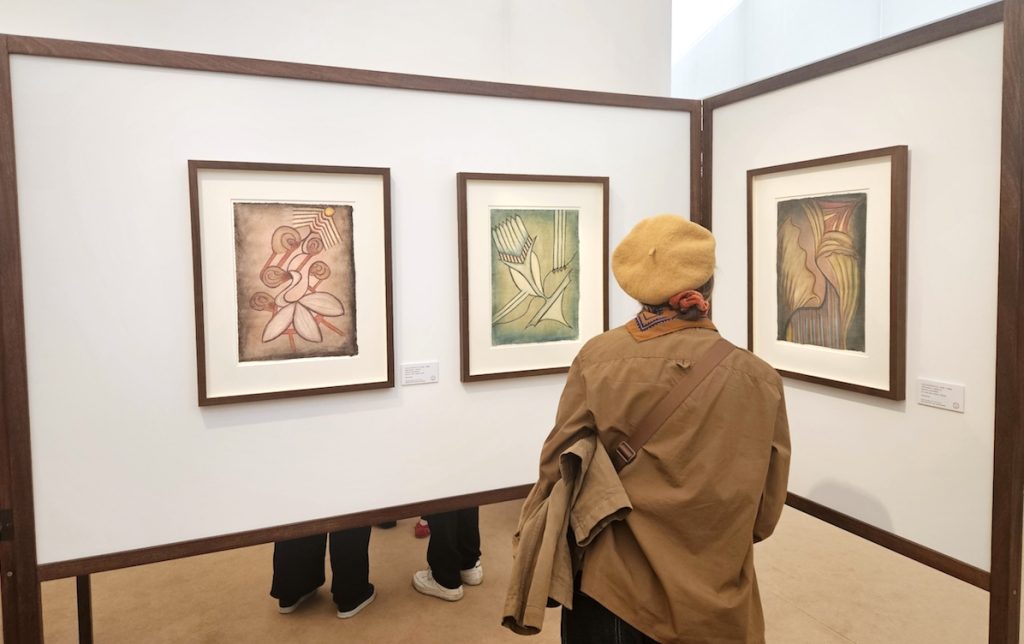
Transcendental: life as an illusion, a projection, a call to the inner voice and understanding is magic; creation is the act of transmutation. So what is the difference between spiritual art, outsider art, and modern art? The spirit that makes an artist create is different from an idea intellectually formalised onto canvas; the spirit, the feeling, the inner voice, as opposed to the mental construct; you can feel it when you look at work that transports you. The Gallery of Everything is always original in its championing; last year the magnificent Madge Gill, this year it’s Czech artist Anna Zemanova(1908-1986) echoes Hilma more quietly, the anatomically botanical, rhythmic, cell-like structures, both organic and calming with their repetitive lines and colours; unlike af Klint, these will not disturb. Is the difference because one was trained as a dentist, the other as an artist? And yet both their work comes from the spirit; does it differentiate? The figurative work of Leonor Fini (1907-1996) at Minsky gallery disturbs with its pale moon faces, drawing you into its witchy medieval world of women; Zemankova placates like pain relief, but I’d rather be with Hilma af Klint. It uplifts as it permeates and rearranges your cell structure, with an invisible charge of energy still vibrating from her magnificent work over 100 years later; there’s never been a better excuse to see the stars in Dublin.
Words/Photos Sophie Parkin © Artlyst 2026
Hilma af Klint at The National Gallery, Dublin. Until Feb 7th 2027
WB Yeats at The National Library, Dublin. Permanent installation.
Anna Zemenkova @The Gallery of Everything, Frieze Masters, London. Until Sunday
Leonore Fini @Minskygallery, Paris and Frieze Masters, London. Until Sunday.
Recommended reading
Notes and Methods by Hilma af Klint, published by Chicago Press. (Handily translated for all us dullards who haven’t learnt Swedish). Collected works of WB Yeats—Ulysses by James Joyce.
The Other Side: A Journey into Women’s Art and the Spirit World by Jennifer Higgie.