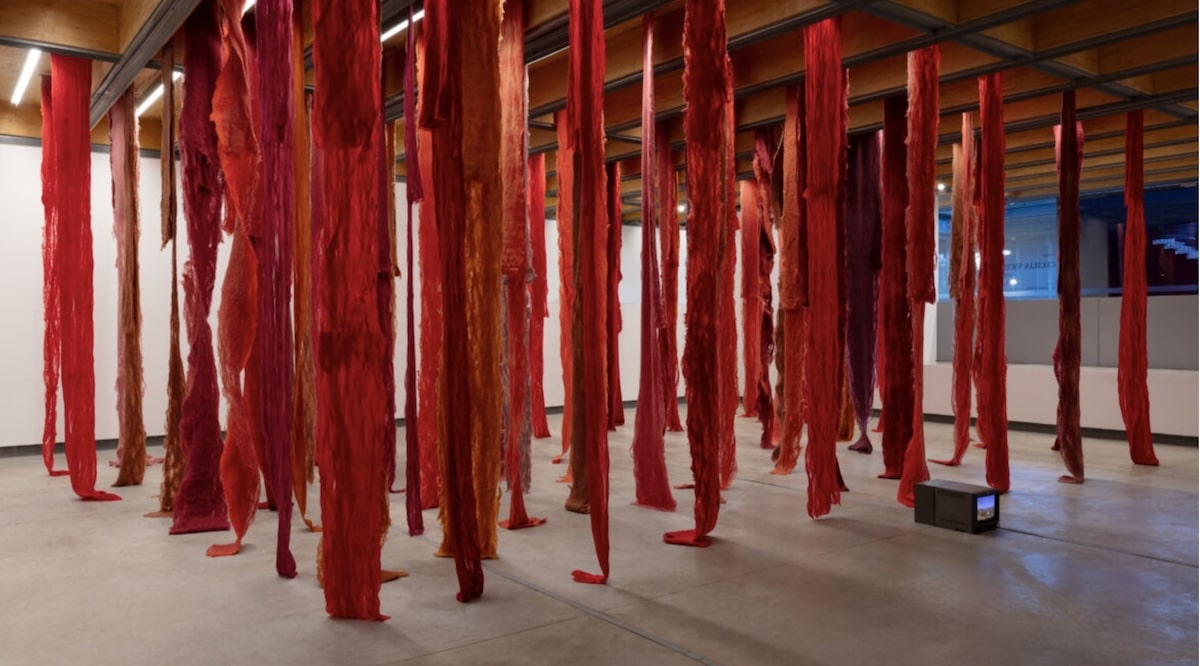
Living Threads is the first major UK exhibition of Cecilia Vicuña, born in 1948 in Chile, and one of Latin America’s most influential feminist figures melding poetry and the visual arts. Vicuña was intervening in landscapes and disrupting cityscapes as a cryptic form of protest against the violent military regime of Augusto Pinochet (1973-90) that was crushing her country, a decade before ‘happenings’, performances and site-specific works became a fashionable means of artistic expression. On entering the Whitechapel Gallery, we are met with Quipu Menstrual, a forest of unspun wool in shades of red and brown that evokes menstrual bleeding. The thick textile festoons cascade from the ceiling like shed strings of uterine lining or handmade umbilical cords that connect the body and female fertility to the earth.
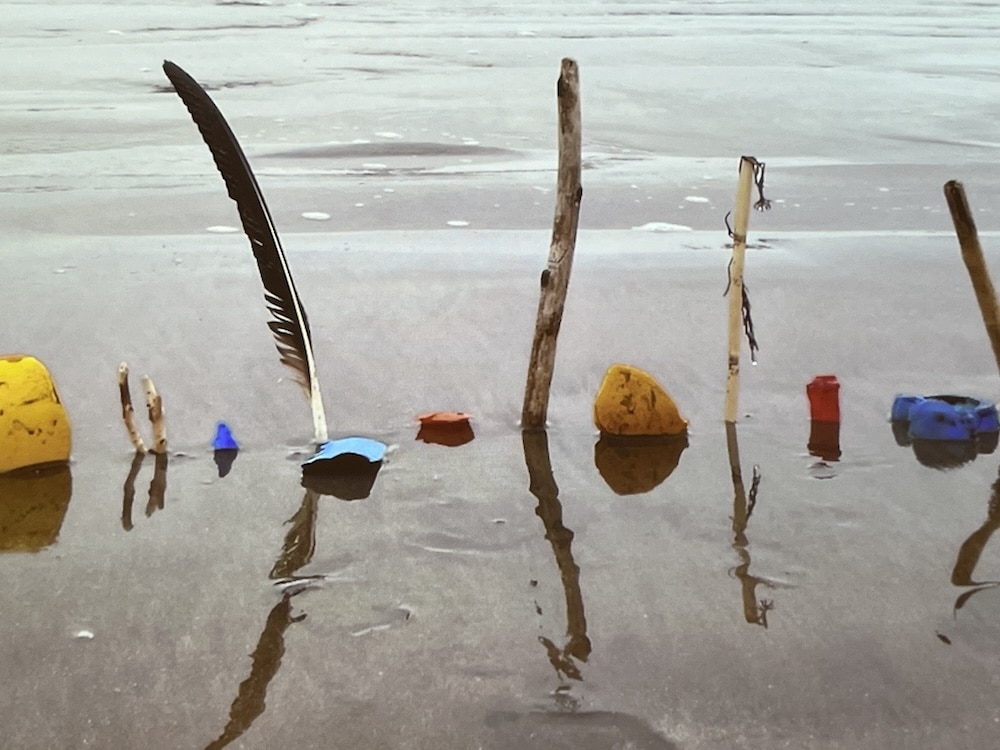
It was in 1966, at the age of 17, that Vicuña created abstract designs on the beach at Con-cón (where the Aconcagua River meets the Pacific Ocean). These precarios: fragile earthworks and votive offerings to the land and sea drew on an indigenous aesthetic. As the patterns in the mud, the fragile sculptures of sticks and feathers were washed away with the tide, they seemed to form a silent protest against the erasure of the domestic language and culture by colonialism. Functioning as funerary rituals and acts of remembrance, these melancholic metaphors highlighted a sense of powerlessness, whilst also suggesting that time is circular rather than linear. In mesmeric film footage – the only evidence that remains of these particular works – the waves slowly reclaim these vulnerable objects. Vicuña has stated that: “To preserve and disappear are not opposite things.” “Awareness [my italics] of disappearance is what needs to be preserved. It’s the belief that life itself is poetry, and poetry is life. Disappearance is regeneration.”
Though many of these works were lost, some of the precarios made during her time in London are on display here. These small sculptures, created from bits of paper, feathers, and fabric, belie, by their ephemeral nature, the notion that sculpture must be permanent and monolithic (and, by implication, male).
Cecilia Vicuña, Whitechapel Gallery
Elsewhere, we encounter footage of her laying strings of red woollen thread on stony ground at the foot of the glacier on Chile’s El Plomo mountain, thus drawing an association between the melting ice and menstrual bleeding. There is something chthonic about her fingers scrabbling amid the hard rocky surfaces, drawing the threads in a single scarlet line of wool amid the grey stones, as if writing on the body of the earth in a visual evocation of the French feminist Hélène Cixous’ l’écriture feminine, which argued that traditional grammar, logic, and philosophy left no room for female voices. In this quiet act of eco-feminism, Vicuña tacitly highlights the industrial exploitation of the landscape and the cost of global warming, long before such issues entered the political mainstream.
The ancient Inca told stories and kept accounts using a series of knots or quipus. Tied and looped with different coloured cords, like Braille, this was a silent language that depended on touch. Traditionally, quipus recorded not only numerical information but also tales, myths, and poems that were destroyed by the Spanish invaders, who, unable to decipher them, saw them as a threat. Vicuña has been using knots as a form of creative expression for over 50 decades to tap into lost cultural knowledge and reclaim both oral and tactile memories of an ancestral, non-alphabetic system of communication that existed in the Andes for around 5000 years. Now, these stories can no longer be told; Vicuñas’ threads and knots function as memento mori to these erased histoires.
One of the most affecting works at the Whitechapel is the film in which she directly asks people ─ from the poor on the street to a Dean of Biology ─ what poetry means to them. The answers are often surprising, philosophical, and rather beautiful. A prostitute says that ‘poetry is what each of us feels inside herself’, while a uniformed policeman suggests that ‘poetry is a second telling… one doesn’t go to poetry to find facts because poetry is more than facts’. For a child standing amid a gaggle of young children, ‘Poetry to me is a story that teaches us many and beautiful things’. It would be hard to imagine such perceptive and heartfelt answers in this technological world where the space for reflection, dreaming and poetry has been hijacked by screens and phones.
In the early 1970s Vicuña came to London to study at Slade School of Art. It was an act of self-exile in response to the violent military coup of 1973 against President Salvador Allende. During her time in London, her practice became more explicitly political, reflecting her experience of displacement, loss, political violence, and instability. There was also a growing insistence that female voices must be heard. This can be seen in the archival material from Artists for Democracy (AFD), which she co-founded in 1974 with other Chilean activists living in London. It was during this period that she produced her first artist book, Saborami, which further expressed her sense of displacement and ecological destruction.
The final space at the Whitechapel is entitled Pain Things and dedicated to Vicuña’s paintings, beginning with those she made at the Slade School of Fine Art. They draw on the Cusco School, an artistic movement that emerged in Peru in the 16th and 17th centuries, melding indigenous and European styles. Her encounter around this time with the Surrealist painter Leonora Carrington can also be seen to have made its mark on her paintings, which include recurring images of eyes, hands, and doors, emphasising the trauma of exile. A unique sense of quiet defiance runs through Cecilia Vicuña’s work. Despite its quiet interiority, there is a determined desire to be heard. Through the silent language of her strings, loops, and red threads, she connects both herself and the viewer to our endangered landscape and her lost heritage.
Cecilia Vicuña: Living Threads, Whitechapel Gallery, 07 Oct 2026 – 14 Feb 2027
Visit Here
Sue Hubbard is an award-winning poet, novelist and freelance critic. Her fourth novel Flatlands, from Pushkin Press can be bought here: Her latest poetry collection God’s Little Artist: poems on the life of Gwen John here https://www.serenbooks.com/book/gods-little-artist/