The National Gallery has plans for an exhibition devoted to objects and works of art that have entered public collections through the Acceptance in Lieu and Cultural Gifts schemes. Collected runs in London from 22 May to 5 September 2027, with a press view on 19 May, and then travels to Edinburgh, Belfast and Cardiff. Arts Council England delivers both schemes on behalf of the UK Government, for the benefit of the four home nations.
Around forty works will be shown in London, and the range is deliberate. The selection runs from a medieval cup to a painting finished in the late 1980s, and the National Gallery says it is only a portion of what the schemes have placed in public hands. Many of the works are loans from museums and institutions across the country, large and small. Over many decades, thousands of objects have been allocated free of charge to museums, galleries, libraries and archives, and the exhibition sets out to follow the journeys that carried them from private ownership into public care, along with the partnerships that keep them there.
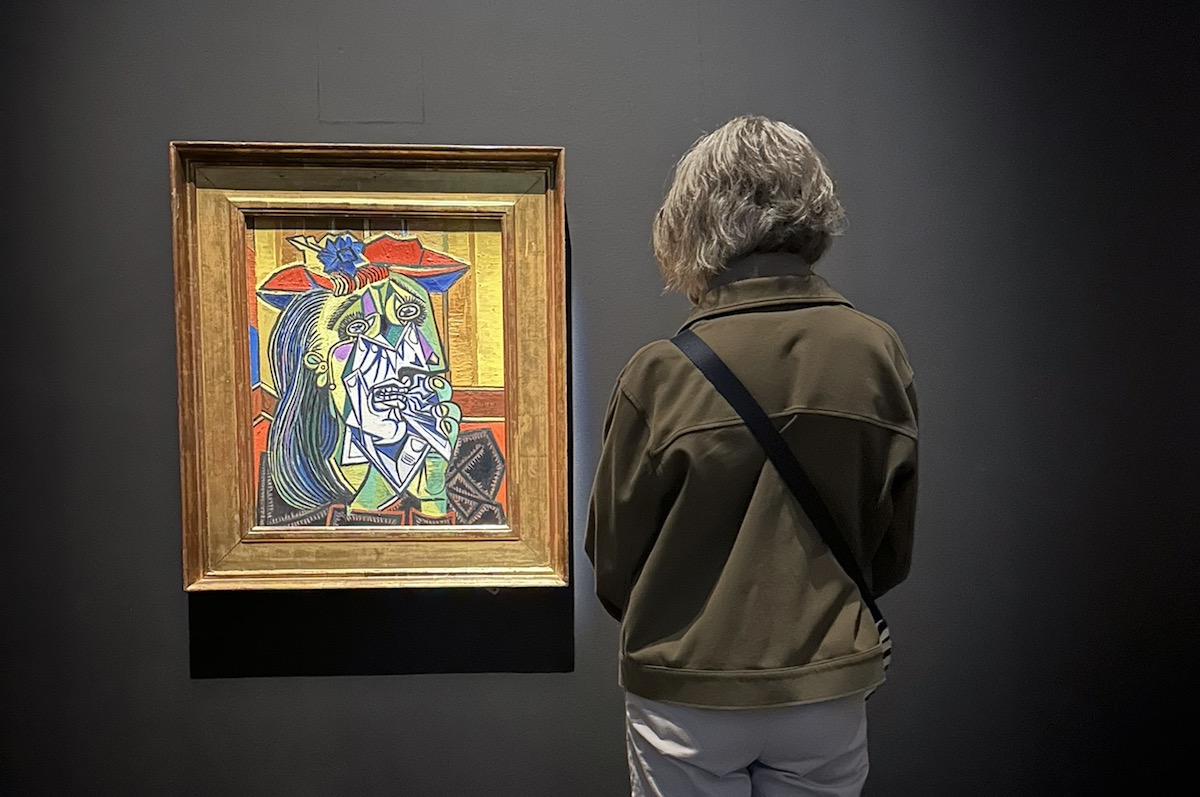
The modern and contemporary section has the biggest names. Pablo Picasso’s The Weeping Woman (1937) comes from Tate, which acquired it in 1987 when the government accepted it instead of tax, with an additional payment made with help from the National Heritage Memorial Fund, the Art Fund and the Friends of the Tate Gallery. Lucian Freud’s Portrait of Hermione Scott (1960) is lent by Lakeland Arts, and René Magritte’s La condition humaine (1935) by Norwich Castle Museum and Art Gallery. Two Picasso ceramics from Leicester Museum and Art Gallery, the decorative plate Bird on a Nest (1949) and Flower Women/Standing Nudes (1948), sit alongside them. The most recent work on view is Peter Doig’s At the Edge of Town (1986 to 1988), from the National Galleries of Scotland. It was offered by the Kennedy Doig family in loving memory of Bonnie Kennedy, accepted in Lieu of tax, and allocated to Edinburgh in 2021.
There are strange objects as well. A Chinese porcelain jardiniere from about 1730, lent by Strawberry Hill House and Garden, is linked to Horace Walpole, whose beloved cat Selima drowned in it. The Hamilton-Rothschild Tazza, lent by National Museums Scotland, is a large Byzantine cup of sardonyx, gold, and enamel, with parts dating from the ninth to the nineteenth centuries. It belonged to Alexander, 10th Duke of Hamilton, one of Scotland’s great collectors, who used it for the baptisms of both his children. It was accepted in Lieu of inheritance tax and allocated to Edinburgh in 2012.
Eight paintings form a core group that will appear at all four venues. They include Corot’s Italian Woman (about 1870), Cézanne’s Avenue at Chantilly (1888) and John Singer Sargent’s Wineglasses (probably 1875), all from the National Gallery’s own collection, plus Max Ernst’s Max Ernst montrant à une jeune fille la tête de son père (1926 to 1927) from the National Galleries of Scotland and Jacob van Ruisdael’s The Cornfield from National Museums NI. Edinburgh will borrow additional works to complement this group, while Belfast and Cardiff will show the core eight and pieces from their own collections.
The curator is Daniel Sobrino Ralston, the Gallery’s CEEH Associate Curator of Spanish Paintings. He calls it a pioneering exhibition that sweeps from medieval to modern and celebrates the cultural riches that have entered UK collections through public schemes. Sir Gabriele Finaldi, the director, says it is impossible to overestimate the importance of Acceptance in Lieu and the Cultural Gifts scheme, and describes the show as a cultural cornucopia. The arts minister, Ruth Mackenzie, congratulated the partners on presenting the first such exhibitions. Michael Clarke, who chairs the Acceptance in Lieu Panel, thanked the offerors and donors, and said the show gives a flavour of what has been achieved and is meant to raise awareness of the schemes. Darren Henley, chief executive of Arts Council England, said the National Gallery was right to bring these examples together for the first time.
A short explanation of the schemes helps. Acceptance in Lieu allows people with an Inheritance Tax bill to pay it by transferring pre-eminent cultural, scientific, or historic assets to the nation. The offeror benefits from a greater share of the object’s value than if it were sold and the proceeds used to pay the tax. Separate material gives the sweetener as 25%, and says accepted items generally must be shown to the public for at least 100 days a year. It is not strictly philanthropy, though it builds public collections. The Cultural Gifts Scheme, launched in March 2013, allows taxpayers to donate pre-eminent objects in their lifetime in return for a reduction in corporation tax, income tax, or capital gains tax, based on a set percentage of the object’s value. An independent panel advises ministers on the importance, whether the value is fair to the nation and the taxpayer, and where objects should go.
The tour follows. At the National Galleries of Scotland, due to open on 24 June 2028, the works will be woven into the permanent displays at the National, Modern and Portrait sites, with around a dozen major loans from elsewhere in the UK. Highlights include an ancient Roman sculpture of a cat, a late Rembrandt portrait, an eighteenth-century volume of natural history drawings by Sarah Stone and Damien Hirst’s Wretched War (2004). There will be paintings by artists the Scottish collection did not previously hold, Édouard Manet among them, and a dedicated room at the National for drawings and prints by Goltzius, Turner, Monet and Crawhall. Anne Lyden, the director general, said the schemes have benefited Scotland significantly.
The Ulster Museum in Belfast shows the exhibition from 26 October 2028 to 28 January 2029. It will concentrate on the core group, most of them by artists not otherwise represented in its collection, and add pieces from the historic needlework collection given by Lanto Synge through the Cultural Gifts Scheme. Hannah Crowdy, head of curatorial at National Museums NI, said that without Acceptance in Lieu the museum could not offer local audiences masterpieces by artists such as Renoir and Tissot at home.
Amgueddfa Cymru, Museum Wales, follows in spring 2029, with works by Rembrandt, Thomas Jones, Monet, Frank Auerbach, Ceri Richards and Giorgio Morandi. Its own holdings include Freud’s youthful portrait of his teacher, Cedric Morris, and Edward Burne-Jones’s decorative panel Perseus and the Graiae (1877), shown alongside works from partner venues by Stubbs, Corot and Cézanne. Ceri Jones, head of art, pointed to Morandi’s Still Life with Bottles, the most recent acquisition of this kind, as part of the display.
The announcement coincides with figures from Arts Council England’s annual report, covering April 2024 to March 2025. It was the schemes’ most prolific year since 2020, with £59.7 million of objects transferred. Allocations included a standing desk used by Benjamin Disraeli and Winston Churchill, now at the National Trust’s Hughenden Manor, and Degas’s pastel Danseuses roses, made between 1897 and 1901, which went to the National Gallery. Lord Howe’s political archive went to the Bodleian Library, and four medieval deeds concerning the murderers of Thomas Becket to the South West Heritage Trust. Pompeo Batoni’s portrait of Martha Swinburne joins her husband’s at the Laing Gallery in Newcastle, while Bill Brandt photographs went to Tate and a Vanessa Bell still life to Charleston.
Top Photo: P C Robinson © Artlyst 2026