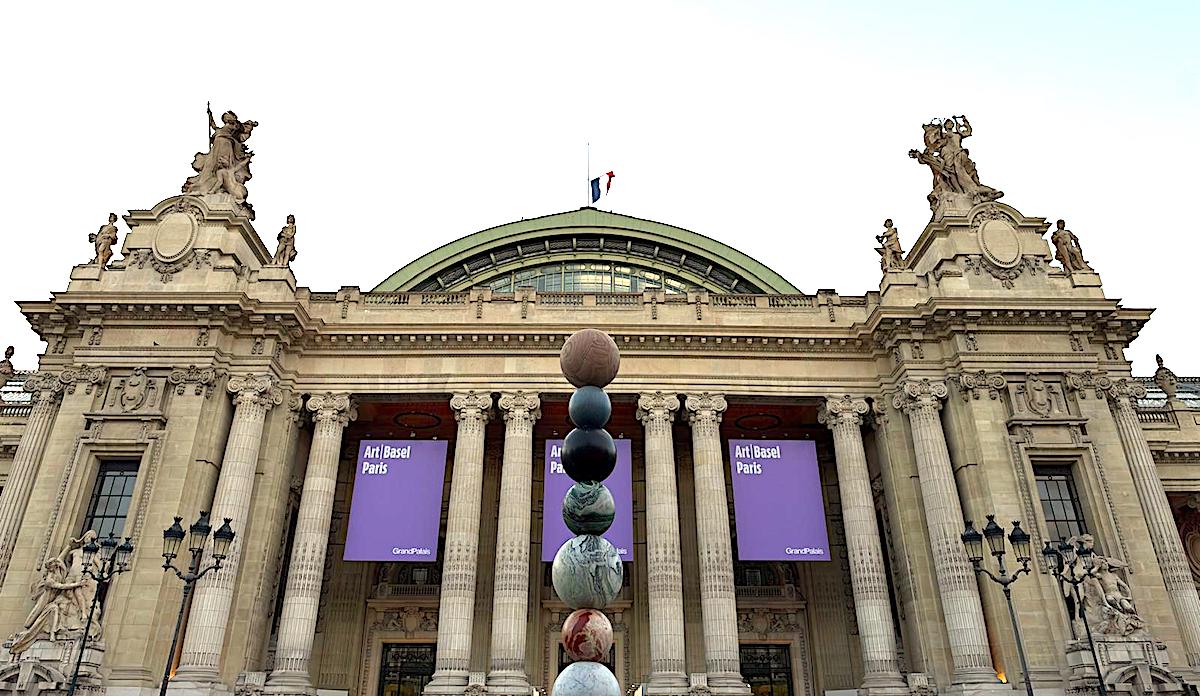
What is the current mood in Paris? The shrapnel of the weekend’s protests still marks many areas, yet the art world has carried on stoically. Events and openings went ahead on Monday night and Tuesday, and at 3 p.m. the Avant Première preview opened at the Grand Palais. About ten minutes beforehand, only a short line had formed outside. That was an early sign that the day would be a little less frantic than last year’s ultra-VIP event, which now precedes the regular VIP days. Over the next four hours, the impression held. The aisles were busy but easy to navigate, and the blue-chip booths were crowded with buyers. The fair and its galleries seem to have trimmed their lists to the most serious collectors.
Some dealers and advisers said they knew of collectors who had cancelled their trips, though no one provided specifics. The fear that Americans would stay away proved unfounded. The Top 200 Collectors on the floor included Allison Berg, Glenn Fuhrman, Pamela Joyner, Nancy A. Nasher, Bob Clark and Jason and Michelle Rubell, along with Anne-Cecilie Speyer, Jessica Seinfeld and Adam Lindemann. Museum figures included Michael Govan of LACMA, Massimiliano Gioni of the New Museum, Ruba Katrib of MoMA PS1, Giampaolo Bianconi of the Art Institute of Chicago, and Max Hollein and David Breslin of the Met, which brought a large group of trustees. Katie Holmes and Natalie Portman were also seen. The stands felt especially curated and well thought out, and the Grand Palais is hard to resist.
Dealers reported positive energy. Mathieu Templon of Templon said, just over an hour in, that they were off to a great start and at home. The gallery sold Bilal Hamdad’s L’envers du soir (2026) for €65,000. Hamdad had a solo show at the Petit Palais during last year’s fair, and Templon described heavy demand ahead of his March exhibition. Because the preview was short, most galleries could report only a sale or two, a long way from the detailed tallies that follow the opening days of other Art Basel fairs or of Frieze, which held its London fairs last week.
The London versus Paris debate continues. The two fairs are complementary. Others at Frieze said it’s mainly for young galleries, artists and collectors with a more adventurous tone, while Art Basel Paris has a higher price point. Marc Payot, president of Hauser & Wirth, said top-tier attendance is the fair’s strength but that the city distracts people, who come to see a thousand things. Thaddaeus Ropac agreed, adding that collectors decide fast in Paris because the fair is competing for attention. Some clients planned to return for the official VIP opening on Wednesday, while others would skip it to attend museum shows or shop.
Even so, the big works came. Ropac reported 15 sales on Tuesday, including four Picassos from 1906 to 1938 at undisclosed prices, a 1953 mixed-media Lucio Fontana for €1.8 million, and a 2019 Georg Baselitz for €800,000. He said they were doing very well, but that it was expected. Hauser & Wirth sold Gerhard Richter’s Rokokotisch (Rococo Table) (1965) in a single afternoon for around $10 million. It was a late addition to the booth and was not in the previews. The gallery also sold Baselitz’s Der Hirte (1965) at a similar price, George Condo’s Woman with Designer Shirt (2026) for $2.9 million, Fontana’s Concetto spaziale (1961) for €1.7 million, Philip Guston’s Untitled (1969) for $1.5 million and Alexander Calder’s Four Dots and Brass Tail (about 1953) for just under $1 million. Payot noted that collectors still take longer to close than they did five years ago, though great things do find great homes.
The most expensive work is probably the Modigliani at Pace Di Donna Schrader, Nu étendu (Lolotte) from 1917, valued at more than $100 million. The gallery says it has not been seen in about a century and was in Modigliani’s only solo show, at Galerie Berthe Weill, which caused a scandal for indecency. Emmanuel Di Donna said the Modigliani would take time to place, while everything else had felt like drinking from a firehose.
Gagosian declined to give prices but said it sold a 1987 Willem de Kooning for eight figures and a Peter Doig. White Cube reported sixteen sales, including two Julie Mehretu paintings from 2001 and 2018 at $7.85 million each, as well as works on paper, a Picasso for €150,000, and a Léger for €65,000. Gladstone sold a Victor Man for $1.3 million and two Wangechi Mutu collages at $325,000 each. Kurimanzutto sold a Haegue Yang sculpture for $110,000. Xavier Hufkens reported ten sales, the top being a Charline von Heyl at $475,000, and quoted the city’s motto, Fluctuat nec mergitur, as fitting for the week. At David Kordansky, Mike Homer said several holds had turned into sales, evidence of a desire to see works in person. One was Sam Gilliam’s Mycenaean Ode (1965), at $300,000.
This year there are a record twelve shared booths for 24 galleries. On the second floor, Layr of Vienna and Kraupa-Tuskany Zeidler of Berlin and Munich paired Franz West’s Passstück (1983 to 1984), a sculpture meant as a strange crutch, with Anna Uddenberg’s White Noise (Soft Skills) (2026), a faceless life-size mannequin bent into office-furniture contraptions. Both galleries sold several works, mostly to European collections, with some going to Americans. They want research and reassurance, which is why decisions are slow. If trust is there, he added, the decision is easy.
The fair is the 5th edition, now led by Karim Crippa. It has 211 galleries from 41 countries and regions, 64 of them operating in France, with 32 first-time participants. Public days run from 23 to 25 October. A Public Program stretches across the city, and the two-day rehang, Oh La La!, returns on Friday and Saturday, art-directed by Philippine Leroy-Beaulieu.
Around the fair, Paris Internationale holds its twelfth edition on Quai de Valmy, featuring 56 galleries and five non-profits, until 24 October. George Vamvakidis of The Breeder in Athens said it is manageable in terms of cost and a nice change after Frieze. Kendall Koppe’s Keith Farquhar works are a hit, and Lucy Beech’s Storm film, based on a five-hour simulated North Sea tempest, is a highlight.
In the public programme, White Cube has placed three monumental Tracey Emin bronzes at Place du Trocadéro in the shadow of the Eiffel Tower: I Lay Here for You (2018), I Followed You to the End (2024), and I Will Not Be Alone (2025). Emin wrote on Instagram of coming to Paris after her mother died, and of the city stopping her from crying. Niru Ratnam presents Kutluğ Ataman’s Küba (2005) at the Chapelle des Petits-Augustins, forty televisions in front of forty armchairs, each showing a resident of an Istanbul district.
Elsewhere, Kader Attia and Elizabeth Peyton show work from their Louvre residencies, Les Hôtes du Louvre, until 14 December. Ibrahim Mahama fills the Fondation Cartier with Parliament of Ghosts and Things Fall Apart (2026), built from bottles and crates from an abandoned factory in Aboso. And Le Large, the new Emerige centre on Ile Seguin, opened on 17 October with Imaginary Engine, curated by Cecilia Alemani, pairing more than fifty works from the Renault collection, including Julio Le Parc’s cafeteria mural, with seventeen new commissions.
Photo: © Artlyst 2026