

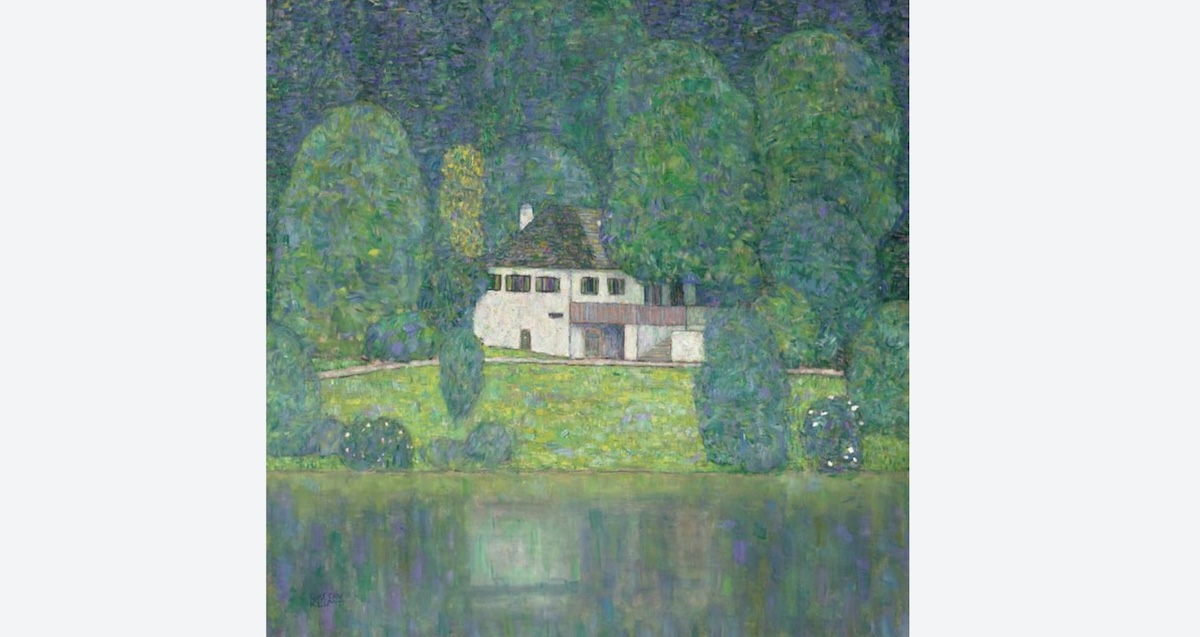
Christie’s will offer one of Gustav Klimt’s finest landscapes this November. ‘Litzlbergkeller’ headlines the 20th Century Evening Sale in New York on November 17. The date falls just days after the Neue Galerie reopens.
The painting has sat in the same private collection for nearly three decades. It last came to auction in May 1997, in the estate sale of Serge Sabarsky, co-founder of the Neue Galerie. That sale set a world record for Klimt. In recent years, the work has been on long-term loan to the Leopold Museum in Vienna.
Klimt spent most summers from 1900 until his death in 1918 beside Lake Attersee in the Austrian countryside. This picture looks across the water to the Litzlberg Cellar, a brewery and inn on the north shore. He had stayed there during his first summers at the lake, between 1900 and 1907. By the time he painted it, he was lodging in a cottage on the south shore. The scene looks back.
He worked from across the water, using a telescope and postcard images. The building, the grassy knoll and the trees are flattened into crisp, interlocking planes. Jewel greens dominate, applied like tapestry across the whole canvas. The foreground breaks from this. It is a half-abstract mirror of the landscape above. Klimt also removed every sign of the inn’s summer crowds. No people appear. What remains is a quiet, contemplative view.
Most of Klimt’s landscapes were private affairs. Unlike the portraits that won him acclaim in Vienna, they were made without a patron’s taste to satisfy. Attersee gave him room to try new techniques. Litzlbergkeller is a rare exception, a picture driven by his own vision and by a commission. The patron was Otto Primavesi. Klimt began in the summer of 1915 and finished in May 1916 at his Vienna studio.
Primavesi was a banker and entrepreneur from Olmütz. He and his wife, Eugenia, supported art, literature, music, and theatre. They became two of Klimt’s most important patrons, starting with two family portraits commissioned in 1912. In the following decade, several of their works passed to Hugo Bernatzik, an Austrian photographer and anthropologist. Litzlbergkeller was among them. Kurt Wieser acquired it in the early 1930s. It later joined the collection of Sabarsky, a dealer, connoisseur and collector.
Sabarsky did much to promote Klimt in the later twentieth century. In 1981 he curated the first Klimt show held in Japan. He went on to co-found the Neue Galerie. The present owner’s family bought the painting at his estate sale in 1997.
Giovanna Bertazzoni, Chairman of Christie’s Europe, called the landscape a lyrical composition in three stanzas. She described the whispering oaks, the house wrapped in their foliage and the shimmering reflection in the lake. She called the work inestimable.
Max Carter, Global Chairman of 20th and 21st Century Art, placed the inn between Klimt’s allover technique and abstraction. He said the painting sits between prewar certainty and the unknown. The evening sale was created six years ago, he noted, to span the range of collectors and the great divides that hinge on works like this one.
Collectors can see it first in Hong Kong, at Christie’s from October 27 to 29. It then moves to Rockefeller Centre, where it goes on view from November 7