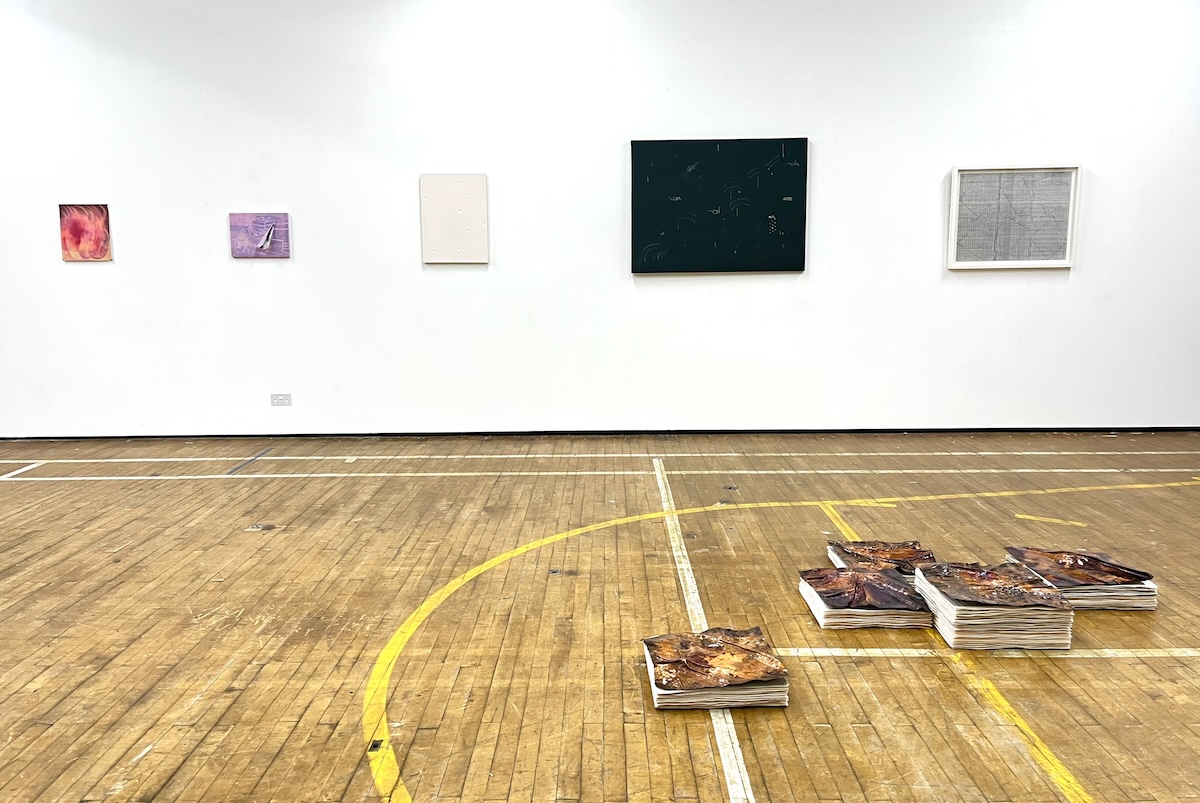
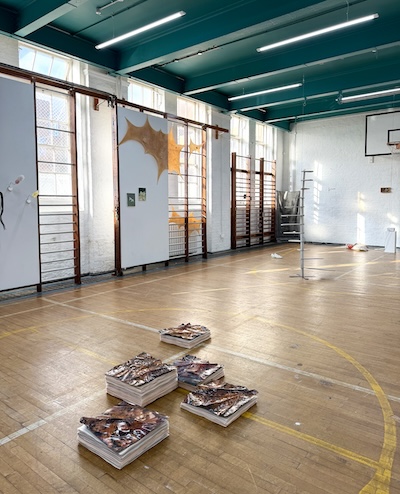
The wooden wall bars and painted court lines of a former school gymnasium form an unlikely backdrop to a staircase. Ruilin Fu’s Untitled (2026) rises from the floor in a narrow, turning column of steps, as though it belongs among the room’s old exercise apparatus. Yet unlike the wall bars, whose purpose is immediately recognisable, Fu’s staircase offers no clear destination. Made from steel, wood, aluminium, concrete and resin, it grew out of a period when the artist felt adrift in London. The curators see in its circling ascent the disorientating experience of keeping busy without knowing whether anything has changed. It is a fitting introduction to Between the Breath, an exhibition about the time in which, apparently, nothing much happens.
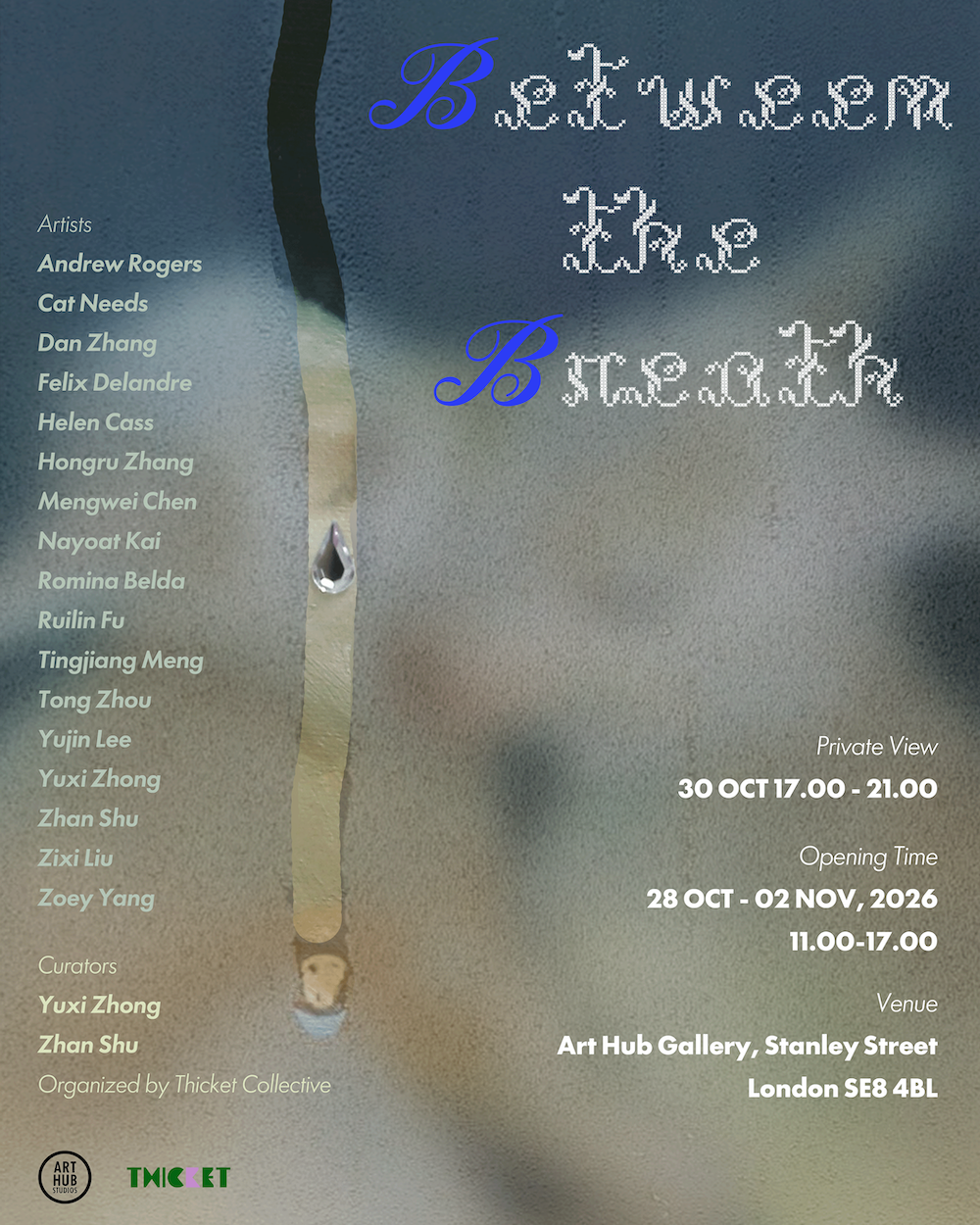
Organised by Thicket Collective, the curatorial partnership of Zhan Shu and Yuxi Zhong, Between the Breath brings seventeen artists to Art Hub Gallery (Apparatus Gallery) in New Cross from 28 October to 2 November. In the curators’ original text, a swimmer surfaces for air, a cursor continues blinking on an office screen, and a train heads towards its next station. Life follows its usual rhythm even as attention briefly wanders elsewhere. The exhibition neither celebrates rest nor proposes an escape from daily life. Instead, it asks what happens during those apparently unproductive intervals, and why they so rarely enter the stories we tell about ourselves.
One of the curators, Zhan Shu, likens the events we remember to keyframes in a film: a decision, a farewell, a destination reached. They give a life its narrative shape, while the footage in between is easily forgotten. An uneventful afternoon may leave behind no story worth telling, yet a feeling from it might return years later. What escapes the narrative can still shape the person living through it. These moments are always there, but they’re difficult to catch hold of,” Zhan said.
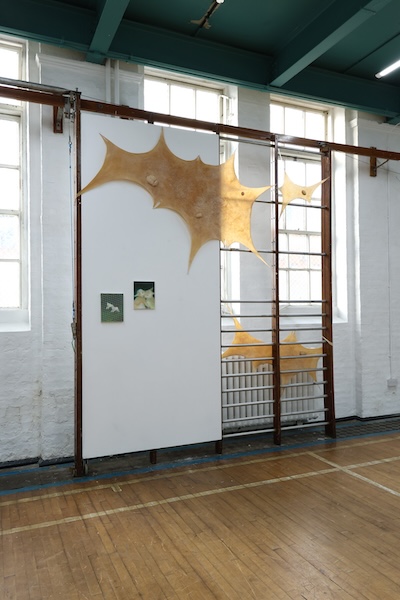
The first two paintings visitors encounter are by Helen Cass and Nayoat Kai, a pairing the curators chose for their seemingly unpremeditated marks. Cass’s Mapping 31 (2023) works ink across scored and folded paper, its fine lines meeting creases in the surface. Kai’s acrylic-and-chalk painting resembles a much-used blackboard; beneath formula-like marks are traces of erasure and correction. Neither entirely conceals the hesitations of making, leaving the viewer to notice what has been revised or left behind. Time spent drawing, correcting or losing the thread remains part of what we see.
Small domestic spaces offer another way into such elusive intervals. Yujin Lee’s Body for the Inside (2026) evokes the cramped angle of a bathroom through pencil-drawn and fabric-transferred elements, wire, and silicone. Beginning with minor things going wrong at home, Lee considers the delay before accepting what cannot simply be fixed. Its fragile structure recalls a room imperfectly remembered rather than carefully reconstructed. In Tong Zhou’s two-part textile work Living in the Gap Between Lines (2025), the curators find echoes of a bedroom, a pillow, and an idle afternoon. Such familiar places can be difficult to recall precisely because so little appears to happen there.
Zhan Shu’s In My Deepest Dream (2026) carries this uncertainty into emotion. Two sheep lean together in a dimly painted scene, a tear disturbing its tenderness. Shu speaks of a vague sadness that enters an ordinary day without a clear cause, neither a dramatic loss nor a fully formed recollection. Memory sometimes keeps the feeling while letting the circumstances fall away.
But what escapes notice is not always gentle. Dan Zhang’s Fresh & Clean (2025) brings soap, hair, household brushes and instruments associated with gynaecological examinations into uneasy proximity. The work addresses bodily shame and demands made of women in the name of cleanliness. The familiar household objects take on a harsher significance beside medical instruments. Scrutiny, repeated often enough, can become an unremarked part of daily life.
Between the Breath: When Nothing Much Happens – London
Other intervals stretch beyond the body. Yuxi Zhong’s Spirit Level (2026) introduces a tool for establishing balance, made of ice, steel, wire, and sand. Its promise of stability meets materials subject to change. Romina Belda’s video Maps of Memory (2026) approaches soil as an archive, drawing on southern Spain and the Valencia floods to consider how climate, urbanisation and political decisions shape a landscape over time. An apparently sudden event may have a long, largely invisible history. The works are hardly equivalent, but both make a single instant seem an inadequate measure.
The gallery occupies a former school gymnasium, a space once organised around movement, training and performance. Its earlier purpose offers a counterpoint to a project that considers hesitation and apparently aimless repetition as subjects in their own right. In a space like this, we tend to notice the movement, the effort, the result,” Yuxi said. “We wanted to bring the pauses between those actions into view, along with the gestures that seem to lead nowhere.” Rather than offering a lesson in slowing down, Between the Breath invites us to reconsider those hours for which we have little to show and even less to recount. The train moves on, the cursor keeps blinking. Much of a life is lived between the moments we remember.
Between the Breath 28 October – 2 November 2026 Art Hub Gallery (Apparatus Gallery), Art Hub Studios Stanley Street, New Cross, London SE8 4BL Organised by Thicket Collective (Zhan Shu and Yuxi Zhong)
Words: Zijia Feng (Jiayu), an independent curator, arts writer, and researcher with an MRes in Exhibition Studies from Central Saint Martins (UAL). Her interests span contemporary art and technology, spirituality, symbolism and visual culture, with a particular focus on how images, beliefs and cultural identities are constructed and interpreted across different cultural contexts.