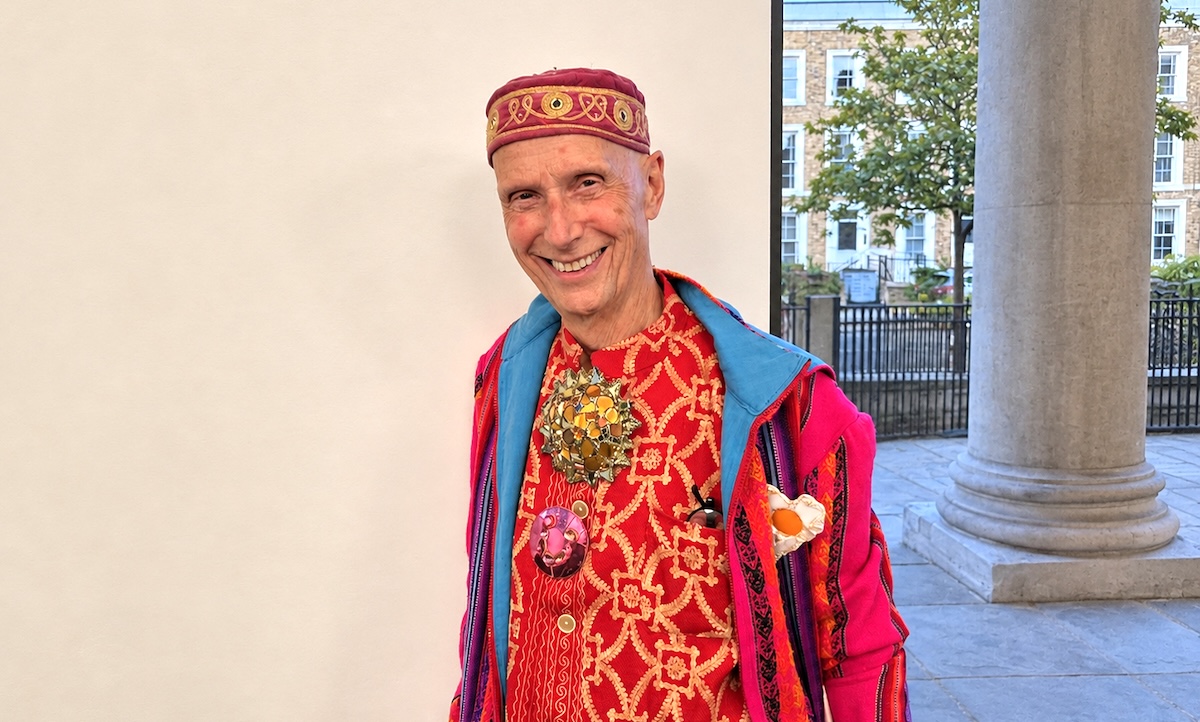
Andrew Logan at eighty-one is an extraordinary human being, not just an ordinary eccentric. Not only does he look like the happiest of sandboys, no Dorian portrait in the attic; he infectiously beams innocent delight from his over 6ft skinny beanpole exterior. An artist who trained as an architect, a gay man of such joyful sensibilities you never see him wearing anything darker than blue, his core belief is that Art is Life and Life is Art.
He espouses joy to the world and is deeply grateful to get to go to his studio every day to make art. He is currently reading Proust by Samuel Beckett; his favourite artists are Brian Eno, Duggie Fields and the Neo-Naturists (Wilma Johnson, Jennifer and Christine Binnie). Grayson Perry was once part of the collective when he went out with Jen, and they are mentioned in his autobiography under bizarre pseudonyms.
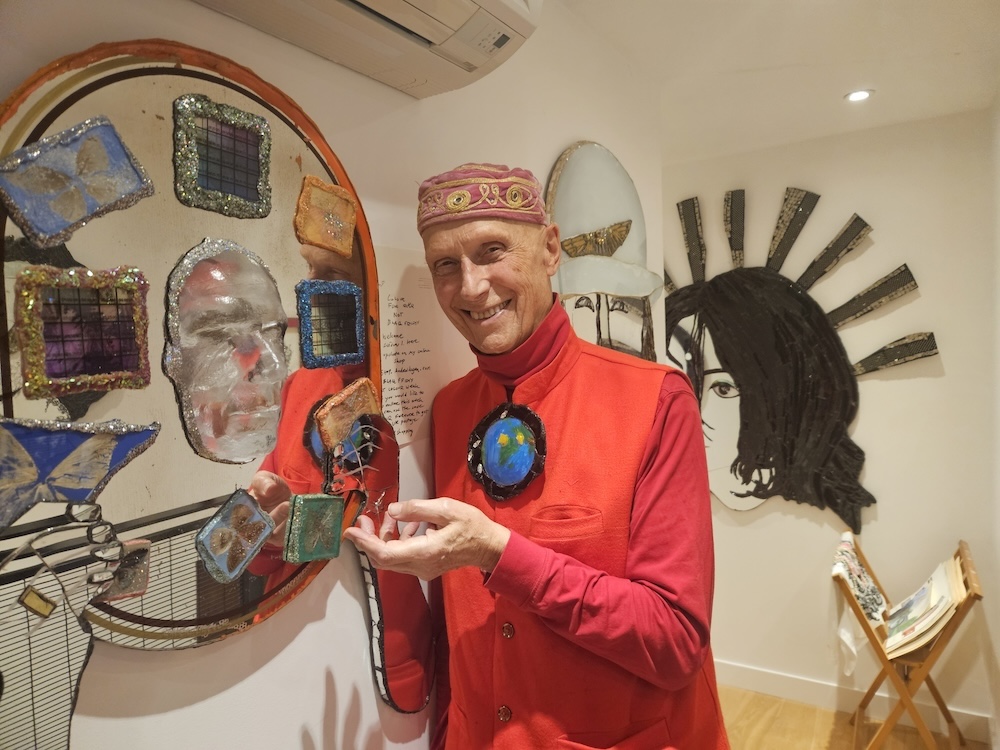
Andrew w sm self portrait and michael jackson Photo Courtesy Andrew Logan ©
Andrew doesn’t have a dealer or a representative to handle his money, which has been difficult at times. Still, he is so serendipitous that something always turns up, and it’s usually his creativity. He has never had a Tate Gallery show. He has never been taken seriously by the big art institutions because they can’t pigeonhole him; he is certainly not an expressionist or a YBA. Yet he has had shows all over the world, from America to Mexico to Russia pre-Putin, and had big commissions in Delhi, Mumbai, and Chennai, where they appreciate him far more in India than we do. Every year he returns to make more work. When I ask him what his favourite show of his work has been, he mentions the one I remember in 1991: a retrospective at Modern Art, Oxford, where we all trundled along for the opening.
Why can we not take Andrew Logan’s work or as an artist seriously in this country, in this day and age, when Grayson Perry and Leigh Bowery have had major shows, and even women are now given exhibitions? It can no longer be about ostentatious dressing up; it was once claimed he was more a part of the fashion crowd. Is it because he started The Alternative Miss World in 1972, a queer interpretation in which artists created fun and ridiculous personas, a satire of what was still really and seriously happening each year on the BBC until 1984! And we wonder why we have a culture of entitled media men liberally helping themselves to women’s bodies as if we were all dolly mixtures.
My mother, Molly Parkin, was a judge on- and offstage from 1975 of The Alt MW, when, aged 13, I saw her pushed into the water feature by that year’s winner. Full of Hockney and Jarman, Ozzie Clarke and Celia Birtwell, the ballet dancer Wayne Sleep, and pop star Bryan Ferry, but more thrilling was the cast of The Rocky Horror Show, the film released that year. It was wild, and she championed him throughout her life.
Featuring him in papers and wore his jewellery. Later in 1978, I entered AMW as Miss Wildlife, making all my own costumes from whatever I could glean: a dress of fake greengrocers’ grass, plastic animals, a stolen bird’s nest from a tree, and a lot of glue in my bedroom in St Ives, Cornwall. I didn’t know I’d be interviewed by Divine or that I would end up in a feature film. I was 17 and doing my A levels. It was a moment on Clapham Common when I realised there was a world beyond television entertainment, and I thought it was the art world, but it was far too wild for them. The dressing up, the make-up, the performances, the creations part Panto, part circus, part performance art, living sculptures; life as art.
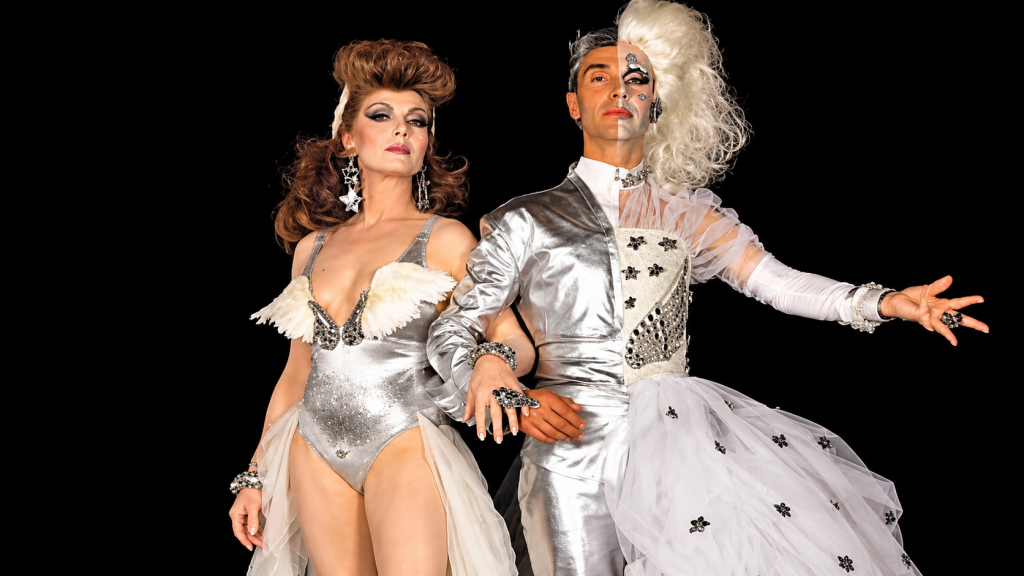
Rula Lenska and Andrew Logan Host and Hostesses. AMW. Photo Courtesy Andrew Logan ©
Andrew was always in a suit, one side female, the other male. I wanted to go to Art school if it was going to be like that, and so Andrew changed my life as he changed so many people’s lives. Perhaps it had actually happened earlier.
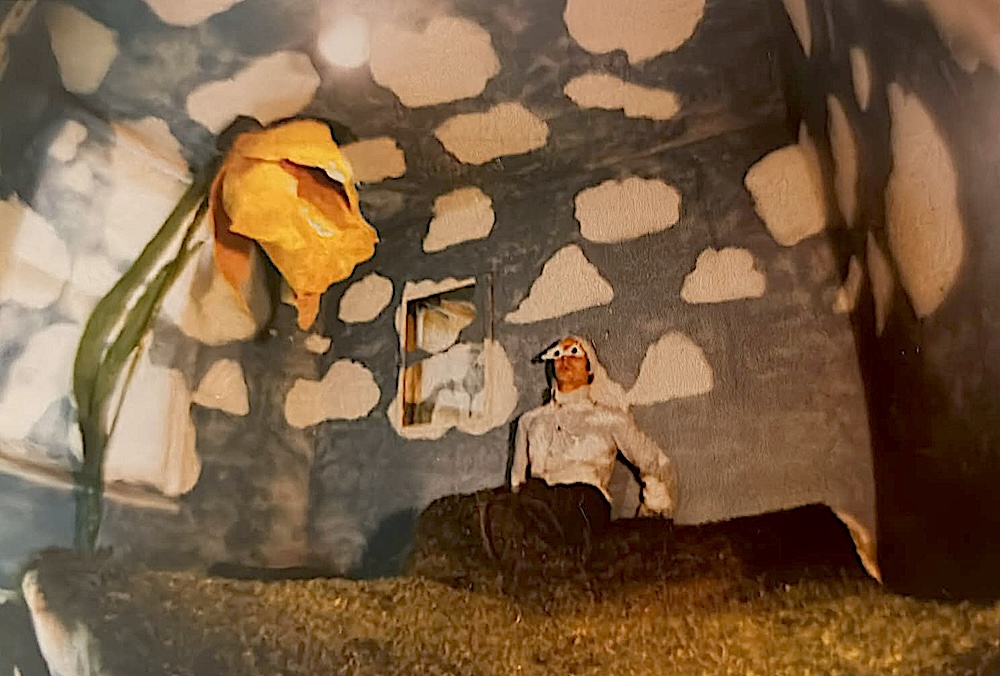
Andrew Logan Ten Sitting Rooms ICA London 1970 Photo Courtesy Andrew Logan ©
I first met Andrew when I was 9 in 1970, when he was part of an incredible show called Ten Sitting Rooms, curated by Jasia Reichardt, Assistant Director of the Institute of Contemporary Art. In those days the ICA was genuinely Happening; she also curated Cybernetic Serendipity in 1968 and Play Orbit. All of them were groundbreaking shows that challenged the sensibilities of any audience and should have sprung her straight to the top of the Tate, but Sir John Rothenstein was still in charge. Andrew’s room included a lot of fake grass and a life-size white horse on its back, perhaps made of papier-mâchépapier-mache. It was my favourite room. How had someone straight out of college walked into a role in this show? A friend had taken a photograph of his bedroom at college, where he’d made a giant daffodil the size of a tree, covered the floor with fake grass instead of carpet, and his bed, whilst he’d painted a sky of clouds and blue across the ceiling. Molly became friends with him and his friends from Duggie Fields, Luciana Martinez, Kevin Whitney, and introduced him to Barbara Hulaniki, who commissioned him to make giant flowers across the roof garden of Biba, turning it into Alice in Wonderland, what with the pink flamingos and giant Black Roses.
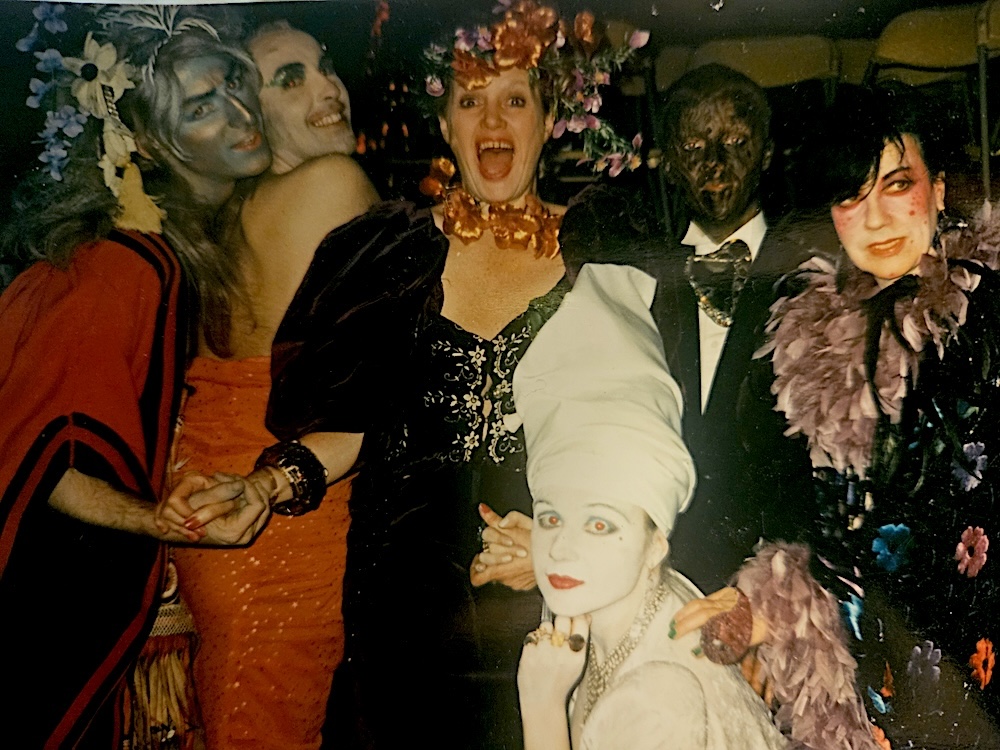
Audience at Earth 1986 Brixton Academy. Sophie as Snow White with Molly Parkin, Alastair Fairley, Ulla, Miss Sweden, Mister Pearl Tailor & Matthew Hawkins, ballet dancer. Photo Courtesy Sophie Parkin ©
When a BBC documentary was made about my mother Molly, One Woman’s Week as fashion editor of The Sunday Times, Andrew was in it, modelling by the Orangery, Holland Park, having fun. And maybe that is the trouble: the art world can encompass immense pain; look at Tracey Emin’s last show.
Andrew seems not to take life seriously because of dressing in such a joyous array of colours, a walking rainbow, a child’s idea of a clown. Blame it on his happy childhood in Oxford. He adored his mum and dad; one of five children, not Catholic, C of E; and the brothers and sister Janet are still close. Proving happy childhoods breed happy adults. He has been with his partner, architect Michael Davies, for fifty-four years, who has designed his museum of sculpture in Berriew, Mid Wales, along with some of the extraordinary other buildings they have lived in, like the Glass House in the Sky and what is now the Fashion and Textile museum in Bermondsey, which was once their home. Now they live between Wales, South London and India.
We are going to have to move from the flat, he says, because of the stairs; no lift; it’s getting too much for our friends. No problem for Andrew; after a lifetime of Yoga, he literally skips about like a faerie, alighting upon this or that subject, here or there, showing me things about the flat, his face in repose, always a smile.
We have an ignoble tradition of holding up misery as more authentic; if it’s funny, it’s not serious. Grey and black denote seriousness; therefore, it’s intellectual, and art has come to represent misery. When art is full of playfulness, with shapes, lines, and colours like Matisse’s cutouts at the end of his life, they are full of art and learning; it was Matisse who had condensed his work into the simplicity of such direct communication. Let us not forget that Tate has not always understood modern art: when offered The Red Studio by Matisse in 1941, after it had been hanging in The Gargoyle club since 1927 for, it is said, a paltry £10, Sir John Rothenstein turned it down for being too modern. The Americans weren’t so picky; it now hangs at MoMA in NYC.
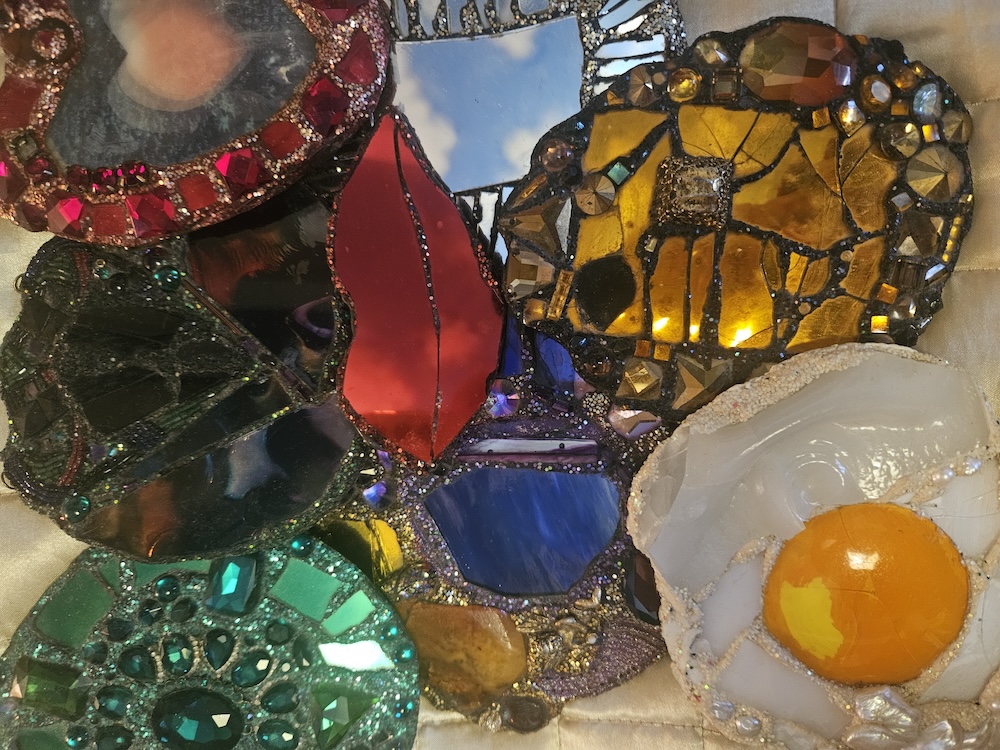
Some of the jewels Andrew Logan made for Molly Parkin Photo © Sophie Parkin
It is in the simple that we find the profound in whatever spiritual world you look to. The mirrors that Andrew uses in his work are perhaps mistaken for decorative, as many mirrors are. Curators mistakenly have done so with Jean Cocteau, minimising his impact. One might have thought that was to do with his sexuality, then, and his engraved mirrors work (walk into Cocteau’s Marriage chapel in Menton, South of France and remain unmoved by such a feeling of love and light that bounces across the mirrors, so why is he not included in the Royal Academy show?); also something Matisse did. What they are all doing is playing with light, and the understanding that we are all reflections of each other’s light and energy as humans. When we look at Hockney, currently on the wall of The Fashion and Textile Museum for the Celia Birtwell show, we see an image of him and then a reflection of ourselves: what we could be, what we might be, and yet this is who we choose to be. Logan is playing with the Universe, juggling flying Pegasus’ of light, Cosmic Eggs of energy and love; he makes real the surreal in creating amazing things every day, whether it is one of his famous heart brooches, friend eggs or huge wall portraits. He is currently working on a huge death mask piece of glass and mirror where the world flows through it; his experience of life. Life has to be treated lightly when we are here for such a short moment. The last Alternative Miss World was this year at Regent’s Park Open Air Theatre, with the theme “Gaia”. It rained, but nobody cared.
If we were all as concerned about and committed to world peace as we steadfastly maintain, the art world would understand the value of his work. ‘But how can you price Joy?’ He says, smiling wistfully. And I am reminded of Oscar Wilde’s famous quote. I wish it weren’t true of a cynical art market which knows ‘the price of everything and the value of nothing’, but perhaps what Proust wrote is more apt for Matisse and Logan – Let us be grateful to people who make us happy; they are the charming gardeners who make our souls blossom.
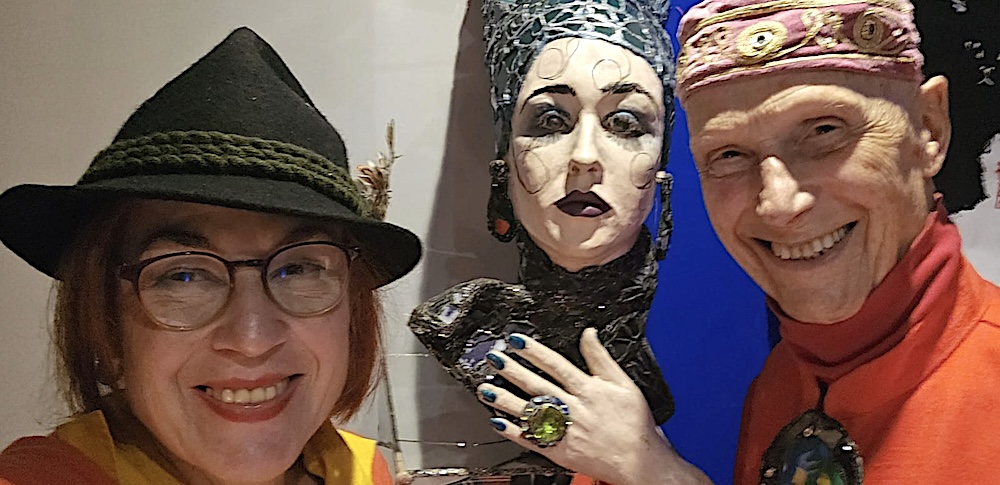
Sophie Parkin and Andrew Logan Photo Courtesy Sophie Parkin ©
I contacted the Tate to ask what the likelihood is of Andrew Logan being exhibited in his lifetime. Whilst we wait for a reply, please do look at his website www.andrewlogan.com. His sculpture museum opens again at Easter, and there’s the lovely 17th-century The Lion Hotel next door. The rooms were designed by Michael and Andrew, now run by a Sri Lankan family, so the food should be excellent.
Top Photo: P C Robinson © Artlyst 2026