

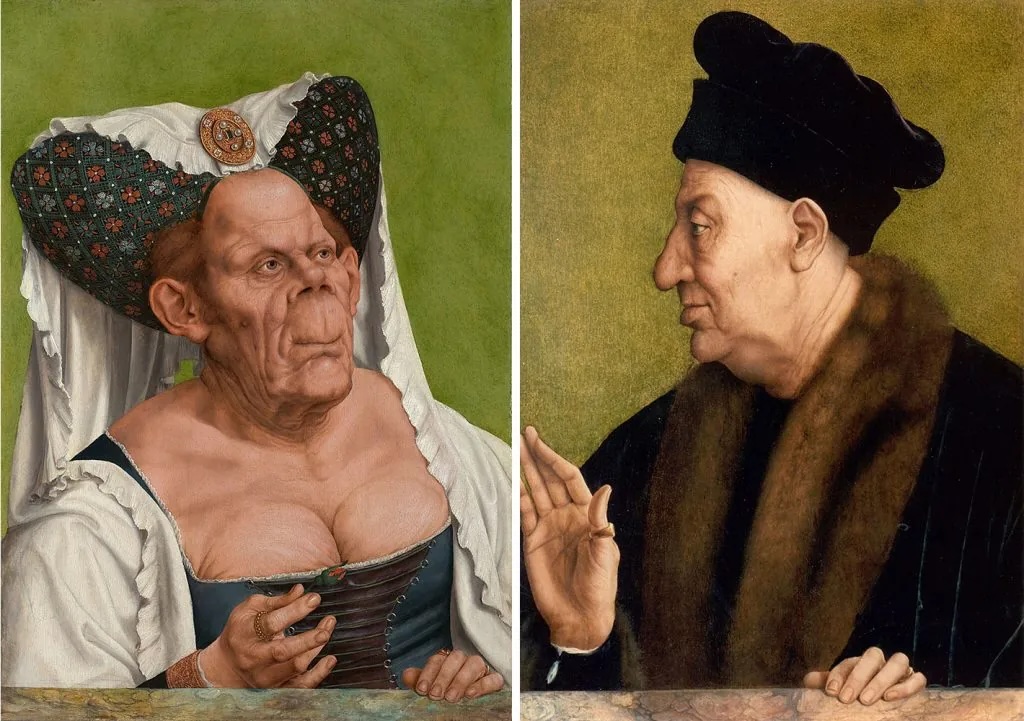
Northern Renaissance master Quentin Metsys’ painting of ‘An Old Man’, a companion piece to ‘The Ugly Duchess’, at the National Gallery, London, is expected to sell for up to £8 million when it goes under the hammer at Christie’s. It is estimated at £6-8 million at the Old Master Paintings evening sale on 8 December.
An Old Woman has hung in the National Gallery since 1947. An Old Man appeared at a market in Paris in 1954 and has been privately owned in New York for at least the past 50 years, so relatively few people will be familiar with it. They are both examples of the grotesque, highly exaggerated and often deformed figures, popular from the Middle Ages onwards. It was a device employed by Leonardo, whose work must have been known to Metsys. According to Maja Markovic of Christie’s, both works satirise conventions of contemporary portrait painting.
An Old Man would have been painted in the 1510s, at the height of his reputation as probably the most prominent living artist in Antwerp. It could well have been one of his earliest experiments with profane scenes. Following completion of his large Lamentation altarpiece, 1508-11, Antwerp Cathedral, he increasingly devoted his attention to such subjects, combining meticulous naturalism derived from the Flemish tradition with various influences from Italy and contemporary humanist thought. Christie’s sees it as an extremely elegant treatment of a ludicrous theme; the contrast between the two is apparent.
Similarly, considerations apply to his female companion, which has continued to pique interest. The subject was reconsidered during the period, 16 March-11 June, of the National Gallery exhibition The Ugly Duchess: Beauty and Satire in the Renaissance. Emma Capron, the curator, went further, saying she preferred to think of her as a male cross-dresser. There was great scope for men to appear as women at carnival, and she was well aware of this; the moresca, a festival dance in parts of northern Europe, commonly featured an attractive girl, generally portrayed as a man in drag. She is described as having penetrating, bright eyes; a short, broad-nosed, snub nose; pockmarked flesh; a mole covered with coarse hair; a protruding brow; and a large, blocky jaw: “every convention of attractiveness” is spurned. Various medical conditions have been suggested to account for her appearance, of which Paget’s disease is perhaps the most likely. None of these possibilities is accepted by Capron, who would also dismiss both dwarfish stature and elephantiasis.
On the whole, she is inclined to think that Metsys produced several grotesques, others less so and some purely imaginary, all perhaps reflecting various aspects of contemporary madness, and to enjoy producing them. One of these may well be that of the older woman, since there is a strong affinity with a drawing of a grotesque older woman’s head. By Melzi, first pupil and heir of most of Leonardo’s possessions, it was borrowed for the exhibition from the Royal Collection, and presumably copies an original by the latter. It is tentatively suggested that the model for The Ugly Duchess could have been one of these.
A comparison of the two figures invites further speculation. Normally, in such pairs of males and females, the male would occupy the left-hand position. Here she holds out a symbol of love, the bud of a rose, to him, and he appears to wave her off. Once more, one might suppose that conventional male and female roles are reversed, supporting the theory of a male model for the “woman”. As one of the most readily recognisable paintings in the Gallery collection, she has had a wide echoing effect on popular consciousness, most notably (it is believed) providing the model for the Duchess of the “White Rabbit” in Tenniel’s illustrations for Alice in Wonderland (1865).
Quinten Massys (also known as Quinten Matsys; c.1466-1530) was one of the most important Netherlandish artists of his time, and the originator of the School of Antwerp.
He was the son of a blacksmith, born at Leuven, and apprenticed as an ironsmith. Tradition has it that he gave up this trade to gain the favour of a certain young lady, who thought painting less noisy than blacksmithing. He went to Antwerp in 1491 and became a master of the Guild of St Luke. With the increasing prosperity and importance of Antwerp as a centre of trade, Massys became the most distinguished painter working there.
His work is a link between the realism of the great 15th-century Netherlandish artists, such as van Eyck and van der Weyden, and Italian influence, particularly that of Leonardo, whose drawings of heads and other studies were clearly very useful to him. Many of his pictures depict common scenes of avarice and other vices, for example, The Money-Changer and His Wife, 1514, and The Ugly Duchess, c. 1513, National Gallery, London. He also produced large altarpieces on religious subjects, full of pathos, for example, St Anne and several versions of The Lamentation. As a contemporary and friend of many humanists, he portrayed a number of them, including Erasmus and Pieter Gillis.
On his death in Antwerp in 1530, he left behind an important combination of Flemish and Italian elements, which subsequent artists, including Rubens, made much use of. Both his sons, Jan and Cornelis, were distinguished artists.