
The American artist Nick Cave and India are the recipients of the two Visitors’ Lions awarded at this year’s Biennale, on 25 November. It was announced three days after the close of the 61st Exhibition. La Biennale di Venezia announced that visitors to the show had voted for their favourites, provided they had entered both the Giardini and the Arsenale sometime between 9 May and 22 November.
The change in voting followed the resignation of all five members of the international jury in April, depriving that year’s Exhibition of its Golden and Silver Lions. All five cited the presence of exhibits from Russia and Israel, over which there had been much controversy since well before the opening. It was made clear some time previously that the jury would not wish to make any award to countries currently represented by heads of state indicted by the ICC for crimes against humanity, which clearly included both Russia and Israel. So it seemed appropriate that the decision be left to the visitors. A large proportion of the individual artists exhibiting in the main show, more than 50%, declared that they would decline to receive a Visitors’ Lion. The award was therefore considerably compromised.
Nick Cave Photo Courtesy Jack Shainman Gallery
Nick Cave was voted best single participant in the main Exhibition, In Minor Keys, curated by Koyo Kouoh, who died earlier this year, before the Biennale opened. Cave continues to live in Chicago, where he was born in 1959, and has become world-famous for his Soundsuits. These can be described as very complex costumes, or perhaps armours, worn over the whole body. In this show, he has presented numerous large-scale works in bronze and a variety of other media, referencing the supposed 7 stages of grief. Flowers are a recurrent theme, as are self-portraits executed in needlepoint, all interspersed with various household objects. Grief and memory are given equal emphasis. A major preoccupation of Nick Cave is metamorphosis. He works in a wide range of media including sculpture, performance, installations and costumes, frequently with very colourful and lavish materials, many about aspects of the self, fragility and relationships.
Probably the most famous examples of his work are his Soundsuits: armatures draped with all manner of objects, including long strands of vividly coloured hair, beads, buttons, and other found objects. All of these obscure the wearer, but provide an impressive envelope of form. They range from the jubilant to the enigmatic and disturbing.
Many dichotomies feature in his work: beautiful and ugly, united and separated, living and dead, and so on. All will be explored in his installation for the Biennale Arte 2026, comprising a procession around various areas of the Arsenale under the overall title Two Points in Time.
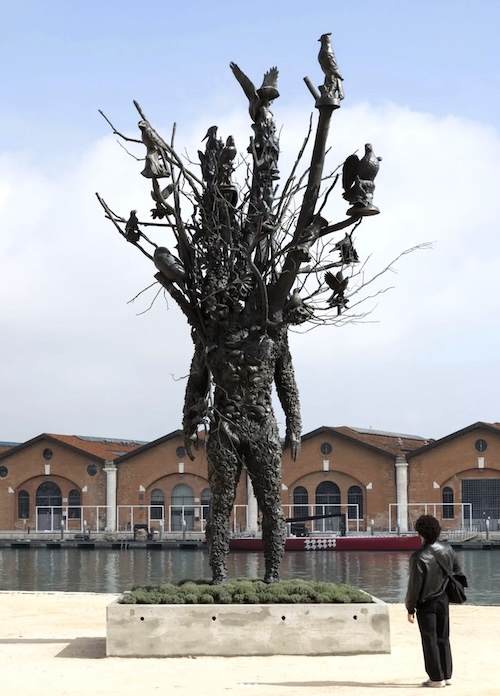
Most impressive, though, was the 26-foot bronze, Amalgam (Origin), sited outside. From the top half of a standing man, tree limbs and various creatures emanate. The work originated from a proposal to create a work which might appropriately replace one of the removed statues celebrating the Confederacy. Unavoidably, it has that connotation: a work to commemorate something by filling the gap left by its loss. Appropriate questions would arise as to the merits of whatever is to be so ennobled.
India was judged the best Pavilion for Geographies of Distance: Remembering Home. After a 7-year absence, India was represented by the National Gallery of Modern Art, acting on behalf of the Ministry of Culture. The Exhibition was curated by Amin Jaffer and occupied a sizeable area of the Arsenale. It has been featured in Artsy’s selection of the top 10 national pavilions at the 2026 Biennales, so it is little surprise that it has been successful with visitors.
The exhibition comprises works by 5 Indian artists, each responding to the theme in different ways and incorporating traditional techniques and materials. All imply that “home” may well be somewhere one has previously inhabited, or may be a construct based on memories and emotions, and for those who have moved many times, over many years and places, can become a combination of objects, practices, beliefs and other intangibles to be carried with one from place to place. Thus, for Jaffer, it can consist of actions and memories, but will constantly change and develop to suit changing conditions and environments.
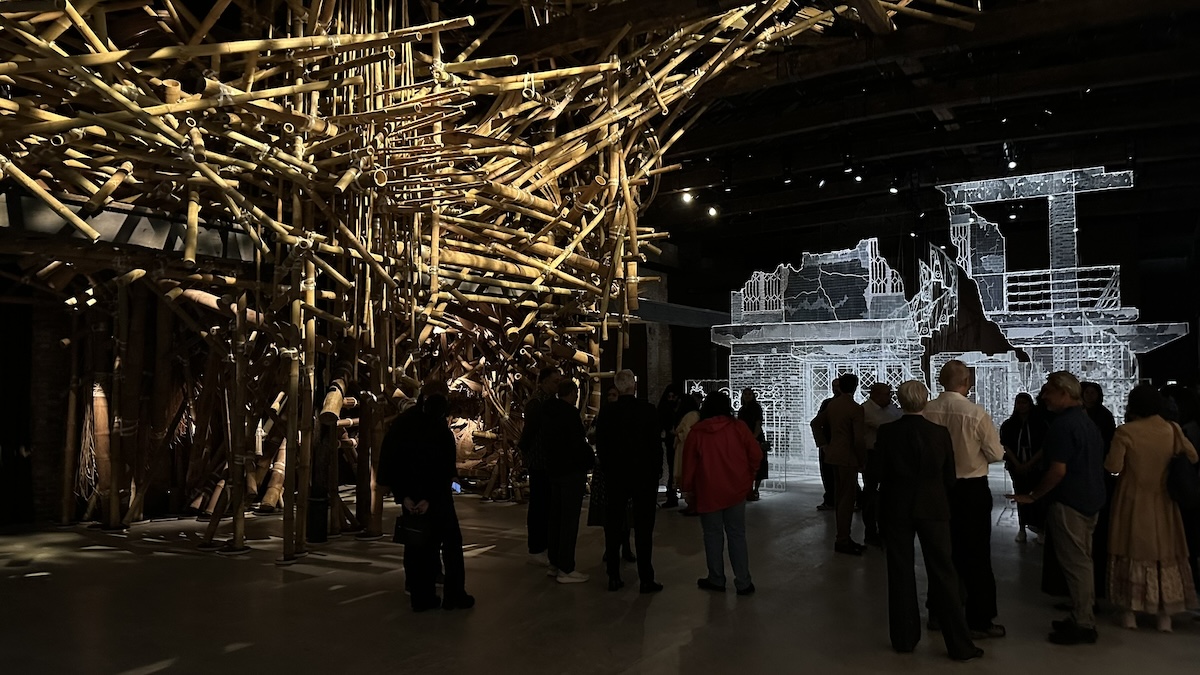
One such condition was the extraordinary rate of urban growth. Much of the material used by the various artists reflects this, and its vulnerability. So Balasubramaniam uses earthenware and clay to allude to the earth’s thin skin. Singh has painstakingly re-created the house in which she grew up, since demolished, entirely in stitch, producing something exquisitely fragile, only as strong as the stitching. Shettar has produced an array of hanging plant forms from natural materials. Plant life obviously features prominently throughout Indian culture.
Sonam Tashi had created several examples of modest buildings in papier-mâché, reminiscent of those in Ladakh, which are now increasingly at risk of modernisation. In contrast, Asim Waqif has produced an exuberant and seemingly vast spread of canes and bamboo, much of it erected de novo in the Arsenale, evocative of the rapidity of much contemporary construction and its obliteration of previous structures. The contrast with the vulnerable buildings opposite is self-evident.
There will always be a difference between what is most popular and what is most deserving, and this year’s awards are inevitably tainted by their origins. However, it seems reasonable that the overwhelmingly attractive and compelling work of someone such as Nick Cave should be highly popular, and that a sensitive, beautiful and skilfully crafted exhibition, very appealing on a tiring visit around the Arsenale, should also appeal to visitors.
The 61st Exhibition has come to an end, with no immediate prospect of another. But controversy over which countries should be featured and who should judge them will continue.
Top Photo: P C Robinson © Artlyst 2026