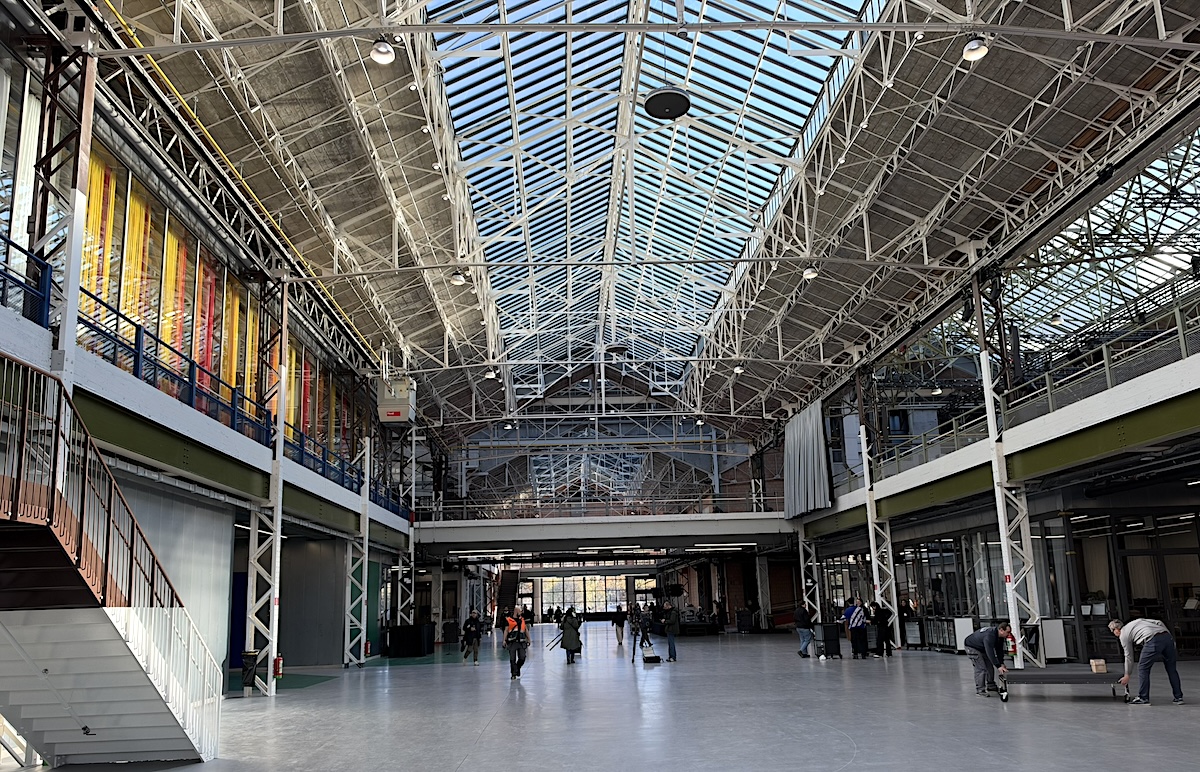
A brand-new, modern/contemporary space devoted to art and architecture, located in the heart of Europe, will open to the public in Brussels over the weekend. It is billed as the biggest museum space ever created in Europe, with some 40,000 sq m and 5 floors of exhibition and performance space for dance, music, cinema and architecture. It is located along the Charleroi canal, in a large former-Citroën showroom and workshops, and will be open continuously for 36 hours, starting at 10 am on Saturday 28 November.
Built in 1933-34 from reinforced concrete, metal, and glass, it comprises the tall corner block on the main road frontage and a series of long, low sheds extending well away from it. A consortium of architects (EM2N, noAarchitecten and Sergison Bates), as part of a much larger international group, Atelier Kanal, with the involvement of over 3,400 artisans and others, has repaired and refurbished much of the fabric, and inserted 3 new areas.
Admission to all exhibitions will be free until 10 pm on Sunday, and all 30,000 tickets have already been allocated, a reality check of demand for such a venue in Brussels. However, there are many other attractions spread over well over 20,000 sq m, all freely accessible. The building houses an enormous array of galleries, plus a roof terrace that resembles an ocean liner, overlooking much of the city. Several libraries, a bookshop, a children’s play area, a bakery, and food outlets, including the restaurant Brasserie Carrosserie, are part of this multipurpose space.
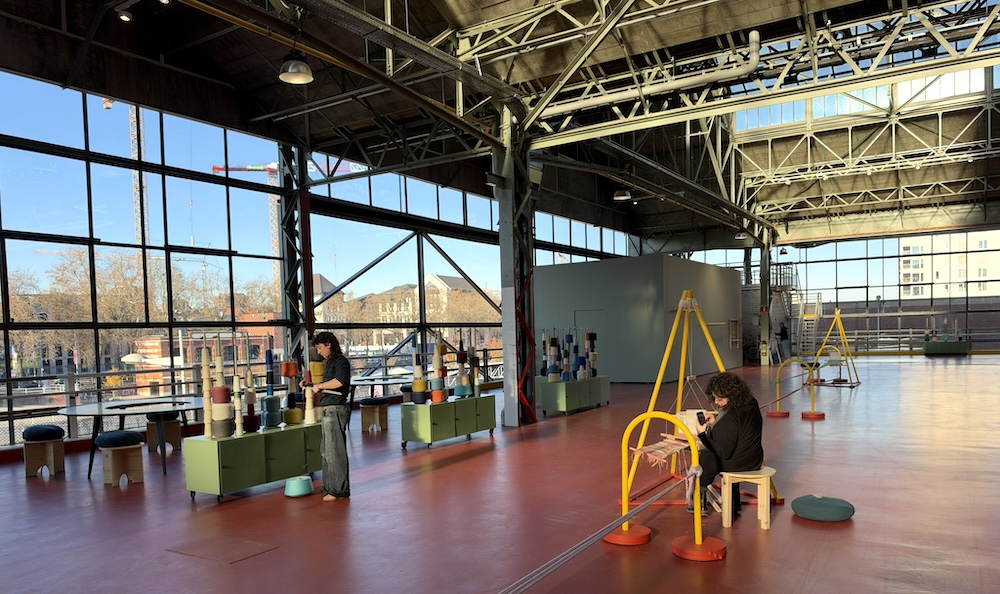
Schoolchildren, about 5,000 from 27 primary and secondary schools, are visiting throughout the day today (Wednesday). Kanal has had links with many of them over several years, and would presumably like as wide a cross-section of young Brusseleans as possible to regard the venue as “their” museum. Visitors can try their hand at various types of weaving, chatting to expert “locals” at the frames in a sizeable room converted for this purpose by Otobong Nkanga. Admission free. A variety of items relating to traps and trickery have been collected from as many as 11 museums, including the Museum of Medicine and the National Museum of Resistance and Freedom, for Département des Pièges, supplemented by works by a variety of contemporary artists, some of whom are Guillaume Bijl, Kasper Bosmans, Pélagie Gbaguidi, Miao Miao.
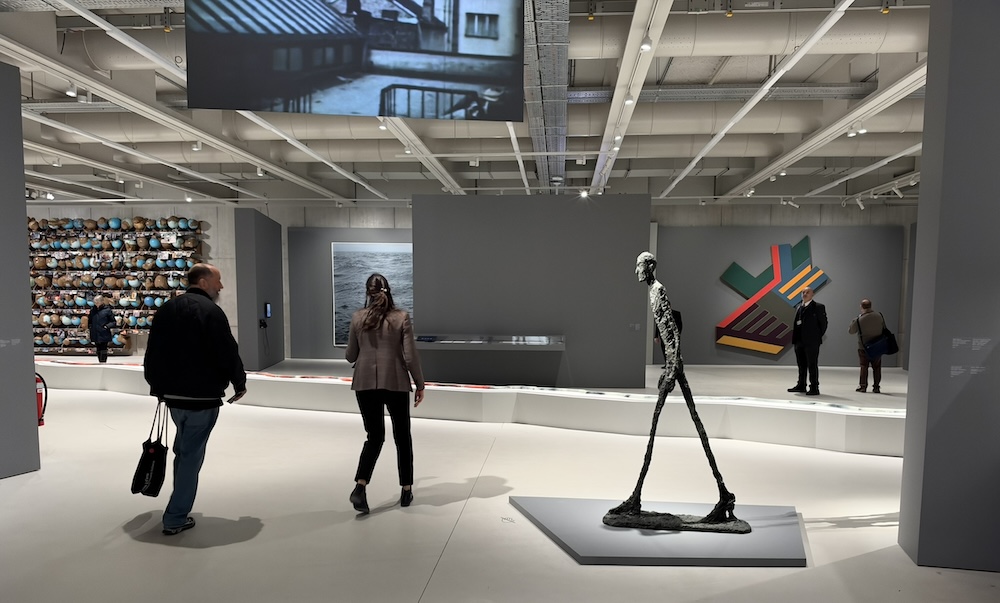
Centre Pompidou has been closely involved in many aspects since 2017, from determining appropriate areas and facilities to assisting with acquisitions. It is expected that there will be several co-organised exhibitions between them each year. Xavier Rey sees parallels with Centre Pompidou’s desire to be more outward-looking and accessible to all comers. After 10 years of development, Yves Goldstein would like all sorts of activities taking place at Kanal: reading, doing business, relaxing, and so on.
More than 350 artworks illustrating various aspects of thinking over the last century, largely from the collections of Centre Pompidou and now also Kanal, form the main exhibition. In addition to Lygia Clark, Sonia Delaunay, Giacometti, Goncharova, W. Lam, Matisse, and Picasso, a good number of living artists are represented, including Sammy Baloji, Edith Dekyndt, Aglaia Konrad, and Hana Miletić. Selection was made jointly by curators of each institution.
Several others are more specific. An infinite woman, in 2 parts, concerns representations of women of the Mangbetu tribe in the Congo, re-interpreted by artists with African roots. A typical example is a woman’s head used to promote La Croisière Noire, the much-publicised series of motor vehicles driven lengthways through Africa by Citroën in 1925. Some 10 years later the garage would begin to operate, presumably selling, inter alia, dreams of colonialism. Appropriate, therefore, to locate the exhibition in these premises. A range of artists is represented, including Simone Leigh, Lorraine O’Grady, Magdalene Odundo, Faith Ringgold, Carrie Mae Weems and Barbara Walker. Admission is payable.
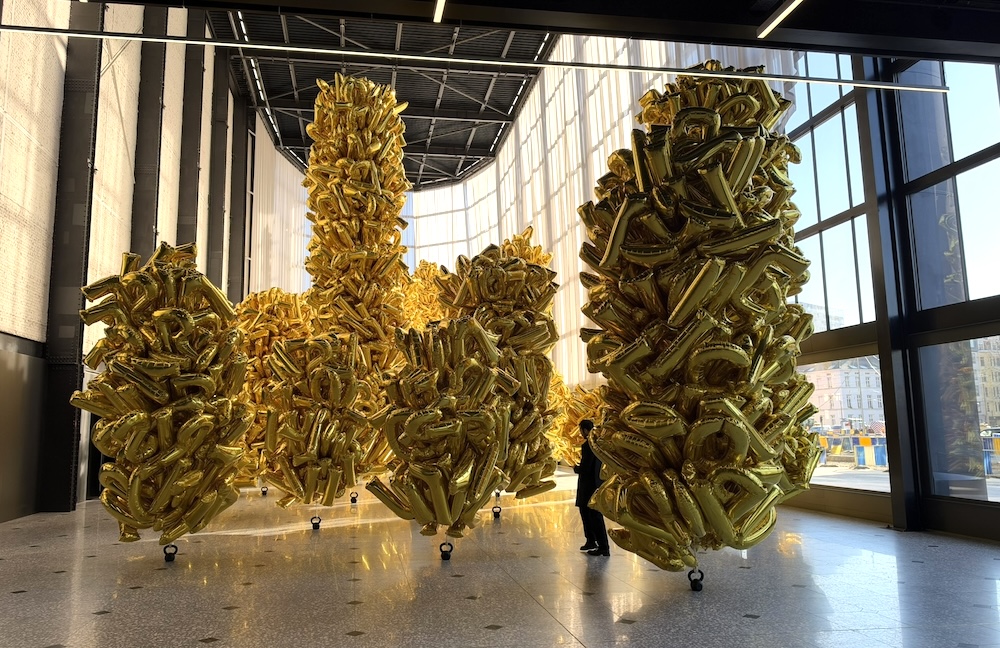
All 30 proclamations of Human Rights, as set out in 1948, are inflated into gold-coloured balloons by Banu Cennetoglu, filling the whole height of the freely accessible Showroom. Gradually deflating, they lose their corresponding force and importance; all too many of the proclamations go unheeded throughout the world today, and this is dramatically conveyed. Apparently no one has previously displayed all of them simultaneously. This will continue towards the end of May.
The very tall underground room has prompted a series of works by Joëlle Tuerlinckx. She spent about 2 years at various stages during its construction, from draining it after flooding to erecting its sides, and the series, with a soundtrack by Christoph Fink, evokes aspects of the canal, works in progress, and the final room.
Several exhibits aim to be at least mildly amusing, not least that by Deborah Bowmann and Maoupa Mazzocchetti with about 20 other artists, mostly based in Brussels, on the possibilities of amusing people in a museum, not far from where a fairground was sited in the early days. Visitors are conducted round 5 variously equipped rooms, of lights, music, projections, live performances and so on, by an untrustworthy narrator. Films by Joshua Serafin all refer to other films made by his Japanese precursors, in the Philippines from about 1909. A restful acoustic environment is offered by Manon de Boer.
A wing is devoted to Architecture, based primarily on existing CIVA collections. Brussels should be seen as an innovative forerunner in many aspects of town planning and development, according to Right to the City, Right to the Future. However, it must face up to, amongst other negative actions, the wiping out of much of the adjacent Quartier Nord. Studies by Adelita Husni-Bey and the Right to Housing association are included.
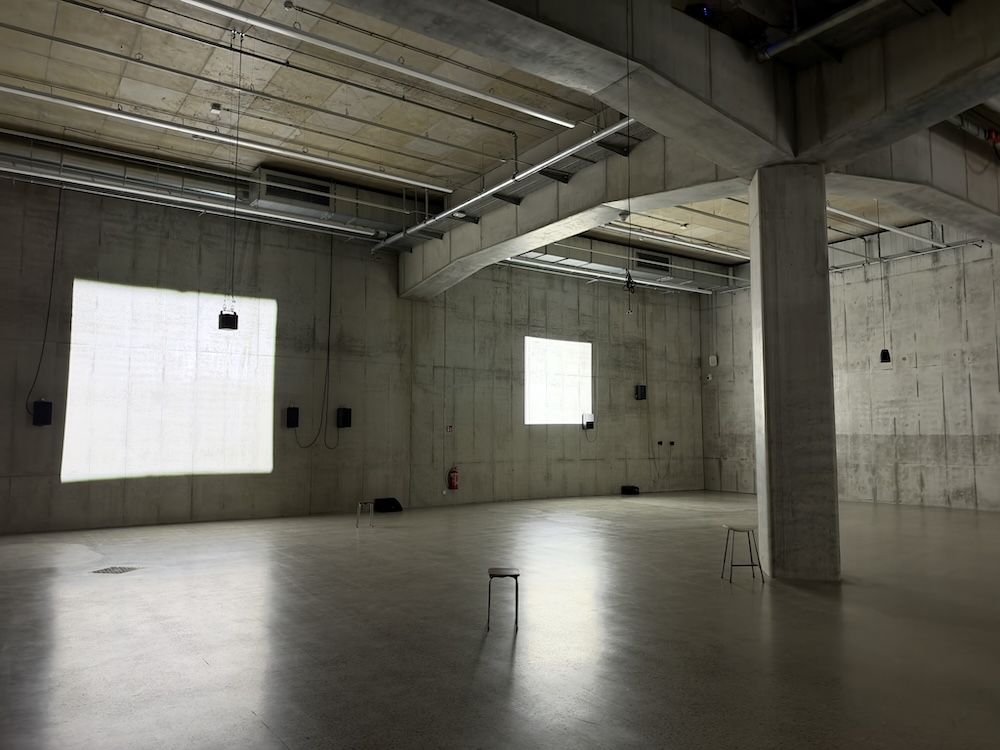
There will be an ongoing programme of performances, initially including those by Apparatus 22, Hans Haacke, Sharon Hayes, Valentina Magaletti, Ula Sickle, Miet Warlop, and all 3 works in Harald Beharie’s Trilogy (Batty Bwoy, Undersang, Sweet Spot).
Children over about 4 years will enjoy various features over some 700 sq m created by the artist collective Assemble. The mounds and heaps allude to the coal once delivered and stockpiled on the canal, but may well suggest other phenomena to youthful imaginations. Various ropes, tyres, and face covers to climb on, crawl on, and hide behind dot the area. A group of printmakers, WERKER, will occupy a studio adjacent to the Showroom for at least 2 years.
Words/Photos P C Robinson © Artlyst 2026
PUBLIC OPENING: SATURDAY 28 NOVEMBER 2026