
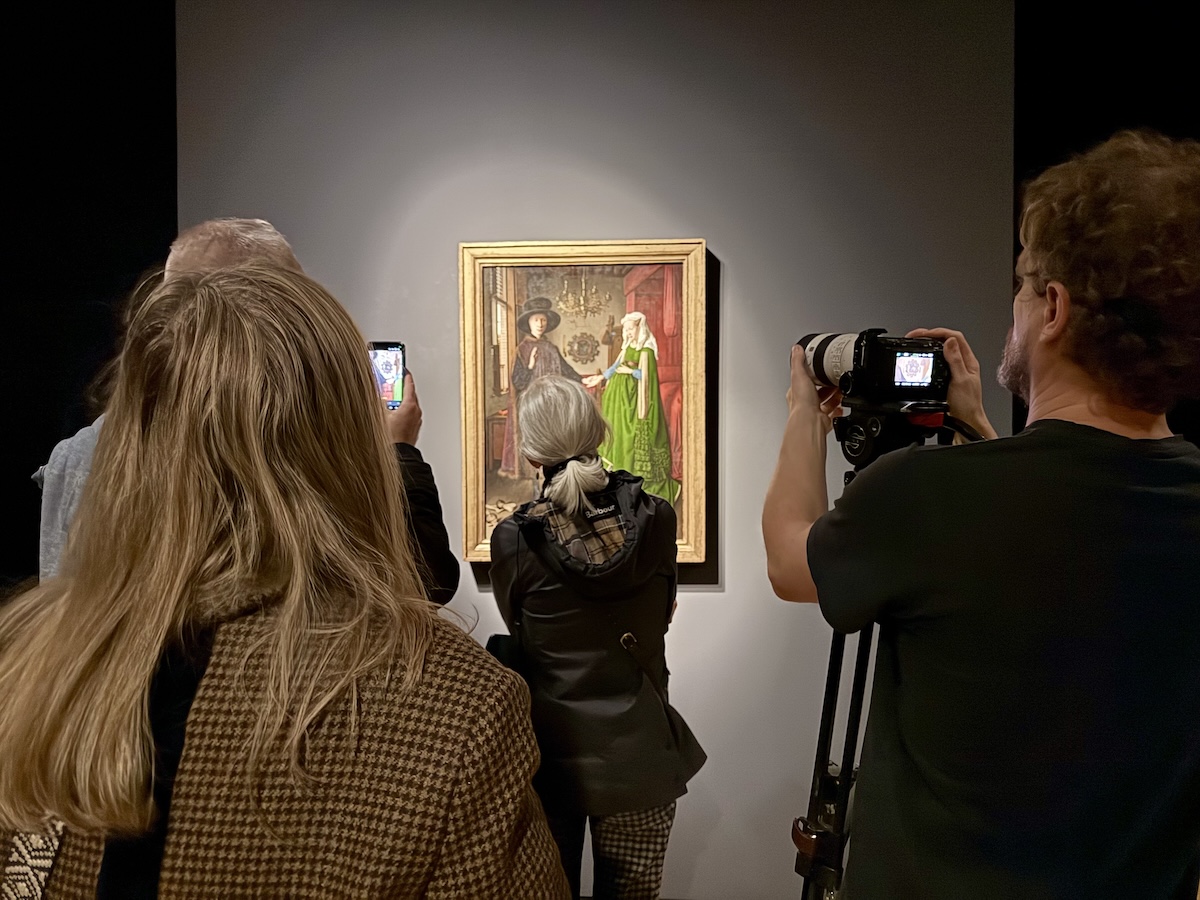
One of the most brilliant things about the National Gallery’s Van Eyck exhibition is that you can walk behind some of the paintings. We’re used to seeing portraits hanging on a wall, with the sitter facing us, but most of these panels were small enough to hold in your hands and turn over. On the reverse of several portraits, Van Eyck painted the wood to imitate polished marble, precious metals, or even leather, taking as much care over what we think of as ‘the back’ as he did over the face on the front. I like imagining someone tilting a portrait towards the light to see how he’d done it, then turning it back to look at the face again. The display gives us a sense of the pleasure of handling these paintings as objects, simply by letting us walk around them.
The exhibition brings together all ten of Van Eyck’s known painted portraits, including The Arnolfini Portrait, and his only surviving drawing, an exquisite study of an elderly man on loan from Dresden. Van Eyck wrote directly onto the drawing, recording the reddish hue of the forehead, the brownish-yellow eyes and the pale purplish lips. Shown alongside the related oil portrait from Vienna’s Kunsthistorisches Museum for only the second time in nearly six hundred years, the drawing makes it possible to follow some of those observations from the page to the painted panel. A coup de théâtre for the National Gallery curators.
What makes Van Eyck feel so modern is his attention to the things a sitter might have preferred him to overlook, from the redness in an eye to the strands of hair that had slipped out of place. Where earlier portraits often emphasised rank and how a sitter wished to be seen, Van Eyck paid attention to the particulars of a face, including details that might have looked different the following morning. Seeing these portraits together at the National Gallery, you get the uncanny feeling that you could recognise some of these people in the street, six centuries after they sat for him.
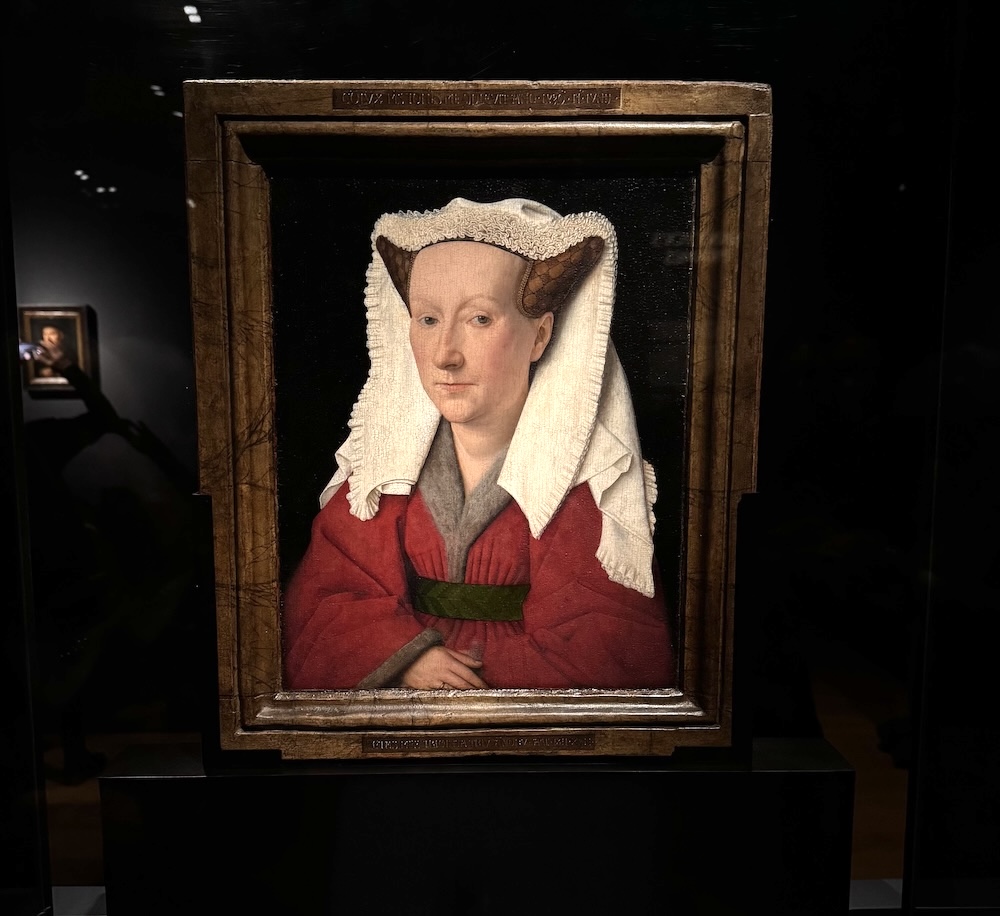
Portrait of Margaret van Eyck by Jan van Eyck, 1439
My favourite is the portrait of Van Eyck’s wife, Margaret, and although I could spend ages looking at the folds of her white headdress or the tiny scar on her eyebrow, it’s the frankness of her expression that keeps drawing me back, making me wonder what she made of being looked at so closely by someone who knew her so well. She’s one of only two women in the exhibition, and the company she keeps is revealing in its own right, with merchants and skilled craftsmen alongside men of rank, giving us some sense of who could afford to have a likeness painted in the fifteenth century.
I made a film about The Arnolfini Portrait, which looks enormous here among these small panels, so I was especially curious about Stephan Kemperdick’s suggestion in the exhibition catalogue that the couple might be Van Eyck and Margaret. He draws attention to the inscription above the mirror, ‘Jan van Eyck was here’, and to the little figure carved near the bed, often identified as Saint Margaret, whose presence takes on a more personal significance if the woman standing beside it shares her name.
I’m still mulling it over. Margaret’s eyes are grey-blue in her known portrait, while the woman in the double portrait has brown eyes. Having seen Van Eyck’s notes on the elderly man’s colouring, I find that difference hard to dismiss.
But what I do love is that a painting nearly six hundred years old can still make headlines, especially when the argument sends you back to the pictures to look at something as small as the colour of an eye.
My only reservation is that a show this popular can make it difficult to get as close as you’d like. It’s a cliché, but this really is a once-in-a-lifetime exhibition, and the people ahead of you will want to linger. Be patient, as it really is worth waiting until you can see up close just how unevenly the stubble grows on the chin of the man in the red headdress or pick out the fine red veins in his eyes or resist touching the fur collars of the man in black. Detail after astounding detail makes this the kind of show you want to see twice, if only because by the time you reach the last painting, you’re already thinking about what you might have missed in the first.
Then walk around one of the panels and look at the veins in the marble. What interests me is what happens when you come back around to the face. A moment ago, you were looking at paint and taking it for stone, and now you’re doing much the same thing with skin.
On one side, you would swear that stone was cold; on the other, you’d swear his skin was warm. It’s no wonder his contemporaries called him “an alchemist”.
Van Eyck: The Portraits, National Gallery 21 November 2026 – 11 April 2027
Visit Here
James Payne writes further on The Arnolfini Portrait in Chapter 2 of his book Great Art Explained
Great Art Explained: The Arnolfini portrait is available on YouTube: