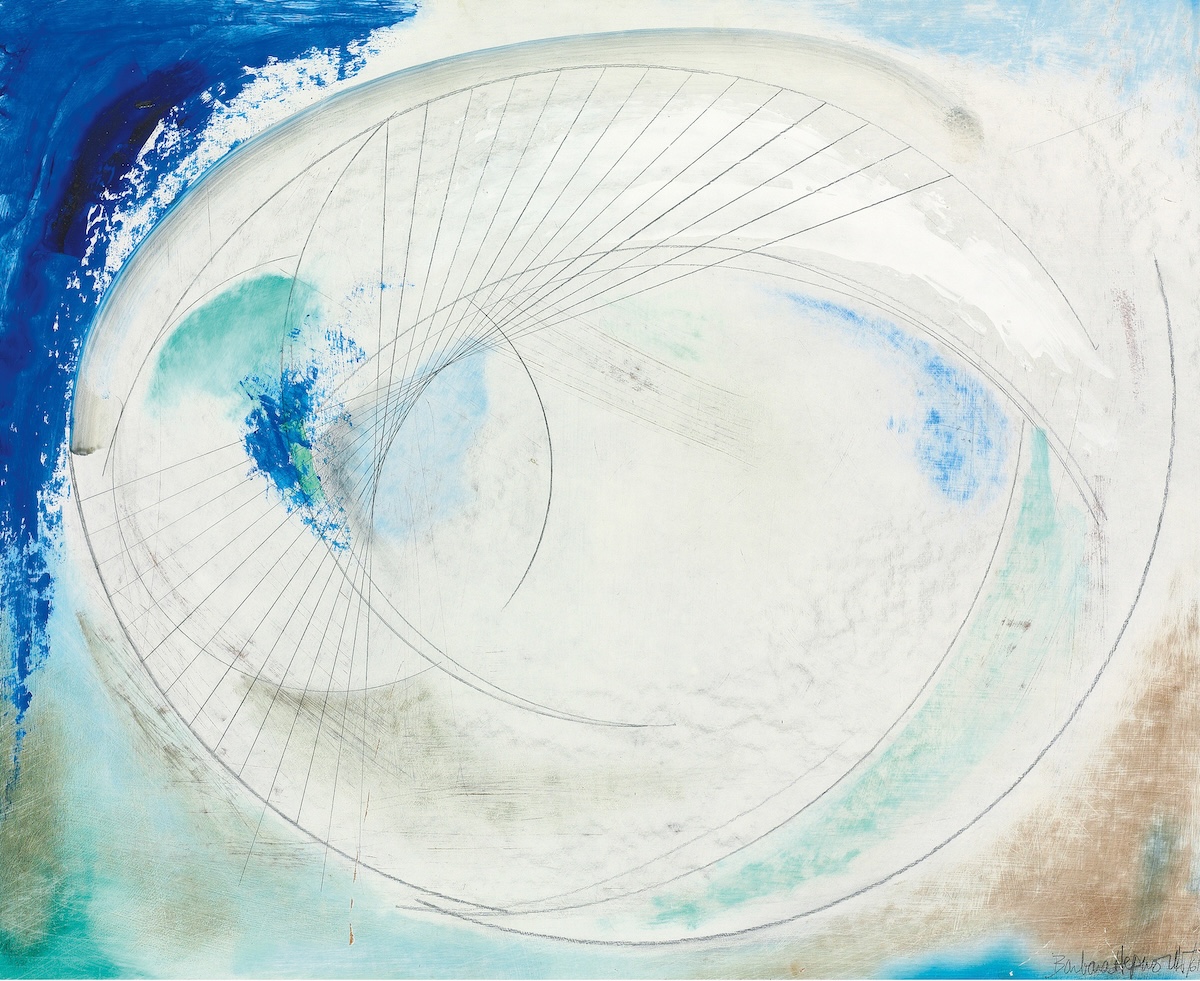
Pallant House shares a new selection of some 40 works examining how Greece brought new life to her aesthetic. While this Summer’s Hepworth in Colour show at the Courtauld Institute in London was remarkable, the Pallant House works have an abstract, holistic femininity. All these works, on paper or sculpted, make it clear why Barbara Hepworth is one of the world’s great 20th-century sculptors. Her monumental bronze Single Form (in Memory of Dag Hammarskjold) , inaugurated at the United Nations Headquarters in New York in 1964, is unsurpassed.
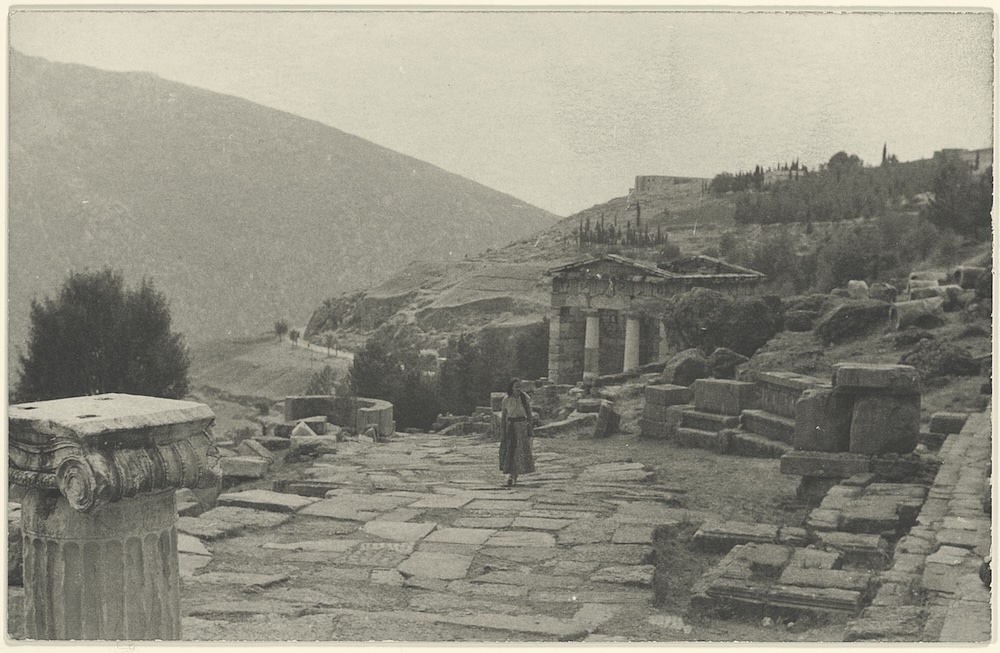
Barbara Hepworth at Delphi, August 1954 copyright Bowness
In 1954, the Whitechapel Art Gallery held a show described by then-Director Bryan Robertson as “one of the most important exhibitions of sculpture ever held in this country.” Sadly, her son Paul Skeaping had died the year before in a plane crash in Thailand. An invitation to visit Greece by boat gave Barbara a much-needed break. The Aegean sea stripped away some of that sadness, for here was light, colour and archaic beauty. Greece was a sculptor’s country, rife with ruins, monuments, temples, sculpted traces… The feel of such a place was about cultural origins, and quintessentially human. Hepworth was attached to the rhythms of the land since her childhood in Yorkshire, and of the sea at St. Ives. Greece brought more spiritual depth to her remarkable abstract idiom. Here was history, the birth of mythology, and the Aegean colours – light itself.
One of the most compelling works in the Pallant House show is Pelagos (1961). It’s a sculpture that captures it all. Integrating her string motifs and openings in space, it becomes a hymn to the universal and archaic synthesised in Hepworth’s own unique way. Included in the show is a John Vickers photo of Peggy Ashcroft with Hepworth’s Apollo (1951). Hepworth’s stage designs for Sophocles ’ Electra were bold and abstract. Hepworth’s works inspired by Greece were influenced by ancient sites such as Mycenae, Epidaurus, Delphi, and Patmos. For her, Greece was “the embodiment of a sculptor’s landscape”.Curved Form (Delphi) 1955, with its brown, stringed linear elements within, is like an ancient lyre, inspired by this site for Apollo, God of light, beauty, music, and the arts.
The substantial, large carved forms made from Nigerian guarea wood in the show are sensual, evocative, and an unveiling of something more ancient than any earlier Hepworth works had been. As a woman working in her era, Hepworth was quite remarkable, for the abstraction she worked with had its own personal universe. The actual world gave way to an inner world that was always there. Something connected Hepworth to nature and the cosmos…
“I, the sculptor, am the landscape. I am the form & the hollow, the thrust & the contour.’” Two Forms with White (Greek), originally carved in dark guarea wood, a darkness darker than primaeval, speaks of time itself. The two standing forms/figures were cast in 1969, enabling the works to be shown outdoors—a simple poetic of inter-relation: two in space.
Each work exists as an entity and has its own magnetic resonance. The closed forms, ovals, spheres, or pierced forms exceeded any sculptor’s way of seeing. With ever-changing perspectives and angles, they are an homage to all of our origins.
Earth-based Hepworth reified life’s eternal mystery and continuity. She always had a profound sense of spatial dimensionality. Figure (Archaean) (1959) evokes such a feeling – ‘archae’ in Greek means ‘beginning’ or ‘ancient’. Bronze torsos recall ancient sculpture but equally her own evolved sculptural idiom. Aegean (1956) has a feel of the warp and woof, of waves or a rhythm, but it’s a simple metaphor. The show includes a sketchbook Hepworth made. We can see how her notes and diaries fuelled her art long into the future. She always had a profound sense of spatial dimensionality.
An entire room is devoted to the Aegean Suite ‘Twelve Lithographs’ (1969), printed by Stanley Jones at Curwen Press. This remarkably playful set of works made late in life uses the circular motif, the emblematic sun and moon, and other celestial or outright abstract motifs. We can feel the movements of fields of energy and figurations that are, above all, abstract. Mycenae (1969), for example, has a Piet Mondrian feel to its colour form arrangement. Yet again, another rare viewing of the great Barbara Hepworth’s remarkably aesthetic, something rooted in a spatial and experiential, ever-revolving, evolving experience. Barbara Hepworth is indescribably archaic and feminine.
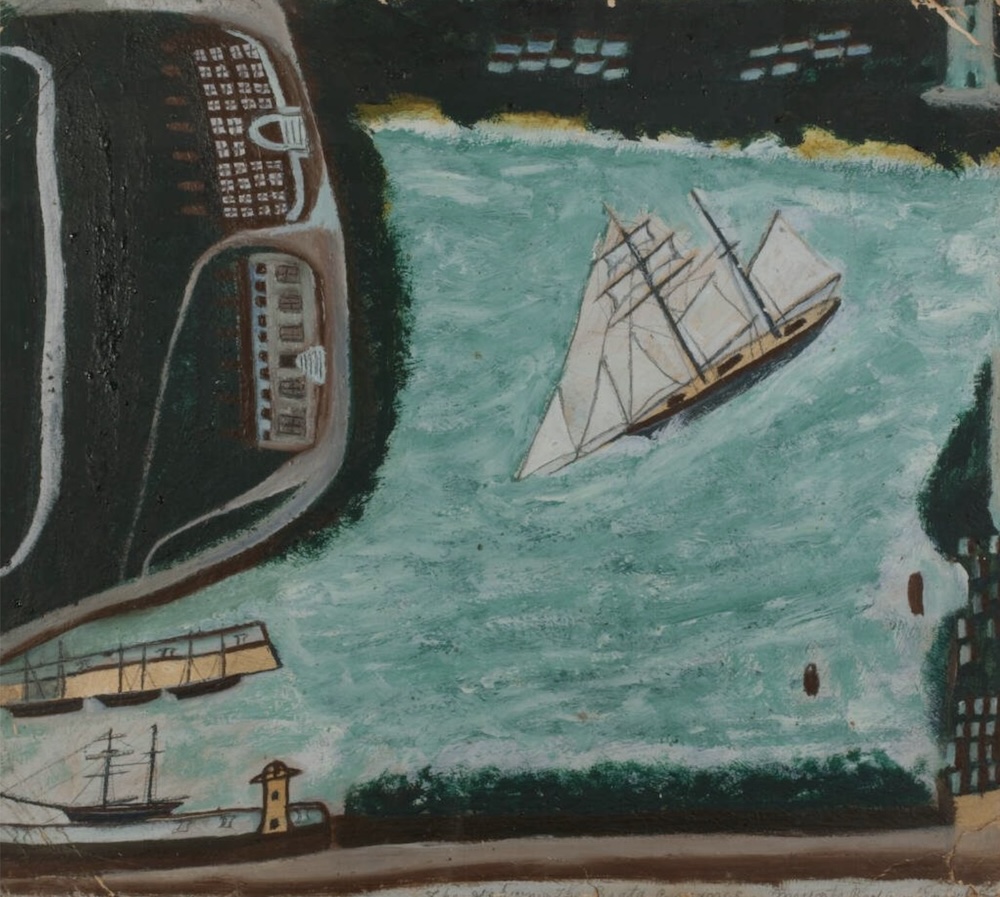
Alfred Wallis, The Schooner the ‘Beata’, Penzance, Mount’s Bay and Newlyn Harbour, n.d., Oil on board. Private Collection
Alfred Wallis – An Artists’ Artist is a discovery for anyone not aware of his art—the show pairs with Barbara Hepworth, adding some context to the St. Ives where Hepworth lived. Alfred Wallis (1855-1942) is a superb artist from the St. Ives area. Curator James Scott made clear in his talk that Wallis was a source and force that helped establish abstraction among younger St. Ives artists in the pre-war era. Admired by all, Wallis was a seaman. He was a magnet who drew so many artists: Ben Nicholson, Winnifred Nicholson, Christopher Wood, Bernard Leach and Patrick Heron ( his best friend at school). The Red Table, St. Ives (1950) by Heron is in the show.
Brilliantly curated Alfred Wallis, An Artist’s Artist, juxtaposes Wallis’s works collected by artists with 14 of those self-same artists’ paintings – Adrian Stokes, John Wells, Peter Lanyon, Terry Frost, William Scott, Roger Hilton, Winnifred Nicholson, Wilhelmina Barns-Graham, Ben Nicholson. The whole show intertwines into a bouquet – Wallis and the artists he knew. Exchanged enthusiastically, gradually growing the art that would in the post-war era become a seminal point of departure for abstraction. Is this art really naïve? One wonders, for Wallis is so effective in bringing the sea and harbour scenes to life..
Wallis, the outsider artist with nothing to prove, was collected by many for his brilliant spatial distortions and the paint and texture of a rumbling universe. This show is ultimately about the ever-so-local universe of St. Ives’ artists and Wallis’ art – the sea, rife with boats, bridges, lighthouses, and houses, is part of that. Texture with texture, rough ‘n ready all these works have a resonance born in the moment. Not art, but visual experiences. Seven Ships at Sail in Harbour and Saltash Viaduct are but two of the works that have a sense of adventure, of a journey. The longest journey as a seaman Wallis ever took was to Labrador on the east coast of Canada in the 1930s. Several of the Labrador paintings with icebergs are, for their textural immediacy, almost abstract, for their simple forms – poetic.
Alfred Wallis’ paintings have a raw, fluid, and textural immediacy, as alive as the day they were painted. Smaller works made on envelopes now unfolded have as much presence as the larger ones. Clouds, shadow, the gust of wind, sails and schooners, stacks, houses, piers, life by the sea. A seldom seen ”naïve” artist!
Both Hepworth and Wallis are worth the visit.
Barbara Hepworth and Greece / Alfred Wallis: An Artists’ Artist, Pallant House Gallery, 21 November 2026 – 2 May 2027
Visit Here
https://en.m.wikipedia.org/wiki/John_K._Grande
Brief bio + publications for John K. Grande…
https://www.amazon.com/author/johngrande
Art Space Ecology; Two Views Twenty Interviews
Black Rose Books / U. of Chicago, 2018)
http://press.uchicago.edu/ucp/books/book/distributed/A/bo34137373.html