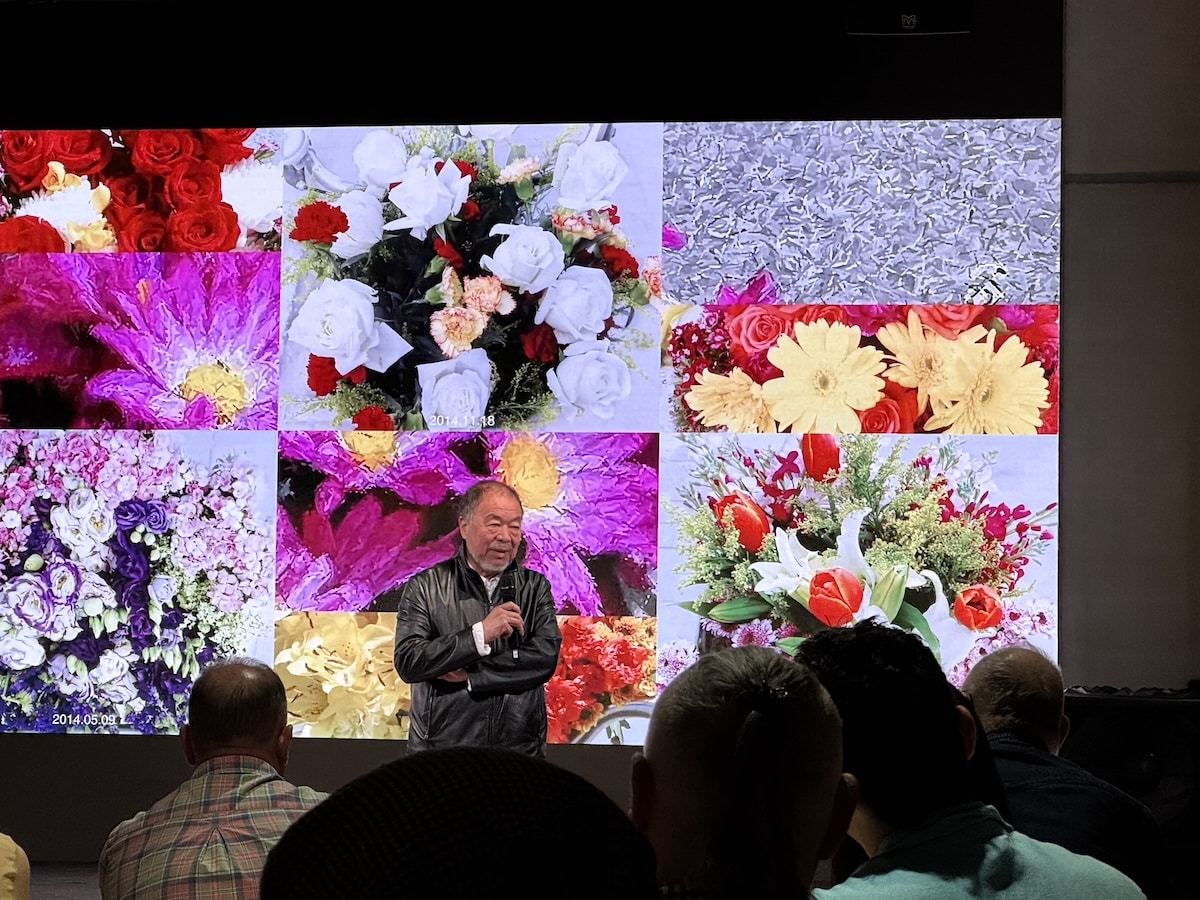
Aviva Studios in Manchester, part of Factory International, is a vast warehouse space. Renowned Chinese artist and activist Ai Weiwei has spent the last four years planning how to utilise this immense area, and he certainly makes an impact. As you enter, you cannot help but feel overwhelmed by its sheer size, scale, and volume. Ai Weiwei has said, “I’m not interested in making very big things just for the sake of it. But in Manchester, that wonderful Warehouse space calls for monumental work”.
The exhibition draws inspiration from Manchester itself, the birthplace of the Industrial Revolution where textile factories made the city rich. Ai Weiwei sets out to explore the legacies of British imperialism, Chinese-British relations, and the rise of globalisation. He examines how historical systems of trade, empire, and exploitation continue to resonate in today’s humanitarian and political crises. He references significant events such as the Opium Wars, migration and the journeys of those who cross oceans in search of better lives. He touches on the triggers of war, the impacts of colonialism, the importance of craftsmanship, human vulnerability, and the environmental crisis. The title “Button Up!” playfully alludes to Ai Weiwei’s ongoing struggle with censorship.
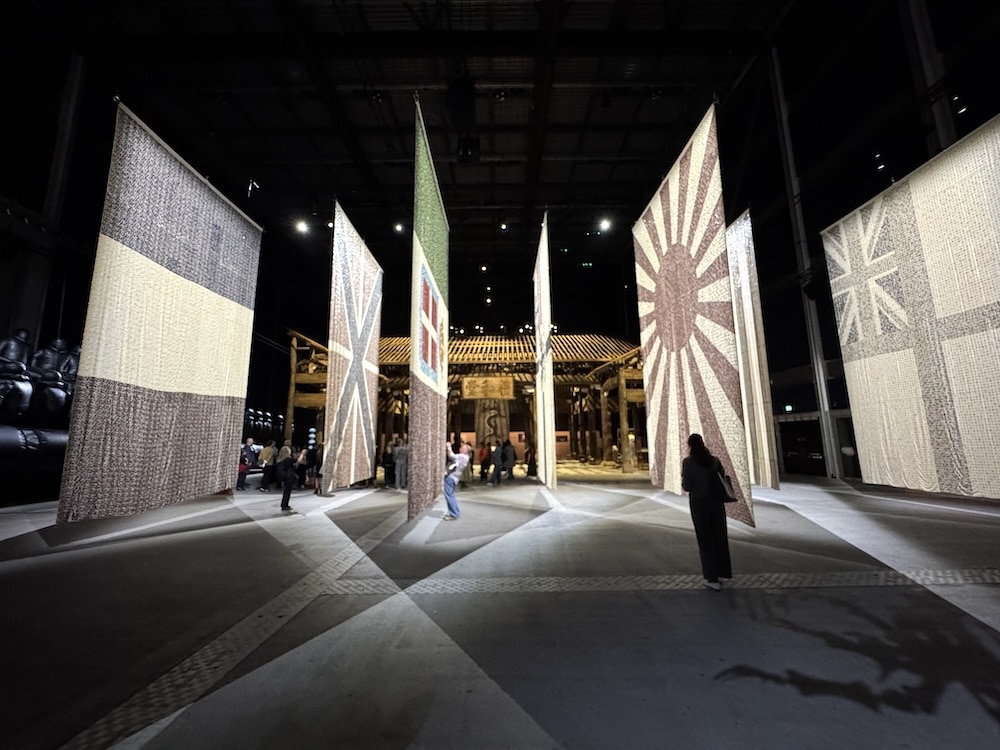
Ai Weiwei, Eight-Nation Alliance Flags
He has created two new commissions for the exhibition. Eight-Nation Alliance Flags is a monumental work comprising eight flags, each made from close to half a million buttons. The installation centres on the history of the early 20th-century invasion of China by the Eight-Nation Alliance, comprising Britain, France, the USA, Germany, Russia, Japan, Italy, and the Austro-Hungarian Empire. The buttons symbolise industrial manufacturing. 30 tonnes of buttons were bought from A Brown & Co Buttons in Croydon when it closed in 2019. The buttons were then sent to China, where 4 million were used to create the flags.
History of Bombs is a 25 x 10-metre mural featuring life-size models of conventional weapons of mass destruction made from 3.5 million toy bricks and is the artist’s largest-ever toy brick artwork.
Ai Wewei has invested his life and work in advancing human rights, freedom of expression, and speaking out against censorship, often at the expense of his personal safety. Born in Beijing in 1957, his father, Ai Qing (1910-1996), was an idealist ‘poet of the people’ persecuted throughout the artist’s childhood, who is still regarded in China as a national hero. In April 2011, Ai Weiwei was arrested at Beijing Capital International Airport for “economic crimes” and detained for 81 days without charge. As part of the exhibition, the artist will present a unique 24-hour durational performance piece that reenacts his time in incarceration. His prolific practice encompasses sculptural installation, filmmaking, photography, ceramics, painting, writing and social media.
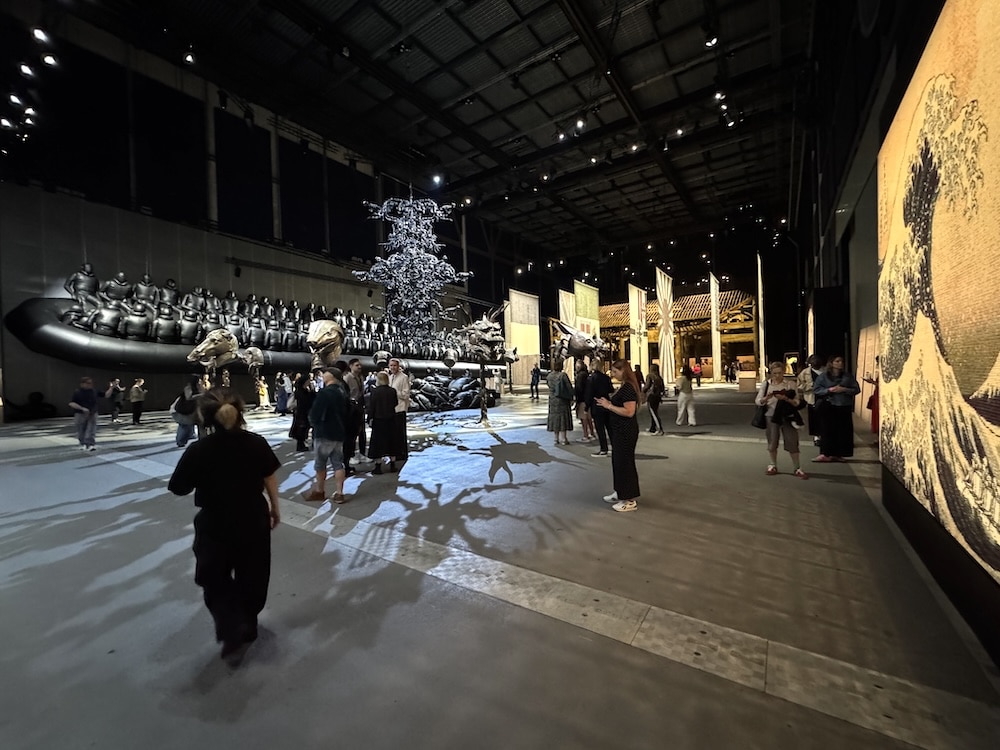
Ai Weiwei, Button Up! installation view
The vast space is crammed with political artworks, and at times feels overloaded, each injustice competing for an individual space. The large-scale Law of the Journey (2017), a 49m-long inflatable migrant boat containing hundreds of human figures, is pressed against the side wall, losing some of its impact. La Commedia Umana (2017-21), a black Murano glass chandelier composed of over 2,000 glass pieces, featuring human bones, skulls, and internal organs, is suspended over inflatable bodies of migrants, surrounded by the Circle of Animals/Zodiac Heads (2010), the animals of the Chinese zodiac. A sound piece in the exhibition is a recitation of the names of the 5,197 children who died in the 2008 earthquake in Sichuan, China. Ai Wewei travelled with volunteers to the earthquake-devastated areas to document the names of victims and collect evidence to prove that school buildings had collapsed due to inadequate construction. The Wang Family Ancestral Hall (2015), a Ming dynasty ancestral temple reassembled from 1,500 individual wooden pieces, encapsulates China’s past. A porcelain pillar with six image motifs relates to the refugee experience: Warm Ruins, Journey, Crossing the Sea, Refugee Camps and Demonstrations and references different styles in art history, including traditional blue-and-white Chinese porcelain and early Greek and Egyptian carvings and pottery. An antique Qing dynasty (1636-1912) mirror is splashed with industrial paint to highlight how objects, their meanings, and values change over time.
The overriding impression is of all the tiny elements that make up these artworks. Ai refers to these large pieces made from smaller individual elements as ‘accumulation’ art. He explains how each piece represents the individual and how that is repressed under strict political regimes. Together, these vast ‘fields’ of objects illustrate the strength of collective action.
A cap for sale in the gallery shop features the slogan ‘Everything is Art, Everything is Political’ – a very fitting description of Ai Weiwei’s work.
Ai Weiwei: Button Up! The Warehouse, Aviva Studios, Water Street, Manchester, M3 4JQ, 4 Jul – 6 Sep 2026
Visit Here