At the Royal Museum of Fine Arts Antwerp (KMSKA), a white cube has been inserted into the centre of the vast building, creating gallery space for the display of the permanent collection and temporary exhibitions. The approach to this space brings the visitor through a grand entrance hall to a doorway under an imposing staircase, flanked by a pair of questioning caryatids, as if dubious about what lies beyond. In the borgo of San Gimignano at Galleria Continua, a labyrinth of small rooms leads to a large theatre, a unique space for artists to create site-specific installations, then outside to a glorious terrace overlooking the Tuscan landscape below.
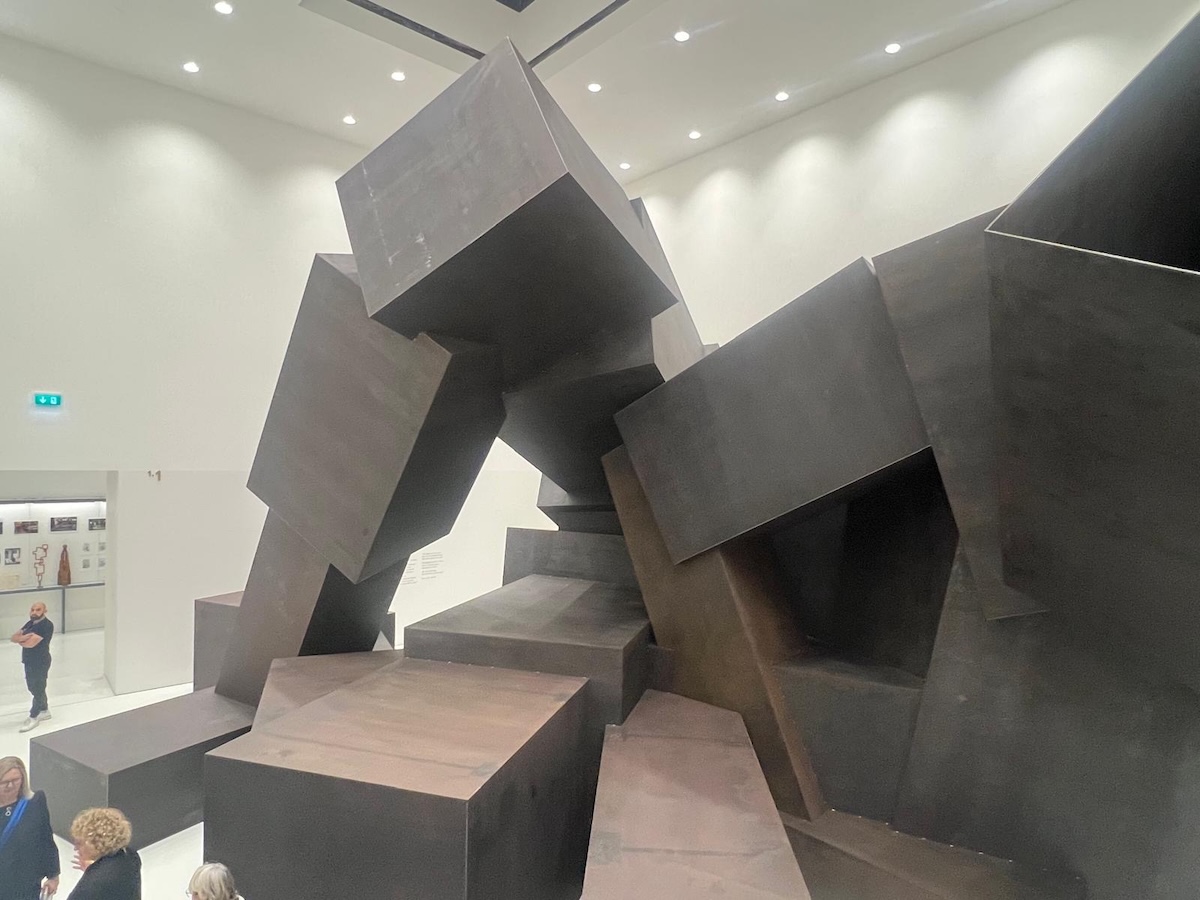
Antony Gormley, Cave, Royal Museum of Fine Arts Antwerp (KMSKA)
Antony Gormley tells me location is critical to him. In Antwerp, “my instinctive reaction to this extraordinary, hidden and secret utopia in the middle of the city is unlike any other museum space I’ve ever been to, like going into a cave.” In the last room is a work entitled Cave (2019), a steel behemoth bursting out of the white cube, barely containing it, threatening claustrophobia. Gormley overcame this phobia when at school by going on caving expeditions, yet he encourages us to enter the secret dark spaces inside the sculpture. He tells me he’s not a fan of experiential or immersive works in museums, yet here we are…
In the theatre at the centre of Galleria Continua, Gormley has created the cardboard Innercity (2026), comprising fifteen huge body buildings that evoke a similar labyrinthine maze, though more permeable. He speaks to the temporary nature of the medium, material used for billions of daily-delivered packages worldwide, and is cognisant that these will disintegrate over the run of the exhibition by those clambering through the installation. I see the cardboard cities of the underpasses near Waterloo station.
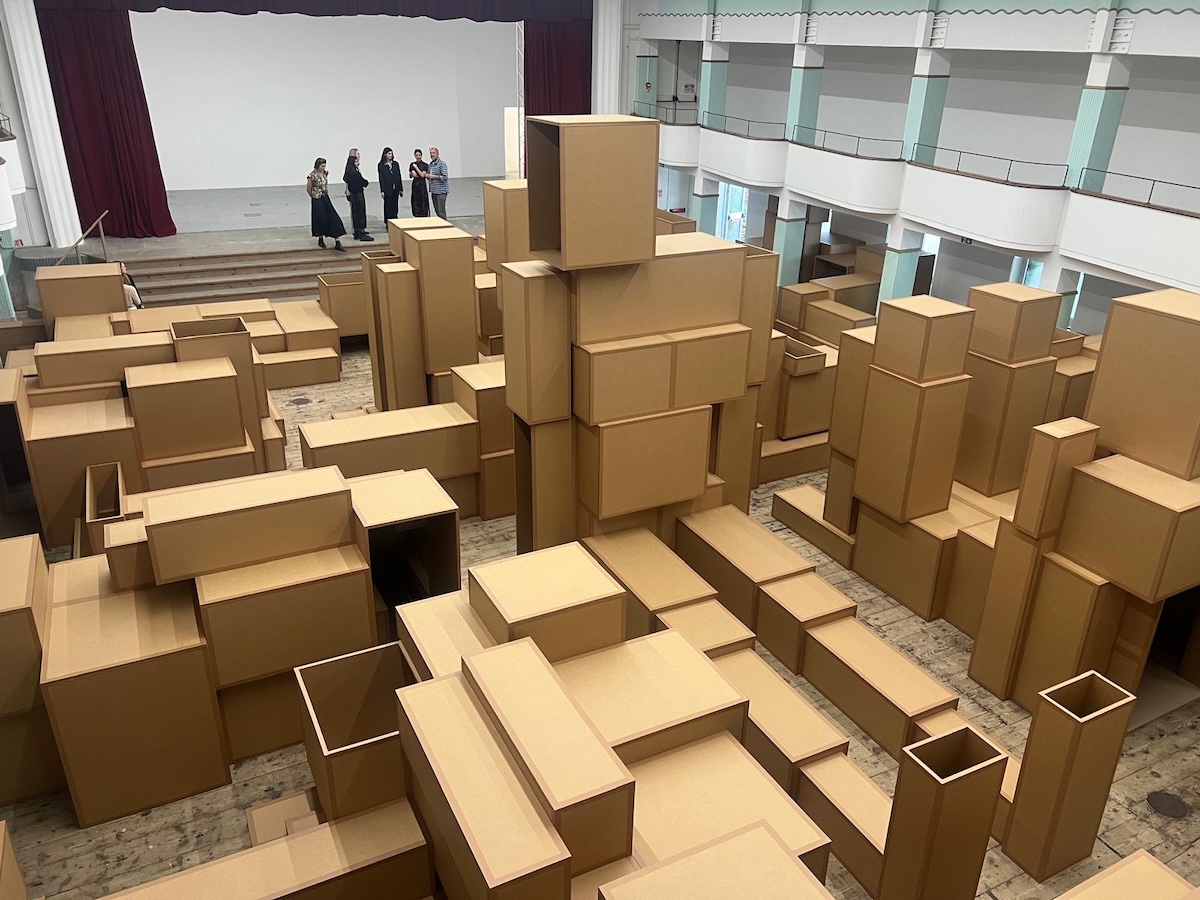
Antony Gormley, Innercity, Galleria Continua, San Gimignano
During a conversation at the San Gimignano gallery to accompany his exhibition What Holds Us, Gormley mentions being forced, as a boy, to nap after lunch in a small space, something he came to welcome because it allowed him to focus on the body, mind, and self. Perhaps this focus led him to use his own form as the basis for his work.
Entering the Antwerp exhibition Geestgrond, past Rodin’s Fallen Caryatid (1881-82 / cast 1924), the first large space contains Orbit Field III (2026), 37 overlapping aluminium rings radiating outwards, criss-crossing and filling the entire gallery.
The next room is prefaced by a quote from Walt Whitman:
“I celebrate myself, and sing myself
And what I assume you shall assume,
For every atom belonging to me as good
belongs to you.”
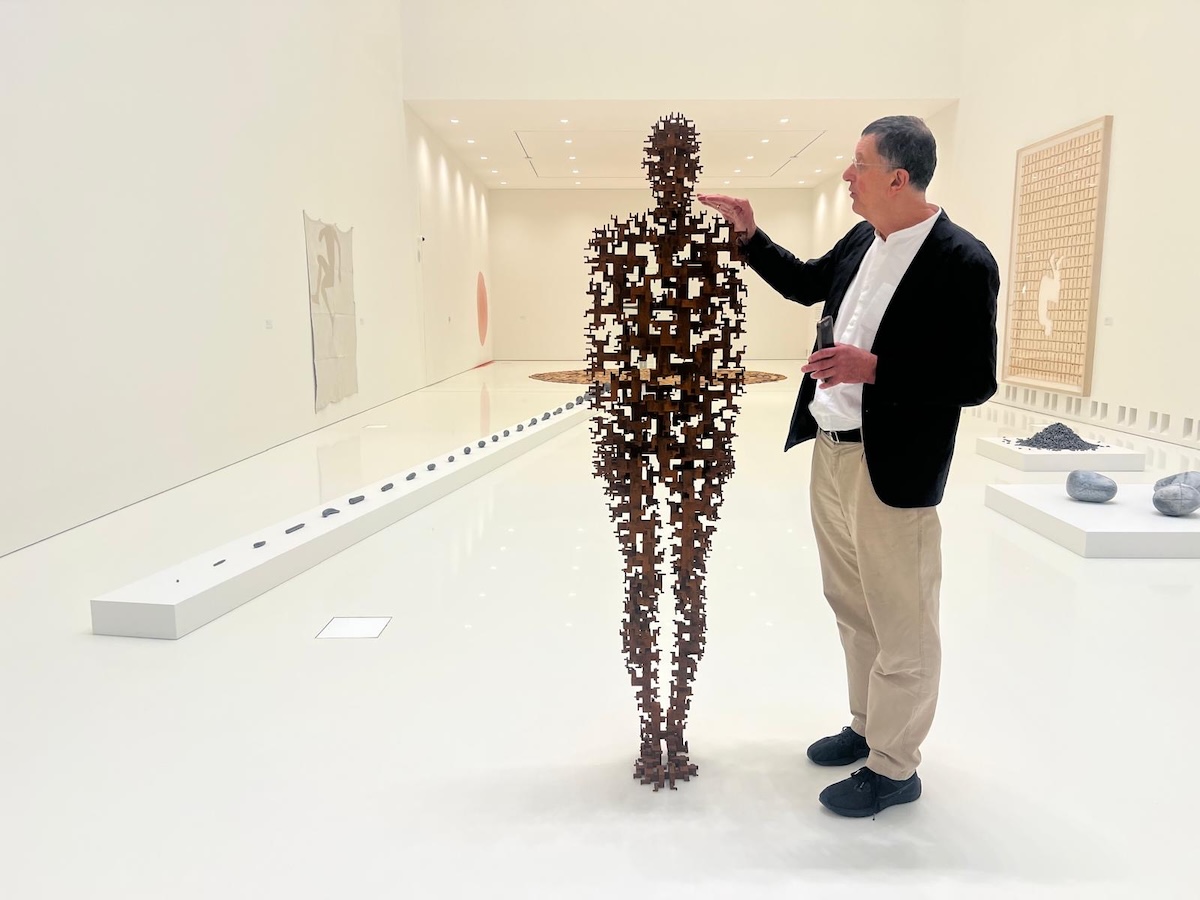
Greeting the visitor is a ‘Brancher’ work, Attend (2025), shown here for the first time, its rusty branches becoming thinner the closer they come to the extremities of the form. The rest of the room holds a variety of early pieces made from diverse materials, as if Gormley was experimenting – bread, wood, chalk, marble, lead, steel, cardboard. A beautiful tree-ring spiral reminiscent of Richard Long bisects the floor. A blood-red chalk wall drawing echoes the tree rings nearby, though, up close, it looks like a fingerprint. The outline of a figure emerges from several slices of white bread.
The KMSKA exhibition is curated by Carolyn Christov-Bakargiev, who has placed Gormley’s works alongside those from the museum’s permanent collection. An untypical, to me, Ensor painting, Grey Seascape (1880), shows an extravagant sky, a long, flat horizon, and standing on it, barely there, is a transparent figure. This figure echoes the three ‘Domain’ sculptures outside the museum – in the courtyard, on the parapet, and the last on an embankment wall down by the Scheldt river. They trace the boundaries of Gormley’s own body yet weigh only about 17 kilos each. We can see through them to whatever lies beyond. Back in the museum, a 14th-century wooden Flemish Crucifixion is displayed close to a supplicant ‘Weave’ work, a medieval polychrome Sedes sapientiae and a Yombe power figure adjacent to another.
I’m curious as to how Christov-Bakargiev and Gormley worked together and sense a respectful relationship between them. The quotes on the walls were a mutual decision, as Gormley didn’t want long interpretive panels but to encourage the visitor to really look at his work. He’s relinquished some control, too – in recent exhibitions at Houghton Hall and the Rodin Museum in Paris, he had a certain amount of autonomy. He tells me he thinks he put too much in the Paris show.
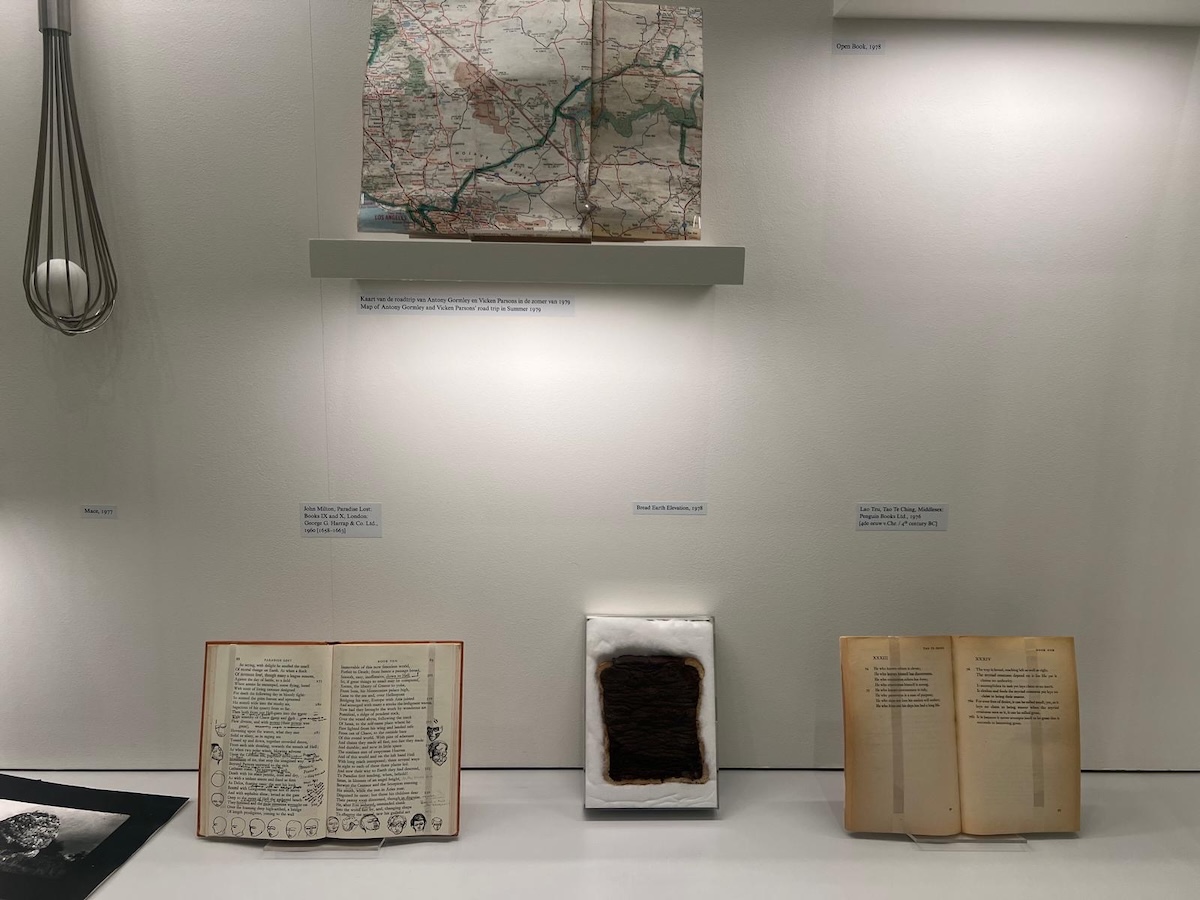
Antony Gormley, The Heart, Royal Museum of Fine Arts Antwerp (KMSKA)
But it’s in the section called The Heart, containing drawings, maquettes, photographs, and notebooks alongside materials he uses in his works, including lead, iron, clay and wood, and books that have informed Gormley’s thinking, where you understand his process. A bookshelf includes works by Seneca, Descartes, Kant, Walden, Darwin, Nietzsche, Tagore, Heidegger, Auden, Jung, C.S. Lewis, Sartre, Weil, T.S. Eliot and many more. An annotated and doodled schoolbook of Milton’s Paradise Lost, an open passage from Melville’s Moby Dick, “…about man’s relationship to stone.” This takes you back to the first room of early works and a piece entitled Land Sea and Air I (1977-79), three lead ‘stones’; one solid, one filled with water, the other air – it’s like trying to guess where the ball is under the magician’s cup. Gormley’s drawings shown here are surprisingly emotive, and the media he uses for them are as prolific as with his sculpture: lampblack, bone black, casein, linseed oil, milk, semen, blood, coffee, chicory, earth, shellac, and varnish. He practices drawing daily.
Circling back through the exhibition in Antwerp, a marble sphere in the first room demands my attention again and reminds me of one of Michelangelo’s trapped slaves emerging from solid stone, though also the hollow void casts from Pompeii, or ancient petroglyphs – a hand outlined here, a limb there. Is this a precursor to Gormley’s standing figures – the foetal form not yet ready for corporeality?
Antony Gormley. Geestgrond – Royal Museum of Fine Arts Antwerp (KMSKA) , Belgium, 23 May to 20 September 2026
Visit Here
Antony Gormley What Holds Us – Galleria Continua San Gimignano 9 May to 13 September 2026
Visit Here