
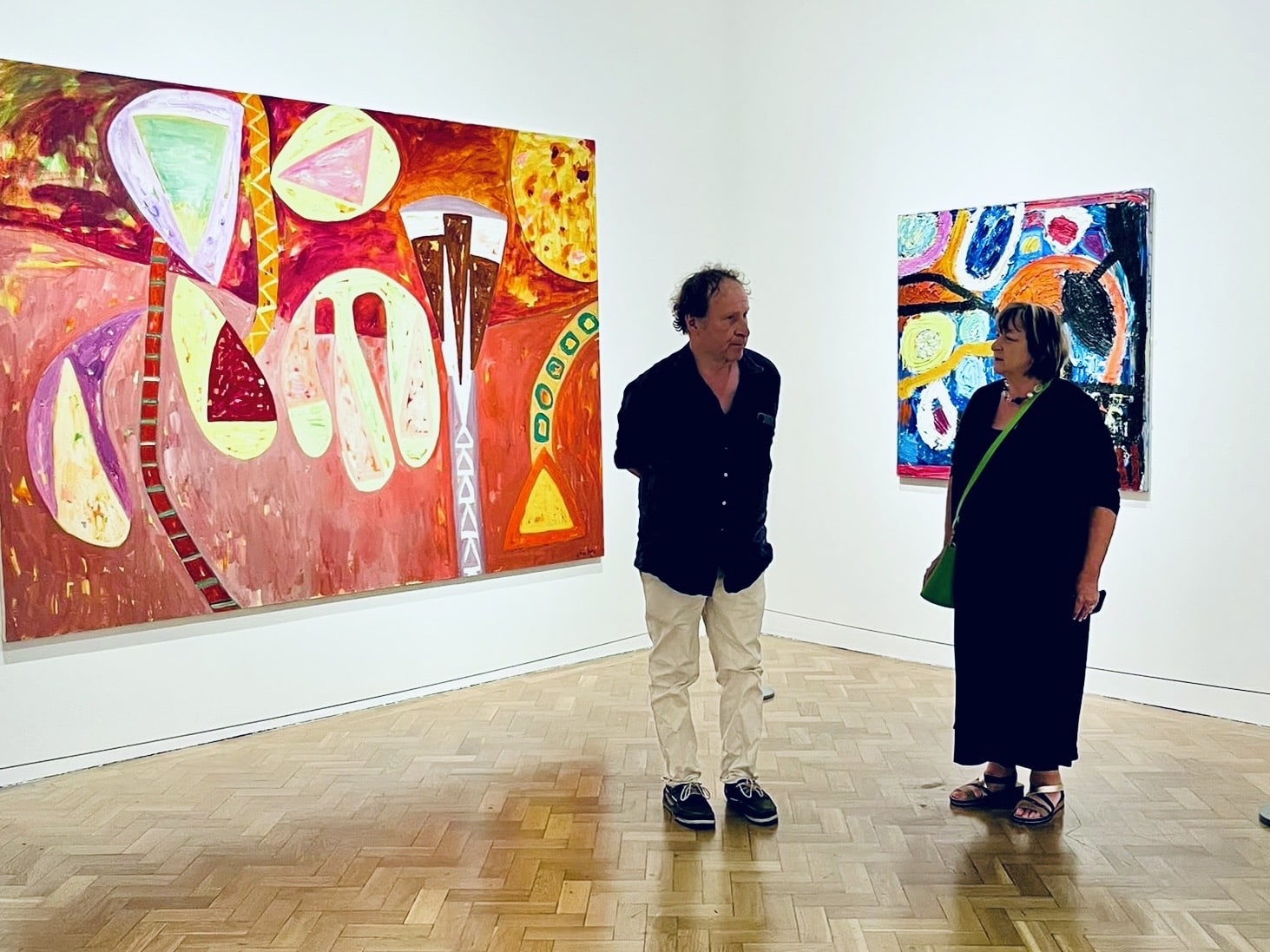
I first met Gillian Ayres in the 1980s when, as a young art critic, I went to interview her in her three-bears’ cottage filled with dogs, paintings and antique furniture ─ a wonderful eccentric chaos hidden down a wooded lane in North Devon. She was feisty, direct, well-read and spoke like one of her paintings in loops and swirls, different subjects being drawn into a continuous stream of consciousness as she spoke with erudition about painting and her own work. I was delighted by her unconventional approach to everything, and we became firm friends. I spent a wonderful week with her when she was the Sergeant Fellow at the British School in Rome, visiting the Sistine Chapel and the Berninis, eating in interesting little restaurants. She was sharp, caustic, wonderfully generous and a great cook, as well as a one-person encyclopaedia of art history.
Now, The Box in Plymouth, which has just been awarded the Art Fund Museum of the Year 2026, is hosting Gillian Ayres: A Life of Colour. It is a powerful and beautiful tribute to an important painter that covers different periods of her artistic development. Walking round the gallery with its large, vibrant canvases, one can’t help but conclude that, if these were the work of a male painter of the same generation, they would be much better known. Although she did become an RA, I remember her talking of her struggles with different galleries. She never had the visibility of, say, John Hoyland or Victor Passmore, and had to fight to have her artistic voice heard. Though no feminist in the modern ‘me too’ sense ( a movement, I think, that would have infuriated her), she just knuckled down and got on with things, whether bringing up her two sons in a remote farmhouse in Wales, or teaching in various art schools as the family’s main breadwinner. She simply wanted to be judged on a level playing field. Somewhere, there is a photograph that shows her after a day’s teaching relaxing in a London pub, the only female among a group of male painters, including her husband, Henry Mundy.
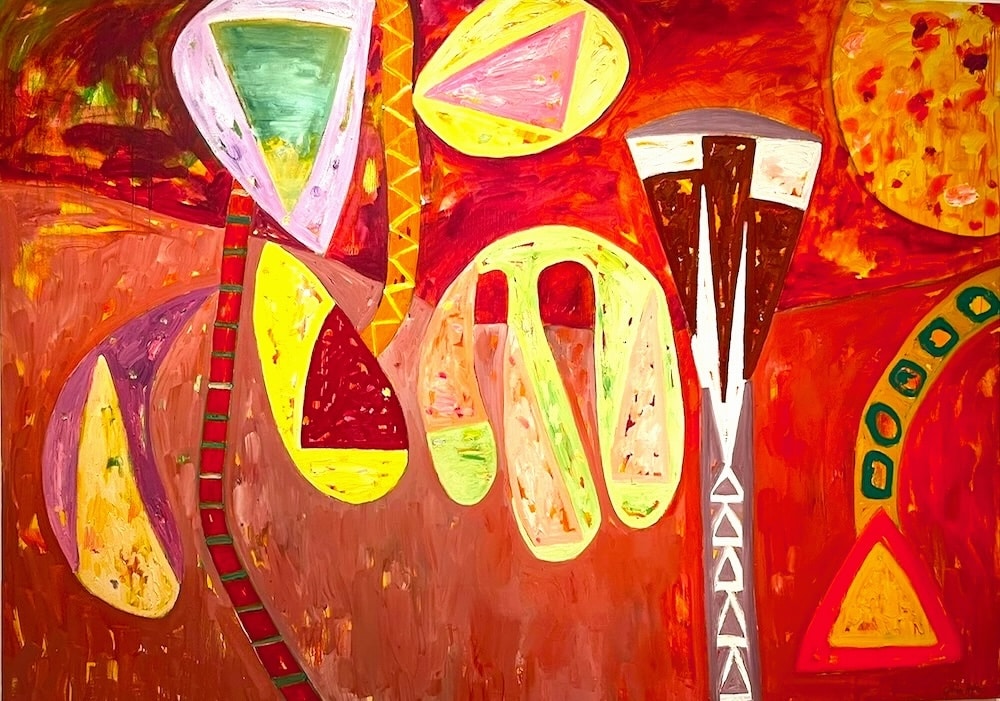
Gillian Ayres, Sang the Sun in Flight, 2009
Born in 1930, she had a comfortable upbringing in Barnes, west London, where she was sent to St. Paul’s Girls’ School and became friends with the future politician, Shirley Williams, the daughter of the feminist Vera Brittain. At weekends Gillian taught art to children in Stepney who’d been affected by the Blitz. ‘Obsessed with painting’ from a young age, in 1946, aged just sixteen, she marched out of school and enrolled herself in Camberwell School of Arts and Crafts. This unshakeable desire to be a painter was rare in postwar Britain for a well-brought-up, middle-class girl.
It is hard for those born later to appreciate the grey drabness of London in the 1950s, with its bomb sites, rationing and dearth of art galleries. The ‘art world’ was very small, and British painting was mostly figurative, influenced by the Euston Road School, with its gritty scenes of a depressed city, described in meticulous detail in muted duns, browns and greys.
Gillian was a rebel by nature, more attracted to the Abstract Expressionists and Colour Field painters from across the Atlantic, who had none of the British reserve, than to homegrown painters who had trained under the likes of William Coldstream. Jackson Pollock’s Retrospective at the Whitechapel in 1958 and a photo of him balletically pouring paint onto canvases laid on the floor, encouraged her to experiment with new ways of applying paint. She was also attracted to the work of Roger Hilton, who wrote that ‘the abstract painter submits himself [note the male gender] entirely to the unknown… his only props his colours, his shapes and their space creating powers.’
One of the walls in The Box is taken up by the large-scale mural commissioned by South Hampstead High School for Girls in 1957, a stunning work that’s as fresh now as when it was made. Painted on board, it’s a storm of tachiste colour across four panels, the pools of deep blue and splodges of scarlet broken up by accents of paler blue, white and yellow. Full of drama and movement, it’s a visual symphony where themes and motifs are introduced, only to recur in different places. Painted in Ripolin (a form of enamel household paint) and oil poured straight from the can and squirted directly from the tube, she worked with rags and brushes, as well as her fingers. These were usually, even when you met up in a smart restaurant such as the River Café (one of her favourites to which she invited me on several occasions – have anything you like, she would say generously), still ingrained with paint.
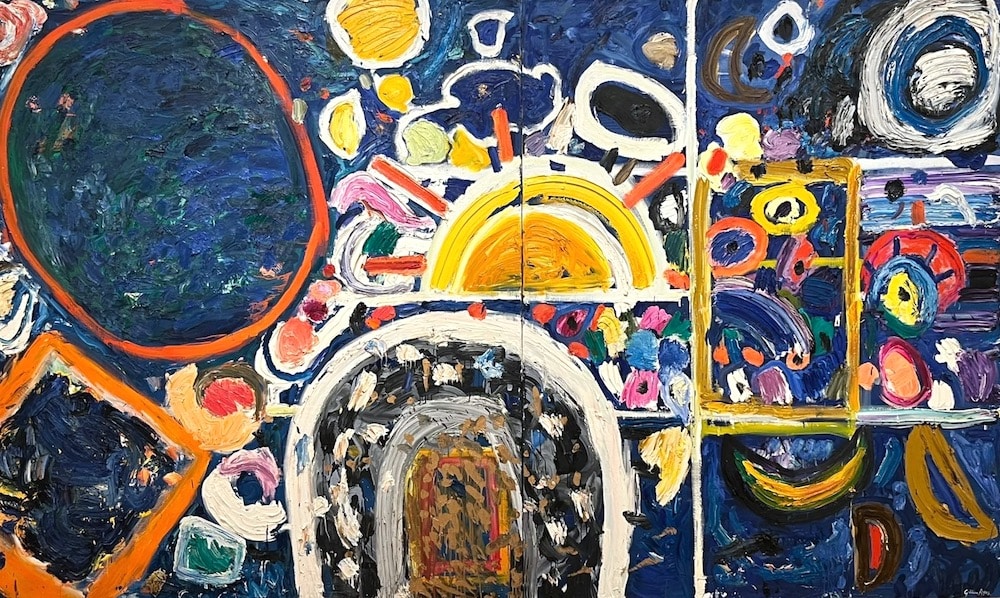
Gillian Ayres Sundark Blues, 1994
She once claimed ‘I don’t know how to be very clear … in words. I suppose that’s why I paint’. This is not strictly true. She was highly articulate, but becoming an abstract painter allowed her a visceral way to explore the world that language did not. Her move into Abstraction permitted an emotional energy and spontaneity unknown at the time in the work of most British painters. Even the most celebrated of the period – Freud, Bacon or Auerbach ─ remained ultimately figurative. What Gillian was doing then was completely new in this country. As I said earlier, if she had been a man, her work would, undoubtedly, have been far more visible.
By the 1970s, painting was quite out of fashion – many proclaiming that, as a form, it was ‘dead’. Gillian, with familiar cussedness, responded not by changing her medium but by painting paintings on a roll of canvas that was so long she had to paint out in the garden. Untitled (Cerise) 1972, painted in acrylic, is over five and a half meters long. A stunning visual composition in fuchsia pink, the surface is punctuated by starbursts and spills of green, red, gold and yellow.
By the early 1980 she was again working in oil paint, her paintings taking on a powerful poetic lyricism. Her titles reflected her interest in Shakespeare and poetry. In Dance of the Ludi Magni, painted in 1994, she used large brushes in an attempt to create what the academician Joshua Reynolds described as ‘the vastness and incomprehensibility’ of the sublime. There is something raw and primal about these works, as if the viewer is being sucked into a maelstrom of elemental colour.
In 1998 she painted Sundark Blues, which she described as ‘a bloody big painting’. Knowing her tiny studio in north Devon, it is amazing to think that she managed to produce this explosive painting in such a small space. Yet, despite its size, it reverberates with the intimacy of touch. The reach of her arm can be felt in the white arc, the movement of hand and wrist in the yellow splodges. Looking at the painting now, I see something of the grit of Philip Guston. The horseshoe arc could be read as the sole of a shoe, the white spots as nails.
I often discussed with Gillian whether she saw herself as an exclusively abstract painter. She always said she never minded if people saw horizon lines, moons or stars in her paintings, for that, she claimed, was how the human mind worked. The paintings in this show are brave and audacious but also deeply human. They still hold their power but are accessible to anyone who simply enjoys a riot of colour. Finally, her position in the pantheon of 20th-century British painters is being elevated to its rightful place. This beautiful show will surely help.
Gillian Ayres: A Life of Colour, The Box, Plymouth, 04 Jul 2026 – 04 Oct 2026
Visit Here
Sue Hubbard is an award-winning poet, novelist and freelance critic. Her fourth novel Flatlands, from Pushkin Press can be bought here. Her latest poetry collection God’s Little Artist: poems on the life of Gwen John can be bought here