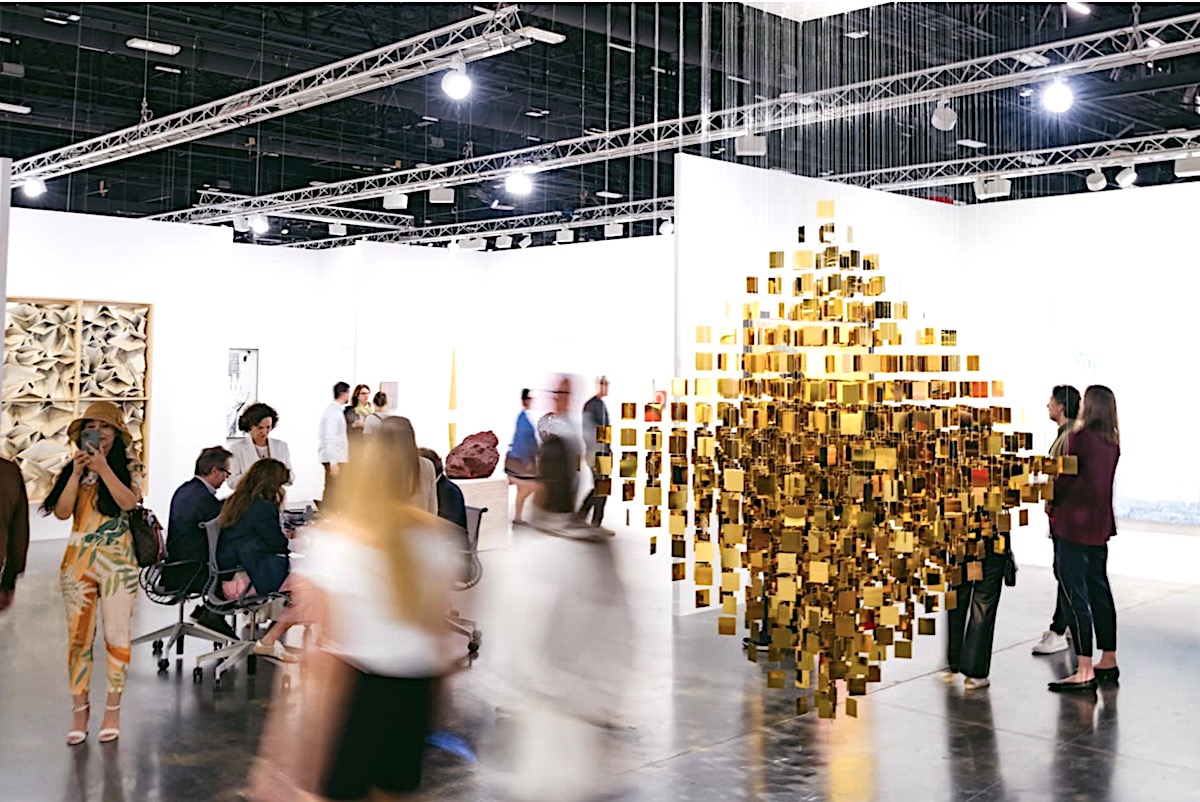
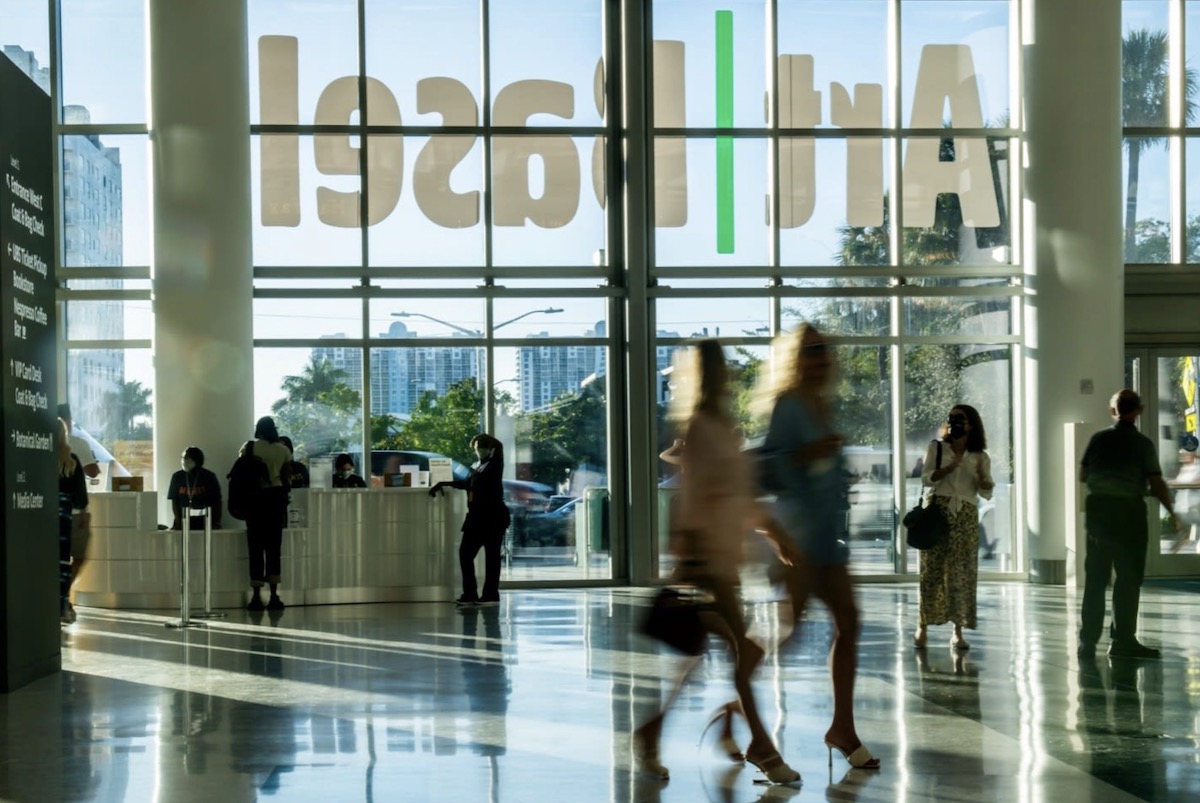
Art Basel Miami Beach 2025 opened its VIP doors with the kind of confidence the fair has always been famous for, though this year the confidence felt a shade more deliberate — a market trying to remind itself of how to breathe. Day 1 wasn’t a buying frenzy, but neither was it tentative toe-dipping. It sat in that more interesting middle ground where serious collectors make serious decisions because they’ve already done their thinking beforehand. And at the top end, the numbers landed fast.
Hauser & Wirth, reliably one of the first stands to report seven-figure activity, placed two major Louise Bourgeois works almost immediately: a sculpture at USD 3.2 million and a painting at USD 2.5 million. Bourgeois continues to be one of the few artists who cuts across generations and categories, and buyers seem to know it. David Zwirner chimed in with a Gerhard Richter Abstract Painting for USD 5.5 million — a familiar sign that the Modern–contemporary continuum is still where the fair’s oxygen flows thickest. Alongside that, Zwirner placed a 1967 Alice Neel canvas for USD 3.3 million and two Josef Albers paintings from the Homage to the Square lineage (USD 2.5 million and USD 2.2 million). It’s the art fair equivalent of stating your credentials before the room even asks.
White Cube, meanwhile, played a different game: a blend of blue-chip stalwarts and contemporary star power, anchored by Andreas Gursky’s four-metre-long Harry Styles photograph (or portrait, depending on how you measure celebrity now). That work sold for EUR 1.2 million, and the context helps — the musician collaborated with Gursky over an extended period, making this one of those cross-industry objects that the market loves to mythologise. The gallery also moved works by Willem de Kooning (USD 2.85 million), Damien Hirst (USD 2.5 million), Tracey Emin (GBP 1.2 million), and Richard Hunt (USD 1 million). Emin’s sale ticks forward her growing momentum ahead of her Tate Modern survey; Hunt’s aligns with ICA Miami’s posthumous exhibition, a reminder that the secondary conditions of the fair — exhibitions, anniversaries, the slow turning of institutional interest — still shape what collectors pull the trigger on.
There was plenty more movement in the high-value bracket. Thaddaeus Ropac placed an Alex Katz for USD 2.5 million; Pace moved a Sam Gilliam for USD 1.1 million; Almine Rech logged sales of Pablo Picasso (USD 2.8–3 million) and James Turrell (USD 900,000–1 million). Gladstone Gallery marked the Rauschenberg centennial by placing Tarnished Honour (Copperhead) (1989) for USD 1.5 million — a tidy way to sync historical recognition with commercial appetite.
But focusing on the top tier alone always misses the pulse of the fair, and this year the middle market — that eternally fragile ecosystem — actually had a solid opening stride. Jessica Silverman placed a Lava Thomas work for USD 75,000 with a U.S. institution, a quiet but meaningful indicator that museums were in acquisitive moods. kó reported the sale of Nike Davies-Okundaye’s The Lost Cat (1973) to the Toledo Museum of Art for USD 100,000, precisely the kind of cross-regional institutional acquisition that Miami prides itself on facilitating. Cayón placed a Blanca Muñoz sculpture with the Maria Cristina Masaveu Peterson Foundation for over USD 40,000; Wentrup sold an Anastasia Samoylova piece for USD 13,000 — modestly priced, but strategically placed.
Goodman Gallery had one of the strongest mid-tier showings: two William Kentridge works moved for USD 240,000 and USD 120,000, and a Hank Willis Thomas sculpture sold for USD 175,000. In the Kabinett sector, HR Giger — a name perennially revived, reinterpreted, and re-marketed — saw works range from USD 24,000 to USD 125,000 at Mai 36. Timothy Taylor placed two Eddie Martinez works for USD 25,000 each. Nara Roesler sold a Tomie Ohtake painting for USD 240,000; Tina Kim Gallery placed works by Ha Chong-Hyun and Park Seo-Bo between USD 250,000 and USD 390,000; Gomide&Co rounded out their booth with sales of Amadeo Luciano Lorenzato (USD 150,000–180,000) and Glauco Rodrigues (USD 135,000).
Sprinkled across the halls were further placements — Sanford Biggers, Igshaan Adams, Robert Mapplethorpe, Reggie Burrows Hodges, Cady Noland, Anne Imhof, Rosemarie Trockel, Agnes Martin (always a good sign), Robert Indiana, Robert Motherwell, Sasha Gordon, and an Eva Olivetti headed to a Miami collection. Museum representatives from MoMA, LACMA, the Serpentine, and El Museo del Barrio were clocked doing the rounds early, underscoring that this year’s institutional buying wasn’t merely symbolic — it was active.
And then there was Zero 10, the fair’s loudly publicised new initiative for “art of the digital era,” which, by all accounts, over-performed on its first lap. Beeple Studios sold out several editions of Regular Animals — including BEEPLE, ANDY_WARHOL, MARK_ZUCKERBURG, PICASSO, and ELON_MUSK — each at USD 100,000. At Heft, four relief works by Michael Kozlowski sold for USD 25,000 apiece; Kim Asendorf’s real-time animations landed at USD 145,000. Joe Pease sold five editions of Zero Dollar Man (2025) for USD 35,000 each.
Generative pioneers made their presence felt: Dmitri Cherniak placed multiple works from Polygon Etcetera at 5 ETH; Art Blocks sold Larva Labs Quine pieces in the USD 25,000–45,000 range. XCOPY’s Coin Laundry (2025) triggered a digital stampede with more than 46,000 free NFTs claimed, proving that attention — still the most volatile currency in the digital economy — remains firmly in the artist’s grip. Across SOLOS presentations, seven works by Tyler Hobbs from From Noise (2025) sold for USD 42,000 each.
For all the Noise, the sales suggest something quietly stabilising: digital art is no longer a sideshow in Miami. It’s the second main stage.
So, yes — Art Basel Miami Beach 2025 began with confidence. Not exuberance, not nervousness, but a grounded, almost pragmatic clarity. The market may not be roaring, but it’s speaking — and on VIP Day, people were very much listening. – PCR 2025