

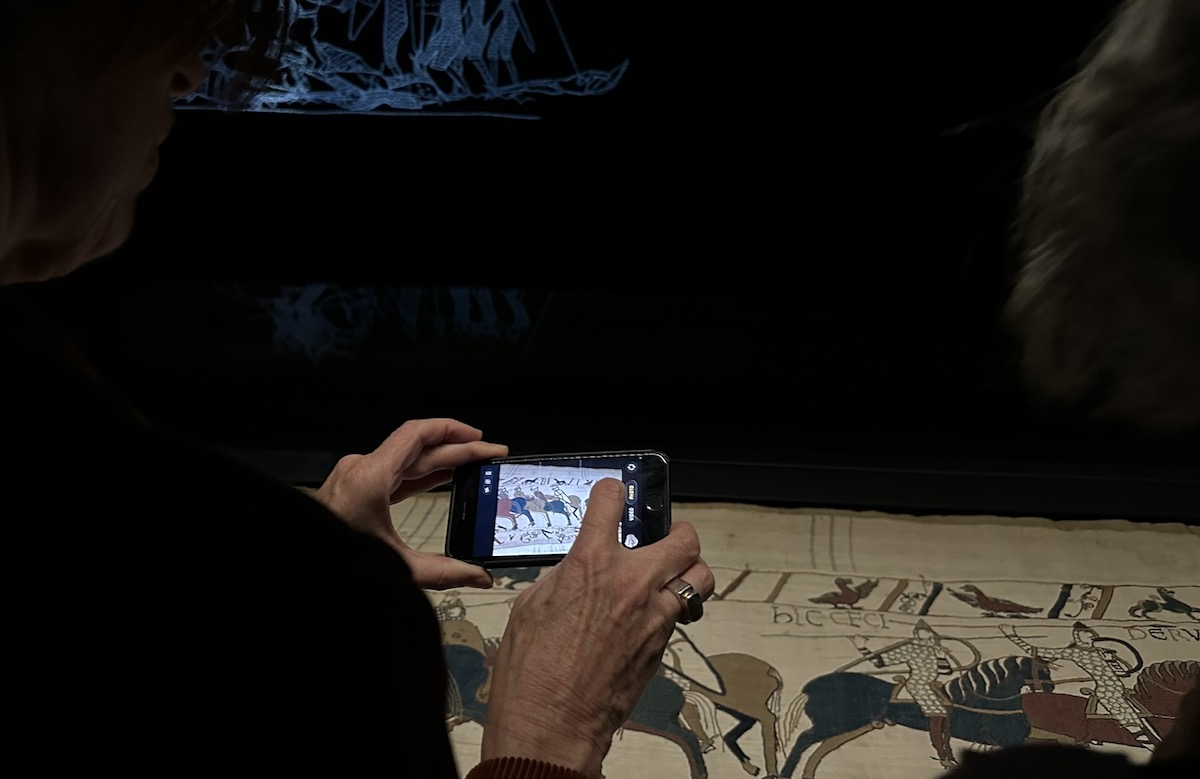
The British Museum has reversed its own policy on the Bayeux Tapestry exhibition, banning visitors from taking photographs after just days of allowing it, once curators realised that people stopping to snap pictures along the 68-metre display were creating serious bottlenecks for everyone behind them.
Visitors are currently being admitted to the sold-out show in small groups every 40 minutes, moving in a single continuous direction along the length of the embroidery. That system depends entirely on people actually keeping pace, and photography, it turns out, does not mix well with a strictly timed, one-way viewing flow. A spokeswoman for the Museum explained the reasoning plainly. “There has been enormous interest in viewing the tapestry, and our priority is to ensure that all visitors have the best experience possible,” she said, adding that restricting photography was necessary. At the same time, people moving along the work was necessary to keep things running smoothly.
The tapestry itself, despite its name, is not technically a tapestry. It is an embroidered wool-on-linen artwork, created in the late eleventh century, most likely in England rather than Normandy, despite having spent nearly a thousand years in France.
The work chronicles the events surrounding the Norman Conquest, following the story from the death of Edward the Confessor through to the Battle of Hastings in 1066, where William of Normandy defeated Harold Godwinson to claim the English throne. Stretching to nearly seventy metres, it remains one of the most detailed surviving visual narratives from medieval Europe, stitched in wool thread across dozens of individual scenes populated by hundreds of figures, horses, ships and, famously, a comet believed to represent the appearance of Halley’s Comet in 1066.
This marks the first time the tapestry has ever left France to be displayed in Britain, a loan confirmed following a Franco-British summit in 2025 after years of quiet diplomatic planning between the two governments. Under the terms of that agreement, the British Museum is covering the costs of transporting and displaying the work, while the UK government has taken on responsibility for insurance. Getting the embroidery to London involved packing it into a specially built, climate-controlled crate and transporting it under police escort across roughly 350 miles from Bayeux to central London, a level of security normally reserved for objects of considerably greater material value, though the tapestry’s fragility and historical significance more than justify the caution.
The work is traditionally displayed in a curved, horseshoe-shaped gallery. British Museum curators opted instead for a single straight line for the London presentation. This decision shapes how visitors move past it and, indirectly, contributed to the crowding problem that ultimately led to the photography ban.
Not everyone has welcomed the exhibition unreservedly. Some prospective visitors have complained about ticket prices running as much as three times higher than the cost to see the tapestry at its usual home in Normandy, a gap the Museum has attributed to the considerable expense of the loan itself. Tickets remain sold out through the end of December, though additional dates are expected to be released in October.
For those unable to secure a ticket, two free alternatives are available in Britain. A full-scale replica of the tapestry is on permanent display at Tewkesbury Abbey in Gloucestershire, and another can be viewed at Reading Museum, both offering a reasonably faithful sense of the original’s scale and narrative sweep without the queues or the ban on photographs currently shaping the experience in London.
Top Photo: © Artlyst 2026