
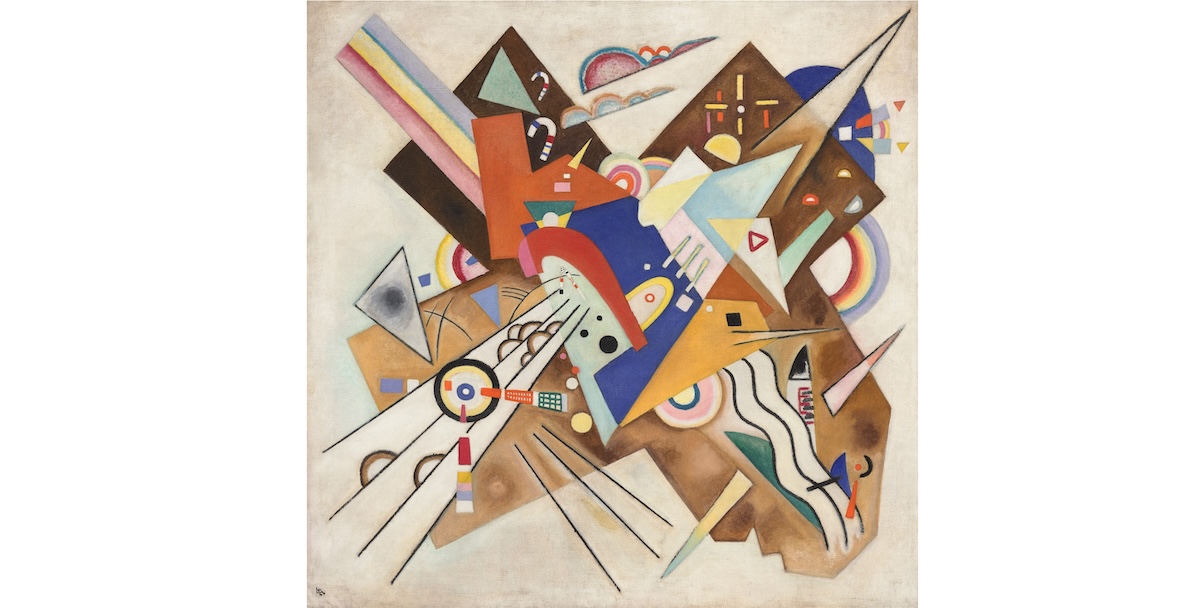
Christie’s has chosen a Wassily Kandinsky painting to lead its 20th-century evening sale. Betonte Ecken, painted in 1922 and 1923, carries an estimate of $60 million to $80 million. The Nahmads, a prominent art-dealing family, are the consignors.
It is a heavyweight lot from a pivotal moment. Coloured geometric forms and abstract shapes crowd the canvas, and the picture comes from Kandinsky’s early Bauhaus period. Christie’s calls it central to understanding how abstract art emerged in the twentieth century. The reason is ambition. Kandinsky had long dreamed of a Gesamtkunstwerk, a total work of art that folds all the arts into one spiritual experience. This is where he came closest.
The artist’s route to painting was a late one. He trained in law. In 1896 he saw Wagner’s Lohengrin at the Bolshoi Theatre in Moscow, and the music did something unusual to his eyes. He later described seeing all his colours standing before him, with wild, almost crazy lines sketched in the air. That was enough to change his life.
Another shock came the same year. He met a Monet haystack for the first time, and did not recognise the subject until the catalogue told him. The picture lodged in his memory regardless. It showed him what paint could do without a recognisable object. Some fifteen years on, around 1911, he heard the atonal music of Arnold Schönberg, and the road to abstraction opened further. Schönberg, he wrote, led listeners into a realm where experience is purely spiritual.
Betonte Ecken is where those threads meet. Kandinsky returns to the ideals he formed in Munich between 1911 and 1914 as a founder of Der Blaue Reiter. He keeps the geometric precision absorbed from Constructivism during the war years in Saint Petersburg. He adds the new principles of the Bauhaus, which he was helping to shape. The outcome, in Christie’s reading, is a model of total abstraction. It reaches for what he called a great synthesis in an essay earlier in 1922, one that would usher in an Age of Great Spirituality and dissolve the border between art and life.
The years before were brutal. At the outbreak of the First World War, he had to leave Munich in a hurry because he was Russian by birth. He settled in Moscow in 1914. Output collapsed. He painted nothing in 1915 and very little in 1916. He married Nina Andreevskaya in early 1917, and during that year’s revolution the couple’s property was seized. Nina’s diary describes their living conditions as unbearable, marked by cold, hunger, and hardship. Still, he followed developments in Russian art, especially the work of Kazimir Malevich and Aleksandr Rodchenko. Politics eventually made life there impossible.
They left at the end of 1921 and found a warm reception in Germany. The early Weimar Republic was full of utopian hope, with generous public money for the arts. Kandinsky found the climate far more stimulating than Russia’s. In the first half of 1922 he took part in several exhibitions, including solo shows at Galerie Goldschmidt-Wallerstein in Berlin in May and the Moderne Galerie in Munich a month later. His standing as a pioneer of abstraction and theorist, plus his personal contacts, soon led Walter Gropius to invite him to join the Bauhaus faculty.
He arrived in June 1922. The timing was lucky. Founded in 1919, the school counted Johannes Itten, Lyonel Feininger, Paul Klee and Oskar Schlemmer among its teachers, and it was then turning from the Expressionism of Kokoschka towards a more technological, Constructivist line. That matched Kandinsky’s own direction. Gropius saw the school as a vehicle for a Gesamtkunstwerk, a body that would unite sculpture, painting and crafts under a new architecture.
Kandinsky had been preaching something similar since 1912. In On the Spiritual in Art he argued that the arts were encroaching on one another, and that this would produce truly monumental work. Back in Germany he could test it. The curator Angela Lampe has described his aim as joining the spiritual, intuitive dimension with the collective approach of revolutionary art schools, to confirm that art and life no longer had a dividing line.
For the market, the price range speaks for itself. Few Kandinskys of this importance come up, and this one arrives with a tidy provenance and a strong scholarly story. Christie’s has pitched it as the evening’s anchor. Bidders will decide if the spiritual future he imagined carries a number to match.
Read More
Visit