
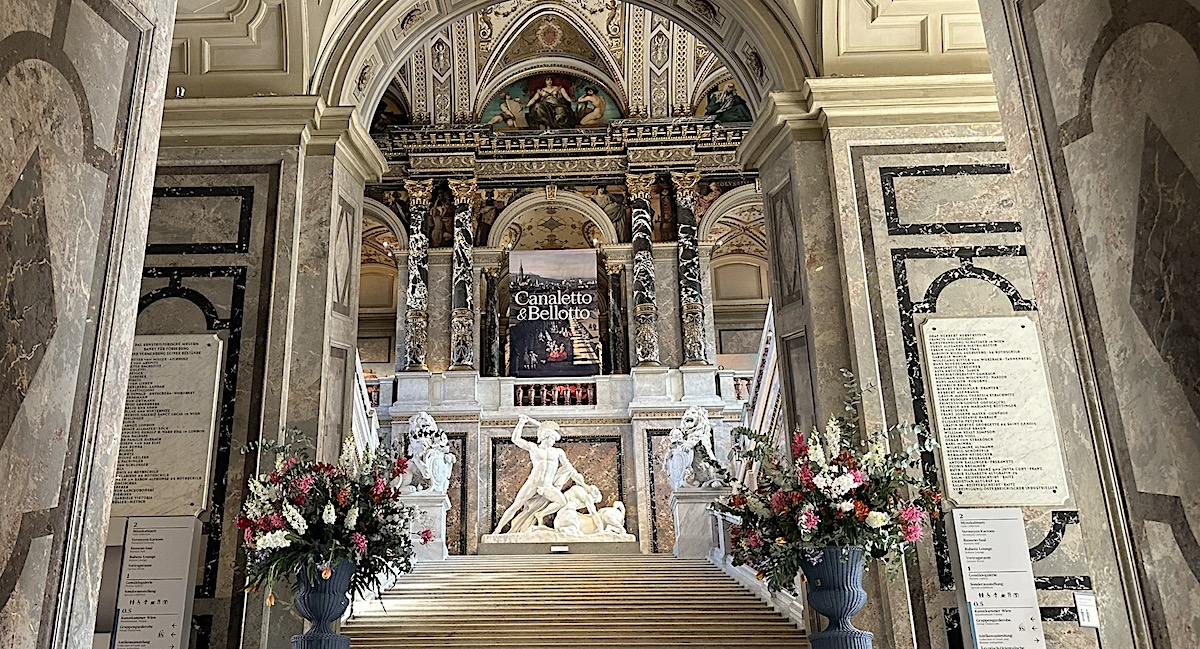
If you love Venice but want to skip the hustle and bustle of the 61st Venice Art Biennale, here is an alternative: Giovanni Antonio Canal, AKA Canaletto (1697–1768), and his nephew and pupil, Bernardo Bellotto (1721–1780). This exhibition also includes paintings of London, Dresden and Vienna.
There is something quietly subversive about an exhibition that takes some of the most popular and apparently straightforward paintings in European art and asks you to distrust them. The vedute of Canaletto and his nephew Bernardo Bellotto have spent three centuries reassuring us that we know what Venice and other great cities looked like in the eighteenth century. The Kunsthistorisches Museum’s new show, bringing together 32 paintings from collections across Europe, gently dismantles that reassurance.
The exhibition’s argument is compelling. These paintings, so often treated as something close to photographic documents, are nothing of the sort. They are carefully engineered images shaped by artistic calculation, patron expectation and the social and political pressures of the moment in which they were made. Curator Mateusz Mayer makes this case without turning the show into a lecture, allowing the paintings themselves to do most of the work.
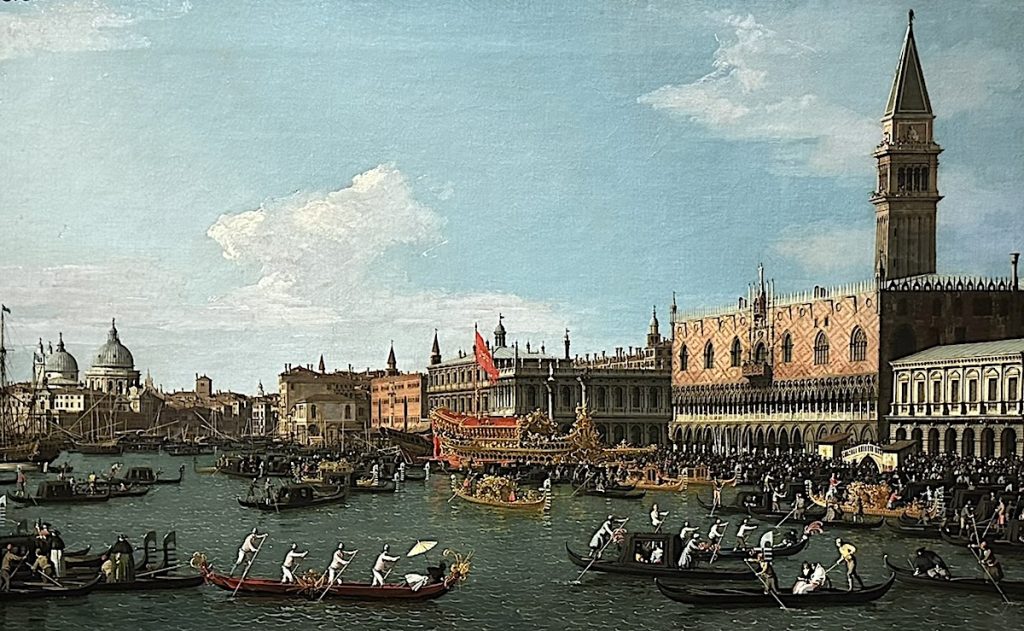
Canaletto The Bucintoro 1745-50 Thyssen-Bornemisza Collection Photo Artlyst
It helps that the works on display are exceptional. The exhibition opens in Venice, where Canaletto established both his reputation and his working method. His father was a stage painter, and that theatrical inheritance never quite left him. The handling of perspective and spatial illusion in The Bacino di San Marco from San Giorgio Maggiore, on loan from the Wallace Collection and dated to 1735 to 1744, is extraordinary precisely because it looks so natural. The light sits on the water with an ease that requires enormous technical skill. Stand in front of it for long enough, and the construction begins to show itself, like a magic trick you can almost but never fully see through.
The London rooms are among the exhibition’s most revelatory. Canaletto spent a decade in England from the late 1740s, a period that has sometimes been treated as a commercial detour rather than a serious artistic development. The paintings on display here argue otherwise. London: The Thames on Lord Mayor’s Day, from the Lobkowicz Collection, and Westminster Abbey with a Procession of the Knights of the Order of the Bath, lent by the Dean and Chapter of Westminster and shown publicly in Austria for the first time, reveal an artist genuinely engaged with a new urban environment. The light and the social texture are different, and Canaletto responds to both. The ceremonial grandeur of the Westminster painting has the same theatrical quality as the Venice work, but the crowd and the architecture carry an unmistakably English weight.
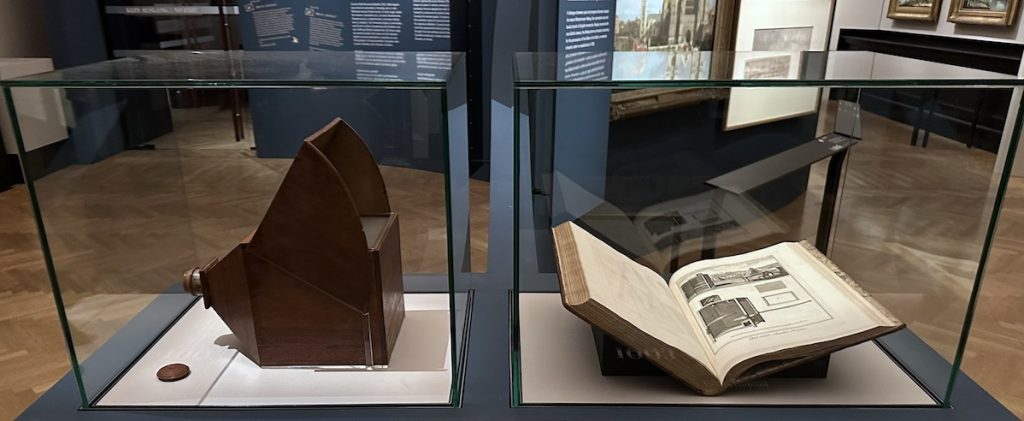
Camera Obscura Photo Artlyst
The context that brought both uncle and nephew out of Italy matters here. The War of the Austrian Succession, running from 1740 to 1748, effectively collapsed the market for vedute by halting the Grand Tour. The wealthy young British aristocrats who had been buying Venetian views as souvenirs of their European education stopped coming, and Canaletto and Bellotto had to find new patrons in new places. The exhibition treats this biographical circumstance not as an interruption to the story but as its engine, showing how the veduta genre evolved under economic and political pressure.
Bellotto’s Vienna period receives the most sustained attention in the second half of the show, and rightly so. His large-scale views of the inner city, including the magnificent View of Vienna from the Belvedere, dated to 1759 to 1760, have been cleaned specifically for this exhibition and are presented together with works from the Liechtenstein collection, among them The Liechtenstein Garden Palace in Vienna, Seen from the Belvedere, for the first time in over two decades. The scale of these paintings is impressive in itself, but what holds the attention is the sociological content embedded in the topography. Bellotto was not simply recording buildings. He was constructing a vision of the city that served the interests and self-image of those who commissioned it, and the exhibition is alert to this throughout.
The question of the two Canalettos, as it were, is handled well. Bellotto had a habit of signing his work “called Canaletto” beneath his own name, trading on his uncle’s fame to elevate his market position. It is an act that tells you a good deal about how the art market worked in the eighteenth century, and the show uses it to reflect on how little that has changed.
The Kunsthistorisches Museum is itself the right building for this exhibition. Its holdings of Bellotto’s Vienna paintings are central to the show, and there is something appropriate about seeing images of the city constructed for powerful patrons hung in one of the grandest expressions of Habsburg cultural authority. The building is, in its way, another kind of veduta.
Other aspects to explore include the use of the Camera Obscura, with a period example on display, as well as one of the best AI immersive experiences I have seen, bringing to life a painting by Canaletto.
This is a serious, intelligent exhibition that wears its scholarship lightly. It will change how you look at both painters and, probably, at city views more generally. – PCR
Photos: © Artlyst 2026
Canaletto & Bellotto is on view at the Kunsthistorisches Museum, Vienna, until 6 September 2026.