
Clive Davis, who died earlier this year after roughly six decades spent identifying musical talent before anyone else quite saw it, applied the same instincts to buying art. That, at least, is the argument Christie’s is making ahead of a November sale devoted entirely to his personal collection, and having looked through what he actually bought, it is not a hard case to accept.
Davis built his reputation as the industry’s most reliable star maker, a title that gets thrown around loosely but in his case was more or less literal. He signed and shaped the careers of Janis Joplin, Santana, Aerosmith, Whitney Houston, Barry Manilow, Bruce Springsteen, Billy Joel, Aretha Franklin, Alicia Keys and Jennifer Hudson, moving from a young lawyer at Columbia Records to founding both Arista Records and later J Records, before finishing his career as Sony Music’s longstanding Chief Creative Officer. He had no formal musical training whatsoever, which makes the run of hits he oversaw slightly harder to explain except through the sort of intuition that cannot really be taught. In his own autobiography, he described the pleasure of the job in fairly simple terms, writing that working with artists across genres, whether Manilow or Gil Scott Heron, Patti Smith or Springsteen, came down to helping each of them realise something they were already reaching for.

Clive Davis Photo Courtesy Wikimedia Commons
Sara Friedlander, who chairs Christie’s post-war and contemporary art department, sees a direct line between that professional gift and Davis’s approach to collecting. The same discernment that let him hear a hit before it existed, she suggests, is visible in the works he chose to live with, a collection spanning Frank Stella, Joan Mitchell, Jean Michel Basquiat, Jean Dubuffet, George Condo and Fernando Botero, along with a cluster of portraits depicting friends from both the art and music worlds.
One of his earliest purchases, and reportedly among his most cherished, was Frank Stella’s Attica II, a strong example from the artist’s Concentric Squares series, a body of work Stella began in the 1960s and returned to a decade later almost as a way of recalibrating himself.
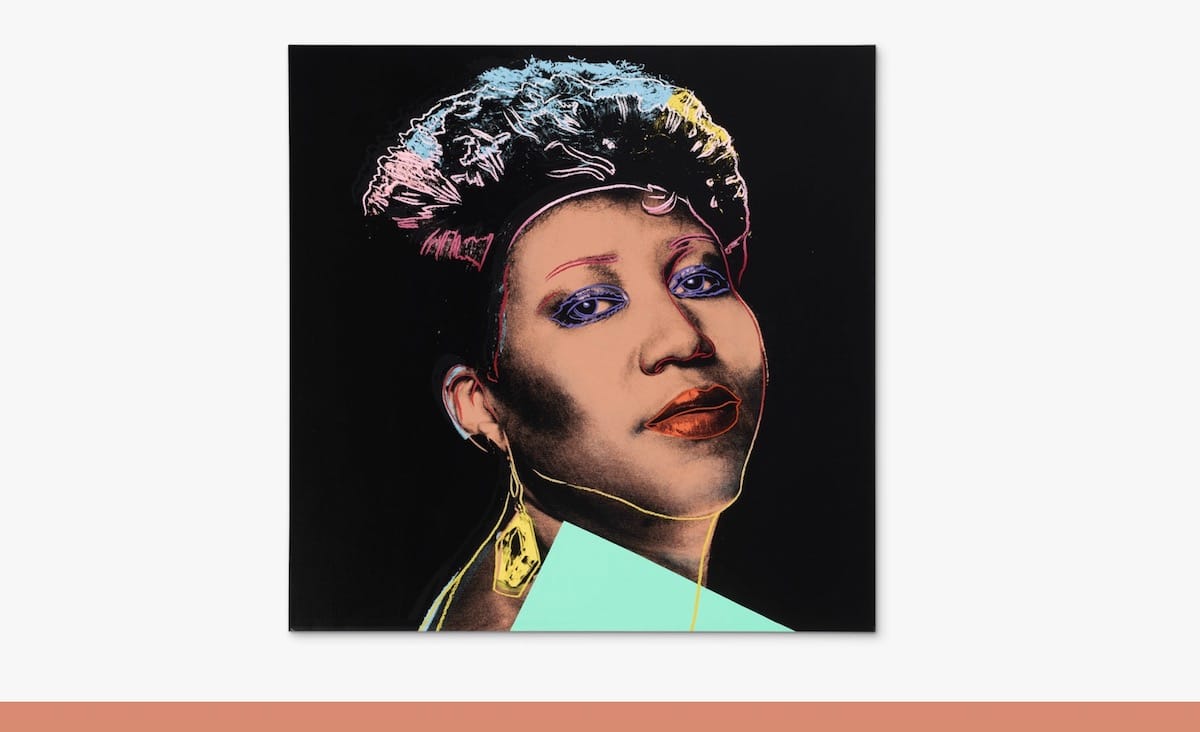
The portraits in the collection carry a different kind of weight, functioning less as trophies than as documentation of actual friendships. Andy Warhol’s portrait of Aretha Franklin (Top Photo), made near the end of Warhol’s life, grew directly out of Davis’s own decades-long relationship with the singer, which began in 1980 when Franklin signed to Arista and Davis helped orchestrate what became a genuine late-career resurgence, culminating in her 1986 album Aretha. Franklin herself asked Davis whether Warhol might be willing to paint her for the cover. Davis had known Warhol since the mid-seventies, introduced by Patti Smith and Lou Reed. He had subsequently been invited to lunch by Warhol’s assistant, Bob Colacello, for an afternoon of art and music gossip that apparently went well enough that Warhol asked for a repeat. When Davis later floated the idea of the Franklin portrait, Warhol agreed immediately. Both Davis and Franklin loved the result, and the painting now stands as a record of two overlapping friendships rather than a single commissioned image.
A second Warhol portrait, this one of David Hockney, dates to 1974 and exists in only three versions, made during the same period Warhol was producing his celebrated silkscreens of figures like Brigitte Bardot. Warhol and Hockney were introduced through the curator Henry Geldzahler, and the resulting portrait was part of an informal trade, with Hockney soon producing his own image of Warhol in return. Davis’s connection to Hockney ran deeper still. When the executive was inducted into the Smithsonian’s National Portrait Gallery in 2022, Hockney painted him specially for the occasion, and Davis travelled to the artist’s studio in Normandy to sit for it in person, a gesture that speaks to a friendship built over considerably more than shared taste in art.
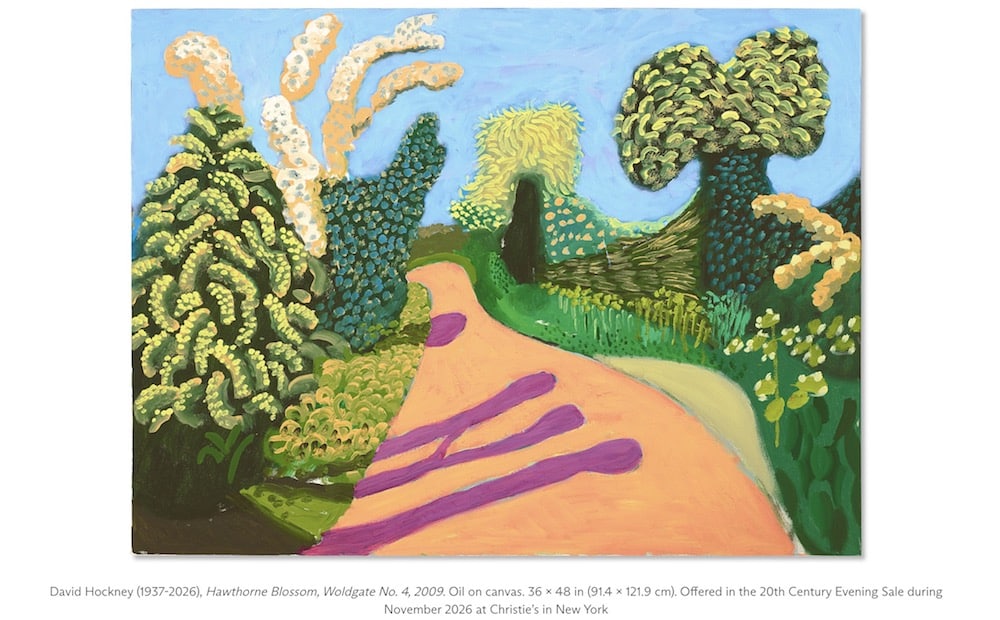
Hockney also appears in the collection through Hawthorne Blossom, Woldgate No. 4, a large 2009 landscape painted after the artist returned to his native East Yorkshire and spent weeks simply walking the countryside of his childhood. The painting is thick with the greens and curling forms typical of that period, memory rendered through Hockney’s particular flattened perspective rather than straightforward observation.
Hockney’s own early influences trace back to Jean Dubuffet, represented here by La Flibuste, a 1963 painting from the artist’s L’Hourloupe cycle, dense with the red and blue crosshatching that defined the series and populated by four distorted figures. Dubuffet had a well-documented fondness for eccentric titles, and La Flibuste, meaning roughly “buccaneering,” clearly appealed to him enough that he reused the motif twice more in later works.
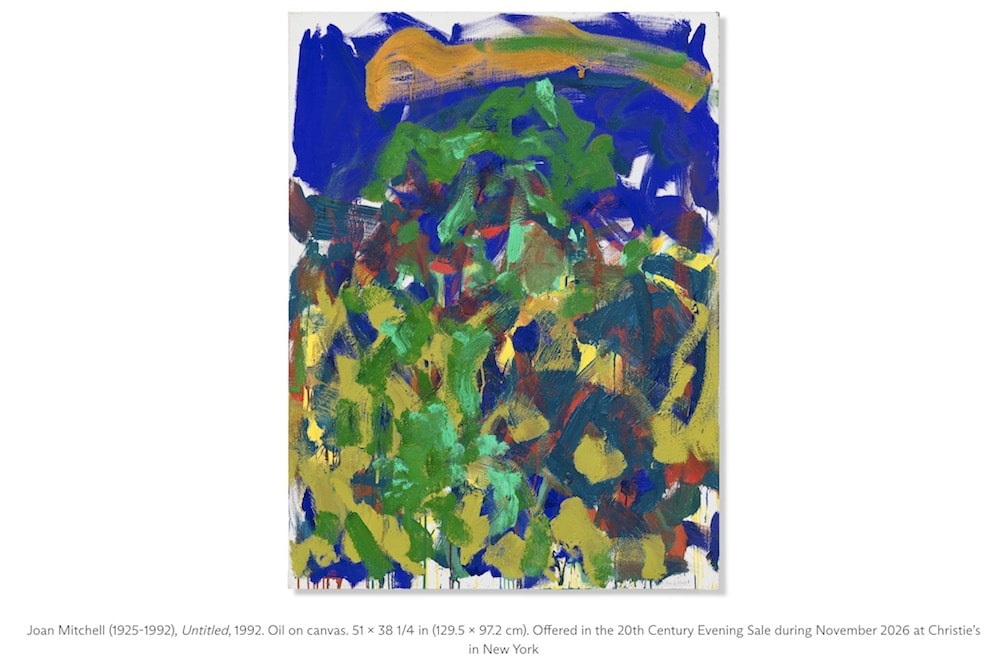
The collection closes with Joan Mitchell’s Untitled from 1992, painted the year she died, its upper register dominated by the deep blue she associated with l’heure des bleus, the brief twilight hour when light over the French countryside turns faintly cobalt. Mitchell was struggling badly by then, in poor health and mourning a string of losses among friends and family, yet the painting shows no diminishment of her powers. She once said people turn to painting or music precisely because certain things resist being said in words, and this late canvas reads very much like an attempt to say something that could not be said any other way.