In Estonia in June, the days are long, the nights short, and the light is incredible. Saaremaa, the country’s largest island, is green, flat, with huge skies. In the centre is the large impact crater of a huge meteorite that landed in the Nordic Bronze Age, 3,500 years ago, according to recent estimates.
I was in the area filming and staying briefly at the Okapii Gallery (Tallinn) art residency, based in an old fish factory on the Eastern shores of the island. Also in residence were two Ukrainian artists with a photography-based practice, Elena Subach and Olia Koval.
Both artists are processing the effects of the war in Ukraine through documentation, research, and installation, as well as finding respite in this idyllic environment, where birds and grass snakes are the dominant predators. The golden mornings on the mirror-like sea are noisy, bright and ring from the cries of waterbirds.
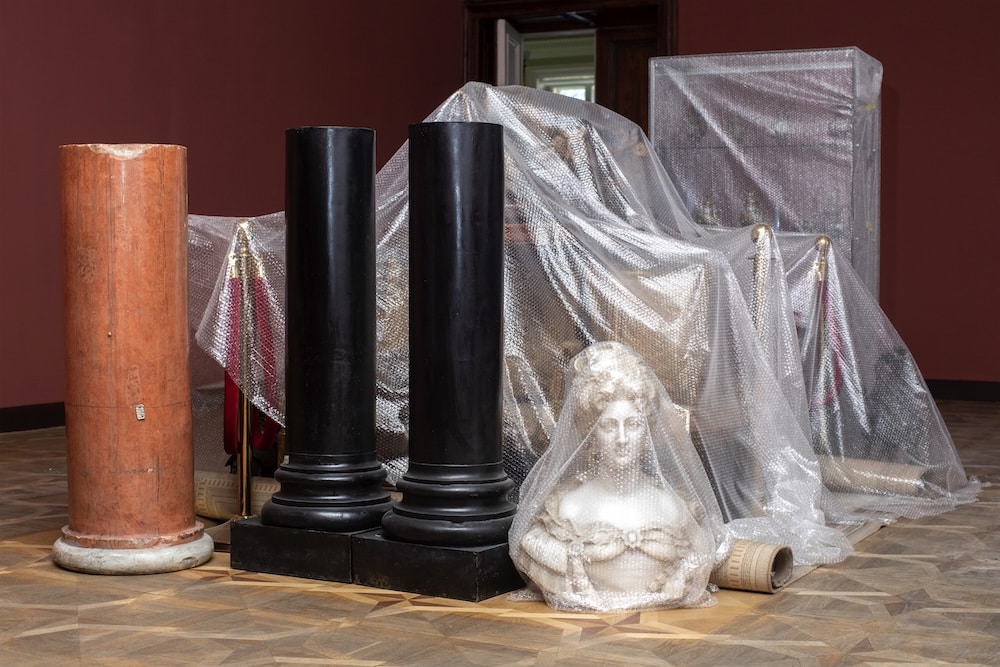
Elena Subach, Hidden
Elena Subach was working as a curator in her hometown of Lviv, near the Polish border, when the invasion of Ukraine made protecting and caring for the priceless works of the museums a top priority. She began to document the object handling, recording the care with which the figures and paintings were wrapped and carried into storage. This documentary project has a sentimental strength that communicates the love of art and the desire to protect what we love, the efforts we make to do so when there are threats to well-being. This project leads, as if seamlessly, into her work looking at prosthetics and the care taken of human bodies broken and challenged.
Subach photographs patient management, in particular water therapy, which she explains can help relieve phantom limb pain due to the pressure. The images are tender and powerful, engaging international and historical conversations through their juxtaposition with illustrations from a textbook on physical therapy and innovation after the First World War.
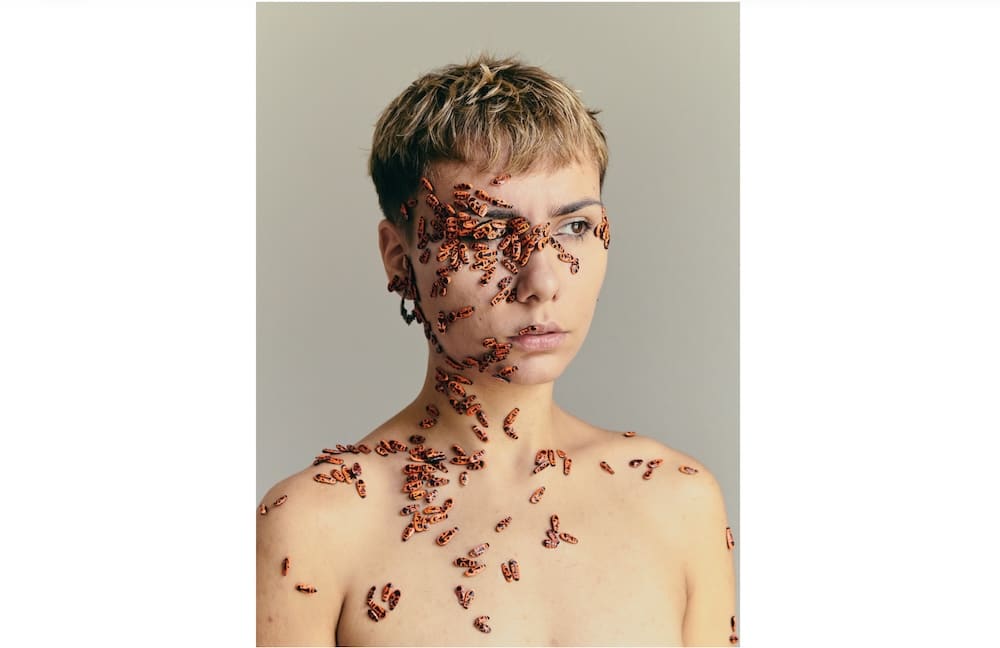
Olia Koval, Eruption
Olia Koval’s work uses installation, a kind of theatrical design, to tell her narratives of her personal and emotional experience living through the invasion of Ukraine. Her most recent large-scale piece, Eruption (2024), presents this sensation as a living room invaded by bugs, 40,000 soldier bugs, red and dangerous, covering chairs, books, windows, floors and wallpaper. It’s a powerful theatre scene. The firebugs are handcrafted, and she also photographs herself naked, her skin covered by the little bugs. Her approach is very tactile and emotional. She is an artist to watch and, if possible, to exhibit. Her work communicates with great maturity the emotion of her age group, the experience of coming-of-age in a time of invasion. It is strong work from any generation.
Toomas Järvet, co-curator of the Dokfoto Centre, the Juhan Kuus Documentary Photo Centre / Juhan Kuus Dokfoto Keskus, presented the work of the South African / Estonian photojournalist after whom the centre is named. Kuus’s work documenting apartheid, police and state violence, his unconventional approach to life and his ability to capture moments through the lens made him one of the most eloquent witnesses of the pivotal years. UK readers may also remember him as the editor and photographer of ‘The Big Issue’. The Dokfoto Centre promotes documentary photography that supports progressive change. It’s located in Tallinn’s innovation district, the Telliskivi Creative City, well worth visiting and off the tourist track—the current exhibition ‘Claus Rohland. Only a Traveller Is a Stranger’, shows colour photographs taken in Egypt, Turkey, Iraq and Syria in the 1970s. The images are digitally blown-up versions of the original diapositives, which have been beautifully corrupted by decades of moisture damage. There is a distance between the photographer and the subjects of the pictures; there is no pretence of getting close to the lives of those photographed. The decay enhances this distance, taking the pictures into more of the realm of surface texture and textile design, in an overall magenta haze, enhanced by the multiple carpets arranged on the industrial floor, giving the feel of being inside a storybook rather than a newspaper.
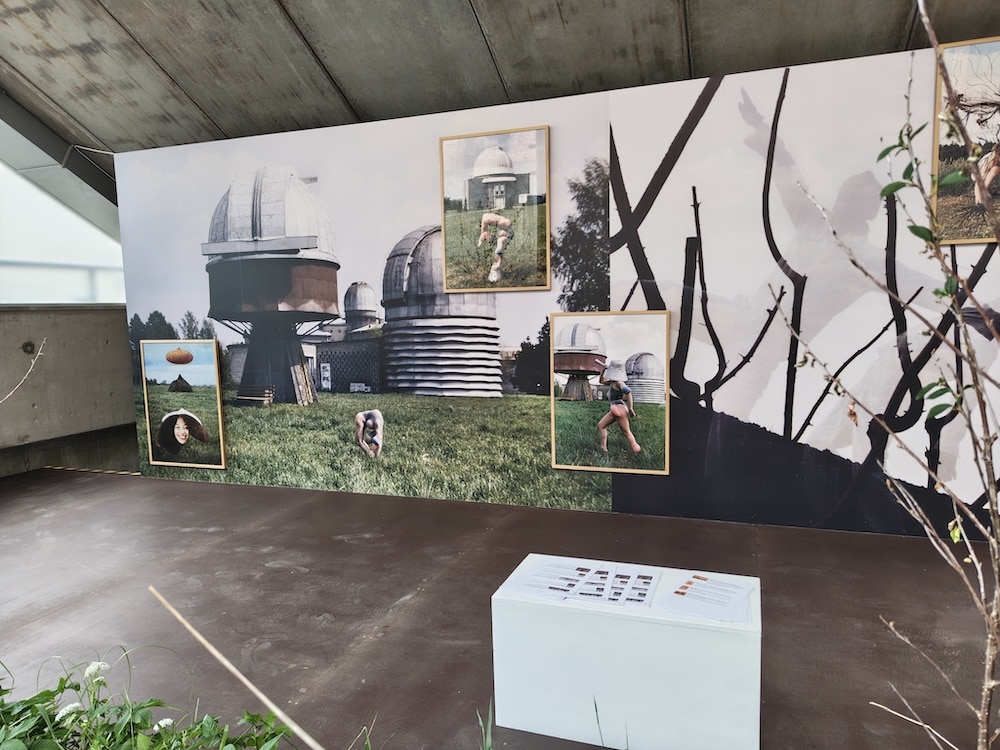
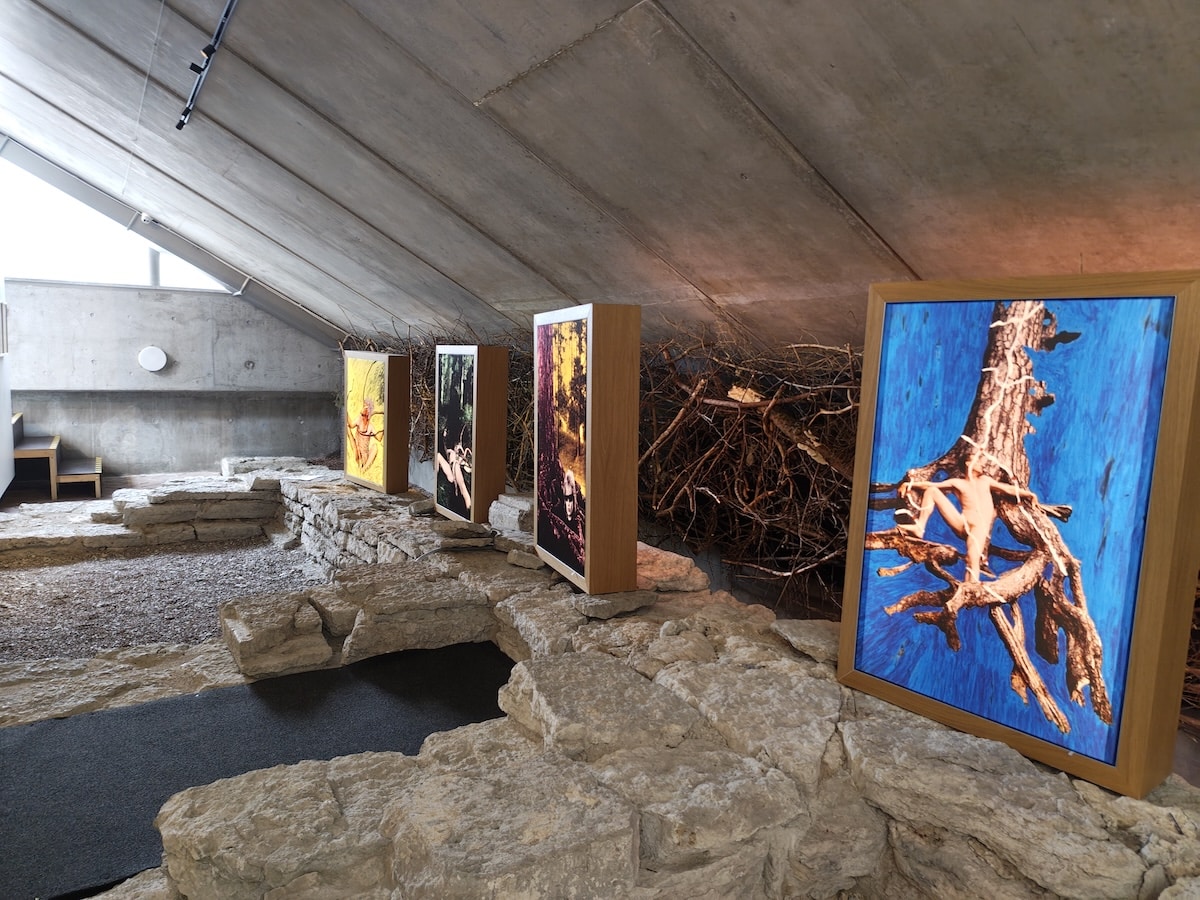
Einar Tiits. How to be a Twig, Galerii SEEK (Tallinna Linnamuuseum)
The Museum of Photography, a branch of the Tallinn City Museum, shows ‘Einar Tiits. How to Be a Twig’, a recent discovery among Estonian photographic art. Tiits died in 2016, and the majority of his work is from the 1990s. Largely unrecognised during his lifetime, Tiits’s work is playful, ingenious and theatrical. A loner and an exhibitionist, he posed naked in the woods and fields around his home, a town near Tartu in the southeast, merging himself with the trees and environment. For him, art was a way to express inner desires, and it has a resonance with Greek myth, of Daphne changing into a tree, escaping the materialism of human sexuality. He used handmade coloured features, filters, gouache, and ink pens to take his pictures into a hand-styled graphic area, merging with experimental printmaking. Much of the original material comes from commercially developed photographs rather than from darkroom work, which have been digitally expanded to create beautiful large-scale pictures, the vision of Annika Haas, whose expert eye has curated this eco-philosophical and lyrical ode to not only living with nature but being inside it.
Triinu Soikmets, curator and art historian, was my invaluable fixer for this visit. She works at the Vernissage Gallery in Tallinn Old Town. The gallery shows an impressive range of Estonian art for sale, including works by landscape painter Richard Uttmaa and Jüri Arrak. Current exhibition: ‘Jüri Mildeberg. Faith in Souls’ 29 May – 1 July.
In London, the works of one of the first modernist painters of the Baltic countries, Konrad Mägi, are on show at the Dulwich Picture Gallery. Vivid light and the reinterpretation of landscape through the influence of German expressionism. His romantic and mystical interpretations are a fundamental force in the visual language of modern Estonia.
‘Einar Tiits. How to Be a Twig’ Gallery SEEK, Tallinn City Museum, 6 June – 1 August 2026.
Visit Here
‘Claud Rohland. Only a Traveller is a Stranger’ Juhan Kuss Documentary Photo Centre, 6 May – 9 August 2026. Co-curators Toomas Järvet and Kristel Aimee Laur.
Okapii Galerii, independent art and design gallery in Tallinn Old Town, glass and photography, ongoing exhibitions. Okapi Art Residency in Saaremaa curated by glass artist Birgit Pählapuu and photographer and curator Temuri Hvingija.
‘Konrad Mägi’ Dulwich Picture Gallery, 24 March – 12 July 2026.
Visit Here