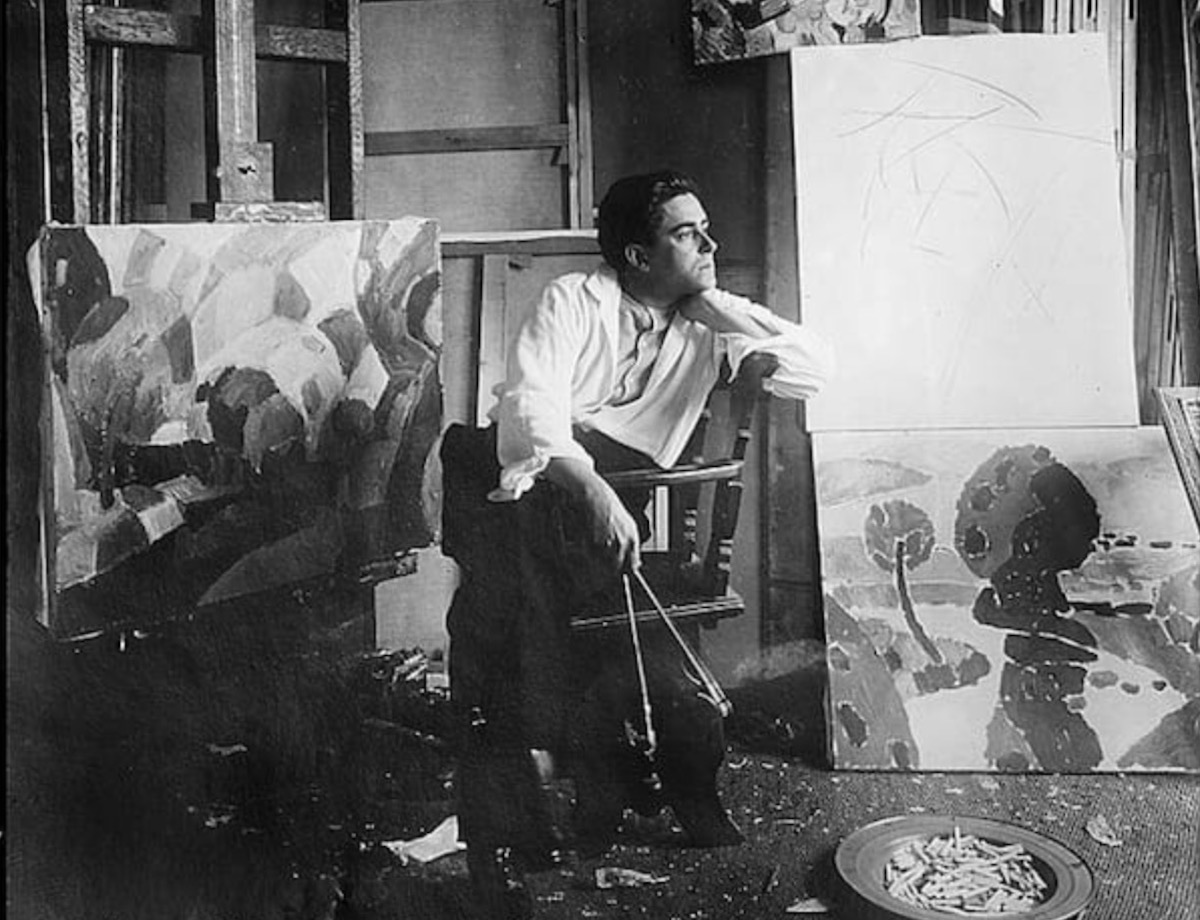
There is a candy-coated version of Francis Picabia that art institutions seem to follow. The dazzling shape-shifter, the Dada provocateur, the man who could paint Impressionist landscapes and machine diagrams with equal facility. Hauser and Wirth’s survey, Expanding Horizons, offers one version tracing his career from 1902 to 1951, across works that confirm his disquiet was genuine and his talent was rarely in doubt.
But there is another side to Picabia. And this exhibition, for all its pleasures, handles it rather silently. The early work is accomplished in the way that early Picabia often is, loose Impressionist landscapes carrying the influence of Pissarro and Sisley, made by someone who had the technical foundations and the independent income to walk away from them at will, which he did. The shift after the 1913 Armoury Show is where things get genuinely interesting. Picabia arrived in New York as one of the only European artists who could afford the passage. His private income put him on a platform, promoting him as a spokesman for Modernism with the confidence of a man who understood that the art world runs on being there. His relationship with Marcel Duchamp produced the mechanomorphic works, cold, mocking diagrams of gears and pistons that replaced human psychology with engineering drawings. There are no major works of this kind in the exhibition, making what is displayed rather scrappy.
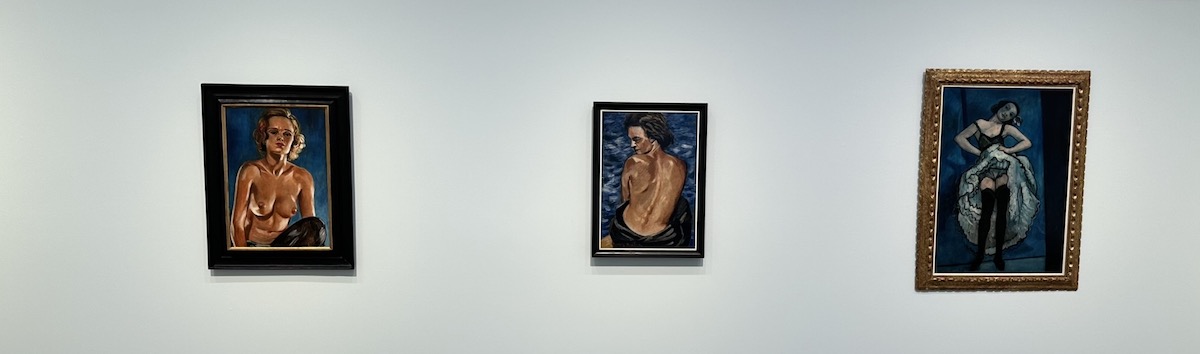
Francis Picabia: A Selection of Wartime Paintings
Then the show reaches the early 1940s, and the catalogue language softens noticeably. There is also a gap in the timeline displayed on the gallery wall. The final years of the Second World War saw Picabia drawing inspiration from risqué magazines of the 1930s. The Nazis occupied France, and his peers were being deported while Picabia was on the Côte d’Azur, selling eroticised nudes to whoever was buying. The pin-up paintings of this period have been compared, not unreasonably, to the marmoreal Nordic nude aesthetic favoured by the Third Reich. He made disparaging anti-Semitic remarks about colleagues and published flattering words about Marshal Pétain (the Vichy regime head) in the press. He wrote after his Côte d’Azur studio was “taken by some Jews”, following the Liberation of France by Allied Forces, publicly stating, “these are vulgar individuals, dirty egoists who think only of their financial interest.” (1) When Liberation came, Picabia was investigated for collaboration. He was never charged, moved to Paris, and pivoted to abstract paintings as though the previous five years had never happened, declaring that ‘figurative art is dead’.
The exhibition treats his wartime period as one more stylistic chapter in a restless career rather than as the morally catastrophic episode it was. The Vichy-era nudes are presented with the same curatorial neutrality as the Dada works and the numerous portraits on view. There is no extended engagement in the exhibition with what this says about the man or about how we situate his reputation within Modernism’s broader failures. In the end, he just gets lumped in with a wider group of disgraced artists who played or tried to play ball with fascism. This list includes Le Corbusier, André Derain, Jean Cocteau and Emil Nolde. – PCR
FRANCIS PICABIA EXPANDING HORIZONS 21 MAY – 1 AUGUST 2026 Hauser & Wirth LONDON
(1) Anne Umland’s opening catalogue essay for the 2017 retrospective at MoMA.