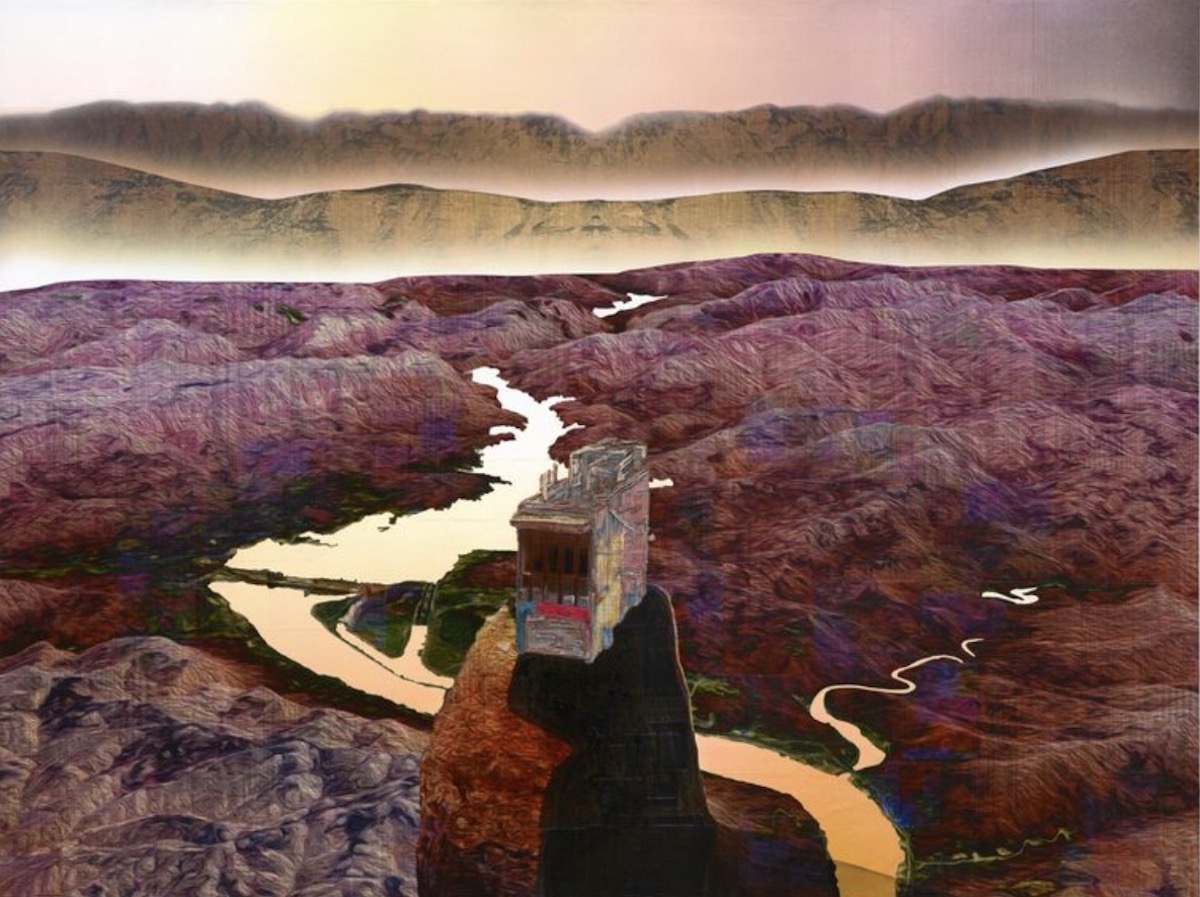
Gordon Cheung works across several disciplines simultaneously, drawing on the tensions between them as a generative resource. The London-born artist, whose parents came from Hong Kong, has spent the past two decades developing a practice that moves with unusual fluency across Chinese philosophy and aesthetics, European art history, the language of global finance and the visual grammar of digital technology. The results are works that, at first encounter, look like classical landscapes and, on closer examination, reveal themselves to be something altogether more complex and contemporary.
Many Worlds, One Mind, a major survey exhibition opening at Close Gallery on 6 June and running until 15 August 2026, brings together key works from across Cheung’s practice in what the gallery describes as a rare opportunity to encounter the full breadth of an artist whose thinking crosses economics, art history, technology and cultural identity without privileging any one of these domains over the others. The exhibition makes a strong case for Cheung as one of the more genuinely singular figures working in British painting today.
Gordon Cheung states, “The title Many Worlds, One Mind suggests both multiplicity and unity. That tension sits at the core of how I experience the world and how I’ve always navigated my own identity. Born in London to Chinese parents from Hong Kong, I am a 29th-generation Cheung, and I’ve lived with the sense of being between cultures, histories, and realities my whole life. The title was suggested by Freeny, who will be curating the show, and I thought it encapsulated perfectly the 20-year cross-section of what will be shown. The “many worlds” reflect the fractured, overlapping realities we inhabit, such as digital and physical, Eastern and Western, past and present, the speculative finance bubbles woven with ancient myths. Yet there’s “one mind” meditating on the poetic resonance in the chaos. Personally, it’s about the human condition under the histories of the rise and fall of civilisations. We’re connected by these vast invisible systems: global markets, information flows, migrations, yet profoundly alienated. The title feels like an acknowledgement that while we might share one underlying consciousness or set of existential questions, the worlds we build or that are built for us pull us in different directions. It’s hopeful in a quiet way, suggesting community can emerge from difference, but it’s also a caution about how fragile that unity can be.”
The most immediately striking material fact of his practice is his use of Financial Times stock listings as a ground for his paintings. Pages of share prices, the daily numerical record of global capitalism’s movements, are embedded into the foundation of the image, their dense columns of figures visible beneath the painted and digitally constructed surfaces that Cheung builds across them. The gesture is not merely conceptual. It has formal consequences that run through everything above it, giving the works a texture and a substructure that speaks of the economic systems underpinning the apparently timeless landscapes they depict. The romantic horizons and Dutch Golden Age echoes that characterise much of Cheung’s visual language are, in this sense, literally built on the infrastructure of financial speculation.
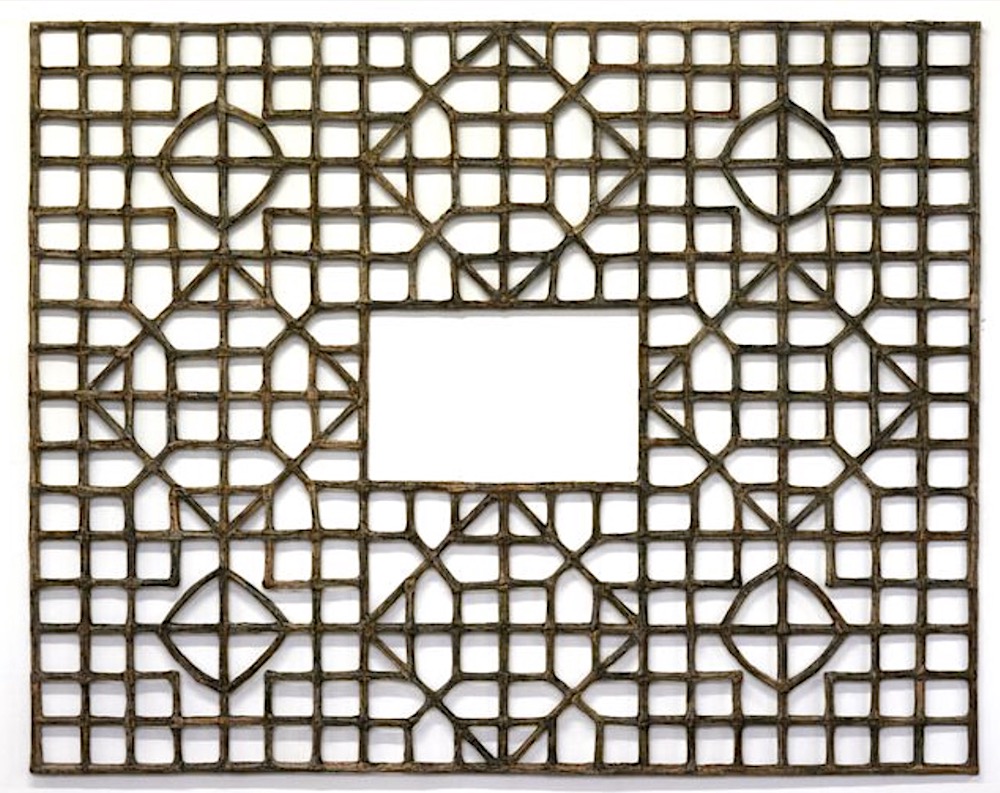
Gordon Cheung Windon 2020
That relationship between historical imagery and contemporary economic reality is central to the research that drives his practice. Cheung has long been drawn to the origins of global trade and the early formations of modern capitalism, and particularly to the speculative markets of seventeenth-century Holland. The tulip mania of the 1630s, often cited as the first modern financial bubble, recurs as a reference point across his work, its resonance with our own era of accelerated digital markets and algorithmic trading providing a historical lens through which the present becomes more legible rather than more distant. The Dutch Golden Age of painting emerged from the same commercial culture that produced the tulip bubble, and Cheung’s formal engagement with that tradition carries an awareness of this entanglement, giving his landscapes a critical edge absent from mere pastiche.
His technical methods are as hybrid as his conceptual interests. What appears painterly in Cheung’s work is frequently the result of processes that combine digital technologies, scientific experimentation, and sculptural construction, including three-dimensional printing and digitally mediated surfaces. The distinction between the painted and the generated, the analogue and the digital, is deliberately difficult to locate, and that difficulty is productive. The landscapes he creates are hybrid territories in which data and imagination coexist, where classical imagery dissolves into digital structures and historical reference is reframed through the language of technological innovation. They feel simultaneously ancient and futuristic, which is precisely the temporal disorientation that Cheung is pursuing.
The cultural displacement that informs his work is not experienced as loss but as a generative space where histories, aesthetics, and philosophies meet. Growing up between the traditions of East and West, with Chinese philosophy and aesthetics on one side and the long arc of European painting on the other, gave Cheung a position from which neither tradition could be taken entirely for granted, and from which both could be examined with a certain critical distance. His practice reflects the experience of living in that in-between space and finding it productive rather than destabilising.
“The 2008 financial crisis was a major catalyst for me, watching these ‘too big to fail’ institutions teeter, and the domino effect across the globe made me question the foundations of the systems we live in. It led me back to the first recorded economic bubble, Tulipmania in the 17th century, and forward through other collapses. I draw from these rhyming histories and parallels not to prescribe solutions or push a specific ideology, but to meditate on patterns of how civilisations rise through the lenses of mythologies and grand narratives confronted by mortal fragility. My work is more about creating spaces for reflection, dreamlike, techno sublime landscapes where the weight of history and data collide with human vulnerability. If it makes a political argument, it’s implicit: that we should look more critically at the narratives of power, territory, and belonging that shape us. But ultimately, I’m interested in the poetry and philosophy of it all, and in how these forces affect our inner worlds, our sense of identity, and what we imagine as possible futures,” he added.
Cheung studied painting at Central Saint Martins before completing his MFA at the Royal College of Art in 2001. His work is held in collections that reflect the international reach of his reputation, among them the Museum of Modern Art in New York, the Hirshhorn Museum in Washington, the Whitworth Art Gallery in Manchester and the British Museum. Previous solo exhibitions have taken his work to Jack Shainman Gallery in New York, Nottingham Castle Museum and Gallery and the Ann Norton Sculpture Gardens in Florida.
Many Worlds, One Mind offers the most comprehensive opportunity yet to follow the development of a practice that has been accumulating depth and complexity over the past two decades. In Cheung’s hands, landscape becomes a site where the invisible architectures of contemporary life, trade, belief, markets and memory are made visible as both poetic and political. It is work that rewards the sustained attention this exhibition makes possible.
Gordon Cheung: Many Worlds, One Mind is at Close Gallery from 6 June to 15 August 2026.