

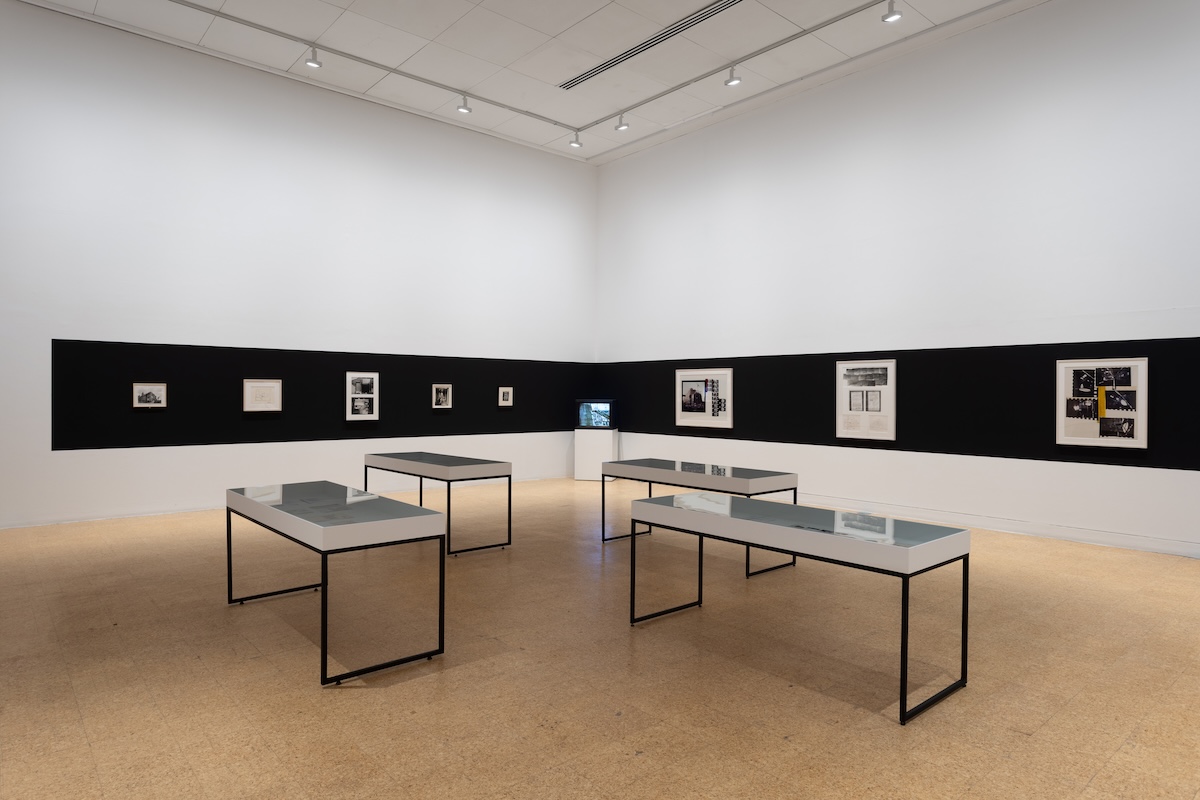
Gordon Matta-Clark applied physical poetics to sculpture. Echoing Jacques Derrida’s literary theories of deconstruction of texts, he became renowned for his large-scale ‘building cuts’ in abandoned structures. His approach broke down the apparently separate disciplines of architecture, town planning, and art. It was influential on many artists with intervention practices, particularly in urban structures, notably Rachael Whitehead and Christo.
Matta-Clark’s works cut through buildings, revealing new vistas inside and through the structures, and have come to define a generation’s thinking about the relationship between art, architecture, and a city’s social life. His outstanding interventions were experimental and influential; ‘Day’s End’ (1975), ‘Conical Intersect’ (Paris, 1975), and the ‘Bronx Floors’ series (1972 to 1973). He was part of an architecture group with whom he developed the games of anarchitecture.
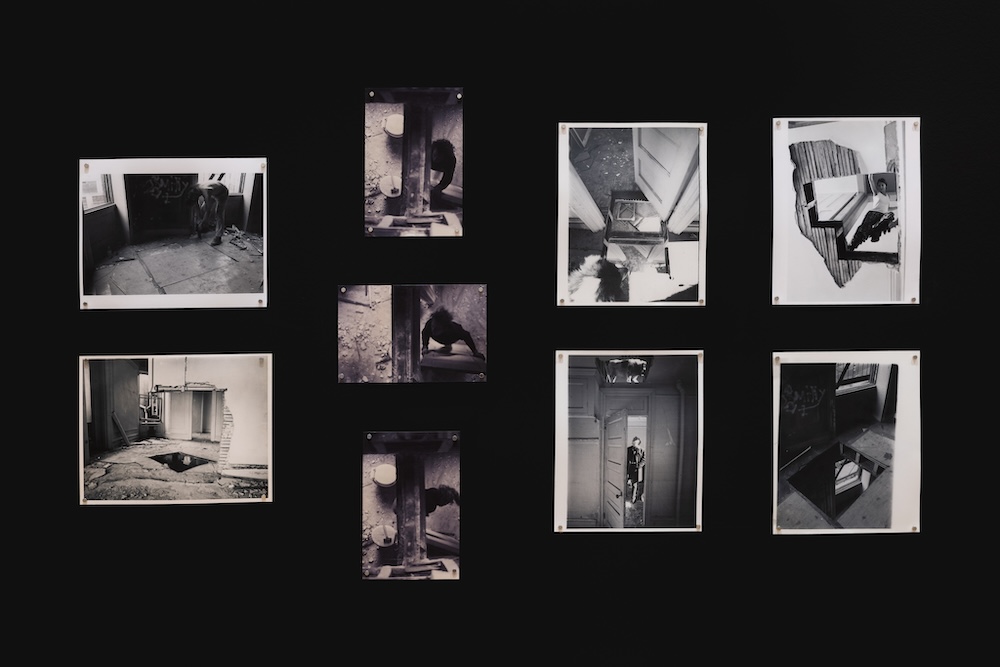
Gordon Matta-Clark Discrete Violations, 2026, Installation View, De La Warr Pavilion, Bexhill-on-Sea. Photography Rob Harris
This exhibition focuses on Matta-Clark’s work through documentation, archival items, paperwork, photographs and video. His cuts and carvings through condemned buildings are presented through pictures of the work in process. We see his and his team’s work, their physical contact with the walls, and, through new sightlines, we re-experience the world outside. In ‘Conical Intersect’ (Paris, 1975), cars of mid-seventies Paris pass by in the opening cut into the building. The cars and people pass by, bringing back memories of what Paris was like, educating those who weren’t there, and illustrating a time gone by. Strange how such very modernist, immediate, and brutal work has shifted in quality from being very present to a nostalgic vision over time, acquiring a sentimental narrative through the video and artefacts.
One of the most interesting presentations of Matta-Clark’s work is his own photographic collages. They are made using a technique born of frustration with the inability to capture the scope and space of his interventions through traditional photography. The camera’s rectangular frame could not capture the floors, walls, and ceilings, so an explosion was needed to make the structure’s complexity visible in the representation. His approach was simple but expanded his vision. The technique echoes his architectural cuts. In the process, function is encoded in form, as the photomontage parallels cine experiments with editing, slicing through celluloid. In the approach, the sense of a wider artistic community engaging in a similar collectively charged activity comes through. It is part of a wider challenge to established social practice through aesthetics. Discrete Violations offers a powerful insight into a radical generation’s thinking.
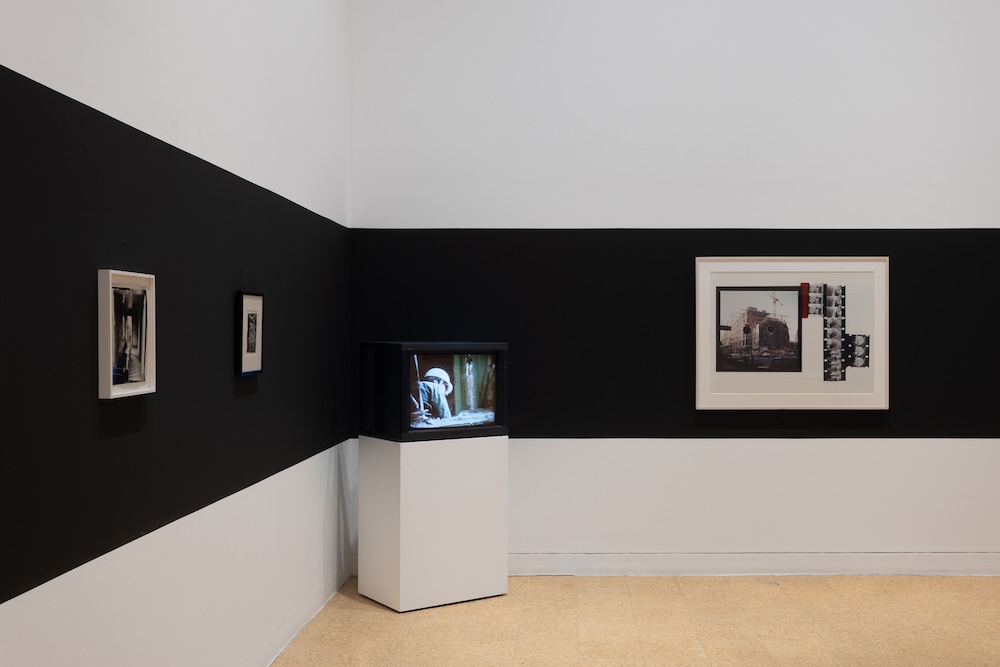
Gordon Matta-Clark Discrete Violations, 2026, Installation View, De La Warr Pavilion, Bexhill-on-Sea. Photography Rob Harris
The humour in Matta-Clark’s work is displayed in many of the pieces. Workers dance in the space for the camera. Written documents clearly provoke and play with convention and bureaucracy. He bought tiny parcels of unwanted land, highlighting the holes in ownership and use. In 1973, he purchased fifteen lots in New York, residual areas, many inaccessible, anomalies that escaped the interests of the real estate. Despite its apparent concern with ‘real’ locations, this purchase of land parcels with no economic value is a conceptual piece that highlights the ridiculousness of land-ownership systems. In a final posthumous bureaucratic act after he died in 1978, the micro properties were reclaimed by the city for tax reasons.
At the De La Warr, one of the first public buildings in the UK in the Modernist style, it feels like the right place to view Matta-Clark’s selected archive. Installed in the First Floor Gallery, Discrete Violations enables an additional dialogue with the building for the visitor and encourages new insight into all its spaces at their stages of conservation, fighting the forces of dilapidation. I found myself looking at the toilets, the windows, the doors, the rails, the stairs with a changed appreciation. This show provides a stimulating setting for discussion of community and use. One might come to this show to be in an incredible historic building and to look at an exhibition about buildings. Primarily, this show challenges the visitor to question how society considers construction and land. Britain is often described as obsessed with property ownership and its financial stake. Hence, this exhibition is a place to turn those assumptions on their head and draw new ideas from a previous generation of radicalism.
Top Photo: Gordon Matta-Clark Discrete Violations, 2026, Installation View, De La Warr Pavilion, Bexhill-on-Sea. Photography: Rob Harris. Words: Jude Montague
Gordon Matta-Clark: Discrete Violations 10 October 2026 – 4 January 2027 De La Warr Pavilion First Floor Gallery – FREE