Last Autumn, cranes tore into the White House’s East Wing, a gesture that rebounded across the news. The reason was obvious enough: a $400 million gold-leafed ballroom was planned for the site, without consultation. Soon after, another announcement came, this one more depressing and no less troubling. The Kennedy Centre is set to close for two years to be reworked into what the president has billed as a “New and Spectacular Entertainment Complex.” No doubt, when it reopens, it will be renamed The Trump Centre for Performing Arts!
The current administration has shown a keen interest in the symbolic power of architecture and spectacle. A proposed ‘Trump Arch’ to rival Europe is in the planning stages. The rejection of Modernism by the Nazis, Mussolini and Franco, whose fascist neoclassical architecture became the norm in the 1930s, raises alarm bells.
Against this backdrop, attention has turned to another federal site whose future now looks uncertain: the Wilbur J. Cohen Federal Building in Washington, D.C. Arguably one of the more interesting buildings in the Art Deco style, it houses a remarkable cycle of New Deal-era murals by Philip Guston, Ben Shahn, and Seymour Fogel. Together, they form one of the most significant surviving ensembles of WPA-commissioned art from the 1940s. It has been described as “a kind of Sistine Chapel of the New Deal.”
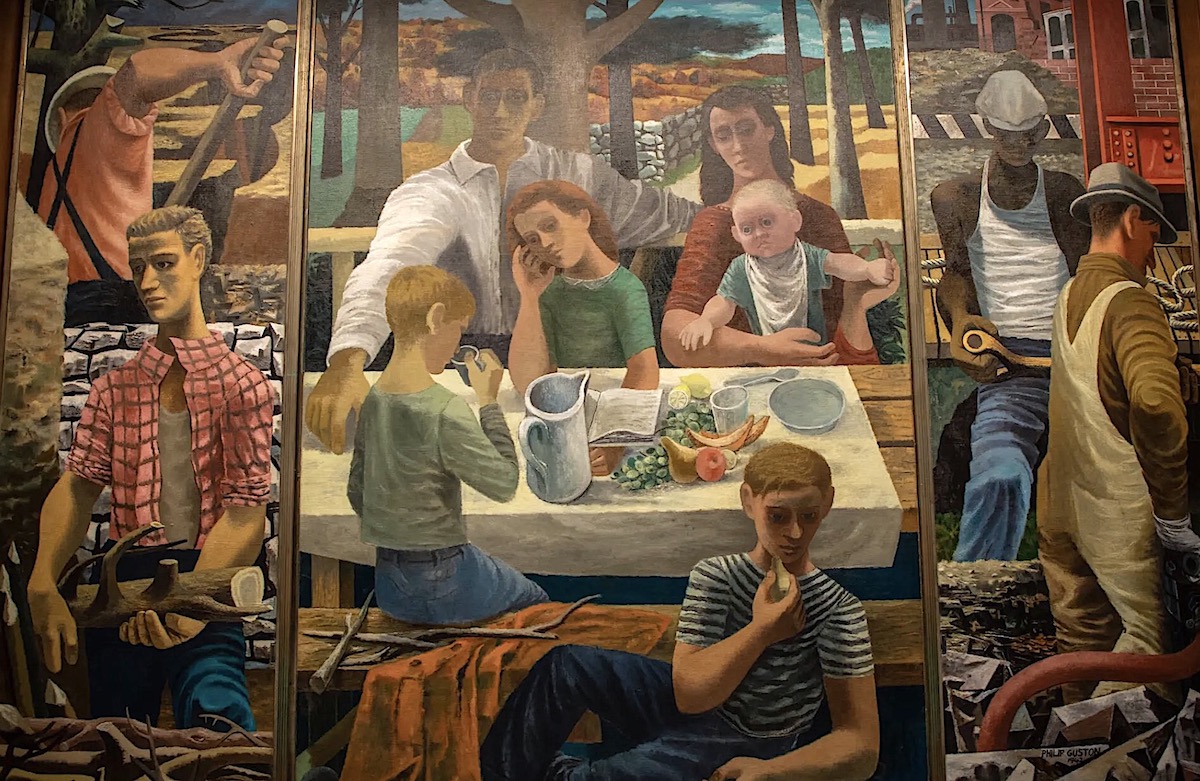
A detail from “Reconstruction and the Wellbeing of the Family,” by Philip Guston, is reminiscent of Italian Renaissance religious triptychs that Guston loved. Credit…via U.S. General Services Administration
The Cohen building, completed in 1940, was conceived as a monument to Franklin D. Roosevelt’s Social Security Administration. Its architecture of limestone and granite blends Stripped Classicism with Deco Egyptian Revival motifs, a hybrid style that speaks to the optimism and authority the New Deal sought to project. Yet it is the art inside that gives the building its deeper resonance. Commissioned by the Treasury Department’s Section of Fine Arts, the murals were installed between 1942 and 1943, at a moment when the country was still recovering from the Great Depression while fighting a global war.
The building appears on the General Services Administration’s list for “accelerated disposition,” bureaucratic shorthand for sale or disposal. Congress approved the move on the condition that the building must be fully vacated before it can change hands. With only a handful of staff still using its vast interior, and major tenants long gone, that threshold may soon be crossed.
The G.S.A. insists that any sale would include preservation covenants protecting the artworks. Yet confidence in such assurances has been shaken. The East Wing demolition has left many wondering how robust those safeguards would be in practice, particularly given how aggressively federal cultural assets are being reshaped or removed.
Public access to the Cohen building has been restricted since 9/11, though limited tours have recently resumed. Walking through its halls today, the murals still exert a cumulative power. They were not conceived as detachable artworks, but as integral parts of a civic environment. Their themes—labour, security, family, dignity—were meant to surround and steady those who worked within the federal bureaucracy, and by extension, the public it served.
Seymour Fogel’s frescoes flank the Independence Avenue entrance. Less well known than his peers, Fogel had previously worked under Diego Rivera on the infamous Rockefeller Centre mural destroyed in 1933. At the Cohen building, his tone is more measured, even serene. Wealth of the Nation presents a smoothly functioning society: scientists, architects and factory workers each absorbed in purposeful activity. Its companion panel, Security of the People, shifts to a focus on domestic calm. A family reads, plays and draws together, the composition arranged with almost classical balance. It is a vision of welfare-state optimism rendered with compositional restraint.
Philip Guston’s contribution, Reconstruction and the Wellbeing of the Family, complicates that clarity. Installed on the stage of a lecture hall, the work is a triptych: oil paintings mounted on wooden panels that recall the Renaissance altarpieces Guston admired. The central scene shows a family gathered around a table, lit like a secular Last Supper. The side panels compress scenes of labour into narrow, crowded spaces. Faces are thoughtful, even anxious. The promise of “wellbeing” feels provisional, shadowed. Guston’s painting suggests that social repair is fragile, not guaranteed.
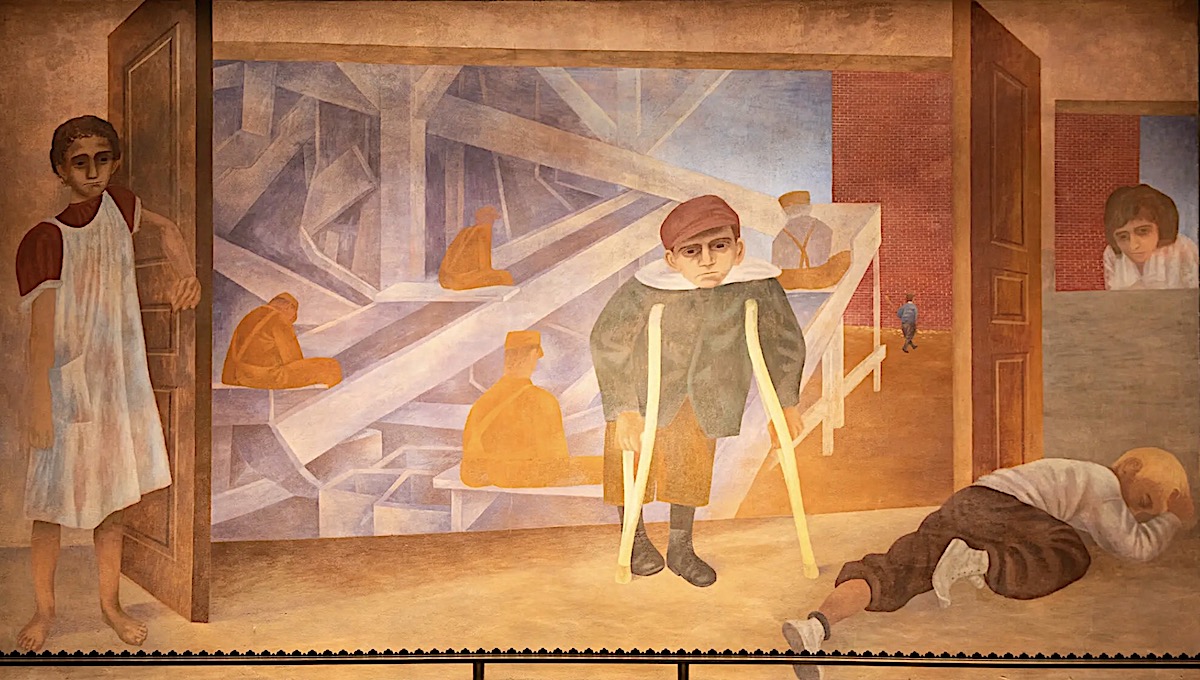
Ben Shahn’s murals, collectively titled The Meaning of Social Security, occupy opposing lobby walls and offer the most politically charged vision of the three. Executed in a mix of fresco techniques, they contrast America before and after the New Deal. One wall depicts construction, sports, and family life, with workers in immaculate white overalls erecting luminous structures. On the opposite page, Shahn depicts unemployment, illness, and poverty with blunt directness: idle men, children sleeping on the streets, and a father and son trudging along railway tracks. The palette darkens, the mood turns accusatory. Shahn later said this was his finest work.
The threat now is erasure. The idea of relocating the artworks is fraught. Guston’s panels could be removed. Fogel’s and Shahn’s murals, bonded to the building’s walls, would be at serious risk. Once separated from their architectural context, their meaning would also shift, diminished by displacement.
Advocacy groups have begun to mobilise. Living New Deal has launched a campaign calling for the building and its artworks to be preserved intact, with any transfer subject to public scrutiny. An open letter by artists Elise Engler, Joyce Kozloff, and Martha Rosler has urged institutions, including the Jewish Museum in New York, to take a leading role in safeguarding the murals of Shahn, Guston, and Fogel, through a federal programme that explicitly linked art to social responsibility.
This isn’t just about heritage management, but about which history a nation chooses to keep visible and alive. The murals remain in place for all to see by appointment, for now. Anyone concerned with public art, social memory, and the legacy of the New Deal should attempt to put an iron ring around the buildings. Once gone, this chapter of American cultural history will not be so easily recovered.
Top Photo: In this panel from “The Meaning of Social Security,” Shahn illustrated the problems of child labour: a girl working in a mill, boys in a mine, a boy with labour injuries, and a homeless child sleeping in the street. Credit…Estate of Ben Shahn/Licensed by VAGA at Artists Rights Society (ARS), NY; via U.S. General Services Administration