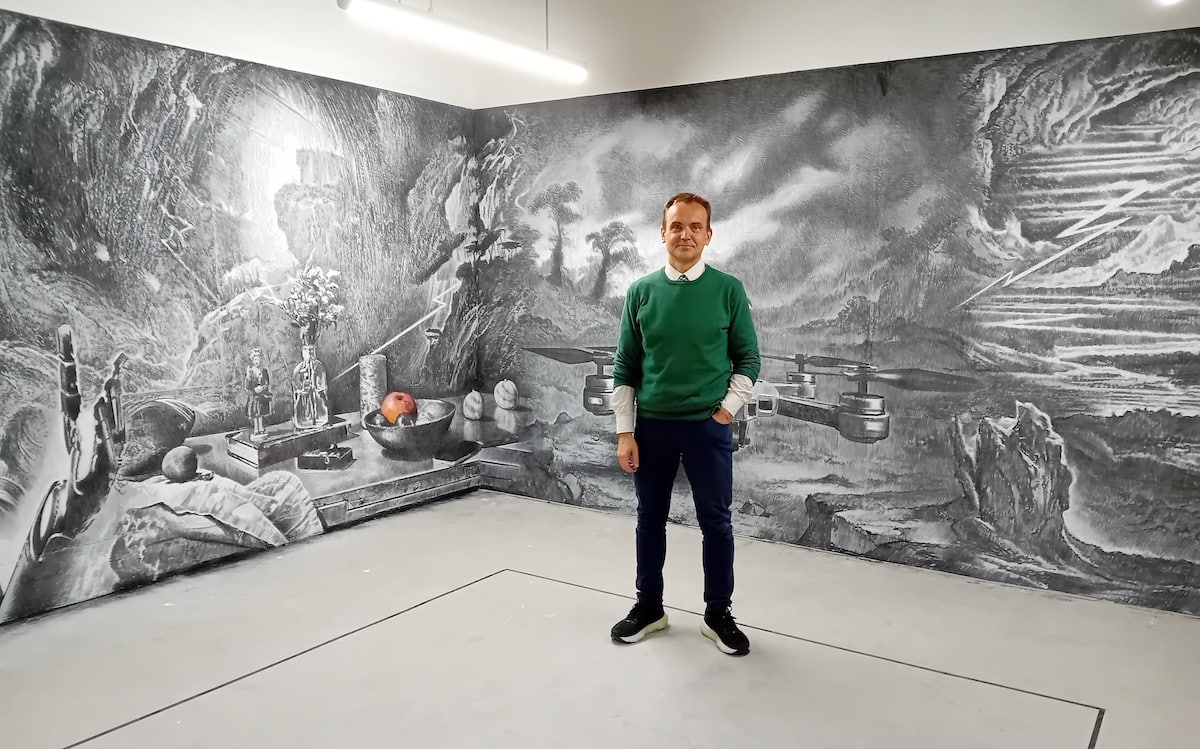
‘Applecore’ isn’t a run-of-the-mill project. London-based Czech and British artist Hynek Martinec has spent a week making a 17-metre-wide wall drawing at Hypha Gallery South Bank, where it’s accompanied by 30 ‘dream drawings’ on paper. The mural is on view until 1 October, when Martinec – dressed as an apple – will publicly destroy it. By then, a related show of his hyper-surrealistic paintings will have opened (30 Sept – 20 Oct) at Varvara Roza Gallery in central London.
PCK: Is this your usual sort of thing?
HM: Not exactly, but it does follow on from a similar project for DOX gallery in Prague, with an even bigger mural. There, I chose the lemon as a topic: I was referencing Dutch still life paintings, with their 17th-century meaning when it was a sign of wealth to have a lemon on the table, when I realised that in every historical era the lemon took on a different role – society changes, though the lemon remains the same. I wanted to give the lemon meaning as a guide to history.
And now you’ve moved on to the apple?
Yes. At first I thought of it the same way, as just the apple tracked through history – Adam and Eve, still life again, Cézanne, the Apple Company as humans move towards technology and AI… Again, the apple is the same, but society’s relationship to it changes. But then I thought of the apple core – we’re on the surface, unaware of what’s going on inside as we use the planet, generating and stealing things at the same time. We think the apple core is at the centre of beauty, but we have lost connection.
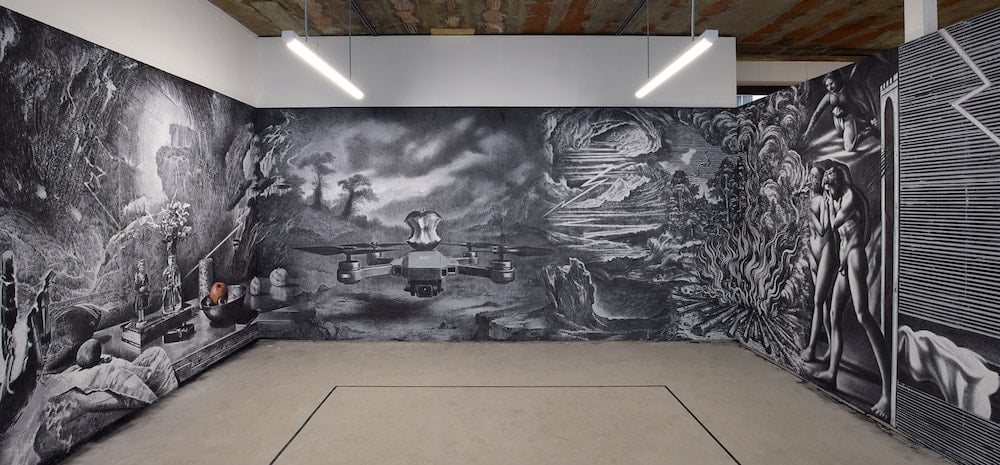
Hynek Martinec: ‘Applecore’, 2026 – charcoal and white charcoal on wall, 17m wide
How did you make the mural?
There was extensive pre-planning, with months of research, followed by the integration of contemporary and historical images in Photoshop. I also – for the first time – used AI to design some areas, so ceding some control as a creator and raising the issue of how AI might control us more widely. I rendered the plans by hand over eight days as a public performance at Hypha, aiming to create an organic whole in a single unified language. I painted the wall grey, then used both black and white charcoal – again, for the first time. I found that visually richer than the pure black-charcoal-on-a-white-ground of my previous mural drawings.
What does the mural show?
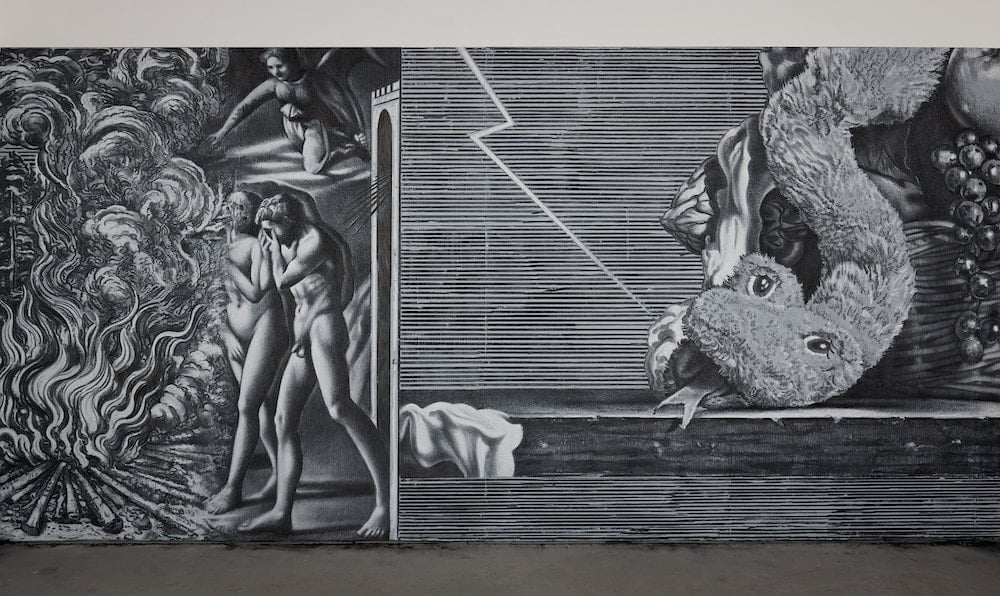
It starts as if we’re looking back at an imagined Paradise – so we can’t see the landscape, only the snake. We enter, imagining what we’ve just missed.
Why a toy snake?
That’s a paradise snake! Ambiguous, rather than straightforwardly evil. It might relate to Mike Kelley’s use of soft toys and suggest Pop Art, but it got there as a personal reference. It’s a twelve-footer that my daughter Agnes got five years ago. Even then, it was a second-hand present from her best friend, so I’ve known the snake even longer. Her friend’s parents were at the opening, and recognised it immediately!
Those look like the figures from Masaccio’s 15th-century fresco ‘The Expulsion from the Garden of Eden’?
Yes, we jump via Masaccio to the first tests for humanity: after The Fall, people had to think about food, family, reproduction… The test is represented by fire, an important yet destructive energy, and by different lightning, symbolising change. The backgrounds of disaster, burning, and deluge are taken from the dramatic 19th-century landscapes of John Martin. The artist imagining things falling apart at the end…
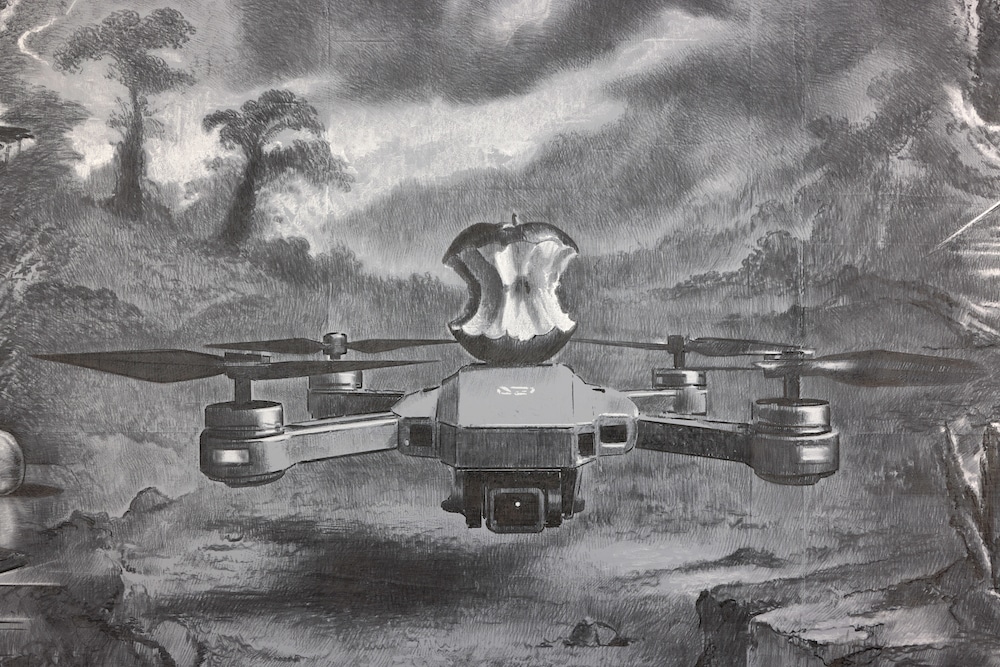
Then we see a drone with an apple core. Is the core somehow driving the drone, or is it just being delivered by it?
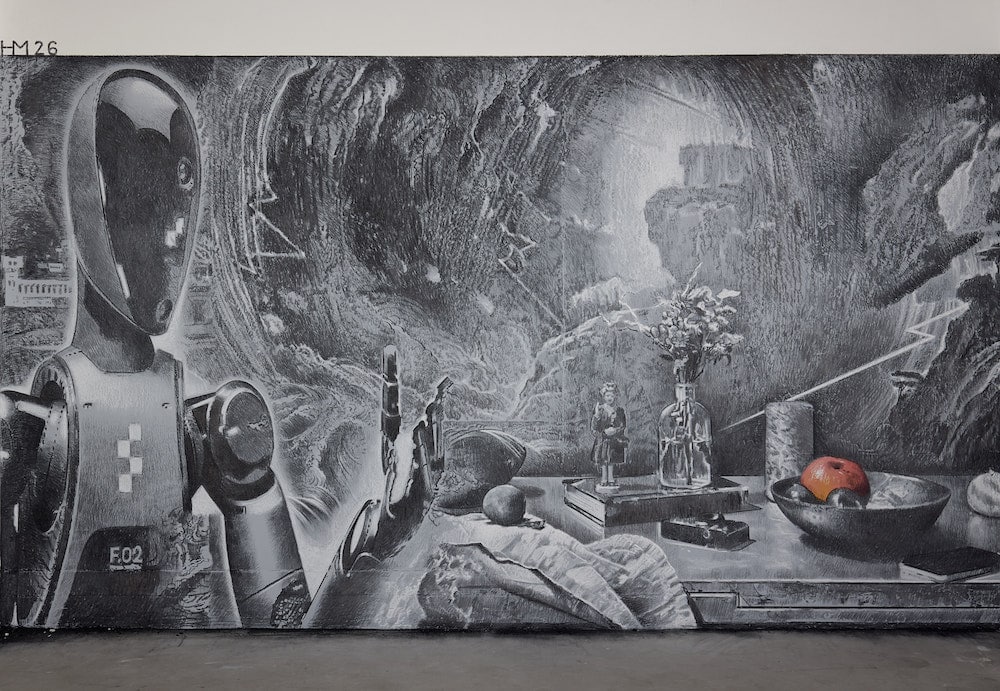
I like the idea that another apple core could be controlling the drone from off-screen. After which we move along to a still life. That references the apple as a normal part of everyday life, but with an iPhone and a camera to remind us how technology moves on faster and faster. And a figurine of Queen Elizabeth II, representing something we remember, but has gone – I don’t want to forget the past.
Why the irruption of colour at this point?
I thought it would be nice to have a weird element in the monochrome. I was thinking of how the running, angelic girl forms a weird spot in Rembrandt’s ‘Night Watch’. But I wanted that to be small scale and to the side, not too dominant.
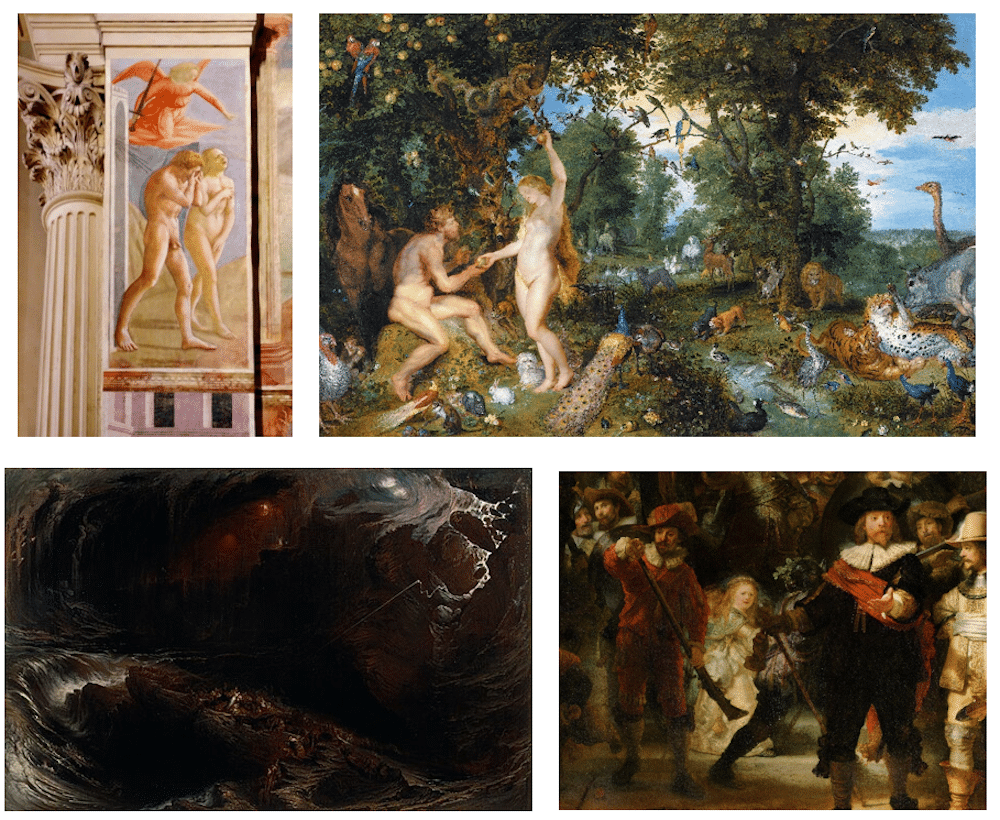
Masaccio: ‘The Expulsion from the Garden of Eden’, 1425; Jan Brueghel the Elder and Peter Paul Rubens: ‘The Garden of Eden with the Fall of Man’, 1615; John Martin: ‘The Deluge’, 1834; and Rembrandt van Rijn: ‘Militia Company of District II under the Command of Captain Frans Banninck Cocq’, 1642 (detail)
And all is overseen by a robot. Any particular robot?
No, I had many images of robots in my database. It’s probably quite recent – as it has a camera and speaker… maybe Chinese…
On 1 October you will destroy the mural as a public performance. How will that be for you?
It has been designed to be destroyed… I am the creator, and I will end it, leaving only the black-and-white images of documentation, as in a 1970s performance by Marina Abramović. I plan to demolish it completely, not just wash it off. That won’t be easy, as I know from being a lemon in Prague that I won’t be able to see much when I’m an apple!
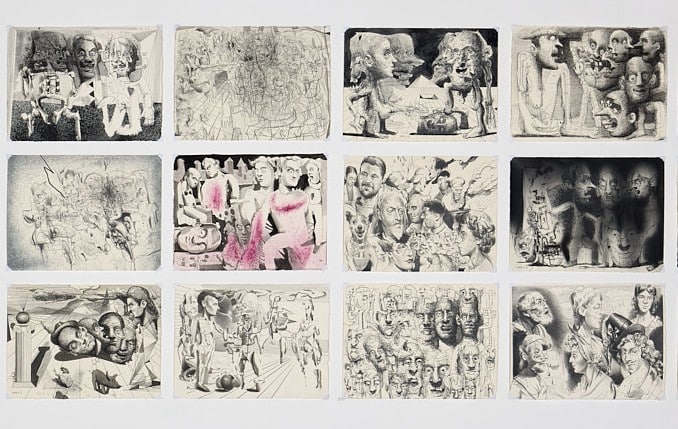
Hynek Martinec: ‘Dreams’, 2026 – 12 of the 30 drawings
Opposite the mural, you are showing 30 ‘dream drawings’. You remember your dreams?
95% of the time, yes. Over the years, I’ve trained myself to recall them. And from 2007 onwards, I’ve spent the first ten minutes on waking by sketching what I recall, with notes such as who is in them – it may be famous people, as well as family and friends. Tony Blair and Francis Bacon have appeared recently. As I come around, the dream fades, and I go to the studio and add additional content, from more conscious fantasies. The dream drawings have an energy I look to translate into my paintings.
Why do dreams interest you?
They show we are human with our own unique worlds, in contrast to how technology brings the same machinery to everyone. There is a secret we all hide in our heads. And they give me a platform independent of photographs. Dreams have an energy we should use, because they are trying to tell us something.
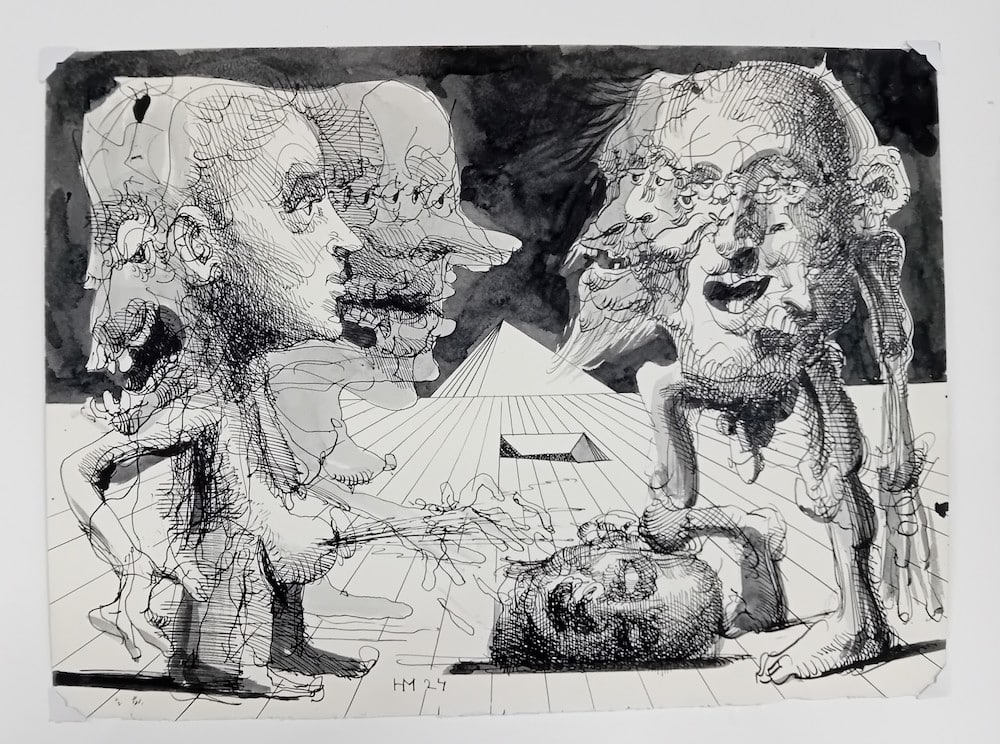
There seem to be a lot of people in your dreams?
There are. I was born nearly deaf, but luckily hearing aids became available in the early 80s, allowing me to hear and speak… So, I have been designed not to hear in the world, and my dream language may have been affected by that. I take my aids out by night, but it’s as if the dreams are busy against silence.
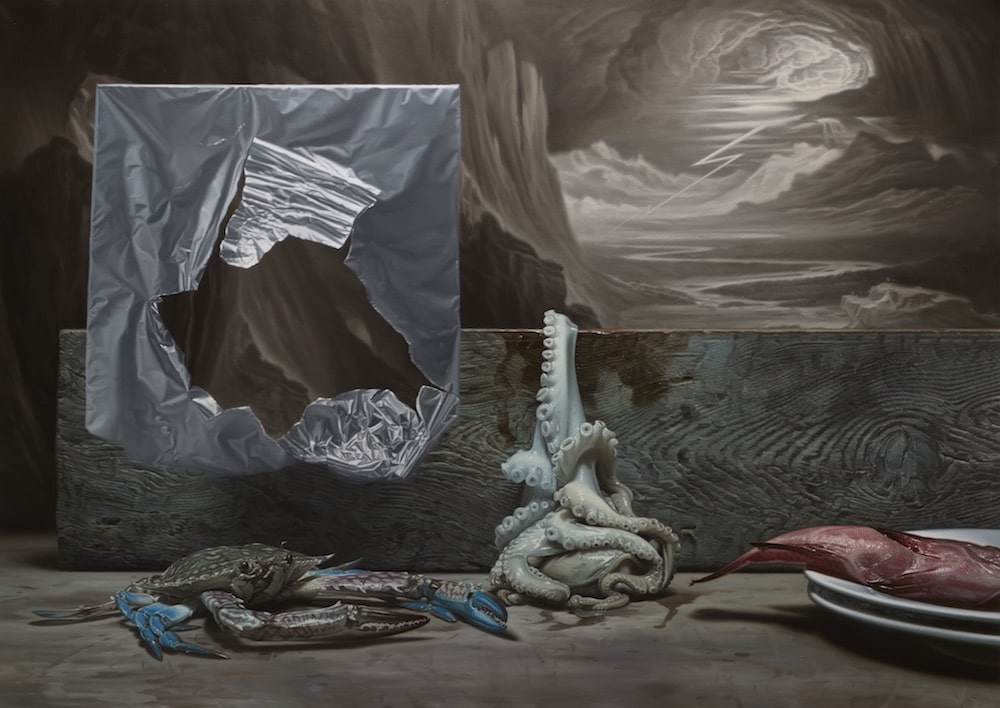
Hynek Martinec Paradise Lost, 2025. Oil on canvas
On Duke Street, you will be showing thirteen new paintings that pick up on the themes in the mural. Can you say something about ‘Paradise Lost’?
The background is from John Martin. Three animals have broken through the canvas, out of the monochrome paradise and into our lives, onto our stage – that’s why they’re in colour. Crab, octopus and fish because painters have shown lots of nice animals in paradise – but they don’t pay attention to these sorts of creatures…
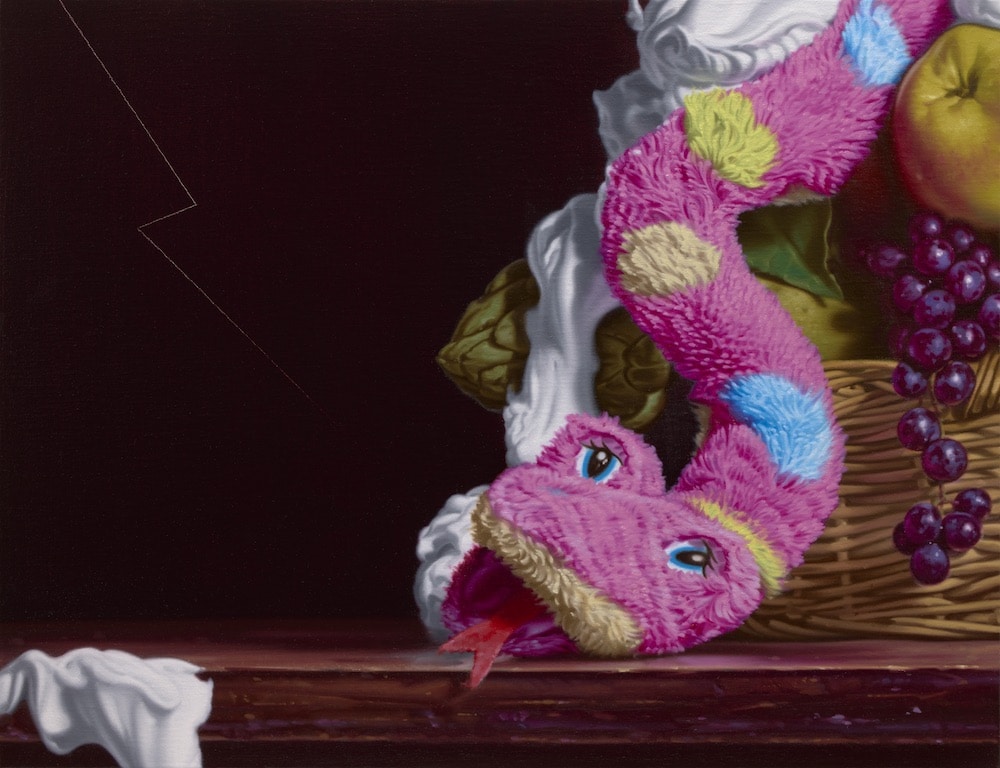
Hynek Martinec: ‘Applecore’, 2026 – Oil on canvas, 50x65cm
Is that shaving foam along with the fruit and your daughter’s snake in ‘Applecore’?
It is. In the same way as a Dutch Golden Age painting shows flowers that are dying, as a reminder of the brevity of life, I use shaving foam as a contemporary reference to Vanitas – it looks sculptural and strong but will soon melt and collapse into a sop.
Hynek Martinec: ‘The Deluge (After John Martin)’, 2026 – Oil on canvas, 170x240cm
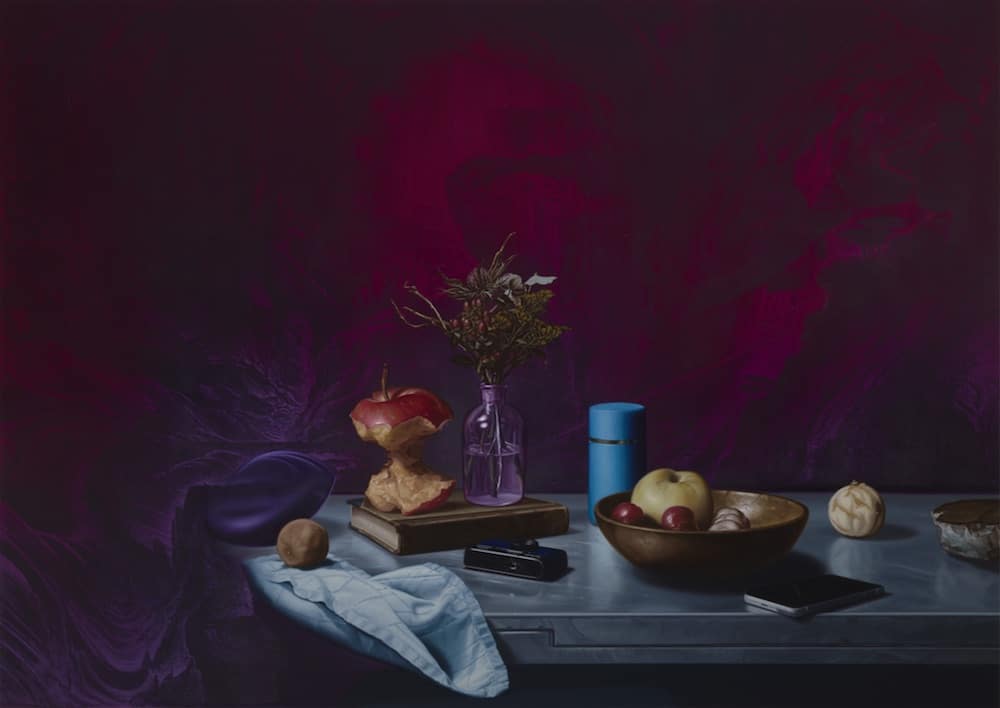
Why the volcanic background and monumental scale of ‘The Deluge (After John Martin)’?
The everyday things of life do matter, even as they change – the camera and iPhone again – but at the back in red-magenta is a disaster, perhaps the end of the world. Yet we carry on…
Hynek Martinec: Applecore consists of Part I: Hypha Gallery South Bank, 42 Southwark Bridge Rd, London SE1 9EU, 29 Aug – 1 Oct (Thurs-Sun) and Part II: Varvara Roza Galleries, 8 Duke Street, St James, London SW1Y 6BN, St James’s, 30 Sept – 20 Oct 2026 (Mon-Sat).
Images courtesy the artist and Varvara Roza Galleries, photos Paul Plews, except portrait and dream drawings (photos Paul Carey-Kent). Top Photo: Hynek Martinec at Hypha Gallery South Bank