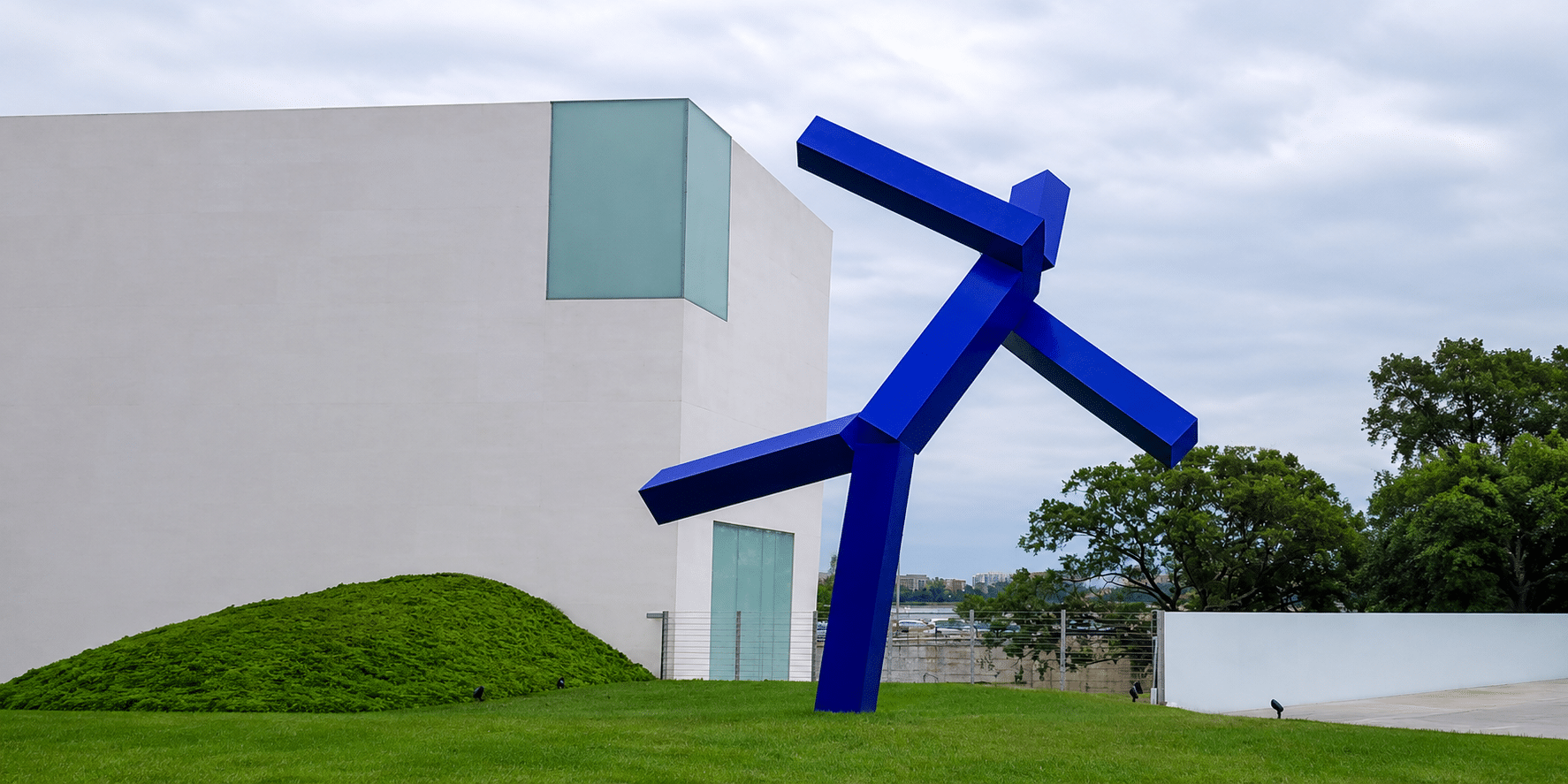
Workers are set to begin dismantling one of the US capital’s most recognisable public sculptures. The Kennedy Centre for the Performing Arts have been forced to take down Joel Shapiro’s “Blue,” a towering cobalt figure that has watched over the grounds of the Reach since 2019. Internal documents obtained by The New York Times suggest the work had been earmarked for elimination not long after President Trump’s takeover of the institution. There had been no public announcement or consultation.
In a brief statement, the institution confirmed the sculpture was being deinstalled and said a foundation representing the artist’s estate would determine where it goes next. No specific reason was given for the timing, though the statement pointed out that removing donated or loaned works for conservation purposes is standard practice at cultural institutions. “We are deeply grateful to Joel Shapiro for the years ‘Blue’ has spent animating our campus and connecting visitors to his vision,” the statement read, adding that the centre considered itself honoured to have served as a steward of the work. Shapiro died last year and was therefore unable to comment on the decision; his daughter did not respond to inquiries either. The White House offered no comment when asked.
The National Park Statement: Specifically, there will be temporary closure and restricted public access to the northbound lanes of Rock Creek and Potomac Parkway NW, with blockades at the E St on-ramp, at the intersection of Rock Creek and Potomac Parkway and Parkway Dr NW, which would direct traffic from Ohio Dr SW to Parkway Dr NW, and at the intersection of Rock Creek and Potomac Parkway and F St NW. The restricted areas are depicted in the enclosed map (Enclosure 1).
These temporary closures and restrictions are at the request of The Kennedy Centre for the removal of the “Blue” Statue on The Kennedy Centre grounds. A crane will occupy the northbound lanes of Rock Creek and Potomac Parkway in order to remove the statue. These closures ensure the safety of the crew removing the statue and the public. Less restrictive measures and means are unavailable for removing the statue due to its location.
For those who worked inside the institution, the removal came as confirmation of something they had already been warned about. Josef Palermo, who lost his job as curator of visual arts and special programming at the Kennedy Centre in March, wrote in an essay for The Atlantic that he had personally been directed to begin pulling pieces from the centre’s permanent collection and told that renovations under the new administration would bring in different art to replace what was there. Speaking in an interview this week, Palermo said “Blue” had been flagged for removal early in the process, and he expressed frustration that the institution had chosen to proceed without any public notice. “The Kennedy Centre,” he said, “is in effect holding these pieces in trust for the American people, and there should be a lot more transparency.”
The sculpture sits, or sat, on the grounds of the Reach, the $250 million expansion that opened in 2019 as the first major addition to the Kennedy Centre since the building itself debuted in 1971. Shapiro completed “Blue” the same year the Reach opened, adding it to a body of public work that spans cities across the globe. Visible both from the Potomac and from roads cutting through the Kennedy Centre campus, the piece had settled into the role of local landmark almost immediately. In a promotional video released around its unveiling, Shapiro explained that he had designed the stick-figure form so that its posture would appear to shift depending on where a viewer stood, calling the work “about action and risk and performance and energy” and describing it as “a celebration of possibility.”
News of its removal has reignited anger among activists who have spent months protesting what they view as the politicisation of the Kennedy Centre under Trump’s influence. This campaign has already included stripping President Kennedy’s name from the building’s facade in favour of the president’s own. A federal judge ordered that change reversed earlier this year, and Trump’s legal team has continued pushing to have his name restored. Hands Off the Arts, a coalition of artists, former Kennedy Centre staff, and longtime patrons, responded to the sculpture’s removal with a pointed message posted to Instagram: “First they came for the facade, and now they come for the grounds.”
Trump has been openly critical of the Reach itself, a project largely bankrolled by philanthropist David Rubenstein, who chaired the Kennedy Centre board until Trump replaced him after stacking the board with allies. In a court filing submitted last week arguing for the restoration of his name to the building’s exterior, Trump’s lawyers dismissed the significance of the Reach’s own naming, writing that the centre had renamed a substantial section of its grounds seven years ago “without a semblance of protest,” adding dismissively that “nobody had any idea what it even meant.” The name, in fact, is an acronym built from the words Renew, Experience, Activate, Create and Honour, chosen to echo Kennedy’s own vision for expanding public access to the arts across the country.
Joel Shapiro was born in New York on September 27, 1941. His interest in art began early. As a teenager, he attended painting classes at the Museum of Modern Art before spending a year at the University of Colorado in Boulder, then transferring to New York University.
From 1965 to 1967, Shapiro lived in India as a member of the Peace Corps. He returned to New York and began working as a sculptor, meeting the conceptual artist Robert Barry that same year. In 1969, he received an MFA from New York University, and his work was included in the exhibition Anti-Illusion: Procedures/Materials, curated by Robert Littman, at the Whitney Museum of American Art.
Shapiro taught at Hofstra University from 1969 to 1970. His work at the time was concerned with repetition, accumulation and the ordinary gestures of everyday life. He made drawings from repeated marks and sculptures based on familiar actions and objects, stripping them down to their most basic forms.
In 1972 he began working on a series of paintings and iron sculptures. A year later he met the painter Ellen Phelan, whom he would later marry. Their relationship became an important exchange of ideas, with Phelan playing a significant role in the development of Shapiro’s work.
By the mid 1970s, Shapiro was teaching sculpture at universities around New York. His work became increasingly figurative from 1977 onwards, a direction that continued through much of the 1980s. He worked across wood, bronze and steel, gradually moving towards larger and more ambitious sculptures. Between 1987 and 1990, he collaborated with Leslie Miller of Grenfell Press in New York on a series of lithographs and stencils.
Shapiro’s first solo exhibition was held at Paula Cooper Gallery in New York in 1970. His work subsequently entered a wide range of museum exhibitions, including the Museum of Contemporary Art in Chicago in 1976 and the Whitechapel Gallery in London in 1980. In 1982, the Whitney Museum of American Art gave him a mid-career retrospective.
A 1990 exhibition at the Des Moines Art Centre examined the development of figuration in Shapiro’s work. The exhibition later travelled to the Baltimore Museum of Art and the Centre for the Fine Arts in Miami.
His contribution to American sculpture was recognised with the Skowhegan Medal for Sculpture in 1966 and an Award of Merit in Sculpture from the American Academy of Arts and Letters in 1990. In 1991, he was commissioned to create a sculpture for the United States Holocaust Memorial Museum in Washington, D.C
Shapiro died in Manhattan on June 14, 2025, leaving behind a body of work that helped redefine the possibilities of contemporary sculpture. His simplified human figures, often balanced between movement and stillness, became among the most recognisable forms in postwar American sculpture.
Whether “Blue” finds a new home elsewhere or disappears into storage remains unclear. What is certain is that its quiet predawn removal has become the latest flashpoint in an ongoing struggle over who controls the institution’s identity, and what, exactly, gets to remain standing on its grounds.
——————-
Update: On Wednesday morning, the figure’s limbs and torso were wrapped in protective material. An arm was the first to be removed, followed by the legs. The sculpture has all but disappeared. It will be stored by the Joel Shapiro Foundation until another place for display can be agreed.
Update:
The NY Times has stated, “The billionaire philanthropist David Rubenstein has purchased the abstract sculpture called “Blue” that was removed from the grounds of the John F. Kennedy Centre for the Performing Arts last week, according to two people familiar with the sale. It will eventually be displayed in the Sculpture Garden of the National Gallery of Art, the people said. Mr Rubenstein, a major arts donor, was chairman of the Kennedy Centre’s board until he was ousted in early 2025 during President Trump’s takeover. He is the chairman of the board of trustees at the National Gallery. He purchased the sculpture from a foundation dedicated to its artist, Joel Shapiro, which received the artwork after its removal. One of the people familiar with the sale said the price was more than $2 million. Since 2019, the 24-foot-tall stick-figure-like sculpture has stood on the grounds of the Reach, an addition to the Kennedy Centre that was partly funded by Mr Rubenstein, who co-founded the private equity giant Carlyle Group. The sculpture was deinstalled with no prior notice or explanation from the institution, drawing a flurry of questions and objections from local patrons who considered it a landmark overlooking the Potomac River.”