
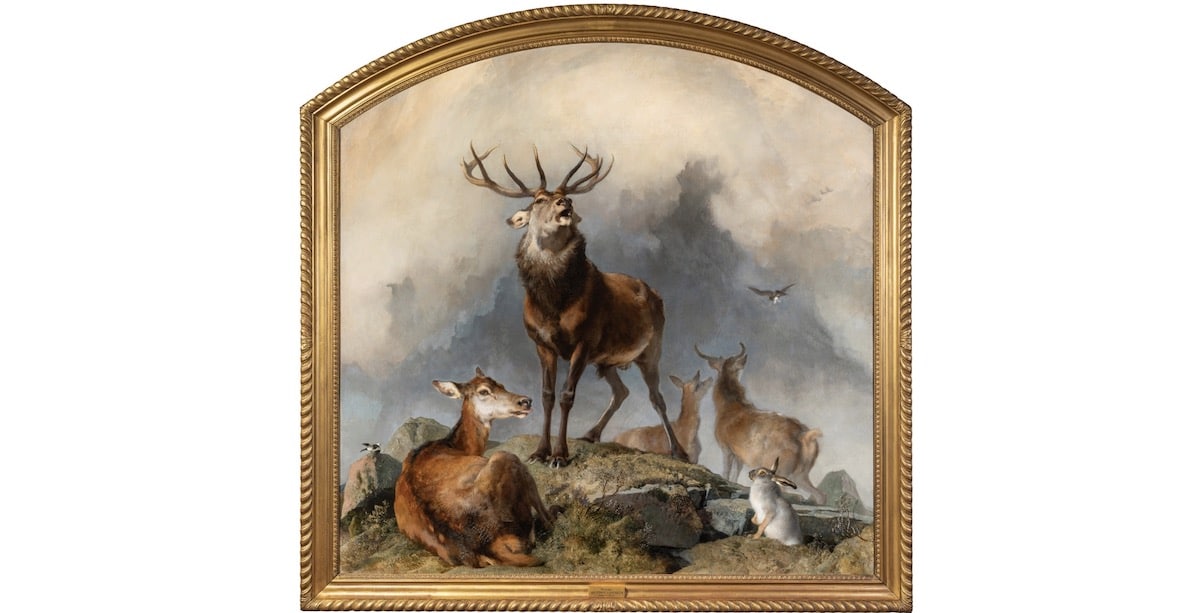
Scene in Braemar by Queen Victoria’s favourite artist, Sir Edwin Landseer, has sold for five times the previous record for one of his works. Scene in Braemar fetched £5,946,000 at Sotheby’s in London yesterday. The previous auction record for the artist was well above the pre-sale estimate of up to £4 million. The last time it came to market was 1994, when it sold for £793,500.
The work depicts a twelve-point stag standing on a rocky Highland peak, massive and grizzled, roaring at some unseen challenger—a mature hind rests in the heather at his feet. To the right, a mountain hare has emerged from among the rocks. Behind, another hind and a young stag stand with their backs to the viewer, looking up at an eagle carrying prey. Something has disturbed the scene, and the painting captures that moment of alertness before whatever comes next. It is almost nine feet wide, larger than its famous companion piece, and carries the weight of that scale in how it handles space and atmosphere.
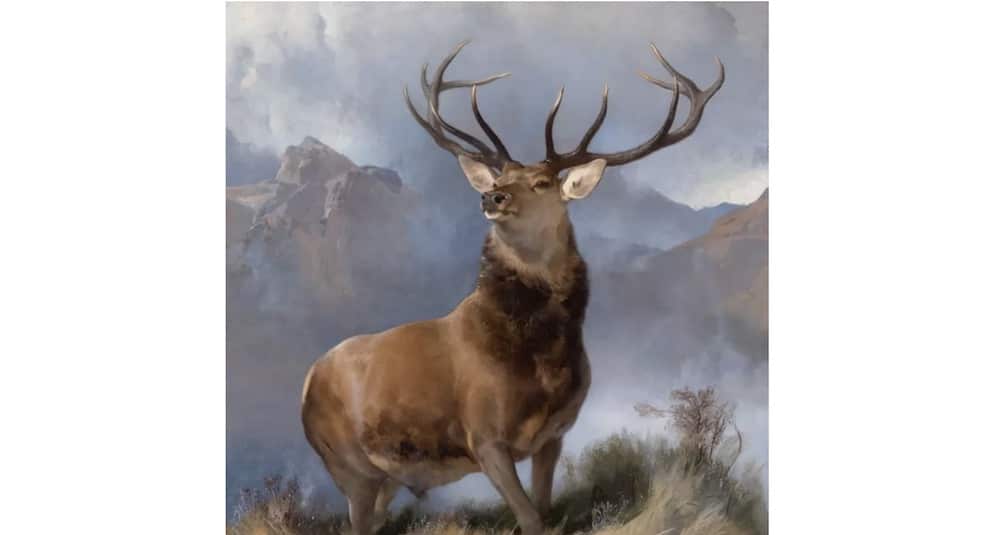
FIG. 1 EDWIN LANDSEER, MONARCH OF THE GLEN, CIRCA 1851. OIL ON CANVAS, 163.8 X 163.9 CM. NATIONAL GALLERIES SCOTLAND, EDINBURGH. © WIKIMEDIA
The Scene in Braemar came roughly six years after The Monarch Of The Glen was completed in 1857. It was first shown at the Royal Academy that year. The Times described it then as masterly in conception and effect, a worthy partner to Monarch of the Glen. The Art Journal placed it among the best works of the artist in this class of subject. Even the art critic John Ruskin, who was not usually disposed to admire Landseer, acknowledged the picture in his Academy Notes. However, he complained that it had been hung too high, preventing viewers from appreciating the quality of the execution.
Julian Gascoigne, senior director of Sotheby’s paintings department, described the relationship between the two works with some precision. Where Monarch shows the stag in the brilliance of youth, Braemar offers something darker and more epic: a grizzled warrior, his brow points declaring his power, his top tines just beginning to go back, marking him as an animal in full maturity rather than youthful prime. The light is different. The mood is different. The Athenaeum’s critic in 1857 wrote that the stag’s dilated nostrils, full eye and firm-planted hoof could only have been painted by someone who had spent a life studying stag nature, and the observation holds. Landseer had been making that study since his first visit to the Highlands in 1824, when he was 22.
That visit came about when Landseer travelled north with fellow artist C.R. Leslie, stopping first at Abbotsford to stay with Sir Walter Scott before moving on to Blair Castle. He was already an established animal painter by then, with a growing reputation for convincingly portraying animals and for his gift for narrative composition. His work reminded contemporaries of the Flemish sporting painters of the seventeenth century, and he was more than once described as the English Snyders. But the Highlands did something to him that Flemish precedent could not have predicted. The landscape overwhelmed him. The deer stalking, the ghillies, the light in the glens, the scale of everything, all of it fed directly into his imagination. He returned every autumn until his death, staying with aristocratic hosts including the Marquess of Breadalbane and the Dukes of Bedford and Abercorn, and Scottish subjects came to dominate his output.
His early Highland paintings were sporting pictures seen through a Romantic lens. By the 1840s something had changed. The stag in his work began to take on heroic and symbolic qualities that went well beyond the sporting tradition. The Sanctuary of 1842, now in the Royal Collection, is generally regarded as the first of what Landseer scholar Richard Ormond called his symbolic pictures of deer, evoking a sense of mystery amid the scene’s extreme calm. Ormond described the series that followed as works of almost visionary intensity, and Braemar, completed at the end of that sequence, represents its grandest and most fully realised expression.
The painting was commissioned by Edward Betts, a railway magnate who originally paid £800 for it. It was intended for a specific location, high on the dining room wall at Preston Hall, which partly explains the elevated viewpoint Landseer adopted. That viewpoint enhances both the spatial drama of the design and the sense of scale, lending the whole composition what Ormond called an almost Homeric quality. Betts was eventually forced to sell the work, along with the rest of his collection, in 1868 following a banking crisis. The painting passed through various private hands over the following century and a half before appearing at Sotheby’s this week.
Braemar is close to Mar Lodge, where Landseer stayed frequently with the Marquess of Breadalbane on stalking expeditions in the Deeside forests. It is also near Blair Atholl and a short distance from Balmoral, built between 1848 and 1853 for Queen Victoria and Prince Albert, Landseer’s most important patrons. This was the part of the Highlands he knew most intimately, and that knowledge is visible in the work, in the way the slate rocks are handled, in the specific quality of the light, in the spare heather at the hind’s feet.
The previous record for a Landseer at auction stood at considerably less than the £5.9 million this painting achieved. The result suggests a market that has reassessed his significance, or perhaps recognised that a picture of this quality and history had long been undervalued.