
After years of construction and considerably longer in the planning, the Lucas Museum of Narrative Art will finally welcome the public on Tuesday, September 22, becoming what its founders describe as the first institution built specifically around the idea that visual storytelling, in all its forms, deserves to be treated as a single continuous tradition rather than a hierarchy with painting at the top and comics somewhere near the bottom. Founded by filmmaker George Lucas and his wife, businesswoman Mellody Hobson, the museum sets out to trace image-based narrative from prehistoric cave art through illustration, comics, murals and cinema, arguing that the impulse to tell stories through pictures runs continuously through human history regardless of medium or perceived prestige.
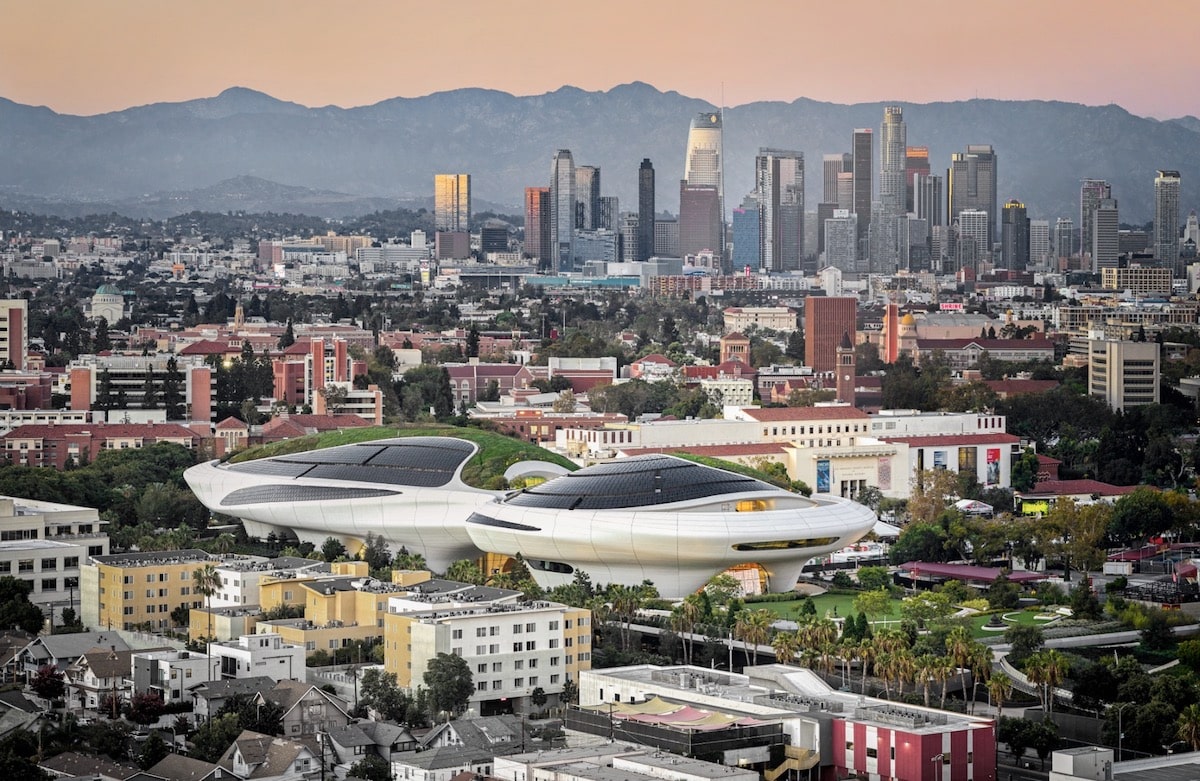
The building itself, a sprawling 300,000-square-foot structure designed by Ma Yansong of MAD Architects, working alongside Stantec, sits in Exposition Park and houses over 100,000 square feet of gallery space spread across more than thirty individual galleries. Inside, the collection ranges from Artemisia Gentileschi and Frida Kahlo to Norman Rockwell, Robert Colescott, Frank Frazetta and Robert Crumb, deliberately mixing canonical fine art with popular and commercial imagery that museums have historically kept at arm’s length. The holdings also include the complete Lucas Archives, spanning 1971 to 2012, giving visitors access to film production material connected to Lucas’s own career alongside centuries of painted and printed storytelling. A free research library and a restaurant named Skywalker Grill round out the visitor amenities. At the same time, the surrounding thirteen-acre campus includes new park space designed by Mia Lehrer of Studio-MLA.
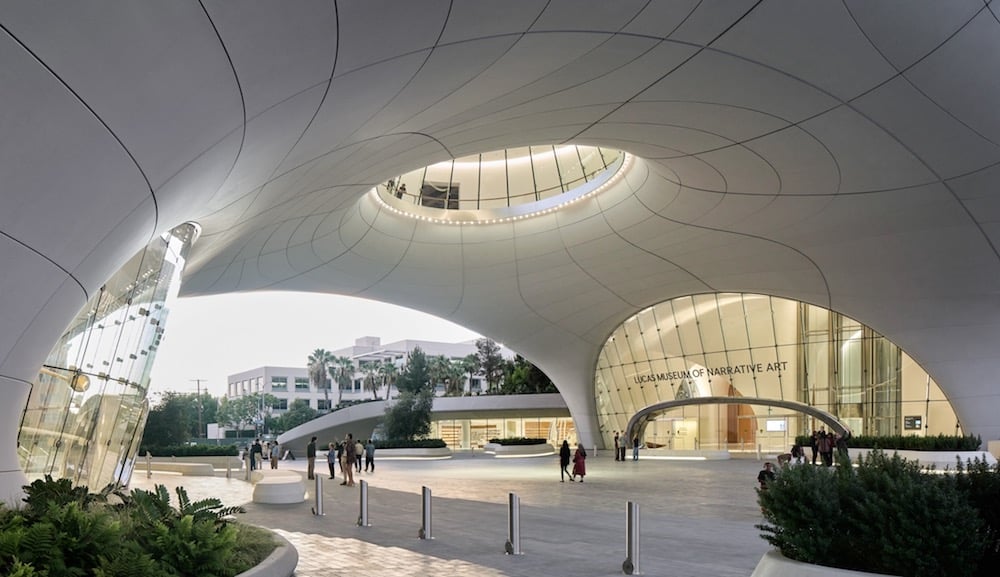
Lucas Museum of Narrative Art
Lucas framed the project as an overdue act of recognition for artists whose work has shaped the collective imagination without always receiving institutional validation. “The artists in this collection didn’t just create images; they connected our modern imaginations with our ancient emotions, with common beliefs creating community,” he said, arguing that their work, spanning genres, media and centuries, belongs in a museum on equal footing with more traditionally sanctioned art forms. Hobson described the ambition behind the collection’s breadth in more personal terms, saying the goal was to build something that would let visitors from vastly different backgrounds walk through the same doors and find some version of themselves reflected somewhere in the galleries.
Museum CEO Tracey Bates struck a similarly optimistic note, describing Lucas and Hobson’s conviction that visual storytelling can bring entire societies together around shared values, not just individuals. Architect Ma Yansong, for his part, spoke of wanting the building to feel as unburdened and dreamlike as a cloud, designed with what he called emotional architecture, fluid throughout and settled into Exposition Park as though it had grown there naturally rather than been constructed. The inaugural exhibitions unfold across more than 1,300 works and begin on the ground floor with a survey titled The History of Narrative Art: Heroes, Myths, The Sacred, which examines how image-making has generated mythologies capable of forging communities and shaping entire belief systems. Alongside original works from the collection, this opening gallery includes remarkably precise reproductions of immovable artworks and archaeological sites gathered from around the world, produced through partnerships with institutions including the Vatican Museums, which contributed to a reproduction of the Sistine Chapel ceiling, the Louvre, which assisted with the Winged Human-Headed Bulls from the Palace of Sargon II, Spain’s National Museum and Research Centre of Altamira for its ancient cave paintings, and Mexico’s Instituto Nacional de Antropología e Historia for the Aztec Sun Stone. High-resolution scans generated during the reproduction process have been returned to each partner institution, turning the collaboration into something of a two-way exchange rather than a simple extraction.
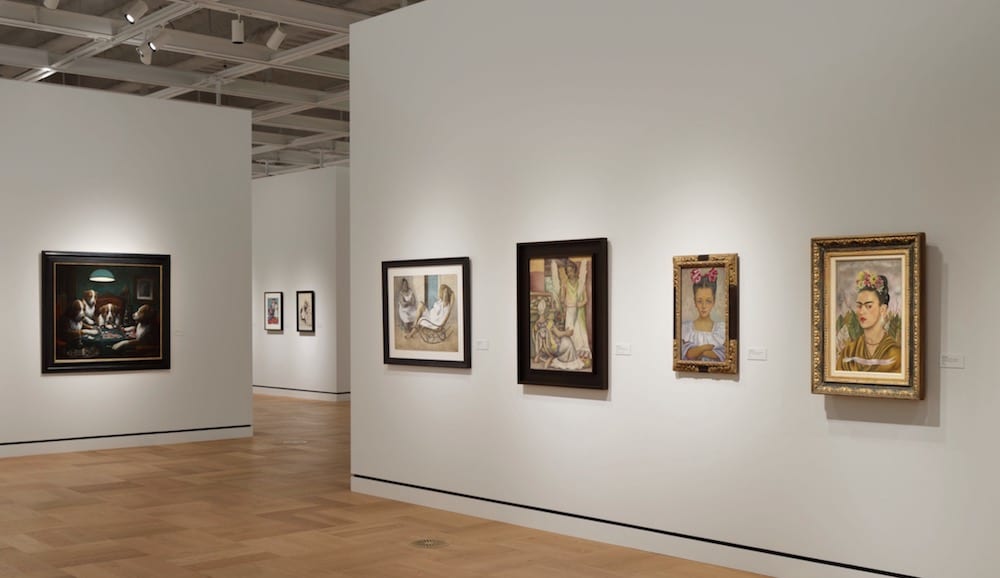
Lucas Museum of Narrative Art Installation
Higher floors organise the collection thematically and by medium. Galleries on the fourth and fifth floors explore recurring narrative subjects such as love, family and community across generations, featuring artists as varied as Vincent van Gogh, Jacob Lawrence, Beatrix Potter and Ernie Barnes. Genre-specific exhibitions cover fantasy, romance and adventure storytelling through figures such as Boris Vallejo and Julie Bell, while separate installations dedicated to comic books, manga, graphic novels, photography and mural work feature artists including Charles Schulz, Frank Miller, Takashi Murakami, Robert Capa, Diego Rivera and Judith F. Baca. Individual galleries also honour major American illustrators of the twentieth century, among them Norman Rockwell, N.C. Wyeth and Maxfield Parrish.
Cinema receives dedicated treatment through Star Wars in Motion, an exhibition drawn from the Lucas Archives that focuses specifically on the land vehicles featured across the saga’s first six films, from Luke Skywalker’s landspeeder through to the earliest physical build of General Grievous’s wheel bike. A separate installation pays tribute to Ma Yansong’s own architectural work, treating his designs, including the museum building itself, as a form of narrative art in their own right.
The fifth-floor mural gallery examines large-scale public storytelling, drawing on Judith F. Baca’s extensive archive from her half-mile-long mural The History of California, alongside works by Diego Rivera, street artist JR, and previously unseen pieces sourced directly from Banksy’s studio.
Two theatres round out the opening programme. The Robert Flaherty Theatre honours documentary filmmaking, while the Slavko Vorkapich Theatre, named for the montage pioneer who once chaired the USC film department Lucas later attended, celebrates the technical and sensory mechanics of cinema itself. Both operate as continuous, drop-in spaces rather than fixed screening schedules. Outside, Lehrer’s redesigned landscape replaces a former parking lot with drought-tolerant native plantings, over 300 new trees, a hanging garden, an amphitheatre, and a waterfall fountain, offering South Los Angeles a substantial new stretch of public green space alongside 10 monumental outdoor sculptures.