
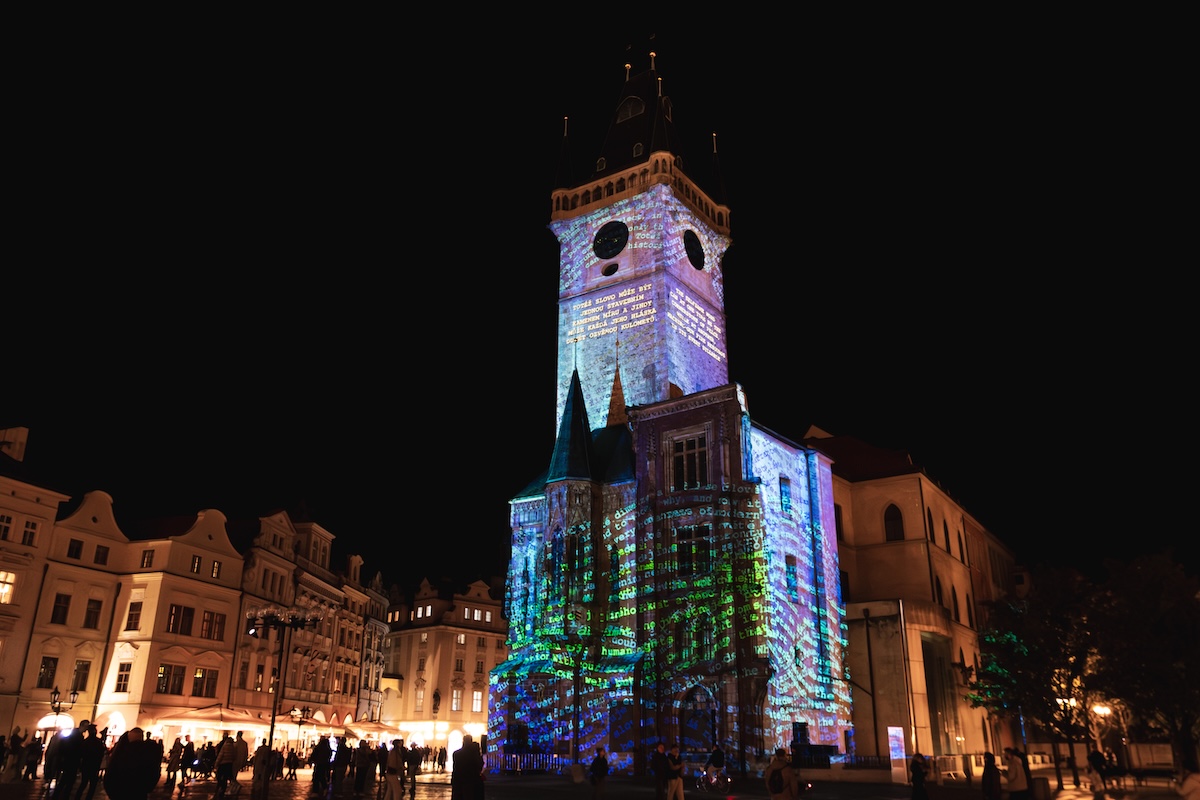
My first encounter with Prague’s Signal Festival was the huge crowd in the Old Town Square, watching Ukrainian artist Svitlana Reinish’s Living in Truth transform the Old Town Hall. Drawing on Václav Havel’s The Power of the Powerless, the work brings words, architecture and music together in a reflection on truth, propaganda and hope.
The following morning, I met Signal’s founder Martin Pošta at Signal Space, the festival’s permanent gallery in a former market hall. Now in its 13th year, Signal Festival attracts 500,000 visitors in a four-day celebration of digital art, with 21 installations across the city.
Our conversation took us from his beginnings in film to the nerve-racking projection that helped set Signal in motion, the importance of music, and his determination to secure recognition for digital art.
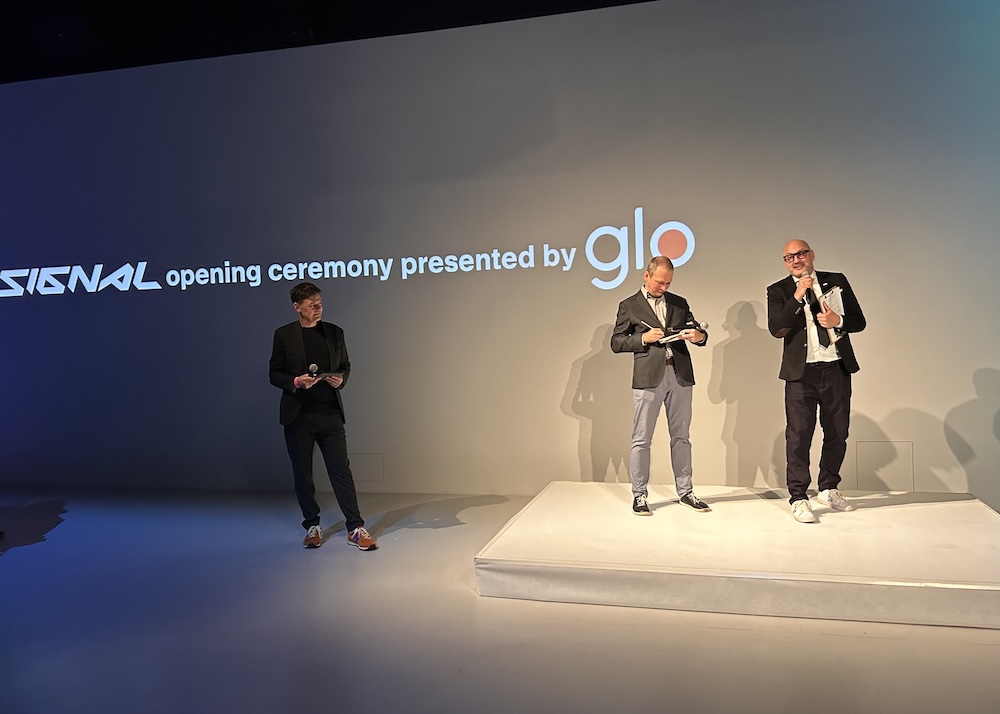
Martin Posta at Signal Space Grand Opening Ceremony
ST: What led you from film to Signal?
MP: My background is film producing. But when I was fourteen years old, I went to work for the Karlovy Vary Film Festival. From that, I spun off, and I created a festival called Fresh Film Fest, which focused on young artists.
A friend showed up at the bar one day and said, “We wanna do video mapping on a church.” I was like, “What the f*** is video mapping?”
ST: How did that become the projection for the Astronomical Clock’s 600th anniversary?
MP: I went to the deputy mayor for culture. He said, “How about you do the church? For the 600th anniversary.”
It blew everybody’s mind, even mine. It was nerve-racking because the guy I was working with, Amar, he was a perfectionist. He was rendering until the very last moment of the first screening.
We plugged it in, and I’m not religious, but I was praying so it didn’t glitch. We played it, it worked. It was truly a magical moment.
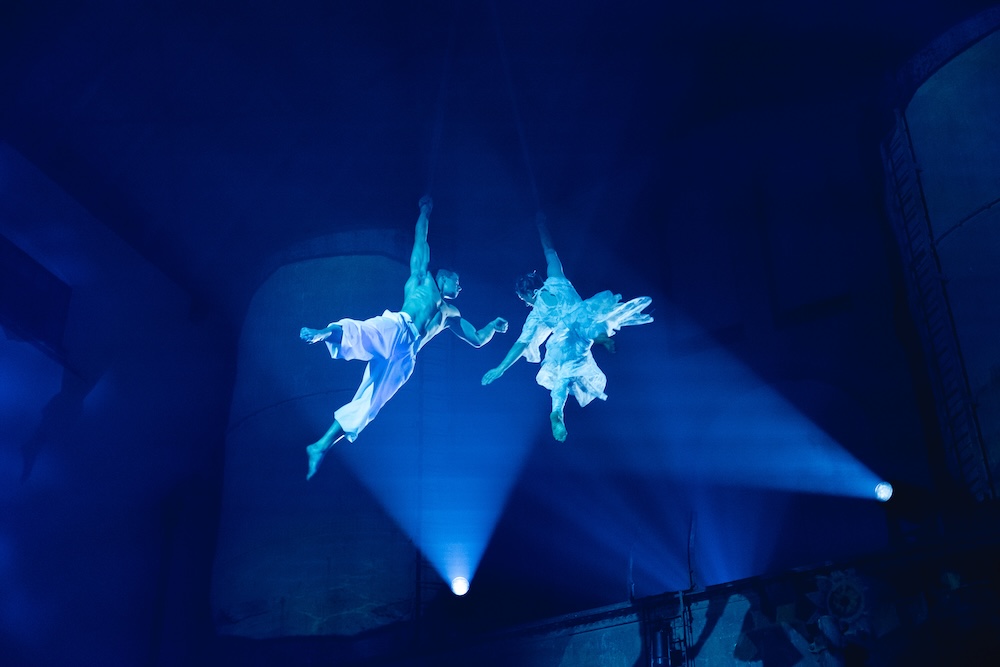
Laterna Magika, PHOTO Viktor Schwing
ST: Did you see a gap in the market?
MP: That was never the thought. Just like, “Let’s do something stupid that nobody has done ever before, and let’s try to figure out how to do it.”
I went amongst the people that were in the crowd and I was listening to what their natural feedback was. There was a gentleman calling his wife and telling her, “You have never seen anything like this. You have to come.”
ST: What was the biggest challenge in creating the festival?
MP: To explain to people what we are anticipating, because it hadn’t been done before. We created a fake teaser with our own footage – Liverpool footage of a video projection we did on the Royal Liver Building – with crowds and other artists’ works.
To show to politicians what we were thinking about. I was jokingly saying, “We’re not a light section in IKEA.”
It was actually really hard to explain the vision. I think a lot of people thought we were crazy.
ST: Watching Ukrainian artist Svitlana Reinish’s Living in Truth, I recognised the soundtrack from Smetana’s Vltava. How important is music to the installations?
MP: We consider ourselves being an audiovisual festival because the audio component makes the artwork complete. Without the sound, it’s flatter, not necessarily just flat, but it’s flatter.
The sound, especially this music, has a lot of history coming with it, or a lot of narratives. You give the piece another layer of information.
It’s not a hymn, but it is like a hymn because everybody knows it and everybody knows the history. Everybody knows it’s about the country and the evolution of the river.
ST: How do Reinish’s own history and Havel’s writing inform the work?
MP: She’s Ukrainian. When the war started, she escaped the country. We actually helped her.
Signal Festival is not just about beautiful art. It’s also about messaging about society.
Former Czech President Václav Havel wrote a piece called The Power of the Powerless, which is an essay about the power of the people who are not in command. What they can do.
Svitlana took this piece, and she took the words. It’s about propaganda. And it’s about how the words are powerful.
It comes very much from her own experience of Ukraine being trampled by Russia.
ST: What is the thinking behind presenting Kryštof Brůha with the Signal Art Award?
MP: Showing appreciation for the people who break what’s expected, by exploring.
The artists that work in this field, they’re technicians, scientists, geeks, creatives. They’re coders, or they’re animators.
Our message is, “You’re doing it right, do it, and you’re good, and we’re going to show our appreciation for your weirdness or geekiness or exploratory direction, for being the Marco Polos of our world.”
ST: What does a permanent home at Signal Space make possible?
MP: With little drops of positivity, we change society, and that’s what I believe is the mission of art.
All the talent, all the ingenuity, all the money, all the effort- it’s so ephemeral; it disappears in four days.
How about instead of four nights, we do it 365 days per year?
We give emerging Czech artists a place to showcase their work. And it’s a continuation of our mission.
ST: What would you like to achieve next?
MP: I want to focus on the educational part of what we are doing. Combining science, technology, arts, and society in some sort of educational form.
I want to go back to opening up a studio that actually creates what we did back in the day when we started in 2010. It was a bunch of creators.
We’re in the age of the internet, in the age of AI. You cannot disregard the evolution.
We will get there.
Signal Festival, Prague
Visit Here