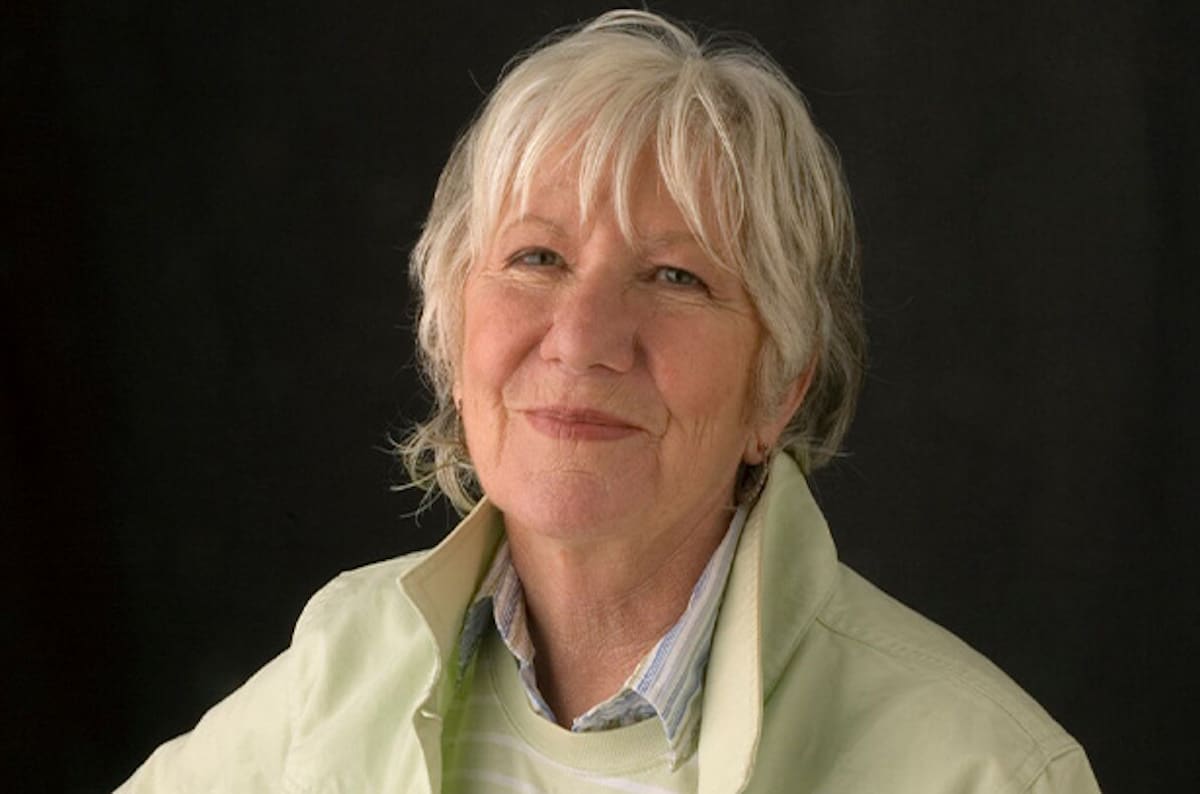
Mary Heilmann, whose intensely coloured, deliberately precarious abstractions made her one of the most quietly influential painters in American art over the past half century, has died aged 86. She was an artist who trusted instinct over theory, valued the pleasure of colour over the authority of system, and spent decades being underestimated before a younger generation of painters found in her work exactly the kind of permission they had been looking for.
She was born in San Francisco on 3 January 1940 and grew up in a religiously observant Irish Catholic family. When she was seven, her father, a civil engineer, moved the family to El Segundo, a seaside village south of Los Angeles, where they lived near the beach. Heilmann spent her early years swimming in the ocean and tumbling down dunes, formative experiences whose light, colour and physical sensation would surface in her paintings decades later. Her father’s death from cancer when she was twelve ended that chapter abruptly, and the family returned to San Francisco.
She studied English literature at the University of California, Santa Barbara, before moving to Berkeley for graduate school, where she worked in ceramics and sculpture under Peter Voulkos, an artist who brought Abstract Expressionist energy to clay. Voulkos was known for walking across the studio carrying a pot, deliberately letting it fall and smash, then assembling the fragments into something unexpectedly compelling. The lesson about process, accident and the value of what gets left behind stayed with Heilmann throughout her life.
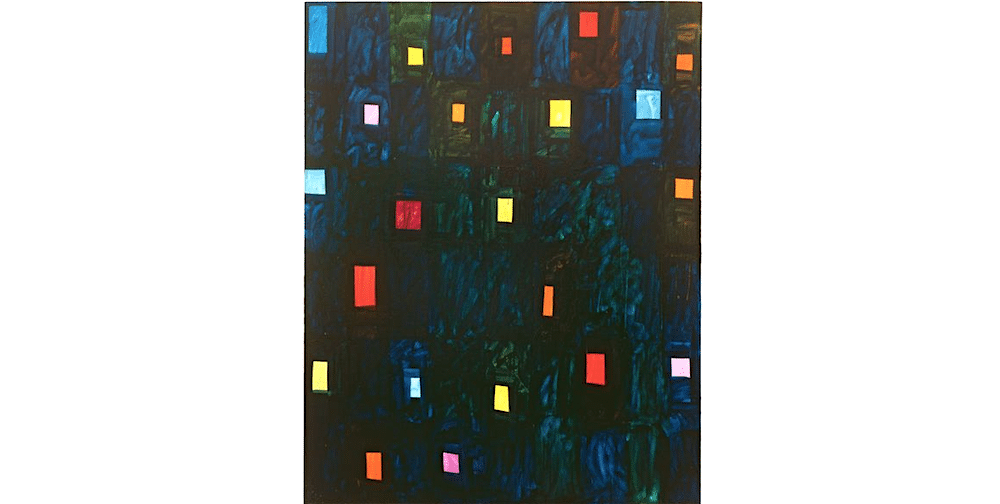
MARY HEILMANN Neo Noir 1998 Oil and acrylic on canvas Courtesy Hauser & Wirth
She arrived in New York in 1968 intending to make it as a sculptor. Through her old school friend Richard Serra, who was already gaining a reputation for his molten-lead splash sculptures, she found her way into the downtown scene. In the red-lit back room of Max’s Kansas City, under a Dan Flavin fluorescent tube, she met Robert Smithson, Carl Andre and others who told her painting was finished. She agreed with them, at least at the time. But female sculptors were finding it virtually impossible to break through in that world. Of the twenty-two artists in the Whitney’s landmark 1969 exhibition Anti-Illusion: Procedures/Materials, twenty were male. Heilmann was not invited. Passed over for that show and others, she made a decision that struck some people as reckless: she took up painting.
She had no formal training in it, and she was thirty. Neither consideration stopped her. She began teaching at the State University of New York at Stony Brook to support herself and found that her students and the younger children she had taught previously gave her ideas. Her early paintings were made with direct, unself-conscious techniques, including finger-painting, which she used to wipe away pigment and create off-kilter grids on red canvases. The apparent guilelessness was deliberate and thought through, not naive.
By 1979, when she joined the Holly Solomon Gallery in SoHo, her style had found its character: shapes that didn’t quite line up, colours chosen for their psychological charge rather than their formal propriety, an overall atmosphere of ease that concealed considerable intelligence. A series of paintings in pink and black, deliberately saccharine and consciously reminiscent of Good and Plenty candy, confused critics who expected abstraction to carry more visible weight. One reviewer in the Village Voice, bothered by what she read as sloppiness, wrote that Heilmann’s paintings could use some real muscle and that she “hadn’t been doing her push-ups.” Heilmann was hurt by the review, not least because it came from a woman. She kept making the work anyway.
A decade later, after joining Pat Hearn’s gallery on Avenue B in the East Village with the help of her friend Ross Bleckner, she found a different kind of audience. Younger painters exhausted by the portentous gestures of Neo-Expressionism and the cash-saturated excess of the 1980s art market discovered in Heilmann’s work an alternative model: intelligent art without being solemn, pleasurable without being trivial, rigorously itself without being rigid. Artists including Laura Owens, Jessica Stockholder and Elizabeth Peyton all acknowledged her influence. Ellsworth Kelly, the great figure of American hard-edged abstraction, called her the best of the new abstractionists.
She also made furniture. Starting in 2002, she produced boxy plywood chairs that acknowledged a debt to Donald Judd’s geometric designs while quietly critiquing their refusal of pleasure. In 2015, forty-five of her chairs in lemon yellow and cherry red were installed on the outdoor terrace to help open the Whitney’s new building in the Meatpacking District. A decade later, they appeared inside the same building, in a gallery overlooking the Hudson River, as part of an exhibition that reproduced one of her 2020 paintings across the walls, in alternating teal and white stripes that brought her childhood ocean back into the room.
Heilmann described her life as a solitary pursuit of artistic purpose. In her Catholic upbringing, she had loved reading about the saints, she said, because in their stories there was nobody except them and God, and that was a model she carried with her. She leaves no immediate survivors.
Her gallery Hauser & Wirth left the following statement:
Artist Mary Heilmann, who forged a singular position in contemporary art through a rigorous and pioneering approach to abstraction, has died. A beloved artist, teacher, mentor and friend, she leaves an extraordinary legacy and an enduring influence upon generations of artists.
It is with great sadness that Hauser & Wirth and 303 Gallery confirm the passing of artist Mary Heilmann, aged 86, on 14 August, 2026 on Long Island, New York. She is survived by her nieces, Ann Jaime and Chris Heilmann, and her nephew, John Heilmann Jr., and their families. She was predeceased by her brother John and his wife Linda. We would also like to acknowledge the exceptional commitment of her studio team—Liane Thatcher, Paul Gabrielli, and Philip Tan—for their steadfast support, thoughtful care, and unwavering dedication to Mary and her work.
Top Photo: Courtesy Hauser & Wirth