
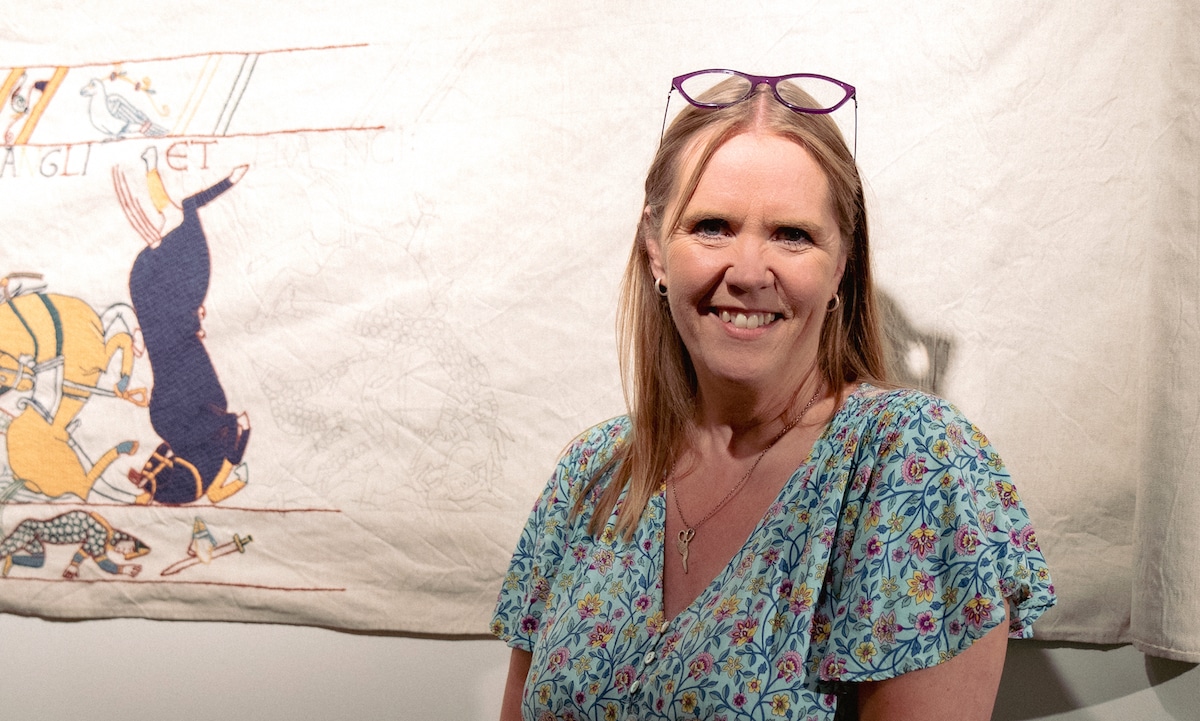
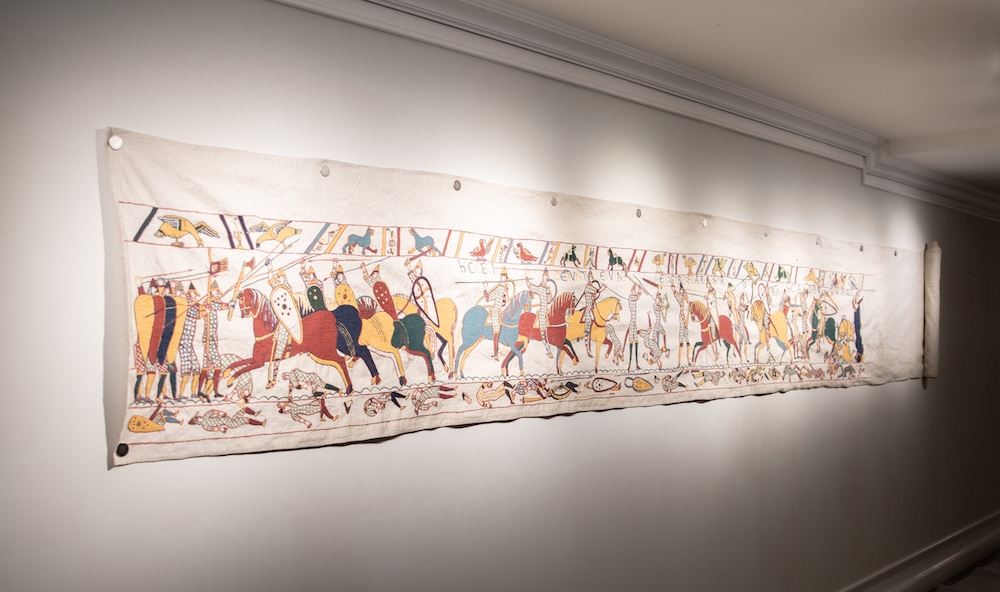
The Bayeux Tapestry has arrived at the British Museum and opens to the public this week for the first time on British soil, a genuine cultural event by any measure, drawing the sort of anticipation usually reserved for a blockbuster loan from somewhere considerably harder to reach than northern France. Nearly a thousand years old, the tapestry is coming home, at least temporarily, and London is bracing for crowds. But amid all the hype surrounding the exhibition, there is another exhibition running in parallel, one that has been unfolding for a decade, in a considerably less hurried setting. Mia Hansson has spent the last ten years, close to nine thousand hours by her own count, hand embroidering a full-scale reproduction of the entire tapestry.
She is a teacher by profession, not a professional textile artist, which makes the scale of what she has taken on slightly harder to process. Working section by section, she has studied every inch of the original imagery, dissecting the stitching patterns and colour choices, scene by scene, to reproduce them at the tapestry’s actual dimensions, roughly 70 metres when finished. She currently has around seven metres left. She hopes to complete the final stretch by July 2027, timed, with what seems like a fairly poetic sense of symmetry, to coincide with the original tapestry’s scheduled return to France once its run at the British Museum ends.
Meet Mia Hansson: The Woman Recreating The Bayeux Tapestry By Hand
The project has grown beyond the embroidery itself. Working in association with the British Museum, Mia’s decade of research has fed into Bayeux Illuminated, a new suite of six limited edition works that translate key scenes from the tapestry’s narrative into the visual language of medieval illuminated manuscripts. Each piece has been hand-finished with metallic leaf in gold, ruby, and sapphire tones, a technique meant to echo the way light once played across the surfaces of illuminated texts, while giving these centuries-old images a finish that feels distinctly contemporary rather than purely archival.
What makes Mia’s story worth attention beyond the obvious human-interest angle is what it reveals about the tapestry itself and why an embroidered strip of linen depicting a Norman invasion continues to carry such cultural weight nearly a millennium after it was made. The Bayeux Tapestry has always occupied an odd space between historical document and pure visual storytelling, narrating the events leading up to 1066 through a sequence of images that reads almost like an early comic strip, stitched rather than drawn, propaganda and art history compressed into the same object. Spending ten years inside that narrative, thread by thread, gives Mia a vantage point that no amount of scholarly reading could quite replicate. She has effectively lived inside the tapestry’s logic, its rhythms, its odd repetitions and compositional choices, in a way that few people alive can claim.
Her presence at Castle Fine Art offers a rare chance to hear directly from someone who has approached this famous object not as a historian or curator but as a maker, someone who has had to solve, physically and repeatedly, the same problems the original embroiderers faced nearly a thousand years ago. As London prepares for the arrival of the real thing, Mia’s version, unfinished, painstaking, and entirely handmade, stands as a reminder that the tapestry’s real power has always lain less in its age than in the sheer, obsessive human labour required to bring an image like this into being at all.