
Henry Moore and Lucian Freud were contemporaries whose social circles often overlapped without ever drawing them into close association, two artists who spent their careers approaching the same fundamental subjects through methods so different as to seem almost philosophically opposed.
Both Artists shared a preoccupation with the human body, with family, with the emotional textures of intimate life. Yet, the distance between Moore’s abstracted, organic forms and Freud’s unflinching figurative realism could hardly be greater. Moore / Freud, opening at Hastings Contemporary on 13 June, is the first exhibition to place these two figures in direct and sustained conversation, and the results are illuminating in ways that neither body of work could produce alone.
The exhibition is focused and deliberately so. Twenty works in total, comprising maquettes, works on paper and paintings, are brought together around a single organising theme: the family. It is a subject that both artists returned to throughout their careers with a consistency that suggests something deeper than mere aesthetic preference. For each of them, the people they loved and lived alongside were not simply convenient models. They were the primary subject of the work itself.
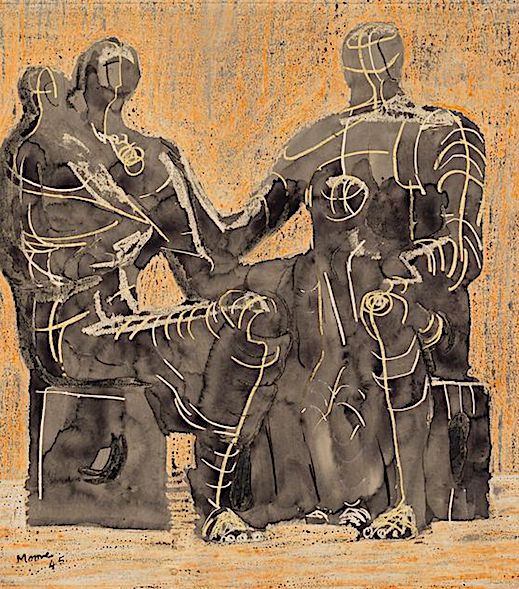
Henry Moore, Family Group, 1945 © 2026 The Henry Moore Foundation. All Rights Reserved, DACS
Freud’s approach to this territory was characteristically oblique. He famously and repeatedly painted his children, his lovers, and his close friends, often deflecting attention from the personal nature of these relationships by assigning titles to the finished works. The exhibition includes several of his portraits of his children, Bella, Esther, and Ali, works in which the knowledge of the relationship between painter and subject adds a dimension of intimacy that is difficult to fully account for in purely formal terms. Bella Freud has spoken about the experience of sitting for her father with a candour that is itself revealing, describing the sessions as deeply affectionate and intense, noting how they made her more conscious of his paternal attitude and the tenderness between them. That tenderness is present in the paintings, though Freud would likely have resisted the description.
Moore came to the theme of family through a different route and arrived at different conclusions. He began representing the family group in his maquettes and drawings from the 1940s, recognising in the subject one of the most ancient and persistent concerns in the history of art. “The Mother and Child is a theme that’s been universal from the beginning of time,” he observed. “Some of the very earliest sculptures we have, from Neolithic times, are mothers and children.” The obsession, once established, proved irresistible. He described a period in which almost any mark he made on paper, any scribble or smudge, could be resolved in his mind’s eye into a mother and child. The theme had become a kind of visual grammar for him, a way of seeing that preceded the work itself.
The exhibition finds its richest material in the wartime Shelter Drawings, works in which Moore recorded families huddled together on London Underground platforms during the Blitz. These are among the most immediate and emotionally direct works he produced, and they occupy a particularly interesting position in the show. In their rounded, natural lines and the vulnerability they depict, they anticipate the more abstracted organic forms that would become his sculptural signature, while sitting in productive tension with the angular geometries of Freud’s drawings and etchings shown nearby. The similarities and the divergences are both most clearly legible here.
Moore / Freud is an interesting angle, in that it focuses on works in which each artist’s hand is most directly present. Moore’s maquettes and drawings, rather than his monumental outdoor sculptures, are placed alongside Freud’s most intimate canvases, including his portrait of the painter John Minton and a particularly affecting work depicting his daughter Esther nursing her son Albie. These are works that reward close looking, and the exhibition’s modest, concentrated scale ensures that close looking is possible.
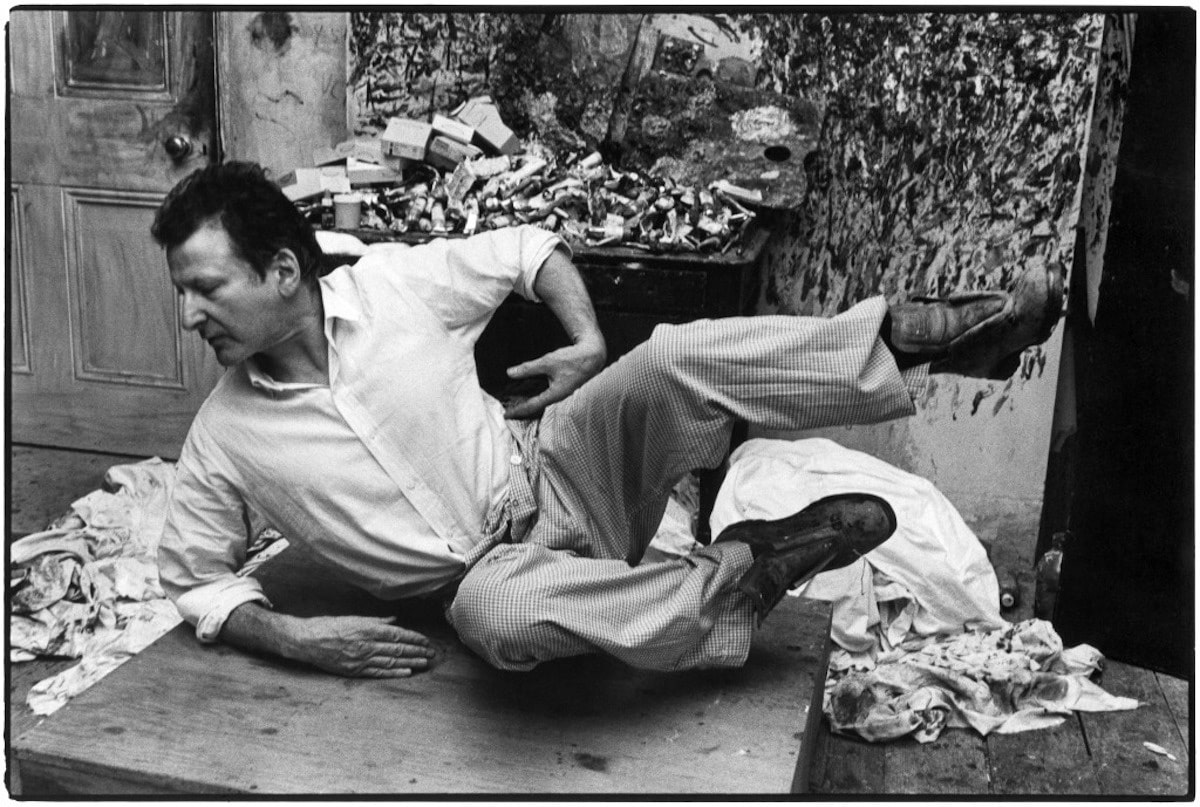
The show opens with a playful and genuinely effective visual proposition. Bruce Bernard’s iconic photograph of Freud posing as a Moore sculpture provides an immediate, almost comic point of connection between the two artists before the more serious business of the work begins. It is a good joke that also makes a real point, one about looking, about the body, and about how artists position themselves in relation to each other and to the tradition they inhabit.
Kathleen Soriano, Director at Hastings Contemporary, has described the exhibition as a rare opportunity to see two titans of the twentieth century in the same space, to consider their radically different approaches to a subject that resonates across every culture and every period. She is right about the rarity. Exhibitions that pair major figures with this degree of thematic precision and this much restraint are uncommon. Moore / Freud does not attempt to resolve the differences between its two subjects. It holds them in tension, and the tension turns out to be the point.
Top Photo: ‘Lucian Freud posing as a Henry Moore’, 1983. by Bruce Bernard © Estate of Bruce Bernard, courtesy Virginia Verran
Moore / Freud opens at Hastings Contemporary on 13 June 2026, as part of the summer season.