

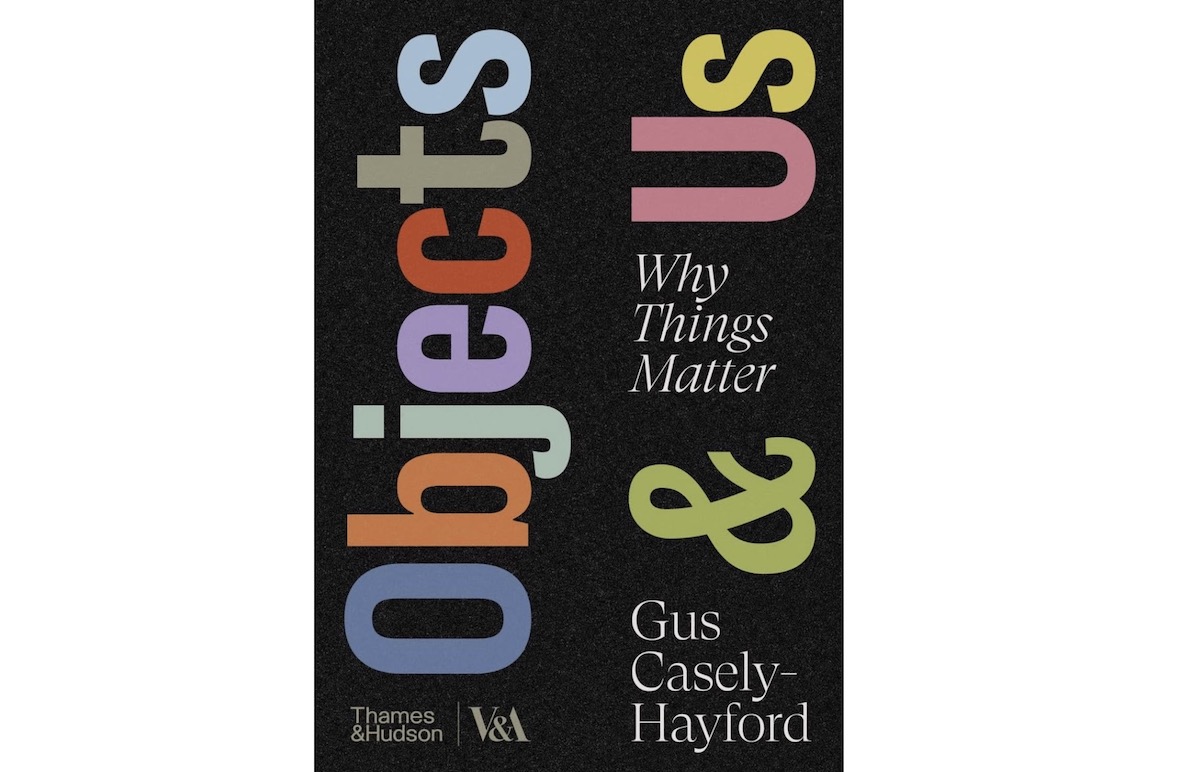
This book takes a familiar theoretical framework and does something original with it, rather than simply state the obvious. Gus Casely-Hayford’s Objects & Us: Why Things Matter belongs, happily, in the first category. It borrows its underlying structure from Abraham Maslow, the American psychologist who, toward the end of the Second World War, sat down and tried to work out what human beings actually need in order not just to survive but to flourish. That framework, the famous hierarchy of needs, has been recycled so many times across so many disciplines that it risks feeling exhausted before you even open the cover. Casely-Hayford, to his credit, finds a way to make it feel fresh again.
His method is simple in concept and considerably harder in execution. He takes 12 human needs, loosely drawn from Maslow’s original categories. He assigns each one a chapter, then anchors that chapter to a specific object drawn from the last 600 years of human making. The result is less a conventional design history and more a series of interlocking essays, each using a single artefact as a way into a much larger argument about why people build, collect, and hold on to things in the first place.
The objects themselves are where the book earns most of its charm. Casely-Hayford has an evident appetite for the unexpected pairing. A fifteenth-century silver pomander sits in the same intellectual universe as Picasso’s costume designs for the ballet Parade, which in turn shares thematic space with Greg Bunbury’s 2014 protest poster I Can’t Breathe and Bita Ghezelayagh’s Golden Spider Mask from 2021. None of these connections feels forced, which is the real achievement here. Casely-Hayford is not simply demonstrating that objects from wildly different eras and contexts can technically be discussed together. He is arguing something more ambitious: that the impulse behind all of them, the need being met, remains recognisably constant across centuries, even as the objects themselves change beyond recognition.
The opening chapter, titled Warmth, sets the tone nicely. It traces the East End of London through successive waves of migrant craftsmanship, beginning with Huguenot silk weavers and running forward to the fabric makers working in the same neighbourhoods today, using textile production as a lens for thinking about hospitality, welcome and the creation of sanctuary within a city that has not always offered much of either. From there the book moves through wellbeing, then into the stranger, more elusive territory of sleep and the various creative escapes people have built around it. Politics enters the picture next, examined through its long and often uncomfortable relationship with creativity, habitat and property, before the book pivots inward toward more psychological terrain: confidence, breath, respect. The closing chapters land on family, food, and a broader sense of purpose, subjects that, by that point in the book, feel like a natural place to end up.
What keeps the whole structure from feeling schematic is Casely-Hayford’s willingness to let harder subjects into the room. Race, gender and the long shadow of colonial history all surface repeatedly throughout the book, not as separate chapters bolted onto a more comfortable narrative but woven directly into the discussion of specific objects, which is a considerably more honest way of handling material like this than treating it as a single obligatory detour.
Casely-Hayford is well positioned to pull this off. He currently directs V&A East, having previously served as Executive Director of Arts Strategy at Arts Council England and, before that, director of the Smithsonian’s National Museum of African Art in Washington. That combination of institutional experience across British and American cultural policy gives the book a breadth of reference that feels earned rather than performed, and it shows in how comfortably he moves between continents and centuries without ever seeming to strain for the connection.
With more than a hundred illustrations accompanying the text, the book functions as much as a visual survey as a sustained argument, and it mostly succeeds in holding both functions together at once. Readers looking for a tidy, linear history of design will likely find the structure a little unconventional, jumping as it does between centuries and continents according to thematic logic rather than chronology. But that is rather the point. Casely-Hayford is not trying to write a history of objects. He is trying to explain why human beings cannot seem to stop making them, and on that count, the book largely delivers.
Read More
Buy This Book Here