
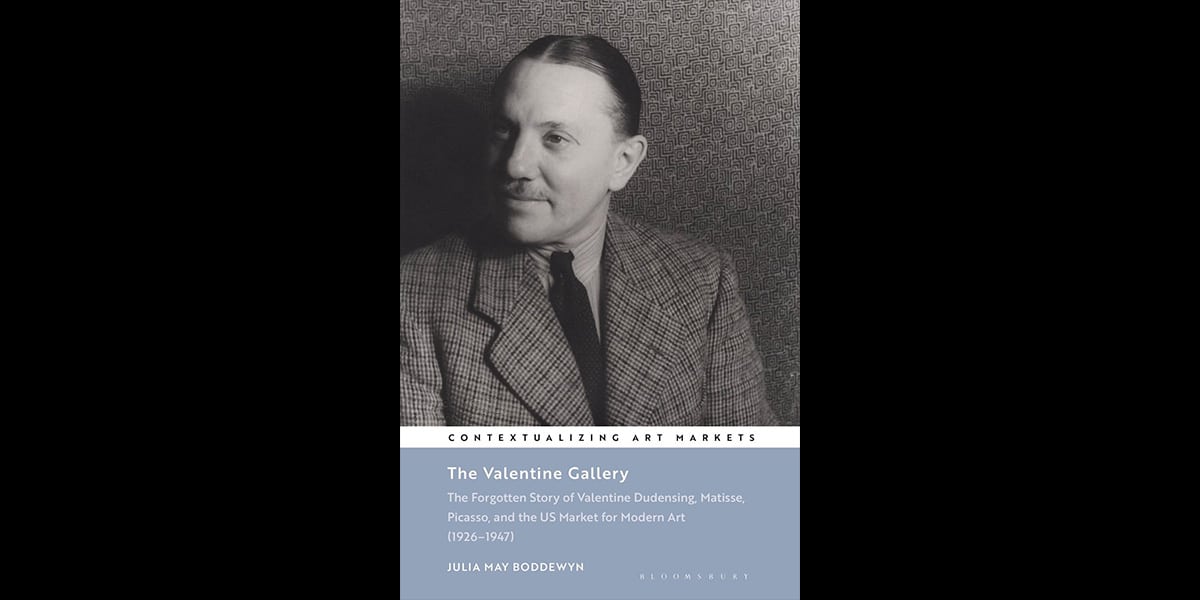
Julia May Boddewyn: The Valentine Gallery The Forgotten Story of Valentine Dudensing, Matisse, Picasso, and the US Market for Modern Art (1926 – 1947), Bloomsbury Visual Arts, London, New York, Oxford, New Delhi, Sydney, 2026.
Until now, little has been known or remembered of Valentine Dudensing, the Valentine of the Valentine Gallery, yet through his relationships with key collectors, he was instrumental in changing the reception of early 20th-century modern art in the US. Opening his gallery in February 1926, he promoted artists considered too extreme at that time, a risk that he recognised. One must remember that Matisse’s paintings in the 1913 Armoury show were considered to have a “wanton perversity” and were “shouting canvases”. By 1921, not a single public collection in the US had an example of either Matisse or Picasso’s work.
Dudensing’s father and grandfather had been dealers, selling first prints, then photogravures, and later watercolours. Thus, art dealing was not new to him. But the sort of art he proposed to deal in was. Before New York’s Museum of Modern Art (MoMA) opened, there were few places to see the artistic developments emerging from Paris. Dudensing’s mission was to establish a market for artists who would come to define modern art, and he became integral to MoMA’s successful launch in 1929. Still, these were challenging times, and Bibi Dudensing, Valentine’s wife, who was integral to their gallery’s running, recounted seeing paintings being spat at: “a Soutine having a lit cigarette extinguished into it, and pictures by Matisse and Picasso defaced with pencil.” Yet today the source of many of MoMA’s most significant works, Matisse’s The Piano Lesson (1916), Picasso’s Girl before a Mirror (1932), Miró’s Portrait of Mistress Mills in 1750 (1929, and Mondrian’s Broadway Boogie Woogie (1942-3), came through The Valentine Gallery.
Dudensing worked with and cultivated other museums and collectors, names well known today: Duncan Phillips, founder of the Phillips Collection in Washington, D.C.; Chester Dale, who bought Picasso’s Family of Saltimbanques in 1931; Stephen C. Clark; and many more who made their first purchases through the gallery.
Early on, Dudensing partnered with Pierre Matisse, who sourced paintings in Paris. Then, in 1930, the Paris-based marchand-collectionneur Paul Guillaume sent 74 African masks and sculptures to the Valentine Gallery for sale. Once Pierre left the gallery to start his own in New York in 1931, Dudensing came to rely more on Guillaume for artwork. With Guillaume’s untimely death in 1934, his widow, Domenica, who needed to pay taxes, seems to have favoured Dudensing over others to sell parts of her late husband’s collection.
The Valentine Gallery held the first US exhibitions of the work of Joan Miró and Giorgio de Chirico, Henri Matisse’s first retrospective, and Mondrian’s only lifetime solo show. When Picasso’s Guernica began its fundraising tour across America, it started in New York at the Valentine Gallery. Familiarity with the painting may have dulled its impact on us today. Still, the author recounts many artists’ visceral responses to the painting on first seeing it: Elaine Fried, future wife to Willem de Kooning, said, “We were stunned – really bowled over … Talk about Passion. It was pouring out of that enormous painting. Bill and I just stood before it-in awe, in wonder, and in a kind of terror. We didn’t talk for a long time.”
In addition to Dudensing’s skills in promoting the art he dealt in, Boddewyn points out that he undoubtedly had economic luck. In the mid-1920s, the Franc was devalued, which made dollar purchases more affordable. Then came the Wall Street crash and the Depression. Dudensing promoted American artists: Stuart Davis, John Kane, Louis Eilshemius, Raphael Soyer, Milton Avery, and others. But he still showed works by the School of Paris that influenced American Art. Then, as Dominica Guillaume began sending her late husband’s paintings to his New York gallery, France withdrew from the international Gold standard in September 1936, and the US dollar rose against the Franc. The dollar peaked again in 1939, but with the onset of the Second World War, fresh imports of art from Europe became difficult. That Domenica Guillaume entrusted her husband’s collection to Dudensing for the duration of the war must have been a godsend. The gallery also exhibited the work of artists such as Mondrian, Léger, and Max Ernst, who had come to New York fleeing the Nazi’s.
Praise for Dudensing: his taste, charm, support of artists, and promotional skills are evident. So why has his gallery and its feats in sourcing and presenting seminal paintings been forgotten? With WWII, many more dealers who showed the School of Paris came to New York, opening galleries; Peggy Guggenheim, Sam Kootz, Paul Roseburg, Sidney Janis, among others, and up-and-coming artists no longer seemed as enthralled by the School of Paris.
Valentine and Bibi’s interest seems to have gone, or rather, they never had an interest in the American Abstract Expressionists. In 1947, they quietly closed their gallery, a move that seems to have been on their mind since 1944, when they sold Mondrian’s Victory Boogie Woogie to Emily Tremaine for the price of a château in France. Moving there, they lived quietly until Valentine died in 1967, and Bibi died four years later. They left no archive. To research this book, Boddewyn lists more than 30 archives she has consulted. In the appendix, she includes a list of the gallery’s exhibitions, and in the text, she includes critical press responses to those exhibitions, both good and bad. She had the great good fortune of finding the gallery’s sales ledgers in a rusty trunk in the attic of the château they once lived in, so she includes many figures for the paintings that were originally sold for. It has clearly been a monumental task of primary research, producing a very good book indeed, one that will be a reference for many years to come.
Buy this book Here


