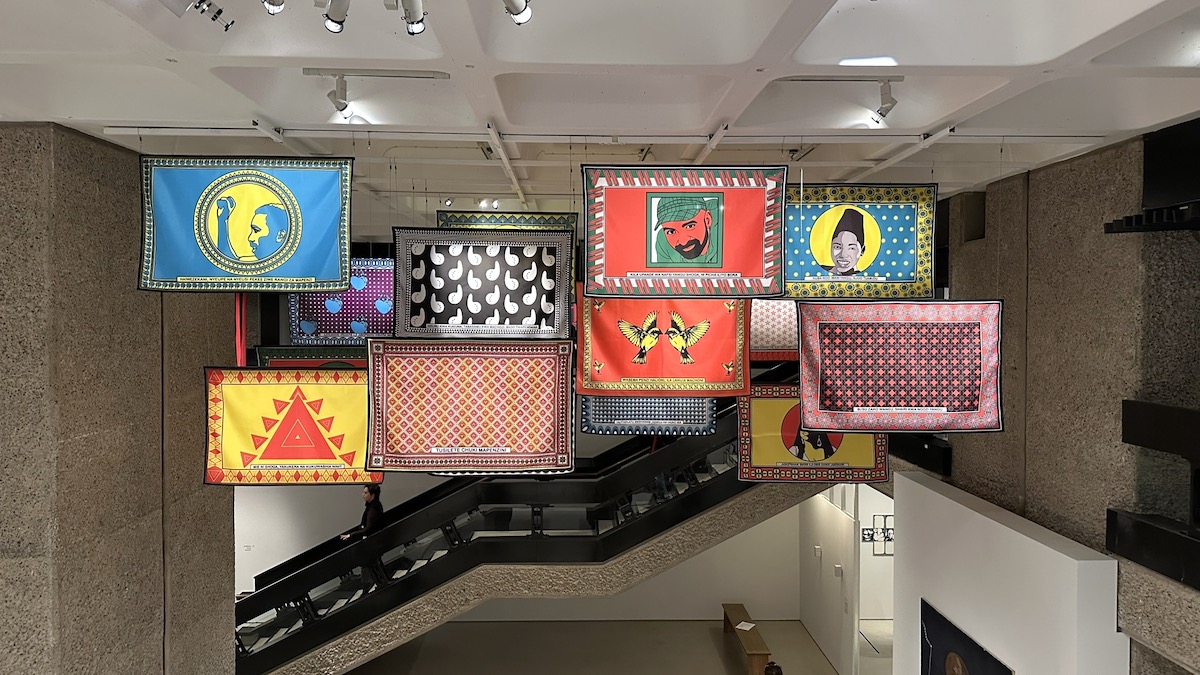
The Barbican’s summer exhibition is large. More than 300 works, over fifty associated events across film, music, performance and talks, artists drawn from across Africa, Brazil, the Caribbean, North America and Western Europe, and a curatorial ambition that stretches back more than a century. Project a Black Planet: The Art and Culture of Panafrica opens on 11 June and runs until 6 September 2026. It is, by any measure, a serious undertaking.
Pan-Africanism as a political and philosophical current has been well documented in historical and sociological scholarship. What this exhibition claims, and the claim seems justified given the scale of what’s assembled, is that the visual and cultural dimensions of that movement have never been examined at this level before. The show positions itself as the first major international exhibition to consider both the impact of Pan-Africanism on art-making and the reciprocal role artists played in shaping Pan-African thought. Those are not the same thing, and the distinction matters.
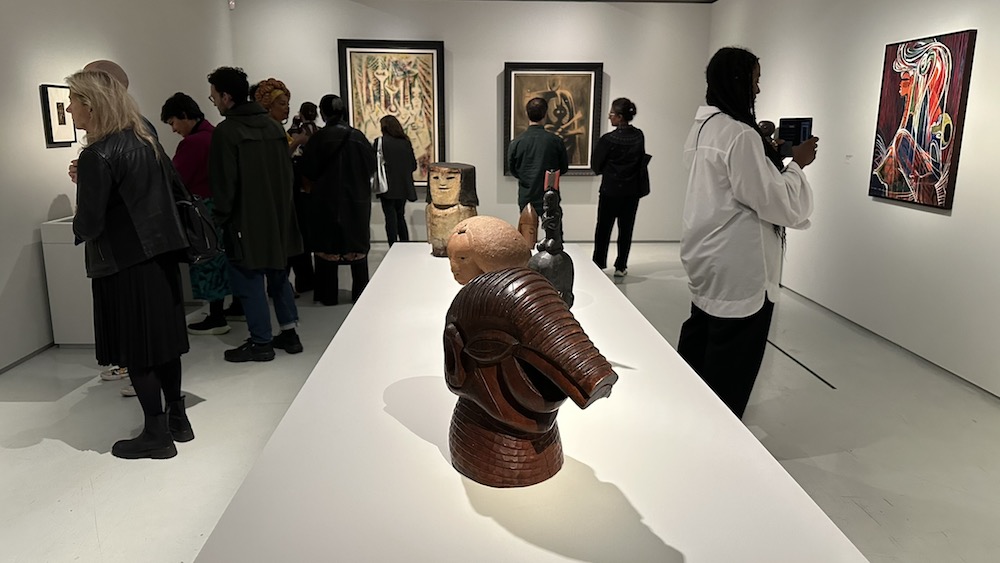
Project A Black Planet: The Art and Culture Of Panafrica Photo © Artlyst 2026
The curatorial frame is deliberately open. Panafrica in the exhibition’s title is not a place on a map. It functions instead as what the organisers call a conceptual terrain, a shifting set of ideas, desires, and solidarities rather than a fixed geography. Pan-Africanism itself is taken broadly: the term, coined around 1900, covers a range of political and philosophical positions united by commitments to anticolonial resistance, self-determination, and transnational solidarity among peoples of African descent. The exhibition traces several distinct strands within that broad current: Garveyism and its vision of symbolic return and Black political autonomy. Quilombismo is grounded in Indigenous knowledges and self-determination. Négritude, which argued for African and Afro-Caribbean intellectual traditions as central rather than peripheral to modernism. These are not presented as a tidy progression. They coexist, overlap, and sometimes contradict each other.
The exhibition spans diverse media, including paintings, sculptures, films, large-scale installations, protest art, and themes of private life, providing a comprehensive view of Pan-African cultural expressions across different contexts and periods. The international artist list, spanning generations and regions, aims to inspire pride and a sense of inclusion in a shared global artistic dialogue rooted in Pan-African culture. Several works are worth noting individually. Yiadom-Boakye has created a new body of twelve paintings and drawings for the exhibition, tracing how Pan-Africanism has shaped the inner lives of communities like hers.
Hammons’ African-American Flag from 1990 and Ofili’s Union Black from 2003 each reworks the Pan-African flag against the backdrop of their respective countries. Lam’s paintings from the 1940s are included for their role in the formal experiments through which he gave visual form to Négritude’s recuperation of African cultural histories. Kader Attia’s Asesinos! Asesinos! from 2014 fills a room with 35 household doors and 10 megaphones, evoking bodies surging forward in collective protest. Inji Efflatoun’s Dreams of the Detainee, painted in 1961 during a four-and-a-half-year imprisonment for political activism, carries particular historical weight.
The exhibition also gives significant space to printed matter. Original copies of independent magazines, pamphlets, anthologies and mass-circulation periodicals are included, from W.E.B. Du Bois’ The Souls of Black Folk through to Angela Y. Davis’ If They Come in the Morning and issues of EBONY. This material is not supplementary. The distribution of ideas through print was central to how Pan-Africanist thought spread and mutated across geographies, and treating it as exhibition-worthy rather than archival context is one of the show’s more considered decisions.
The exhibition is co-organised by the Art Institute of Chicago and MACBA Museu d’Art Contemporani de Barcelona, in collaboration with the Barbican and KANAL-Centre Pompidou in Brussels. The curatorial team includes Antawan I. Byrd and Matthew S. Witkovsky from the Art Institute of Chicago, Elvira Dyangani Ose, director of MACBA, and Adom Getachew, professor of political science at the University of Chicago. The combination of art historical and political science expertise is visible in how the show is framed, for better and occasionally for worse, but mostly it holds together.
Top Photo: © Artlyst 2026
Project a Black Planet: The Art and Culture of Panafrica Barbican Art Gallery 11 June – 6 September 2026