R. Crumb is back in London. It’s been a while. There’s No End to the Nonsense, now open at David Zwirner, marks the American artist’s first solo exhibition in the city in a decade. The show keeps things tight: an intimate, restless survey that tracks Crumb’s unfiltered work across six decades, from underground provocation to late-career introspection.
Crumb’s place in the cultural canon is long settled. He helped shape the look and attitude of 1960s and 70s counterculture through characters like Fritz the Cat, Mr Natural and The Snoid, pushing comics far beyond their commercial and moral comfort zones. His work fused erotic excess, satire and self-loathing with a loose, improvisatory line that treated drawing as confession as much as performance. Comics, in Crumb’s hands, became a blunt instrument for social critique and personal anxiety.
The exhibition borrows its title from a late-1990s sketchbook page: a twitchy character, the punning “little master baiter,” dressed in children’s clothes and locked in an absurd exchange with an anthropomorphic bird against an anonymous city backdrop. Speech bubbles pop up and contradict one another, slipping into a kind of cognitive slapstick. It’s unmistakably Crumb: humour that misfires on purpose, inner commentary leaking into public view. From there, the exhibition moves loosely between early figures, autobiographical detours and later, more inward-looking work, charting how certain obsessions circle back repeatedly, not so much resolved as compulsively revisited.

‘A broken, terrible dork’ Untitled. Illustration: © Robert Crumb, 2007 Courtesy the artist
Early material brings out the stars of Crumb’s world, Mr Natural, The Snoid, alongside a seldom-seen painted cut-out from 1974. Equal parts sexual threat and grotesque impulse, it marks a shift in tone, the breezy psychedelia of the 1960s curdles into something sharper, more punitive, fixated on appetite and control. Works such as What O’Hail (1975) and Yeti Woman (2000), with their outsized female figures stalking the city, are shown with drawings that lay bare the obsessions Crumb has never quite shaken.
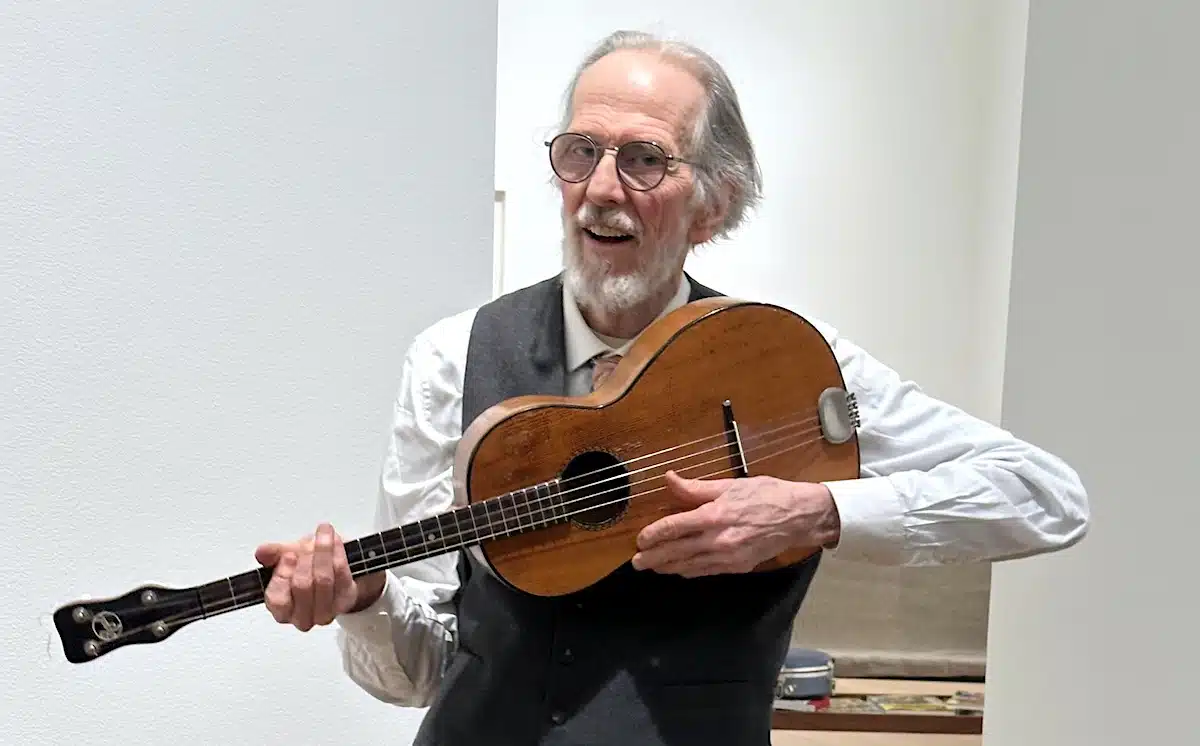
Elsewhere, Unknown Detroit Bluesman (1970), originally commissioned for a blues compilation, nods to Crumb’s deep attachment to early American music, while a 1995 drawing captures him frazzled and overwhelmed during his first trip to Finland. He performed an acoustic set last Friday to a packed gallery with his daughter and granddaughter.
Using the familiar mechanics of comics as a way of taking stock. A rare early sketchbook is shown alongside the finished pieces, offering a more tentative, almost private counterpoint. Placed next to recent drawings and new etchings made with Two Palms in New York, the continuities are hard to ignore. The line tightens or drifts, the focus wanders, but the underlying urges remain stubbornly the same.
In A Difficult Conundrum (2025), Crumb casts himself unravelling panel by panel, his tirade against a pharmaceutical company breaking apart as the speech bubbles crowd and buckle. Elsewhere, The Very Worst LSD I Ever Had (2025) circles back to a brutal acid trip in 1966, an experience that sent him into regressive hypnosis and continues to loom over the work decades on.
These are not nostalgic returns but uneasy reckonings, rendered through the familiar grammar of comics as a form of psychological accounting. The exhibition shows recent drawings and new etchings produced with Two Palms in New York. It points us to think both how much has changed and how much hasn’t. The line may sharpen or loosen, the targets may shift, but the compulsions remain intact.
Born in Philadelphia in 1943, Crumb moved to San Francisco’s Haight-Ashbury in 1967 before settling in the south of France in 1991, where he still lives and works. He joined David Zwirner in 2006; this is his eighth solo exhibition with the gallery. Museum shows over the past two decades from Paris to Santa Barbara have cemented his reputation, but There’s No End to the Nonsense resists any tidy summing-up. Instead, it offers Crumb as he has always presented himself: contradictory, abrasive, funny, and still arguing with his own thoughts on the page.
Top Photo: P C Robinson © Artlyst 2026
R. Crumb: There’s No End to the Nonsense David Zwirner January 29—March 14, 2026