Sean Scully, who was recently named an Officier de l’Ordre des Arts et des Lettres, one of France’s highest cultural honours, was born in Dublin, moved to London in 1949 and settled in America in the mid-1970s. He is best known as a painter of monumental works in oil, although he is also a printmaker, producing woodcuts and etchings. Hughie O’Donoghue was born in Manchester, England, in 1953 and now lives and works in London and Erris, Co Mayo, Ireland. He uses figuration and abstraction to explore themes of human identity, memory, and experience, and draws on history, mythology, and personal records to create works that resonate with emotional intensity.
Initially admirers of each other’s work, the two artists have subsequently become good friends. In this joint interview, they reflect on the nature of friendship while discussing aspects of their Irish identity, their experiences working during a hostile period for painting, the subsequent triumph of painting, and their experiences creating works for sacred spaces.
JE: You are both dear friends and have been for some time. How did you first meet and how has your friendship developed since? I wonder, also, to what extent your friendship has developed because of similar experiences through your respective upbringings; both growing up within Irish families that were living in England.
HO: We’ve both known each other through our work for a long time, rather than knowing each other as friends or as colleagues. Ireland is very different from the UK, in that you tend to meet everybody in Ireland who’s involved in the arts in some way or another. So, we had crossed paths at various times, but without actually knowing each other to any great degree.
My position as an artist is very much predicated on the complexity of identity. That is something I probably something inherited from my parents, when it was much more of an issue – the idea of being Irish and being English at the time when the state broke up. So, in my work I have been interested in that area.
I was elected a member of the Royal Academy (RA) some years ago and, at the RA, we vote for people to become members. When Sean’s nomination came up, I felt very strongly that not only should we have him as a member, but could we really afford not to have him as a member! This was based entirely on the quality of his work – the force and strength of it – and so I spoke about that. Subsequently, I installed Sean’s work at the RA and, at some point, we got to meet. Then, I suppose through our various connections, we hit it off, and we’ve been good friends ever since.
SS: What I would say is that Ireland, historically, is a classless society. I mean, I’ve stood in a pub with one President of Ireland, drinking a beer, and had a visit with another one. Historically, Ireland is classless because they used to elect their kings and queens, and that is no small thing! So, as my buddy here says, everybody meets everybody, and you can’t pretend that you’re too important to meet in Ireland. You can meet everybody!
I remember one beautiful occasion when I entered the Merrion Hotel and the doormen were standing outside with their uniforms on. One of them said that his son died and, you know, my eldest son died. So, then, there’s this guy sobbing in my arms right outside the premier hotel of Dublin and the other guys thought it was completely normal. I think it’s completely normal and it’s very beautiful. I can’t imagine that happening elsewhere because, in Ireland, this division between people doesn’t really exist.
This eventually led to our meeting in that it has something to do with our attitude, our egalitarian attitude. I’m attracted to the idea of the classless society. As Hughie will attest and, as my son will attest as I walk him to school, I don’t really make a difference between people. So, you don’t really get any credit with me, being important. We got to like each other and have become very good friends. I regard Hughie as one of my essential friends.
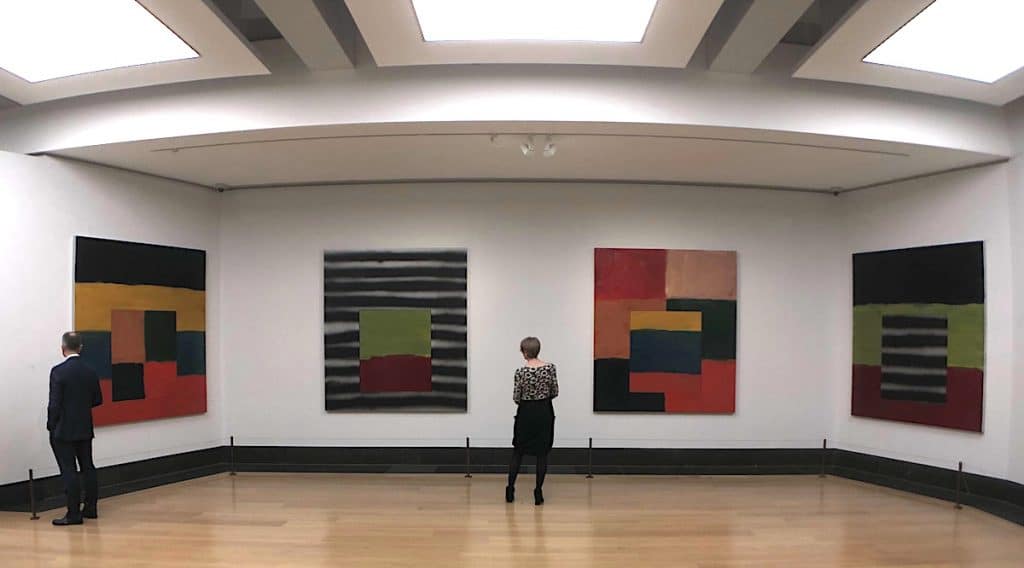
Sean Scully, National Gallery, London ©Artlyst
JE: What would you say you particularly appreciate in the art of the other?
SS: I showed Hughie’s work in New York. I run this Kunsthalle in Manhattan. I can’t say I’m objective. I show my friends and people that I like and respect and who I think are a bit overlooked in some way. And that’s the purpose of my space. That’s who I show.
I always thought that Hughie’s work was extraordinarily theatrical. The only person I can liken him to is Anselm Kiefer. His work has an extraordinary force. It’s kind of wild, in a sense. It’s very academic, you might say, in the way that it’s painted, since he puts shadows in the right places, that sort of thing. But the effect is thunderous. And painting on tarpaulin, it’s outside anything that fits within a commercially viable situation and is probably patronised by crazy people. So, this attracted me to it.
HO: I think I probably should start this one saying I believe that all artists, in some ways, have to be a little bit mad. They have to have a little bit of intensity about them. Our whole instinct as human beings is to go against that, to fit in.
The very first time I saw Sean’s work, what engaged me was its physical presence. It may not have been stylistically in the genre I, personally, was looking at with my work, but something in the physical presence of the work, particularly in the handling of paint, as that’s something that has, in a conceptual culture, been denied and at times denigrated. In the art of painting, it’s absolutely the most essential thing as to what a painting is and how a painting feels.
We can discuss a painting, all the symbols that are in it and its content, ad infinitum but, at the end of the day, when you stand in front of a painting, it’s how it feels; whether it’s an early Renaissance altarpiece or whether it’s a piece of contemporary painting. And the painter’s job is to make that painting shimmer with intensity. There are very few paintings of Sean’s that I’ve not felt that about and it’s often been encountering them in the most competitive environments – the art fair at Basel, with all the cacophony of different styles – that his work has stood out for its physical presence and its intensity.
It’s difficult to put it into words but, recently, I saw a beautiful selection of his works in Liechtenstein, at the Hilti Foundation, shown alongside Paul Klee, who was a great favourite of mine in the early years. The works resonated with Klee. So, they are inventive and they are authoritative and, more than anything else, they’re absolutely decisive. Sean’s paintings have a formal power.
All those things have drawn me to Sean’s painting. Even though his language is possibly more abstracted than mine, I feel that we’re very much on the same playing field in terms of the emotional inspiration for our painting.
JE: You’ve both spoken about the sense of presence in each other’s work. Although, on a simplistic level, one of you is more figurative and the other more abstract, it’s that shared sense of presence that you’re both connecting with in each other’s work. I wonder, as artists, how you bring that about in your creations and to what extent it’s been an unconscious or conscious experience in achieving that level of physical presence in the work?
SS: I hope this doesn’t cause you any disturbance because we’re going to travel back 60,000 years! There. Are you feeling all right? Time travel’s great! When you look at cave paintings, you can see that they’ve been around longer than the word, longer than the song, and second only to fire. So, we’re part of something very ancient.
What I think is important in both our work and what unifies our work is what we paint on. Hughie paints on exaggerated material, semi-industrial material, and he puts refined images on top of that. Now, that’s very interesting. The way he paints is a form of realism, though not hyperrealism, but it’s on exaggerated material. So, the material plays into the message. You have this dichotomy between the refinement of the painting technique and the materiality of it, and the way the materiality of it is shown.
The same thing happens with my work. There’s a lot of refinement in my work because I’m a very knowledgeable painter. You can see the School of Paris in my work and a lot of the colour of the Quattrocento and so on. My work is extremely sophisticated in that regard, but there’s always this sense of what it’s painted on. And there’s insets, abutments, and so on. The paintings that made me famous in New York were the ones where I cut up paintings, and break the idea of picture space because I thought the picture space was a pointless conversation, and we had to get right down to the impact of the thing itself.
So, it’s basically an image and a thing. I spoke with somebody the other day who told me that in a research study, people, when they look at paintings, not reproductions of paintings, but paintings themselves feel cured in some way. That’s fascinating, that painting has a powerful spiritual, emotional effect on people. But it has to be the painting itself. In other words, the image and thing, finished.
HO: One of the things I probably didn’t say about Sean’s work because it’s very difficult to put into words is that always in Sean’s work, they’re paintings, but they’re also pictures. Not every painting is a picture, and not every picture is a painting. The power of a painting is when you have the two things in some sort of tension at the same time. Sean tells me he’s going to Paris tomorrow. He’s going to look at some paintings by Cezanne, and Cezanne perfectly embodies that. People look at Cezanne often and think, “Well, that figure’s not right. The arms are too long or the legs are too short or whatever.” But the point in Cezanne’s work is the tension between the representation and the painting. You’re looking at two things. You’re looking at a picture of a window, looking through a window, but you’re also looking at an object. And Sean’s work always has that muscular, tactile presence, which is what I want from painting.
I try to achieve that in my own work but I’ve gone via different routes. I’ve never actually gone into abstraction apart from a couple of years in my youth. I’ve always kept some recognisable motifs in my painting. Even though, at the end of the day, it can be very hard to unravel what the motif was, it is there. I think, in a way, I’m looking for the same thing as Sean. If I’m making a painting of a tree, which I’m doing at the moment, it’s a humble thing but I want it to be a painting first and foremost. Not a recreation of a tree, not an image of a tree simply. So, it’s about that kind of tension in the process, and that’s about looking, and it’s about time. It’s about looking at the painting, the painting that you’re making, rather than the idea that is particularly strong in the English tradition of looking at a model, somebody naked on a stool or something, and constantly referencing that thing. The looking, in my work and, I think, to some extent, in Sean’s, goes in looking at what we’re making. That’s why it has the power it has. It’s not beholden to some other outside reference point. It is what it is.
There are different strategies for doing that and one of the things I’ve consciously tried to do is try to bring a recognisable subject back into painting. Whether I’ve done that or not, I don’t know. I’m still trying to do it but I don’t want to lose the things that Sean has in his work. I want the painting to stop you in your tracks as a thing. Before you start asking, “Well, what’s it of?” you should have that gut response to the painting first. And then learn about what’s happening in it later.

Hughie O’Donoghue, Time and The Architecture of Memory, New York photo: Miranda Carroll
JE: Sean mentioned earlier your New York solo exhibition at 447Space. ‘Time and the Architecture of Memory’ brought together nine of your works spanning more than three decades. I wonder if you could both share a little of how that exhibition came about and what it meant for both of you?
HO: It came about as the easiest show that has ever come about in the whole of my career. I’ve done rather a lot, right! I forget exactly where I was, but Sean said, “Would you like to do it?” I wasn’t even sure what he was talking about at the time. It was decided fairly quickly.
I’d always wanted to show in New York because, for people of my generation, New York would be seen as a very significant place to show your paintings. It was the centre of painting after the Second World War. I hadn’t shown in New York, other than occasional bits and pieces of my work. So, the idea of showing some very serious works, in terms of their ambition and their scale, greatly appealed to me, and Sean gave me that opportunity out of the blue. I grasped it with both hands.
What I wanted to do was to make a show that would exploit the amazing architecture of the gallery, which is a cavernous space and a perfect space for experiencing large-scale work. It was an opportunity also to reappraise certain pictures. I’ve made pictures on a monumental scale, which are not the kind of pictures that are easily placed either in museums or in private collections. This was an opportunity to show paintings of a really ambitious scale.
If you’re trying to do something new in art, it’s not often immediately obvious to people what you’re actually trying to do, and part of that is because you don’t fully know yourself what you’re trying to do. It’s a slow process. Albert Pinkham Ryder, the great American painter of the 19th century, described it as an inchworm on the end of a leaf, sort of finding its way out into space. Wow! You’re trying to do that, and sometimes you don’t know if something’s going to work or if it’s not going to work, but actually, the main contract the artist has with their audience is to be willing to fail, to be willing to try to make the effort. It’s not about demonstrating skill or cleverness; it’s about actually opening up and making yourself quite vulnerable. That New York show was a wonderful experience. I’m hugely grateful to Sean for having the vision to do that and the generosity of spirit. He’s a very kind man in many ways I’ve come to know.
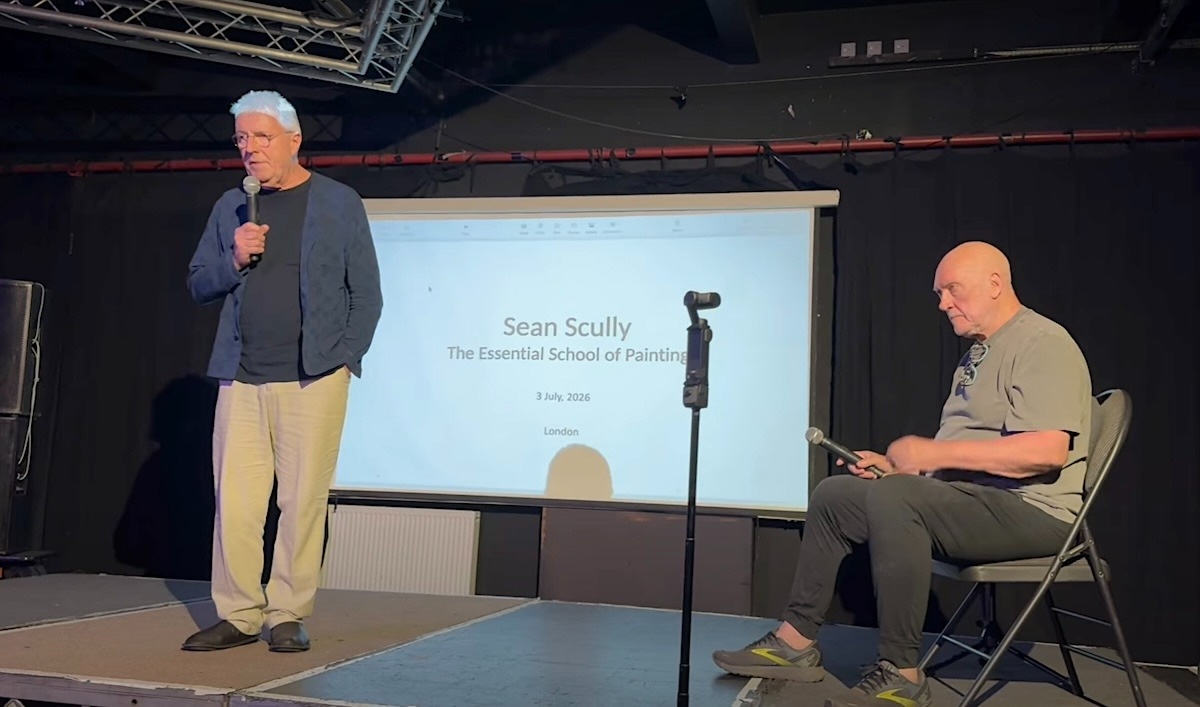
JE: Earlier this year you gave an introduction to Sean and his work at a talk for The Essential School of Painting in London. In your introduction, you spoke about how you have both been painting for 50-plus years during what you described as a hostile period for painting. I wonder if you could expand further on that sense of having been in a hostile period for painting and, Sean, whether that accords with your own experience in that same period? It’s the sense that, even though the works you have both been making have this incredibly powerful presence, it hasn’t always been appreciated or regarded in terms of the fashions within the art world over the period you’ve both been painting.
HO: The first thing I’d say about that is that the dominant idiom in art during my lifetime has been conceptual art. Conceptual art, in its purest form, proposes that the only thing that is important in a work of art is the idea. Which is clearly ridiculous, in my view, as, for a start, that means that painting as an art form is completely redundant. If the only thing that’s important is your idea, there are much easier ways of communicating your idea than messing around with canvas and paint.
I don’t believe that that’s true. I believe that painting establishes meaning in a different way to the conceptual. I’m not particularly attacking conceptual art but I don’t buy into it. I feel that the parallel most close to painting for me, is music and poetry. Painting is not about mark-making, but it’s about the sensibility of the painter who can give their vision of the world, their sense of being in the world through the medium of paint, and that’s not the same as writing an idea down. There’s no such thing, in my view, as a conceptual painting. It’s a contradiction in terms.
SS: Conceptual art was invented by a group of intellectuals in Paris with the assistance of Samuel Beckett, who was actually a lover of painting. But he was playing a kind of double game. There’s a film made by Beckett and Buster Keaton called ‘Guess What ‘, and it’s the biggest load of crap you ever saw in your entire life. It’s completely pretentious rubbish.
The problem with conceptual art is that it has obviously been conquered now by painting. The reason I believe that it’s been conquered by painting is because of inclusionism. Inclusionism has let everybody in and they’re not interested in a kind of refined white guy, esoteric, intellectual nimbleness. They don’t want to begin adding to that. They want to begin at the beginning because now they’ve been let in. And then you see the evidence of that; it’s empirical. The evidence of that is that you see painting everywhere now. Painting rules. Mostly, it’s figurative painting. It is definitely dominant, and conceptual art is having a difficult moment, which I think will make it very difficult to return. That’s my prediction. I don’t think that conceptual art is going to find it very easy to return at all because of globalisation and inclusionism.
Conceptual art is essentially ironic, and we are now in a different place globally, humanistically, environmentally, politically. We are in a place where we don’t really have much patience for that kind of effete preoccupation. We don’t have time for the sophists. We don’t have time for the mechanics of art making as a thing and as a subject in and of itself, which is ironic. Also, I would say that, in terms of abstraction, abstraction blossoms all over continental Europe and America. In America, it’s the dominant art form and also in Germany. I, of course, identify with this and am part of it.
It’s difficult in the UK, because the history of the UK is different. The UK has always been a holdout. In 1937, let’s say, that holdout benefited humanity exponentially. So, you have to take the rough with the smooth. The British Isles is part of Europe and not part of Europe. When fascism was running through Europe like wildfire, the British Isles resisted that to their eternal credit. They also resisted other movements that were driven by Europe and one of them is abstraction, which was then exported to America.
Here’s a very interesting sidebar. Abstraction in China, where I am super famous, was illegal 40 years ago, and the reason that it was illegal is that you can’t edit it. You either take it all or you take none of it. It promotes freewheeling thought. China has built 1,000 museums in 10 years. America has 1,000 museums; Germany has 900. China has now recognised that it cannot advance without art, without highly intuitive, imaginative thinking, and that’s where art and, in my view, particularly abstraction, comes into play.
JE: You have both had the experience of creating work for sacred spaces. I wonder if you could both reflect on the distinctive aspects of creating work for such spaces and how the experience differs from other commissions and from creating work for traditional gallery spaces?
HO: I spent 10 years making a commission of paintings of the Passion of Christ, which was a bit of a passion in its own right. What I’d say first and foremost is that there’s a difference between private painting and public painting. A public work of art is, in my view, something that you’re making where you’ve got to surrender some of your own vision, as there are other stakeholders.
When I get out of bed in the morning and decide I’m going to do some painting, and I go into the studio and start making a painting, there’s nobody else I’ve got to keep happy at all, other than myself. I can scrap what I’m doing, change it, do this, that, and the other. But if you have a specific piece of art for a public space, there’s got to be a bond of trust between the people who have asked you to do that and you, and that can sometimes be extremely tricky to negotiate.
I made a painting for the Imperial Society of Knights Bachelor for St. Paul’s Cathedral about St. Martin dividing his cloak. That was probably the most difficult commission of that nature, as I knew I would have to tick certain boxes, and the decision that I would have to make as an artist is, “Can I do this?” I’ve also turned commissions down, most notably in Ireland, but also in Fatima in Portugal, because I felt that too many constrictions were being put on my ability as an artist to make a work of art. So, whilst I accept there is an obligation to address the needs of the people who are putting forward the commission, I’ve also got to satisfy my needs, and if those two things can’t be resolved, then, I couldn’t go forward with that kind of commission.
To open it up a little bit more, I think that all my work is personal to the extent that I have to feel something in relation to my own history and my own identity and my own life in order to try and make a painting. I can’t make a painting of something that is remote from me. I was born as a Roman Catholic. My mother was quite a devout Roman Catholic. My father, less so, as he’d been in the Second World War. I had all that legacy behind me and I think that painting, philosophy, and religion do have crossover points, in that they are all disciplines that engage with trying to find meaning in our existence. That’s where I come from and if I’m making a stained-glass window for a church, I look to see if I can find points to connect with this.
I made windows in Westminster Abbey, and the points of connection were personal ones, not illustrating dogma. It was about the Lady Chapel, and I was thinking about my own relationship with my mother and what she believed. So, I found points of connection to make this public work. I think that’s the key. Essentially, my view is that you’ve got to find your point of connection. Only connect and if you can’t connect, walk away. Which I know Sean has done on occasion.
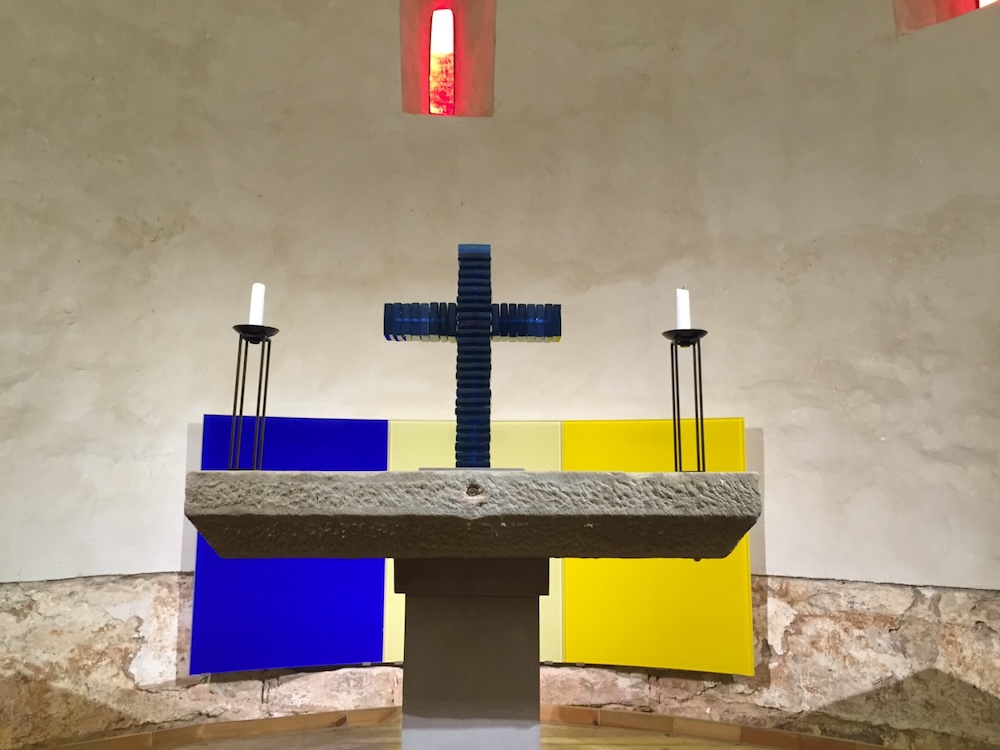
Sean Scully, Chapel of Santa Cecília de Montserrat, Spain ©Artlyst 2015
SS: When you make a space – and I have made several sacred spaces, including one, in particular, in Montserrat – you cannot operate with committee. Once you start operating with a committee, you will never achieve anything extraordinary. That, I would say, is a basic rule. It’s high risk, of course, but then the alternative is mediocrity. Michelangelo’s ceiling was basically a collaboration between the Pope and the artist, and that was it. There weren’t any other people involved.
I was once offered a church in Munich and did a big design for it, which I thought was fantastic for all the windows. I had respect for the ones that were already there, which I said they should not change. Then they started coming back with alterations and adjustments they wanted to make because they had a little committee of people who didn’t know what the fuck they were talking about. So, I just said, “Get yourself an obedient graphic designer.” You want a famous artist as an idea, but not as a reality, because you don’t want to let that artist loose.
In Montserrat, they did let me loose. I did St. Michael in Bavaria [Altdorfer Chapel of St. Martin’s Abbey Basilica], which is the world’s highest brick building, a 15th-century building. I made four windows, and they accepted it. So, I think what you basically have to do, if you want a space like that, is have somebody who’s a really great artist to do it, and accept the results. If you bugger around with it and subject it to committee, it’s already a dead thing before it’s begun!
HO: What’s that old recipe for jugged hare? First, catch your hare. I think that’s the point with a commission. Choose your artist and then let them get on with it. I think artists want to do a good job. They want to do a great job, if they can get away with it as long as the brief is reasonable. Sean’s point about micromanaging, I’ve experienced that, and it really destroys art.
JE: It’s ironic that the commission presumably comes your way because people experience the physical presence that’s there in the work but then the process for developing the commission seems to undermine the creation of that physical presence in the work that’s being commissioned.
HO: I think that’s common enough, and it’s usually because of committees. Committees can be stifling, and usually what they achieve is the lowest common denominator. That’s not what you want for a work of art. It’s hard enough to be confident as an artist. I can only speak for myself, but I struggle to have the liberty to make a brushstroke. I’ve gone through quite a lot, a certain conceptual process, to know what I’m doing.
JE: You’ve both had the experience of creating powerful works over a lengthy period of time in this context that we’ve said hasn’t always been favourable towards painting, and yet you’ve been able to maintain your work and the power of your work over that period of time. So, presumably, you’ve pushed on through those periods or moments of doubt or uncertainty about your practice in order to come through or are you saying that that continues to be a part of your practice?
HO: I think that making a work of art requires some intensity. It’s obvious to see that in an artist like Van Gogh. But intensity is not a nice, comfortable place to be, and people actually don’t like intense people most of the time. They didn’t like Van Gogh very much, and he was a fucking pain in the neck by all sorts of accounts.
I think, in a way, you have to have an engine as an artist. What I mean by that is you have to have something that stimulated this in the first place, and you have to be able to overcome disappointments, and there will inevitably be disappointments and rejections. So, that engine has to be a really good engine because there’s far more disappointments than there are going to be celebrations. So that engine usually, unfortunately, comes from not a great place. Certainly, that was the case with Van Gogh, if you look at his life! I think that that’s one of the reasons why artists are quite special individuals. How you nurture artists is a difficult thing. They’re not pets that you can patronise occasionally. They need to keep their sense of self and their integrity, because it’s the easiest thing to lose. Those people who tell you that they’re helping you are usually the people who are trying to take it away from you.
JE: Is that one of the reasons why the kind of friendship that the two of you have is so important? You’ve got that shared experience of dealing with those kinds of things and are able to provide encouragement to one another?
HO: Absolutely. I’ve always respected Sean’s work even though I didn’t know him initially, so it’s hugely encouraging to me to engage with him and to listen to what he’s been doing and to see his work and see his studio. I think artists are important to other artists. Going back to Van Gogh, he craved for other artists. And then you look at what happened – artists are volatile individuals. I think it is like in any profession: you have people who you admire, and they are sustaining, because you do have to sustain yourself over a long period of time.
JE: Thank you both for your time and your insights, and especially for sharing what you have of your friendship.
Top photo via Instagram
See more on Sean Scully Here
See more on Hughie O’Donoghue Here