
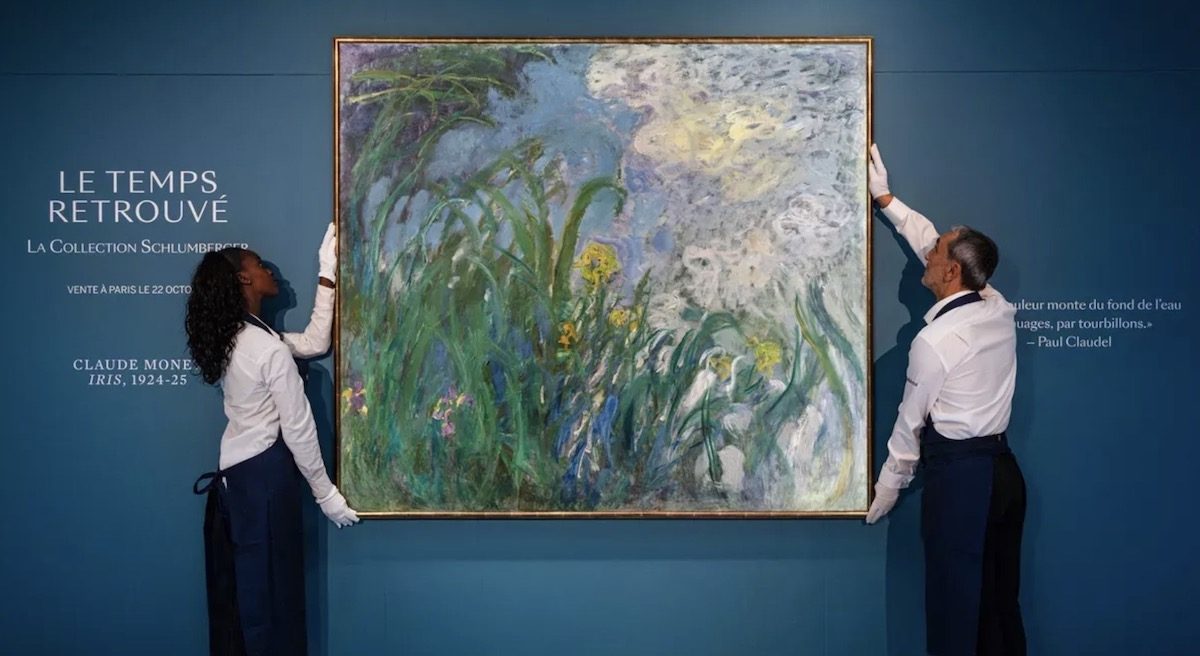
Sotheby’s Paris has unveiled Le Temps Retrouvé, its title for a collection of Impressionist and Modern works that ranks among the most significant private groupings of its kind ever to be offered at auction in France. Assembled over more than four decades by Jeanne Schlumberger, the collection carries a combined estimate of more than €40 million. It includes 28 works, many of which have never been seen by the public before, in some cases not since they left the artist’s studio.
The headline lot is Claude Monet’s Iris, painted between 1924 and 1925 during the artist’s final years at Giverny, carrying an estimate of €22 to 30 million, which Sotheby’s says is the highest estimate ever placed on a painting at auction in France. It is also, notably, the largest surviving work from Monet’s final decade still in private hands, with its only real counterpart permanently housed at the Musée Marmottan Monet in Paris. Until today, the painting had been publicly available only as a black-and-white photograph. Nobody outside a small circle had actually seen it in colour.
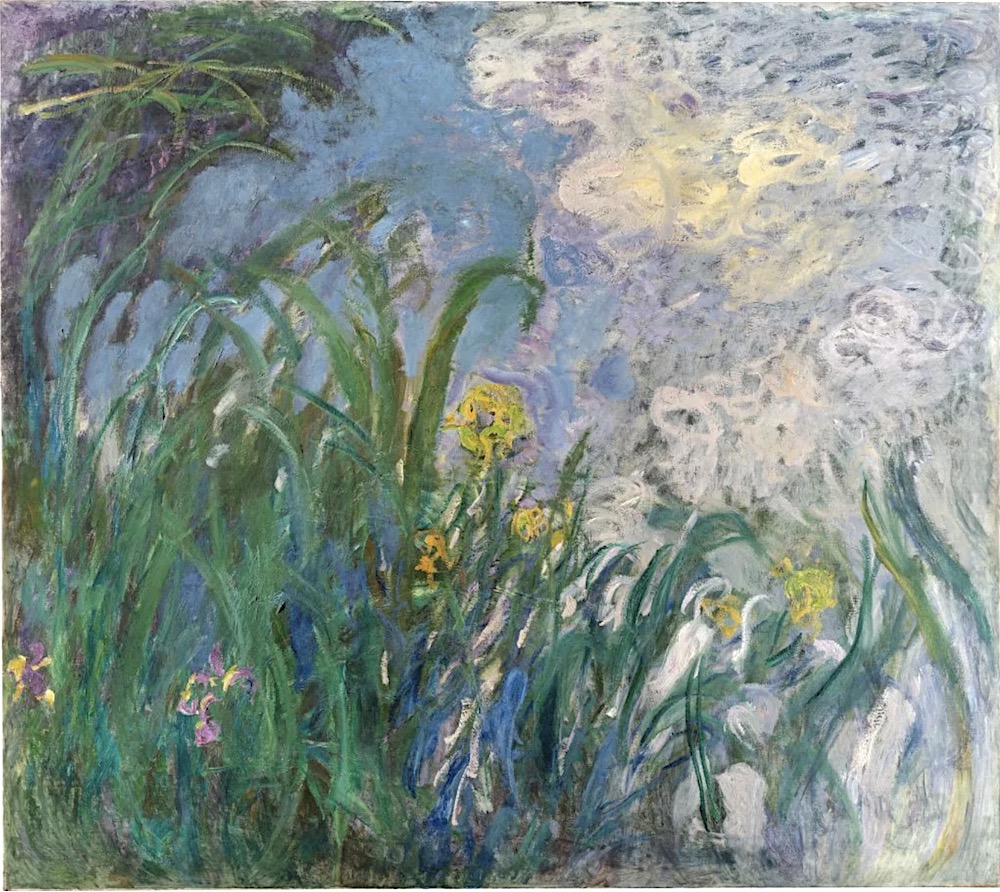
Claude Monet, Iris (1924–25). Photo: © Damien Perronnet, Blok Design Group & Art Digital Studio, Sotheby’s.
Measuring 160 by 180 centimetres, Iris belongs to a tight group of just twenty paintings Monet produced on the subject between 1914 and 1925, a series that marks, in retrospect, his clearest break from anything resembling conventional Impressionism. By the mid 1920s Monet had transformed his Giverny garden into what Marcel Proust once called a garden of hues and colours, and Iris reflects exactly that ambition, an attempt to construct what Monet himself described as the illusion of an endless whole, a painted world without fixed horizon or conventional perspective, meant to envelop the viewer. Irises themselves held particular meaning for him, a flower he encountered repeatedly in the Japanese prints he collected, including works by Hokusai, and other major paintings from this same series now hang in the National Gallery in London and the Art Institute of Chicago.
Before heading to the auction in Paris on October 22, timed to coincide with Art Basel, Iris will first travel to Hong Kong and New York. It arrives on the market, somewhat fittingly, during the centenary of Monet’s death, a year that has already seen museums across France and elsewhere organising tributes to the artist.
A second Monet, Saule pleureur, also known as L’Arbre de feu, joins the sale with an estimate of €9 to 12 million, one of the artist’s celebrated weeping willow paintings from the Giverny garden. Both works share an identical provenance, passing from Monet directly to his son Michel, then into the hands of the dealer Katia Granoff, before eventually entering the Schlumberger collection.
That provenance is really the heart of the story here, and Sotheby’s has clearly leaned into it. The collection traces back to the Paris townhouse on rue Las Cases where Jeanne and Marcel Schlumberger lived, a family whose name is more commonly associated with industrial engineering than with art history. However, it was Jeanne, not her husband, who quietly built one of the more consequential private collections of her generation. Beginning in the 1950s, she worked closely with Katia Granoff, the dealer whose advocacy for artists including Pierre Bonnard, Chaïm Soutine, Georges Rouault and Othon Friesz ran largely counter to French taste at the time. Jeanne provided support and financial backing. Katia provided access and, more importantly, judgment. Together, according to Sotheby’s, they functioned less as collector and dealer than as genuine partners.
In 1958, Jeanne appears to have quietly helped finance Granoff’s acquisition of Michel Monet’s studio holdings. This deal gave Granoff access to an extraordinary trove of late Monet paintings at a moment when almost nobody in France wanted them. Granoff placed several with American institutions, including the Museum of Modern Art, the Cleveland Museum of Art and the Art Institute of Chicago, helping build the case that these late, nearly abstract garden paintings represented not the exhausted tail end of Impressionism but something closer to a bridge toward Modernism, anticipating painters as far removed as Mark Rothko and Joan Mitchell. Before the Musée Marmottan Monet consolidated the artist’s estate in 1966, only three collections in Paris were seriously devoted to preserving these late works: the Orangerie, Granoff’s own gallery, and the Schlumberger collection.
Thomas Bompard, who co-heads Sotheby’s Modern and Contemporary Art department in France, framed the sale in terms that leaned heavily on that history. “Great collections are built on taste,” he said. “The greatest, perhaps, are built on conviction.” He described Schlumberger and Granoff as two women who saw radical brilliance in these paintings long before the market caught up, one collecting, the other championing, both trusting instincts that ran against prevailing opinion.
Beyond the two Monets, the collection extends into work by Cézanne, including a rare mural originating from Jas de Bouffan, the artist’s family home, alongside pieces by Bonnard, Gustave Moreau, Gustave Courbet, Camille Claudel, Eugène Delacroix and Soutine, tracing a fairly coherent arc through the artistic innovations that shaped the run-up to Modernism. Both Iris and Saule pleureur remain, according to Sotheby’s, remarkably well preserved, unlined and unvarnished, offering what the house calls an unusually direct window into the final phase of Monet’s career, one that collectors will get their first real chance to examine in person before the October sale.