
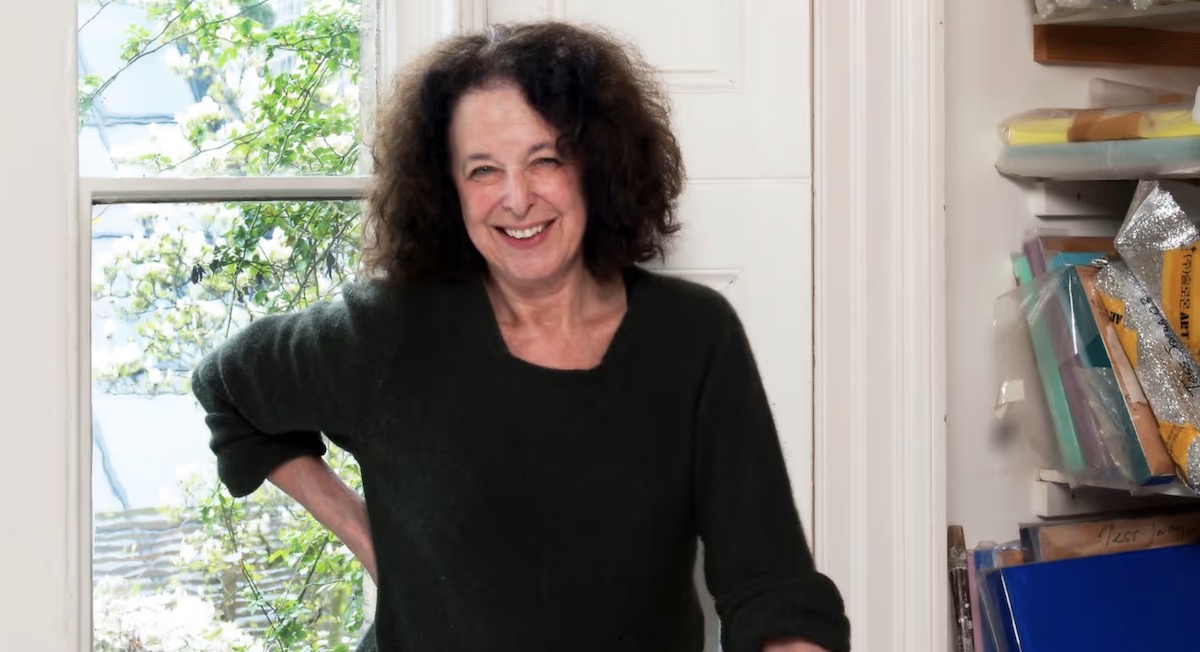
Tess Jaray, who has died at the age of 88, was an artist whose significance was always slightly larger than her public profile suggested. She never quite fitted the categories that art history keeps ready for artists of her generation, and she seemed to regard that as a reasonable state of affairs. Her work touched Minimalism without surrendering to it, engaged with Op Art without becoming an optical spectacle, and drew on architectural tradition without ever becoming an architectural illustration. What she made across more than six decades of sustained practice was entirely her own: paintings of spatial paradox in which geometric forms appear to hover between distance and proximity, between stillness and movement, between the controlled and the felt.
Vienna-born, she came to England as a baby in 1938, her family part of the Jewish flight from a city that had turned on its own. She grew up in Worcestershire, studied at Saint Martin’s and then the Slade, and spent most of her adult life in north London. The Slade hired her in 1968, making her the first woman to teach there. She stayed thirty years.
Her paintings, at first glance, look like they belong to a tradition of cool geometric abstraction. Hard edges, flat colour, careful pattern. Look longer, and something starts to happen that cool geometric abstraction doesn’t usually do. The forms begin to move. Space opens up where there shouldn’t be any. You find yourself uncertain whether what you’re seeing is advancing or receding, near or far. She understood this effect completely and spent sixty years refining it, never quite explaining how it worked, never needing to.
She laid the terrazzo floor at Victoria Station in 1986. Thousands of commuters walk across it every morning without a second thought, which she would probably have considered a reasonable outcome. Centenary Square in Birmingham came later. Then Aleppo at King’s Cross in 2017, which was named a destroyed city without making a fuss.
The work is in Tate, the Pompidou, the British Museum, Harvard, and the Whitworth. She was elected a Royal Academician in 2010. An honorary doctorate from UAL came in 2025, the year before she died.
In 2012, she was the Co-ordinator for the Summer Exhibition, the world’s biggest open submission show at the Royal Academy. This was the first time the exhibition was hung in a wave-like pattern.
She is survived by her daughters Anna and Georgia and four grandchildren. The paintings survive, too, still doing their unsettling quiet work on anyone patient enough to stand in front of them.
Top Photo: Tess Jaray R.A. Marcus Leith Courtesy Royal Academy