The June Art diary begins with solo exhibitions or installations by the likes of Sanya Kantarovsky, James Turrell, Lakwena Maciver, and Renaud Muraire, among others, that tap aspects of spirituality. Exhibitions engaging with churches come next, including Manifesta 16 Ruhr. Then I highlight exhibitions by female artists that explore aspects of mysticism, often in the context of particular environments. ‘British Landscapes: A Sense of Place’ at Pallant House explores similar themes in a British context. A series of group shows explores art created within regions that addresses elements of re-visioning history, enduring knowledge and evolving faith. I end with two interesting exhibitions in my local area: Focal Point Gallery and Beecroft Gallery in Southend-on-Sea.
Sanya Kantarovsky’s exhibition at Palazzo Loredan in Venice extends the artist’s interdisciplinary practice through site-specific interventions that engage with the architecture of this historical site. The exhibition includes a group of paintings, ceramic works, and a sculpture made in collaboration with a Murano glass studio. Known for a painting style that blends psychological anxiety with a sharp, cultured irony, this new body of work deepens Kantarovsky’s inquiry into humanist, art historical themes of spirituality, alienation, and vulnerability within the tradition of the painted figure.
‘Lifting the Veil’ by James Turrell surveys the artist’s practice of shaping light and perception with holograms, prints, and three Glasswork pieces, along with site plans, photographs, and models of ‘Skyspaces’ and Turrell’s magnum opus, ‘Roden Crater’. Turrell’s ‘Skyspaces’ are individual architectural chambers with an aperture in the ceiling open to the sky; they frame the expanse and incorporate both natural and artificial light, amplifying the senses. Under construction since 1977, ‘Roden Crater’ is an unprecedented large-scale artwork created within a volcanic cinder cone located in the Painted Desert region of Northern Arizona.
For over five decades, Turrell has pushed the limits of perception through a practice centred on light as his primary material. Although he is known for his Quaker faith, his work is primarily situated in the art world rather than explicitly in a religious context. However, two Quaker meetinghouses do include ‘Skyspaces’. Live Oak Friends Meeting House (Houston, Texas), completed in December 2000, was the first Quaker meeting house built from the ground up to feature one of Turrell’s signature ‘Skyspaces’. Another can be found at the Chestnut Hill Friends Meeting House in Philadelphia.
Covering more than 1,000 square metres across the basketball courts at Happy Mount Park, Lakwena Maciver’s ‘HA HA HAPPY’ transforms the space into a vibrant technicolour landscape. Rows of interlocking tiles create a playful pattern of repeated “ha, ha’s” — the visual imprint of laughter — while the word HAPPY rises boldly around the perimeter. The project began with the name itself. “The name Happy Mount was what drew me to this project,” says Lakwena. “When I heard it, it made me think of heaven, and I wonder if that’s what the people who named it were thinking of, too. Either way, I’m so grateful for the many beautiful parks, including this one, that are part of our shared heritage, and I’m very grateful to have been invited to create an artwork for this one. I hope it brings people together, I hope people have fun playing here, and I hope it adds to this little glimpse of heaven here on Happy Mount.”
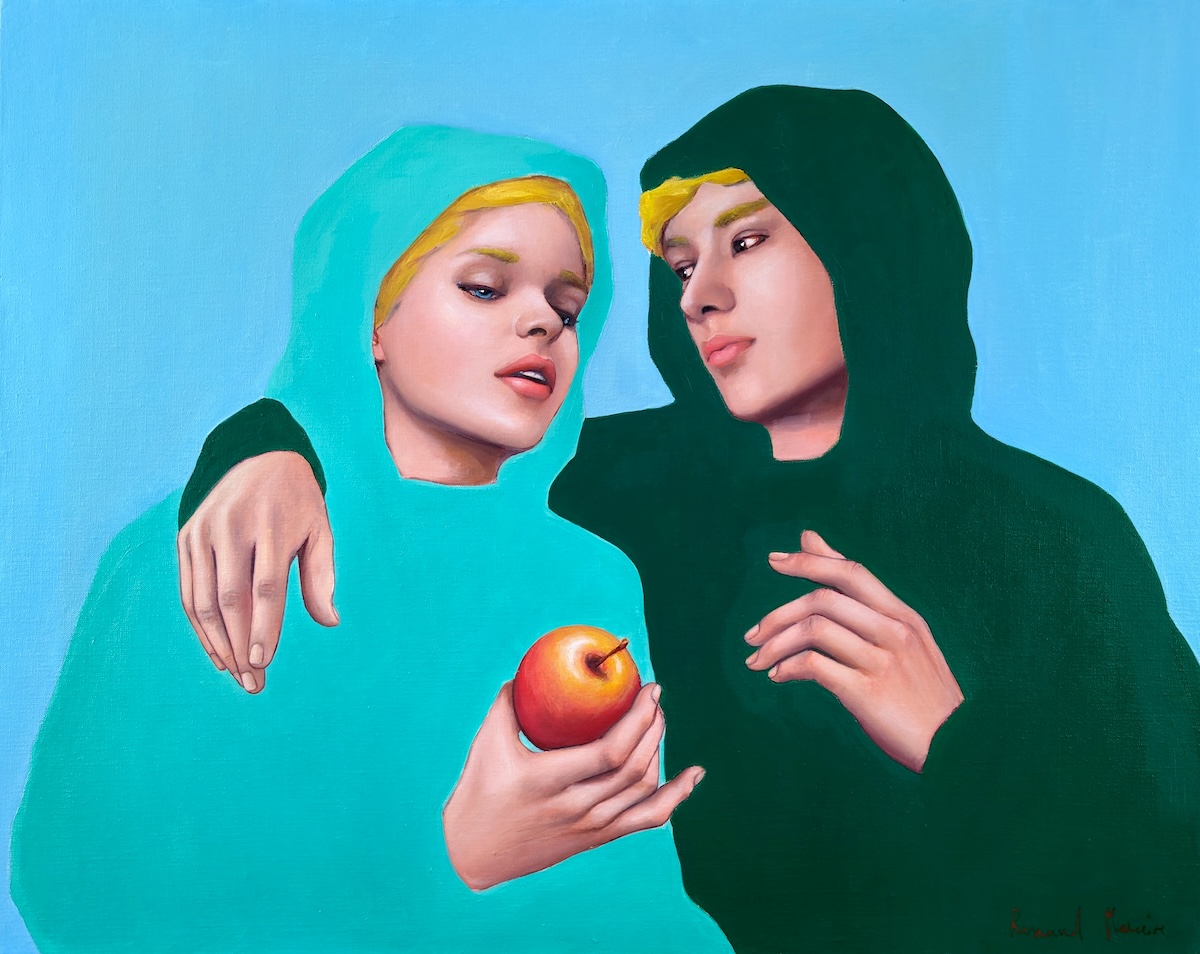
Adam and Eve – Oil on canvas by Renaud Muraire
Renaud Muraire’s paintings create a powerful dialogue between traditional Christian iconography and contemporary human experience. Drawing on biblical narratives that continue to resonate today, his work explores universal emotions, challenges, and aspirations, offering space for reflection on identity and lived experience. In ‘Sacred Resonance’, Muraire presents biblical figures as deeply human, using gesture, colour, and expression to bring emotional immediacy to familiar stories. His work honours the historic role of sacred art as a source of comfort, guidance, and shared belief, while reinterpreting it for a modern audience.
Exhibited in the crypt of Canterbury Cathedral, his paintings present sacred imagery as a living language. They encourage audiences of all backgrounds to reflect on their own journeys, transforming timeless themes of compassion, love, and redemption into reflections of contemporary life. Curator, Jacquiline Creswell, says: “Muraire’s approach is informed by the artists of the High Renaissance and Baroque period, Michelangelo, Raphael, Caravaggio and Rubens, who began treating biblical figures as real people experiencing profound human emotions and communicating through dramatic gestures, symbolic colours and body language to bring the stories to life … His reinterpretation acknowledges this legacy, tapping into symbols and narratives that resonate with collective memory. His work serves as a bridge, linking centuries of visual and spiritual tradition.”
Rob Floyd has exhibited work in galleries and church spaces for many years and has accepted commissions from churches and cathedrals, as well as for portraits. Between 2012 and 2014, he painted a ‘Stations of the Cross’ cycle for Manchester Cathedral, consisting of eighteen life-sized canvases and one drawing. In 2016, he completed the ‘Stations of the Resurrection’ cycle for Liverpool Anglican Cathedral, consisting of seventeen life-sized canvases which are now part of the respective cathedral’s permanent art collections. His latest exhibition, ‘The Gentler Saints & Other Visions’, is at St James the Great church in Congleton and includes drawings and paintings last seen at ‘The Gentler Saints’ show at Manchester Cathedral last year, as well as new work which will form part of his upcoming exhibition at Manchester Cathedral this October.
Éric Mézan lives and works in the Perche region. His latest series, ‘REMIX’, uses broken trinkets whose cracks he reworks to give them new life through neo-Baroque forms. He mixes delightful allusions, reminiscences of art history, childhood memories, tales, and legends, stories told by our elders. The exhibition includes 27 ceramic sculptures whose breaks and chips have gradually been “healed”, giving way to new forms, those that we try to invent when the accidents and tumults of existence force us to get back up and invent a possible future.
This exhibition is at the Church of Saint-Fulgent-des-Ormes as part of the Parcours Art et Patrimoine en Perche art trail. Curated by Christine Ollier, this trail explores the theme of legends, intersecting heritage and contemporary creation across 16 sites. Rooted in a landscape of forests, castles, and churches, the festival offers an engaging, accessible experience open to residents, art lovers, and visitors alike.
Manifesta 16 is taking place in four cities across the Ruhr Area – Duisburg, Essen, Gelsenkirchen and Bochum. Former and underused church buildings are being transformed into cultural and community hubs, where events, workshops, exhibitions, and site-specific artistic commissions and installations will be presented. Manifesta 16 asks: what can we do with these buildings? What is their meaning? How might they be preserved as social spaces? Can they contribute to the formation of a more just society?
The artistic team’s approach to these questions is encapsulated in the image of the rubble bricks: fragments of an old world that were used to build anew. In the resourceful spirit of the Trümmerfrauen, artists reconfigure discarded material – superfluous benches, smashed windows, silent organ pipes – to articulate new ideas. This dual temporality, looking back and forward at once, structures the biennial. On the one hand, the churches are turned into sites for sharing stories of the past, together presenting a kaleidoscopic history of the Ruhr Area and its people. On the other hand, participatory projects and architectural interventions redefine the buildings.
‘A Serious House on Serious Earth: The poetry of our churches’ at The Manger Gallery brings together work by some of the East Midlands’ most imaginative and distinctive artists with some of our greatest poets writing about our greatest buildings – our churches. Poets include TS Eliot, RS Thomas, Nick Cave, Philip Larkin, Sally Read and John Betjeman; with paintings and drawings, hand lettering and copper etchings, stitched textiles and ceramics, stained glass and printmaking, all evoking the age, architecture, atmosphere and art of these most poetic of buildings.
‘Matisse in Vence: The Stations of the Cross’ at the Baltimore Museum of Art brings together more than 80 remarkable drawings that reveal the artist at his most daring, inventive, and spiritually profound. Tracing Matisse’s bold creative journey, the exhibition shows how the artist transformed simple, expressive lines into the monumental ‘Stations of the Cross’ mural created for the Chapel of the Rosary in Vence, his only architectural project and one of the defining achievements of his late career. Stripped of colour yet charged with emotion, these sweeping black lines capture the drama of Christ’s final path in a way only Matisse could imagine. Visitors experience the thrill of watching a masterpiece take shape, from spontaneous sketches to the commanding final vision.
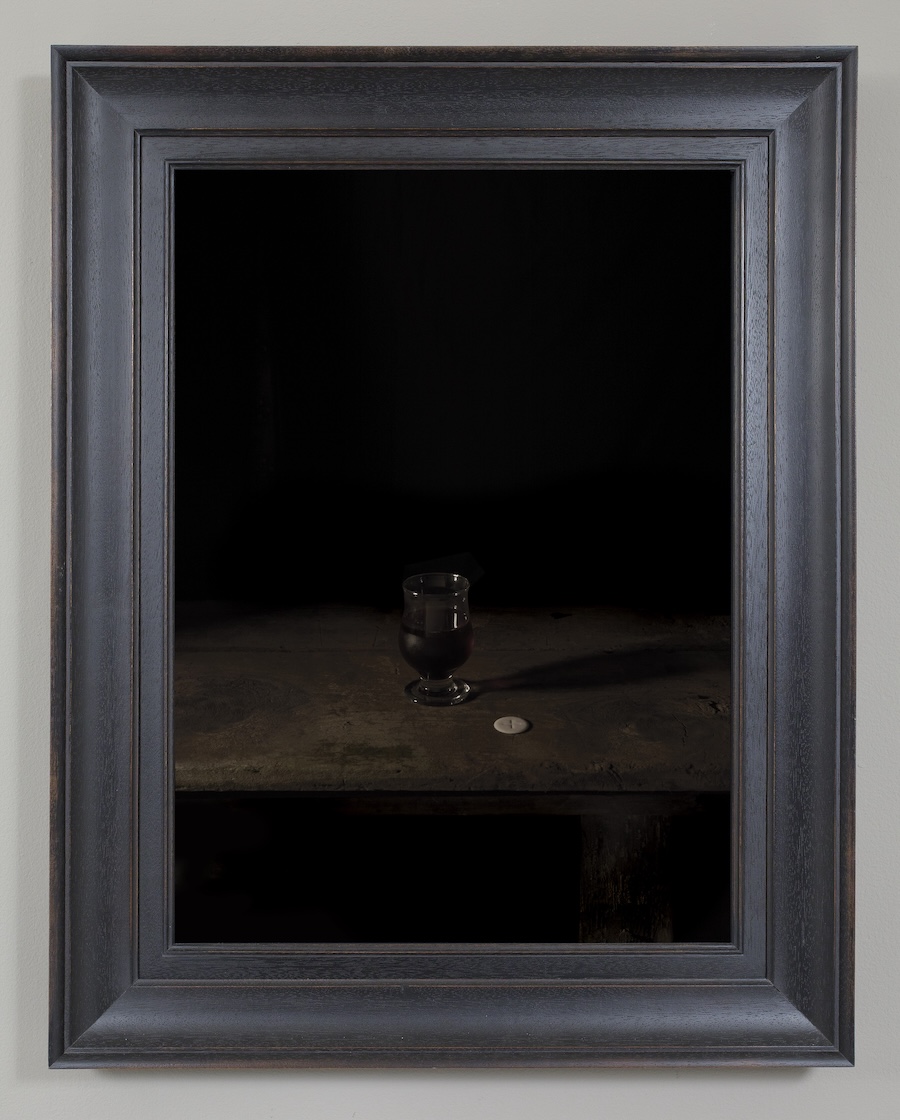
Jonathan Nobles © Mat Collishaw
‘Mat Collishaw: Last Meal on Death Row, Texas’ is an unsettling exhibition that sees ordinary, somewhat banal choices become charged with dark moral and psychological questions. The exhibition at The Sherborne is composed of thirteen hyper-realistic paintings and photographs depicting the final meals requested by named inmates awaiting their imminent executions in the United States of America. The subjects are deceptively ordinary – fried chicken, hamburgers, pecan pie, sweet tea – but rendered with the lush attention to surface and light associated with Dutch Golden Age still life painting from the 17th century. Collishaw’s deliberate art historical framing of the contemporary subject matter is central to the exhibition’s emotional intensity.
Collishaw draws upon the vanitas tradition – in which abundant food and fine objects served as memento mori reminders of mortality – and creates a brutal contemporary echo. Where 17th-century painters used rotting fruit to suggest life’s transience, Collishaw uses a dish of ripe fruit, including a peach, orange and apples, as ordered by Cornelius Gross hours before his death. One of the exhibition’s most famous pieces is the choice of Jonathan Nobles, who fasted and requested only a communion wafer and wine. The exhibition raises uncomfortable questions about capital punishment, the ritualised nature of execution, and what it means to grant a condemned man his choice of a final meal. ‘Last Meal on Death Row, Texas’ is at once a meditation on mortality, a critique of the American penal system, and a deeply humanising act.
Numerous tales intertwine with the enigmatic figure of Lilith, Adam’s first wife. In one rendition, her expulsion from the Garden of Eden stems from her insistence on being on top during intercourse. At the same time, in another, she morphs into a perilous nocturnal demon, snatching babies in the cover of darkness. Other narratives cast her as the very serpent tempting Eve. Lilith emerges as the symbol of the disobedient, uncontrollable, and dangerously alluring woman. The ‘Books of Lilith’ at APT Gallery endeavours to write and rewrite Lilith’s story. What if Lilith herself had chronicled history? How would painting evolve under her influence? These questions are at the heart of the creative endeavour that unfolds in the ‘Books of Lilith.’
‘Frida: The Making of an Icon’ at Tate Modern showcases over 30 of Kahlo’s most iconic works that introduce her ‘many selves’ – the dedicated wife, the intellectual, the modern artist, and the political activist. Alongside treasured garments, jewellery, photographs and memorabilia, there are over 200 works by her contemporaries and the artists she inspired from later generations, celebrating her lasting impact on those who continue to reimagine and reclaim her remarkable story. The show culminates in exploring ‘Fridamania’. Exploring Kahlo’s transformation into a global brand, the show features more than 200 commercial objects that encompass her art, image, style and persona.
The exhibition offers a fascinating insight into the transformative power of this fearless, revolutionary artist’s life and work, the intriguing notion of fandom and the diversity of communities who claim her as their own. Within these strands, the Catholic elements of Kahlo’s art and worldview are evident in many ways, as her work was the product of a deeply Catholic imagination.
‘Leonora Carrington: The Symptomatic Surreal’ at Freud Museum London presents sketchbook drawings by Carrington created at the outbreak of the Second World War during a period of profound personal and political upheaval. Additionally, a painting by Carrington – known as ‘Villa Pilar’ – has also been included. The British-born Mexican artist is one of the most celebrated figures associated with Surrealism. She was a painter, novelist, and visionary whose sustained enquiry into the psyche informed her interests in mythology, psychology, alchemy, tarot, and other esoteric traditions.
Told through her sketchbook drawings and letters from 1938 to 1941, prior to her permanent emigration to Mexico, this exhibition follows Carrington’s flight from Nazi-occupied France, her hospitalisation in Sanatorium Morales in Santander, Spain, and her journey through Madrid to New York, where she was reunited with the Surrealists in exile in 1941. It brings together material from Carrington’s stay in Santander, placing her recurring motifs of horses and the underworld in dialogue with Sigmund Freud’s collection of antiquities devoted to these themes. The exhibition is anchored by the presentation of ‘Down Below’ (1940), a seminal early painting produced during Carrington’s hospitalisation in Santander, offering a rare opportunity to view the work as it has never been exhibited in London before.
Arts Collective in Northampton is launching its new gallery programme with an exhibition revisiting the pioneering work of British conceptual artist Rose Finn-Kelcey. Featuring photographic, installation and video works loaned from national collections and archives, the exhibition recontextualises Finn-Kelcey’s groundbreaking practice through architectural space and coded forms. It considers how formal systems and power structures shape experience through architecture, language, ritual and atmosphere.
The exhibition also explores Finn-Kelcey’s fascination with spirituality and its connections to the commercial and domestic structures of contemporary life, featuring works such as ‘It Pays to Pray’ (1990), ‘God Kennel – A Tabernacle’ (1992) and ‘Jolly God’ (1997). Her iconic flag works are also presented, including documentation of ‘Power for the People’ (1972), in which a collective political declaration was placed directly onto the monumental architecture of Battersea Power Station while it remained operational.
Hulda Guzmán’s paintings at Turner Contemporary open portals into vibrant, dreamlike worlds, where the artist, her family, animals and mythical beings exist in close dialogue with nature. Spanning a decade of work and featuring new, large-scale works, this is the first European institutional exhibition for this Dominican artist. Drawing on folk art, Caribbean vernacular traditions, and art history, the exhibition introduces Guzmán’s vibrant vision of landscape as a site of mysticism and ecological consciousness. The biodiverse environment of the artist’s home in the rainforest mountains of Samaná, Dominican Republic, deeply shapes Guzmán’s visual language. Her richly layered landscapes and interiors echo the lush abundance of her surroundings while engaging with questions of identity, belonging and the urgent realities of climate change.
‘Please awake – asked Nature kindly’ is Guzmán’s most extensive solo exhibition to date, and traces the evolution of her practice from intimate studio interiors rendered on wooden panels to expansive landscapes. Across these works, Guzmán develops interconnected themes of mysticism and the enduring wonder of the natural world. Clarrie Wallis, Director of Turner Contemporary, says that “Hulda Guzmán reimagines landscape at a time when our relationship with the natural world feels increasingly urgent.”
British-Nigerian artist Ranti Bam works with sculpture, performance, film, and photography. She explores our relationship to the environment through touch, spirituality and healing. ‘Sacred Groves’ is her first solo institutional exhibition. Bam has two connected series of sculptures, the ‘Ifas’ and ‘Abstract Vessels’. She creates the ‘Ifas’ by embracing wet clay against her body to form vessels that collapse, crack and fold. She is interested in how physically connecting with the raw material also makes her feel more spiritually connected with the earth. Inspired by textiles and language, the ‘Abstract Vessels’ are adorned with patterns and colours. The act of rolling out the clay, puncturing and studding the surface with pattern, painting with glazes, and then firing combines all the elements – earth, air, fire and water. Bam is also debuting a new film produced in Osun-Oshogbo, a sacred site of the Yoruba fertility goddess Osun. The film tracks the river’s path and the human impact on the landscape.
‘British Landscapes: A Sense of Place’ is a landmark exhibition at Pallant House, which explores how artists from the 18th to the 20th century have responded to the landscapes of the British Isles. Bringing together works by more than 60 artists, the exhibition reveals landscape not simply as scenery, but as a powerful expression of memory, identity and emotion. Spanning Romanticism, Modernism and postwar abstraction, the exhibition traces a rich lineage from Thomas Gainsborough and the golden age of British watercolour to the postwar works of Wilhelmina Barns-Graham, Barbara Hepworth, Paul Nash, and Eric Ravilious. Many of the artists featured have spiritual inspirations.
From quiet lanes and chalk hills to industrial sites and abstract coastlines, painters, printmakers and sculptors have depicted places shaped by labour, conflict and imagination. ‘British Landscapes: A Sense of Place’ invites visitors to reflect on how Britain’s landscapes have been lived in, remembered and reimagined – and how they continue to shape our collective sense of belonging and resilience. The exhibition explores how British artists conveyed the spirit or sense of place, the distinctive atmosphere and emotional resonance that transforms landscapes into deeply evocative spaces charged with history and emotion.
‘Project a Black Planet’ at Barbican explores the impact of Pan-Africanism on artistic and cultural production from the 1920s to the present, through over 300 works – from paintings and installations to posters, journals, and film. The term Pan-Africanism refers to a broad spectrum of political and philosophical movements advocating anti-colonial resistance and transnational solidarity amongst peoples of African descent. While it has long been recognised as a galvanising force in 20th-century global history, ‘Project a Black Planet’ is the first major exhibition to consider both its influence on visual art and culture, and the critical role of artists in shaping Pan-African visions.
The exhibition presents work produced across Africa, Brazil, the Caribbean, North America and Western Europe, from artists including Chris Ofili, Marlene Dumas and Claudette Johnson. The symbolic site of Panafrica is presented not as a fixed territory but as a conceptual terrain where rupture, dissent, and collective imagination converge in the pursuit of emancipatory futures.
Across geographies and communities, and reflecting on a changing relationship with the past, ‘Rising Voices’ at V&A reveals both diversity and commonality in art-making across the Asia Pacific region, marking a pivotal moment in the dialogue between the local and the international that the Asia Pacific Triennial has championed for over three decades. The exhibition draws on the Triennial’s legacy, arranged across an introduction and three thematic sections. ‘Re-Visioning History’ demonstrates how artists respond to political conditions, from histories of migration to domestic conflicts and social upheaval. ‘Enduring Knowledge’ explores artistic heritage and ways of making with local materials. The exhibition concludes with ‘Evolving Faith’, which considers how spirituality and systems of faith are expressed in contemporary practices.
Tarun Nagesh, Curatorial Manager, Asian and Pacific Art, QAGOMA, says that: “Rising Voices has been carefully curated to celebrate the great depth and dynamism of contemporary art from the Asia Pacific region, signalling influential moments and featuring pioneering artists across its immense range of artistic contexts. Through rich material practices and diverse approaches to art-making, the exhibition will draw focus to how histories, belief systems and social conditions are expressed by artists of the region today, while revealing how cultural knowledge is carried and nurtured through communities and across generations.”
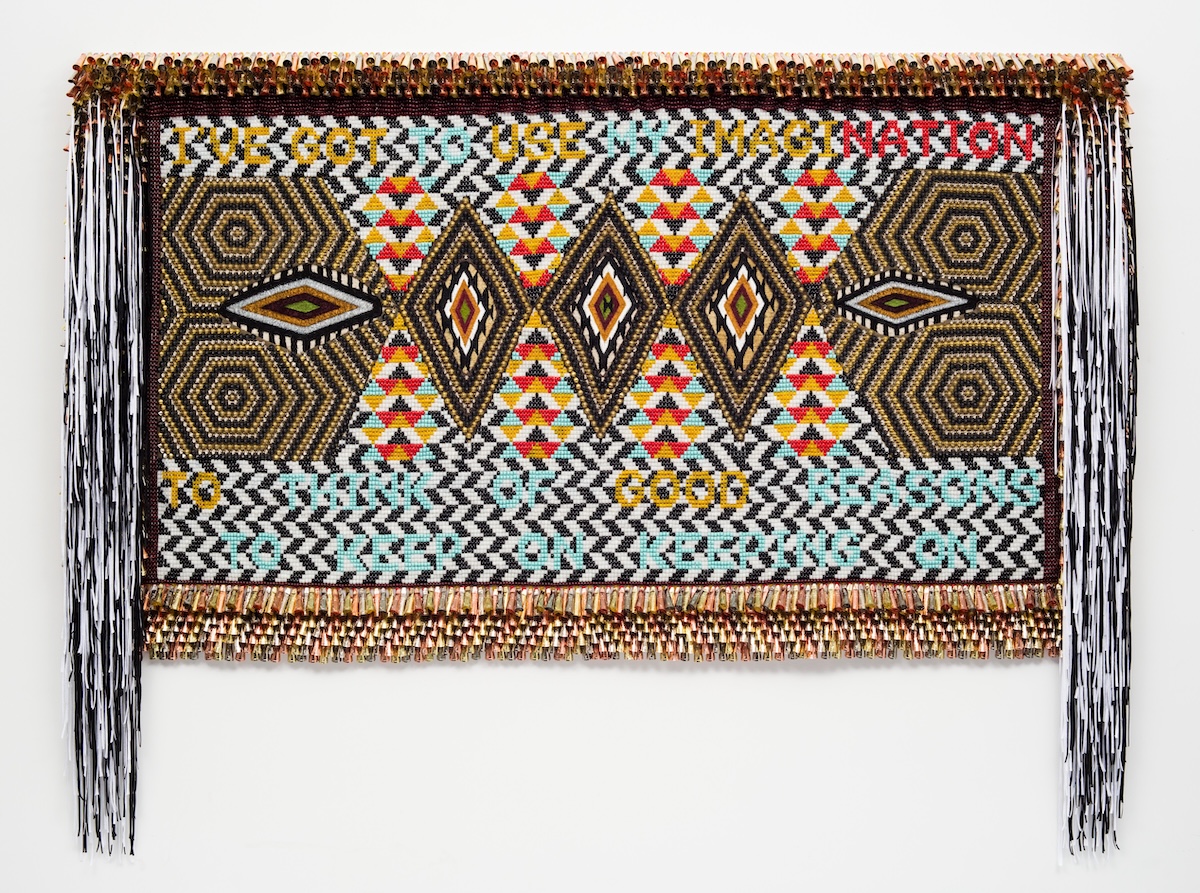
Jeffrey Gibson, TO MY NATION 2017, Image courtesy of the artist and Roberts Projects Culver City, CA Photo Copyright The Artist and Roberts Projects Culver City CA, courtesy YSP
‘Hold to This Earth: Works by Contemporary Indigenous North American Artists from Tia Collection’ at Yorkshire Sculpture Park is a landmark exhibition of contemporary Indigenous North American art on a scale never seen before in the UK. Bringing together 67 works by 38 artists, and including three significant new commissions, it also marks the first group exhibition staged in YSP’s prestigious Underground Gallery in its 20-year history.
‘Hold to This Earth’ is an expansive cross-generational exhibition that offers a rare insight into the broad spectrum of work being produced by Indigenous North American artists today. The unifying theme connecting their diverse practices is the deep, complex and enduring relationship between people and land. Representing over 35 Tribal Nations and multiple generations, established and internationally renowned practitioners are seen alongside emerging voices. They reference and honour ancestral knowledge whilst remaining steadfastly contemporary, asserting a powerful presence and countering narratives of erasure that too often position Indigenous cultures solely in the past.
In their hands, materials such as clay, hide, wool, beads and natural pigments become carriers of powerful stories, memory and tradition, growing from a rooted connection to the natural world. Whilst distinct across each Nation, Indigenous cosmologies centre the earth as a living and nurturing entity where everything is interconnected. Across the works displayed, land is not a passive subject – it is pervasive and fundamental, acting as witness, participant, collaborator and material. Newer modes of expression and understanding emerging from digital culture also speak to the shifting landscapes of Indigenous life in the 21st century and imagine new contexts.
‘Disruptors: Fractured Images and Migrant Wordl’ at Ben Uri traces more than a century of artistic experimentation with the relationship between words and images. It spans early-twentieth-century historical avant-garde practices through post-war developments in concrete poetry to contemporary art. Disruption operates here on two levels. It is a creative force within the historical avant-gardes and their legacies, as artists move words across surfaces and unsettle the conventions of syntax and image-making. It also speaks to lives shaped by movement: from the forced journeys of those fleeing Nazism, to post-war migration, to second-generation artists navigating between cultures, and to the ongoing question of belonging and resettlement.
‘Wordl’, coined in the spirit of the avant-garde’s restless reshaping of language, fuses ‘word’ and ‘world’. It evokes arrival in the UK by different routes, the acquisition of new languages, the accommodation to a new place, as well as experimentation with new forms, all while reshaping British art. What connects the artists presented here is a shared history of migration and movement, alongside an impulse to disrupt the boundary between reading and viewing, probing questions of belonging, conflict, exile, identity, forced and voluntary journeys, the making of meaning, nostalgia, and origin.
‘Flare-Up’ is the first institutional exhibition in London to bring together UK-based and international visual artists whose work engages with the poetics and aesthetics of illness, disability, neurodivergence and Deafness. Presenting work by nineteen artists across Goldsmiths CCA, the exhibition brings together sculpture, installation, painting, film, poetry, music and performance as tools of expression and activism.
A flare-up refers to the fluctuating intensification of symptoms associated with chronic conditions; in music, a flare is a surge in volume or energy – an escalation that can also be celebratory. The exhibition draws on this affective quality, presenting works that use light, sound and water to engage with transcendence, mourning and joy. Many works address the daily rituals of care – or survival – alongside the labour of access. They also attend to the spiritual and redemptive, whether through hope placed in a medical system where much remains unexplained, or through the bodily and emotional intensities of pain, exclusion and alienation, intercut with intimacy and pleasure. The architecture of CCA connects particularly to Jesse Darling’s three-panel altarpiece, ‘The Cleansing of the Temple (Luke 19:46)’ (2024), which is made from generic white bathroom tiles smeared with dirt, drawing on religious narratives of purification and fears of contagion.
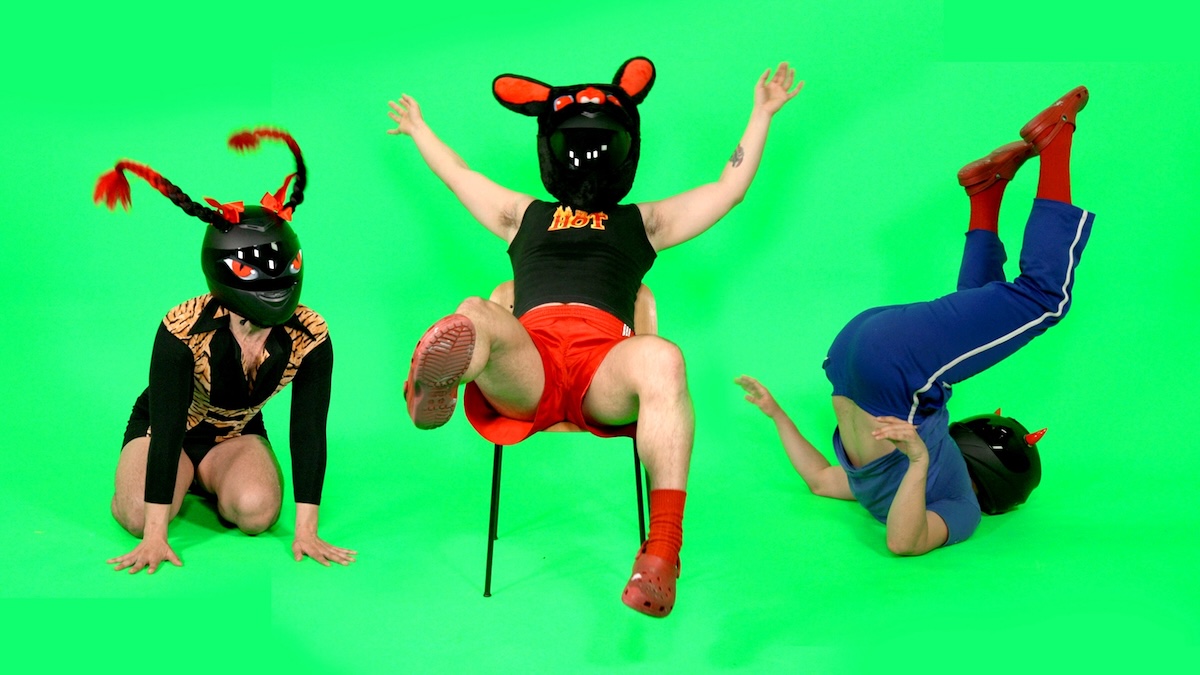
‘Rosie Ridgway: Phantom Power’ at Focal Point Gallery is the artist’s first solo exhibition in the UK. Comprising all new work, this exhibition brings together interactive film, sound, costume and performance. A highly prolific and original artist, Ridgway has, for over two decades,, explored collectivity within artmaking. What is involved in group dynamics? Where do individual and collective identities intersect? What are the strange and multiple ways groups occupy space together?
‘State of Her’ at Beecroft Gallery brings together three decades of Heidi Wigmore’s studio practice as a sharp, unflinching take on contemporary womanhood. From billboards and banners to painting, film and found objects, Wigmore builds a hybrid visual language that challenges, distorts, and subverts idealised images of the female form. Bold, political and deeply personal.
Lead image: Photo © Rosie Ridgway
‘Sanya Kantarovsky: Basic Failure’, 6 May – 22 November 2026, Istituto Veneto di Scienze, Lettere ed Arti, Palazzo Loredan, Venice – https://www.modernart.net/en/viewing-rooms/kants-ext-2026
‘JAMES TURRELL: Lifting the Veil’, 28 May – 1 August 2026, Gagosian, Hong Kong – https://gagosian.com/exhibitions/2026/james-turrell-lifting-the-veil/
Lakwena Maciver’s installation ‘HA-HA HAPPY’ commissioned by theCOLAB.art and Deco Publique as part of the Morecambe Bay Coastal Commissioning Programme – https://lancasterandmorecambebay.com/inspiration-itineraries/ha-ha-happy-a-new-public-artwork-for-happy-mount-park
‘Sacred Resonance by Renaud Muraire’, 21 May – 8 September 2026, Canterbury Cathedral – Visit Here
‘The Gentler Saints & Other Visions’, 24 May – 30 June 2026, St James the Great Church, Congleton – Visit Here
‘ÉRIC MÉZAN: REMIX’, until 14 JUNE 2026, Church of Saint-Fulgent-des-Ormes – Visit Here
‘Manifesta 16 Ruhr: This is not a Church’, 21 June – 4 October 2026, Duisburg, Essen, Gelsenkirchen and Bochum – Visit Here
‘A Serious House on Serious Earth: The poetry of our churches’, 13 April – 20 June 2026, The Manger Gallery –
Visit Here
‘Matisse in Vence: The Stations of the Cross’, 29 March – 28 June 2026, Baltimore Museum of Art –
Visit Here
‘Mat Collishaw: Last Meal on Death Row, Texas’, 3 June – 6 September 2026, The Sherborne – Visit Here
‘Books of Lilith’, 4 – 14 June 2026, APT Gallery – Visit Here
‘Frida: The Making of an Icon’, 25 June 2026 – 3 January 2027, Tate Modern – Visit Here
‘Leonora Carrington: The Symptomatic Surreal’, 25 March – 10 August 2026, Freud Museum London – Visit Here
‘Rose Finn Kelcey: House Rules’, 1 May – 1 August 2026, Arts Collective – Visit Here
‘Hulda Guzmán: Please awake – asked Nature kindly’, 23 May – 13 September 2026, Turner Contemporary – Visit Here
‘Ranti Bam: SACRED GROVES’, 1 May – 23 August 2026, South London Gallery – Visit Here
‘Project a Black Planet: The Art and Culture of Panafrica’, 11 June — 6 September 2026, Barbican – Visit Here
‘Rising Voices: Contemporary Art from Asia, Australia and the Pacific’, until 10 January 2027, V&A – Visit Here
‘Hold to This Earth: Works by Contemporary Indigenous North American Artists from Tia Collection’, 13 June 2026 – 18 April 2027, Yorkshire Sculpture Park – Visit Here
‘Disruptors: Fractured Images and Migrant Wordl’, 14 May – 4 September 2026, Ben Uri – Visit Here
‘FLARE-UP’, 21 May – 16 August 2026, Goldsmith’s CCA – Visit Here
‘Rosie Ridgway: Phantom Power’, 24 June – 12 September 2026, Focal Point Gallery – Visit Here
‘Heidi Wigmore – State of Her’, 30 May – 23 August 2026, Beecroft Gallery – Visit Here
‘British Landscapes: A Sense of Place’, 30 May – 1 November 2026, Pallant House – Visit Here