The Mexican artist Frida Kahlo liked to pretend that she was Jewish, claiming that her father was a Hungarian Jew rather than that she descended from a long line of German Lutherans. One might wonder why, at a time of rising Fascism, she did this, but for Frida the story was all. Claiming to be Jewish made her sound ‘exotic,’ whilst being a descendant of German Lutherans was, in comparison, bourgeois and stuffy. She had numerous Jewish lovers, her doctor, Leo Eloesser, her art dealer, Julien Levy, and, most notably, the Marxist, Leon Trotsky. So insistent was she that her Jewish grandparents came from Arad, Romania, that the Jewish Museum in New York mounted an exhibition to explore her Jewish identity. What mattered to her was not the ‘truth’ but the narrative she constructed. Long before Andy Warhol invented his blond-wigged persona and talked of having 15 minutes of fame or Tracey Emin appearing drunk on TV, heightening her ‘bad’ girl credentials, Frida understood that the story was all.
In 1953, the Tate Gallery displayed five of her paintings in an exhibition, Mexican Art from Pre-Columbian Times to the Present Day. There was also an exhibition of her work alongside that of Tina Modotti at the Whitechapel, but she was hardly a household name. At the time of her death in 1954, her husband, the Mexican muralist Diego Rivera, shut away all her things in a bathroom in their house, Casa Azul (The Blue House), which was not unsealed until 2004. From then on, she has slowly been built into an icon, with her face, its famous mono-brow, plastered on more mugs, tote bags, and tea towels than that of any other artist. Worshipped with cult-like devotion as a feminist icon, she has become the patron saint of suffering women. The Sylvia Plath of the art world (though I would contend that Plath is a more innovative poet than Kahlo is a painter).
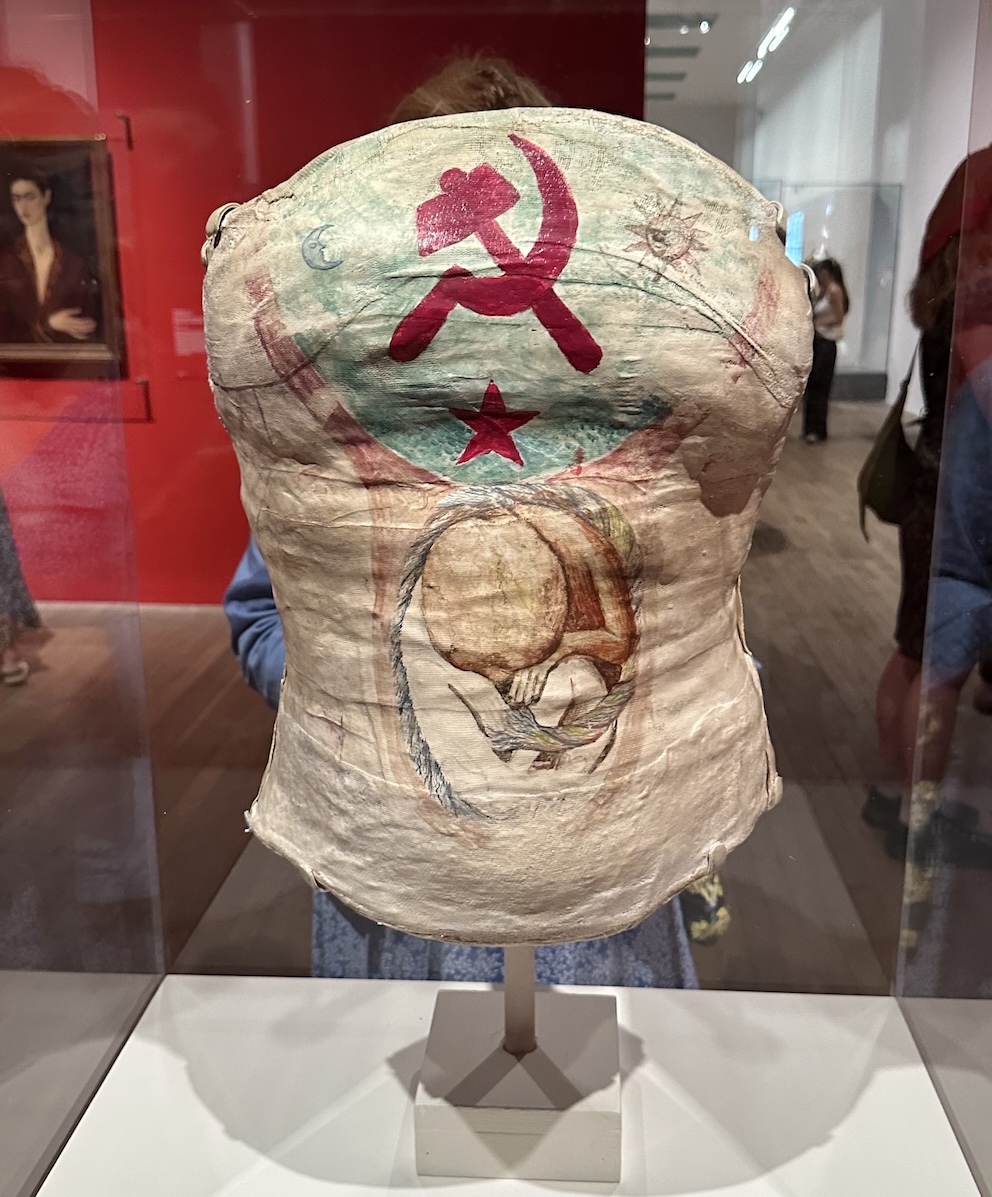
Frida Kahlo, Hammer and Sickle (and Unborn Baby) c1950
Her story has a smattering of everything: childhood polio, a near-fatal bus accident that led to a life in plaster casts and leather body braces (voyeuristically on show here), miscarriages, exotic clothes, sex, politics and a complicated love life. It’s, therefore, probably more accurate to compare her popularity to that enjoyed by torch song singers such as Edith Piaf and Judy Garland, those with whom her audience can identify, rather than to other painters. At the age of seventeen, she enrolled in Mexico’s National Preparatory School, a progressive environment where, even so, there were only thirty-five women among the two thousand students. Her plan was to go to medical school, but a near-fatal and life-changing bus accident curtailed all such plans, and she had to reinvent herself.
The recently opened show at Tate Modern explores this phenomenon rather than the development of Kahlo the painter. There are photos of her early life, taken by her father, with her sisters, and of her sitting prettily in a silk dress, clasping a book. She can also be seen holding a cane, wearing one of her father’s suits. These images highlight her interest in exploring alternative selves and gender-fluid roles, issues that make her relatable to contemporary audiences, where ‘self’ is at the centre of so many creative enterprises. Other photographs show her draped around the mountainous Diego Rivera. ‘There have been two accidents in my life,’ she wrote in her notebook, the terrible crash that left her ‘broken’ and her meeting with Rivera when she was fifteen, and he was thirty-six. It was Diego who encouraged her to paint and introduced her to the Surrealists, who were to have a profound influence (along with indigenous Mexican art) on her work, allowing for the development of her fertile, dreamlike imagery. Yet, so physically incompatible were she and Diego that some dubbed them the elephant and the dove; though he was to become the love of her life.
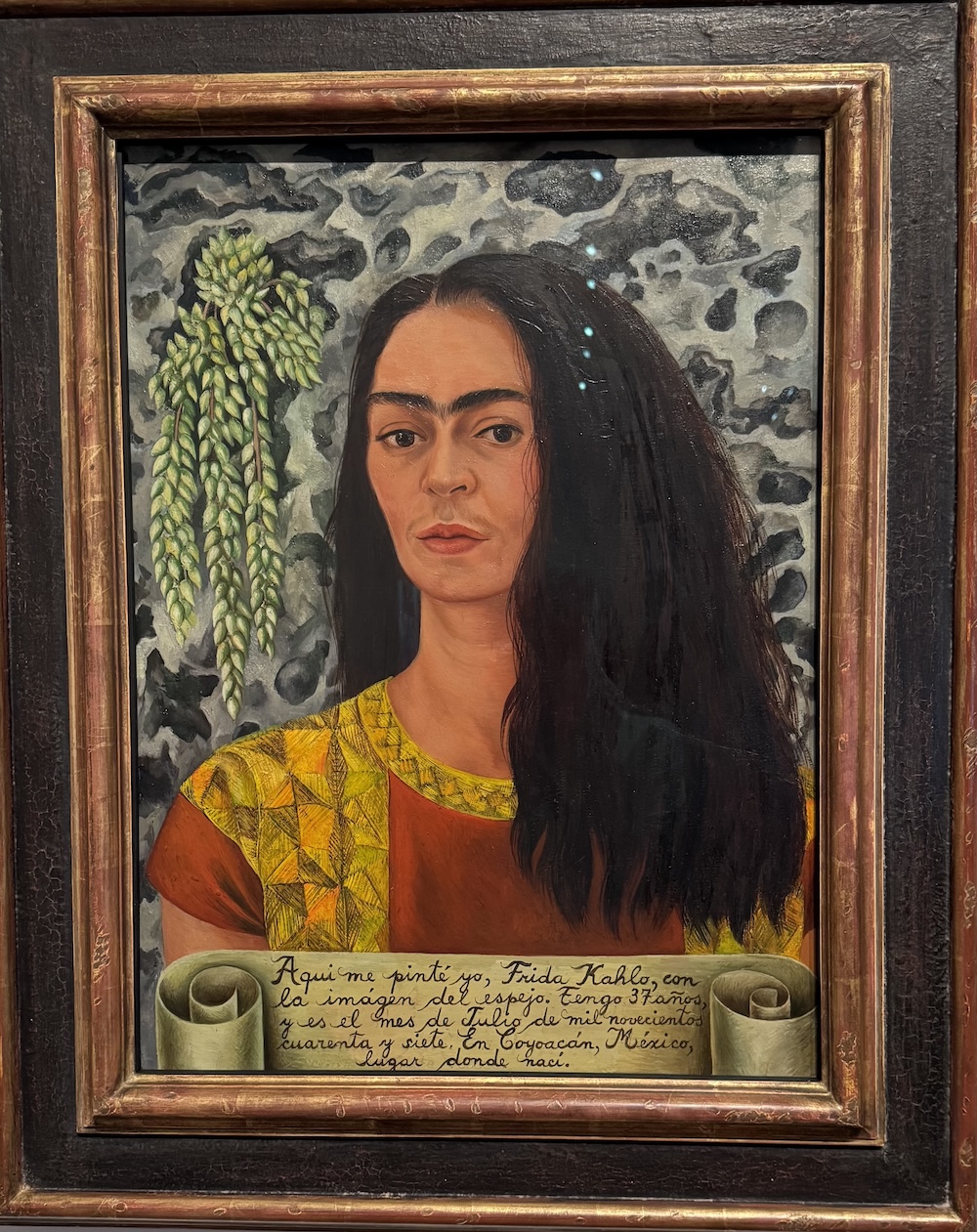
Frida Kahlo, Autorretrato con el pelo suelto, Self-Portrait With Loose Hair, 1947
The Tate’s raison d’etre for this show is to explore the life and work of a female artist and her self-representation within the canon of art history. To examine how women artists such as Kahlo shaped pathways through a largely male terrain. There is no doubt that she hit the right moment. The smell of revolution was in the air. In Russia and in Mexico. The suffrage movement was in full swing, and women (at least a privileged minority) were demanding to be noticed. The Tate show features examples of her jewellery and cases of her exotic Mexican dresses, which were to become her signature look. (Before Diego Rivera, she dressed much more conventionally). And there are rooms of the work of more than eighty contemporary and modern artists from all over the world. Alongside these are numerous books on her life and assorted memorabilia, some of which is as kitsch as an Elvis impersonator strutting his stuff at a karaoke night in Burnley.
In fact, there are disappointingly few actual Frida Kahlos in the show, and as they are generally so small, they tend to feel rather underwhelming and don’t really hold the space allotted to them. Her early work incorporates elements of symbolism, 16th-century Italian portraiture, indigenous Mexican art, and futurism. But this assessment is dependent on the labels rather than offered up by this rather patchy exhibition. (A number of her most famous paintings are not included, for whatever reason.) But the paintwork is generally flat, as if she were painting by numbers. There is nothing sensual or edgy about the use of the medium, and many of the works feel more like illustrations than 20th-century paintings in an era when painting was having essential dialogues with itself as to what a painting might be. In fact, these are ‘pictures’ for those much more interested in life stories than in painting.
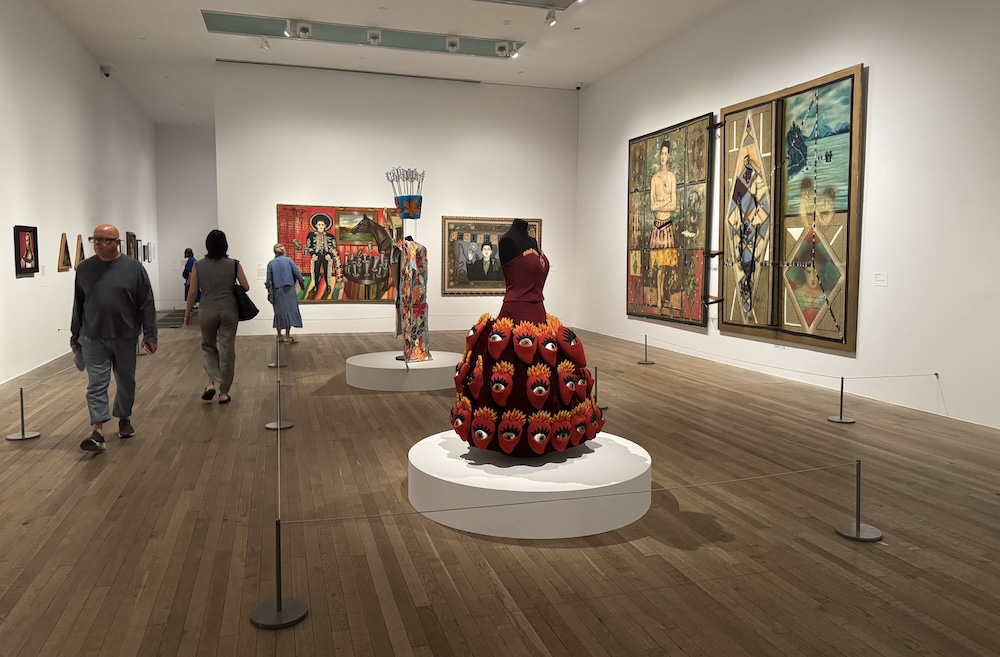
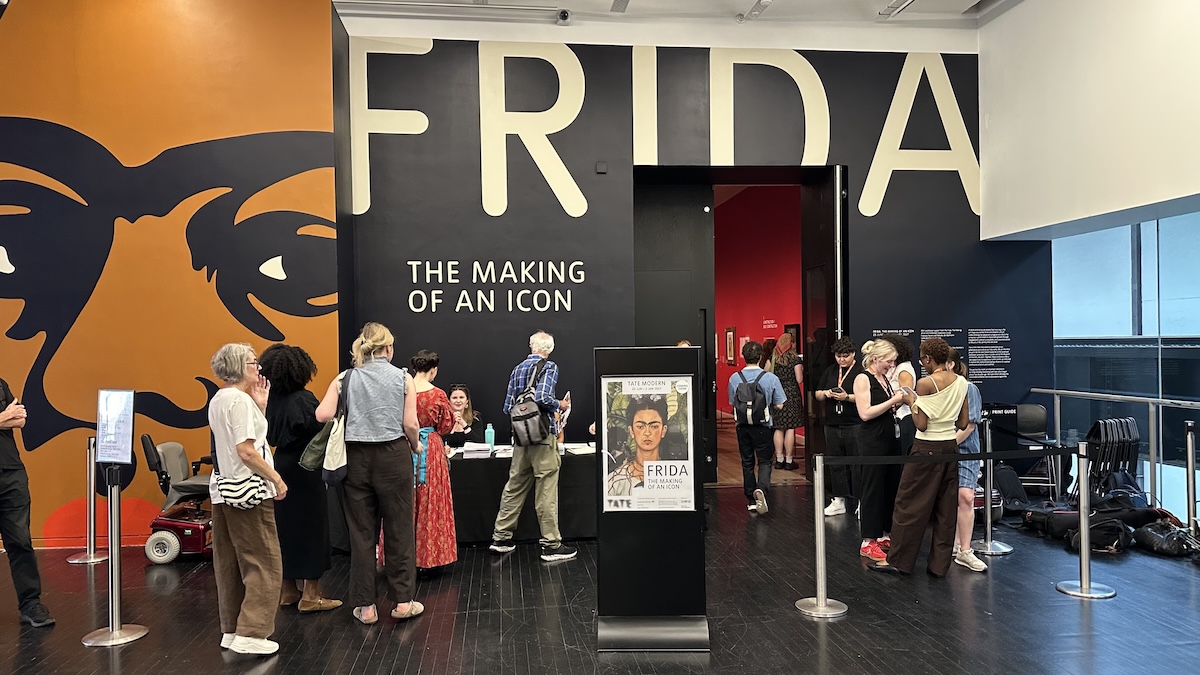
Frida: The Making of an Icon, Tate Modern (installation view)
When I visited, a woman was wandering around dressed as a pastiche Frida Kahlo, flowers woven in their hair. She was of an age when Frida would have long been dead, and seemed more concerned with being noticed than looking at the work. It made me think of a video clip I saw recently of people in Dublin dressed in turn-of-the-century attire for Bloomsday, celebrating James Joyce’s Ulysses. Asked if they had read the novel, most admitted they had not. Something similar might be said of Frida Kahlo. She is a painter for those who want stories, who want to dress up in flouncy Mexican-inspired skirts and weave flowers in their hair, rather than those who are seriously interested in the plasticity and possibilities of painting. Yet, along with the current Tracey Emin show, this exhibition has allegedly already sold out. The Tate knows a money-spinner when it sees one. ***
Frida Kahlo: The Making of an Icon, Tate Modern, 25 June 2026 – 3 January 2027, £25
Visit Here
Sue Hubbard is an award-winning poet, novelist, and freelance critic. Her fourth novel Flatlands, from Pushkin Press can be bought here. Her latest poetry collection God’s Little Artist: poems on the life of Gwen John available here.