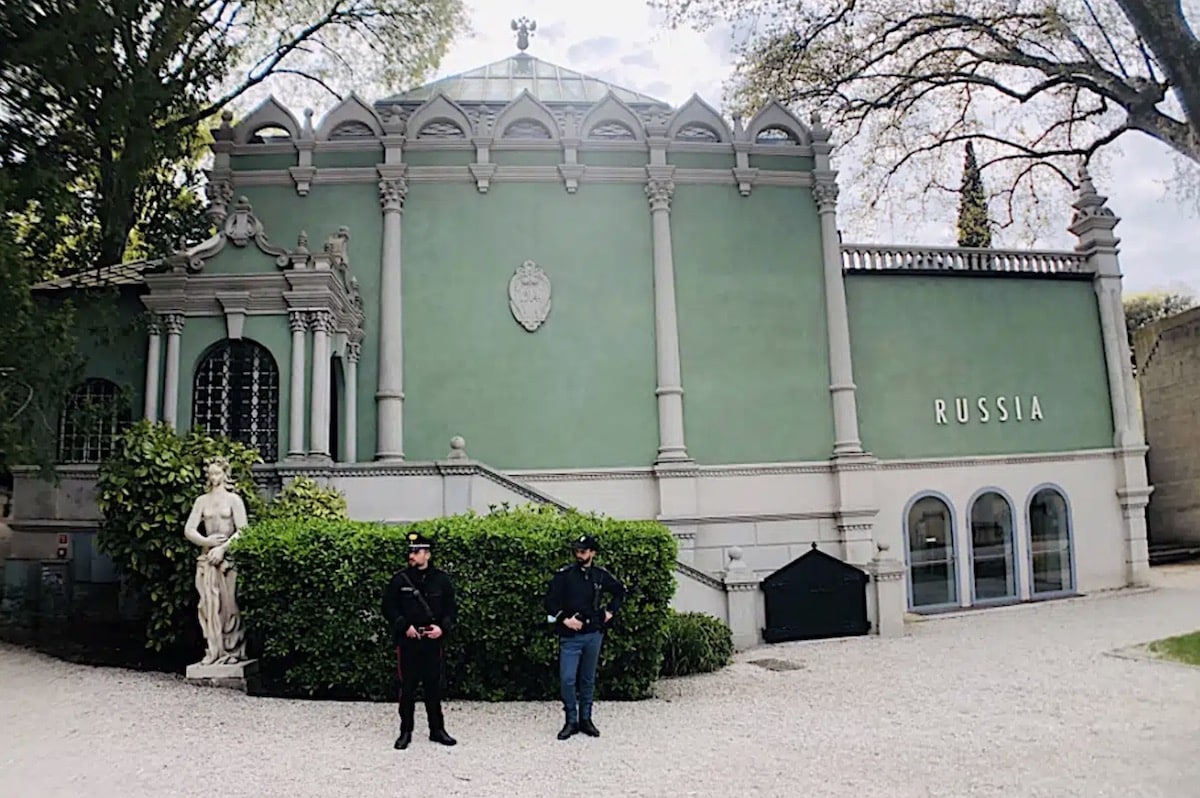
The Venice Biennale is facing the prospect of losing €2 million in European Commission funding over its decision to allow Russia to reopen its national pavilion at the 2026 edition. A letter sent by the Education and Culture Executive Agency to Biennale president Pietrangelo Buttafuoco on 10 April gives the institution until 11 May to respond and explain its position. That deadline falls two days after the Biennale’s public opening on 9 May. The timing is not subtle.
The Commission’s position is that Russia’s participation constitutes a violation of EU sanctions linked to the invasion of Ukraine. The letter asks the Biennale to “respond to these allegations” and to “inform us of any corrective measures you intend to adopt.” If the institution reverses course on Russia’s inclusion, the grant will almost certainly proceed. If it doesn’t, the Commission is prepared to suspend or terminate the funding entirely. The €2 million in question was allocated for the realisation of the 2028 edition.
This has been building for weeks. The Russian pavilion has been closed since 2022, when the invasion of Ukraine prompted a wave of cultural boycotts across Europe. The Biennale’s decision to reopen it for the 61st International Art Exhibition provoked immediate criticism from the Ukrainian government, which has announced sanctions against five Russian cultural figures involved in the pavilion, including its commissioner Anastasia Karneeva. Twenty-two other EU member states have registered protests. A group of MEPs called on the Commission to take urgent action. EU Commission Executive Vice-President Henna Virkkunen and Culture Commissioner Glenn Micallef issued a joint statement on 10 March strongly condemning the decision.
The Commission’s letter is pointed in its assessment of what it believes the Biennale has done. “The fact that within the context of Russia’s war of aggression against Ukraine,” it reads, “the Biennale accepted the participation of Russian artists as a government delegation whose participation is entirely funded and promoted by the Russian government via a national pavilion implies that the Biennale appears to have accepted indirect support from the Russian government in exchange for granting a cultural platform.” That is a carefully worded but unambiguous accusation. In the Commission’s framing, the Biennale has not simply made a curatorial decision. It has provided a state-sponsored platform for a country currently engaged in a war of aggression against a European neighbour.
The Commission has also written directly to Italy’s foreign ministry, in a letter dated 26 March, asking Italy to state its position on Russia’s inclusion. It requested a response within a week. That response has not been received. The foreign ministry told Italian media it is still working on its reply, and is now coordinating with the culture ministry, which has sent over all documentation received from the Biennale. A response may come before the 11 May deadline, as the EU Foreign Affairs Council meets on 21 April to discuss Russia, and Italy is expected to address the matter there.
Italy’s political response to the crisis has been fragmented and, in places, actively contradictory. Culture Minister Alessandro Giuli has expressed disapproval of the decision without directly challenging the Biennale’s autonomy. In a gesture that was more symbolic than administrative, he skipped the restoration ceremony for the Biennale’s Central Pavilion to travel to Lviv instead. This Ukrainian city has been targeted by Russian bombing. It was a pointed statement. It was also one that stopped well short of demanding the pavilion be closed.
Prime Minister Giorgia Meloni has so far declined to take a clear position on Russia’s inclusion, stressing the Biennale’s independence in its decision-making while avoiding any direct call for the pavilion’s withdrawal. Whether she will attend the public opening on 9 May is currently uncertain, which is itself a form of political communication. Her deputy prime minister, Matteo Salvini, has been considerably less ambiguous, describing the Commission’s funding threat as “vulgar blackmail that is being carried out by the European bureaucracy.” That response will play well in certain quarters. It does not resolve the problem.
The diplomatic dimension deepened further this week. Ukrainian President Volodymyr Zelensky is meeting Italian Prime Minister Meloni at Palazzo Chigi in Rome on Wednesday, and the situation at the Biennale is expected to feature in those discussions. The meeting puts additional pressure on Meloni to define Italy’s position before the Commission deadline, or at least before the Biennale opens its doors.
The deeper question, running beneath all of this, is what the Venice Biennale thinks it is doing. The argument for allowing Russia to participate tends to rest on the principle of artistic autonomy, the idea that the pavilion separates artists from their government, and the broader claim that cultural exchange should continue even when diplomatic relations have collapsed. These are not trivial arguments. They have been made in various forms by people who are not apologists for the Russian government.
But the Commission’s letter makes a harder point. This is not simply a matter of Russian artists attending an international exhibition independently. The pavilion is funded and promoted by the Russian government. Its commissioner is a Russian state appointee. Participation, by the Biennale’s own structural logic, is a government-sponsored presence. At a moment when that government is conducting an active war against a neighbouring country, the distinction between artistic autonomy and state platform becomes considerably harder to maintain.
The Biennale has 30 days to clarify its position. The opening is in less than a month. The EU Foreign Affairs Council meets in eight days. Zelensky is in Rome this week. The situation is moving faster than the institution’s usual pace of deliberation allows.
Whether the pavilion opens, whether funding is suspended, and whether Italy’s government finds a coherent position before the opening ceremony are questions to be answered in the coming weeks. What is already clear is that the 2026 Venice Biennale has become considerably more politically charged than its organisers may have anticipated when they decided to let Russia back in.